The AI marketing team: who owns what in an AI-ready paid media team
An AI-ready paid media team needs few new titles; it needs four named owners, job descriptions that say so, and ad account access that matches the roles.

An AI marketing team in paid media is usually the team you already have, with four jobs given named owners: the AI workflows, the data those workflows read, the creative they draft, and the platform permissions they act through. Few new titles are needed. What changes is that job descriptions, account access and sign-off rights say who owns each one.
The question tends to arrive as a headcount request. Your head of paid media asks for another specialist, and the CEO forwards a memo like the one Shopify's Tobi Lütke posted in April 2025, which said, as TechCrunch reported, "Before asking for more headcount and resources, teams must demonstrate why they cannot get what they want done using AI." Now you need an answer about the shape of the team, and a vague one about "upskilling" won't survive the next planning meeting.
This article is for the CMO or VP of Marketing deciding that shape. It covers who owns what, what goes into the job descriptions, how platform permissions map onto the roles, and what the team looks like at different sizes. What each person should learn is in our guide to AI training for marketing teams, and the sequence for putting it in place is in how to roll out AI across a paid media team in 90 days.
Job postings ask for AI skills and rarely say who owns the AI output
More than a third of marketing job postings now ask for AI skills, but very few say what the person will be responsible for. Ryan Doser's study of 1,229 US marketing job posts live on October 7, 2026, taken from company job boards at 605 companies, found that 38.7% asked for AI skills, and that 84.2% of the 476 posts asking for them (401 posts) never named a specific AI tool. The American Marketing Association's 2026 career report says the share of marketing postings mentioning AI doubled in 2025.
The more telling gap is in responsibilities. The Poznań University of Economics and Business DIGIT report from March 2026, which coded 319 US marketing postings from Indeed where AI was part of the role, found responsibility for AI-generated content and decisions signaled in 8.2% of them, and "working with agents" in none at all (0.0%). Its authors add that governance may simply sit in IT, legal or compliance instead.
Either way, the marketing job itself rarely says who answers for what the AI produces, and that question tends to get settled only when something goes wrong. That is the gap an AI-ready team closes, and it closes it on the org chart and in the job description, well before anyone buys a tool.
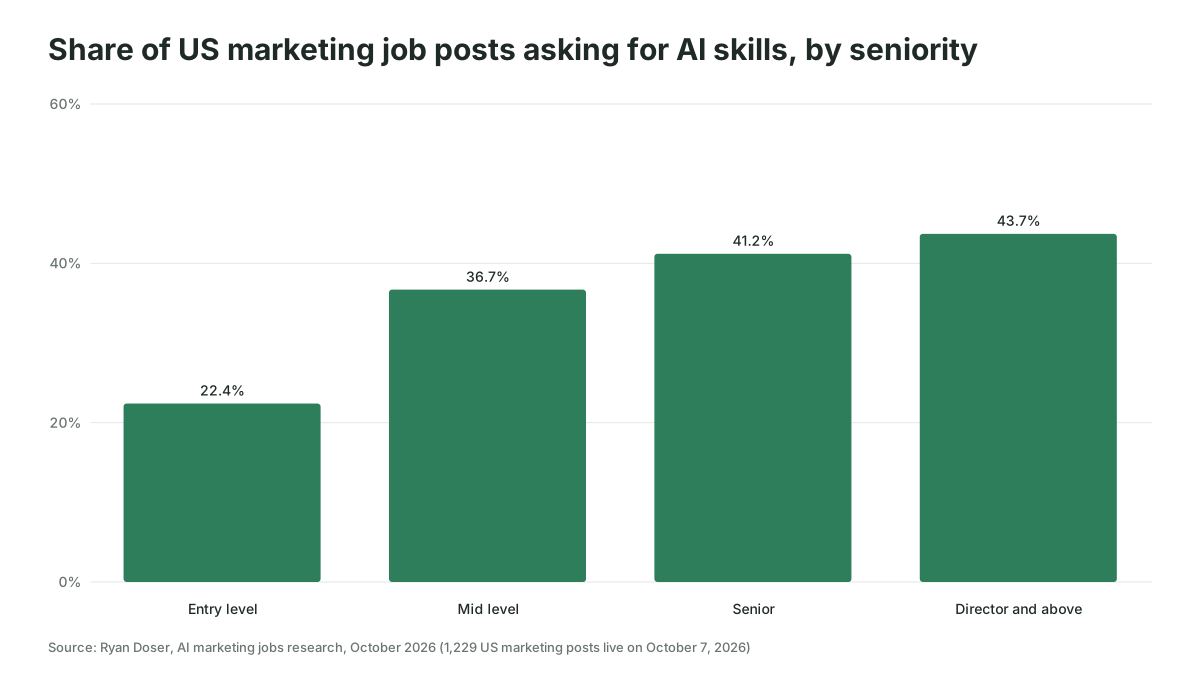
The seniority pattern in that chart matters for you. The people being asked hardest for AI skills are the ones who approve spend, which means AI readiness is being written into leadership roles faster than into the roles that run the accounts every day.
An AI-ready paid team has four owners and a clear line of sign-off
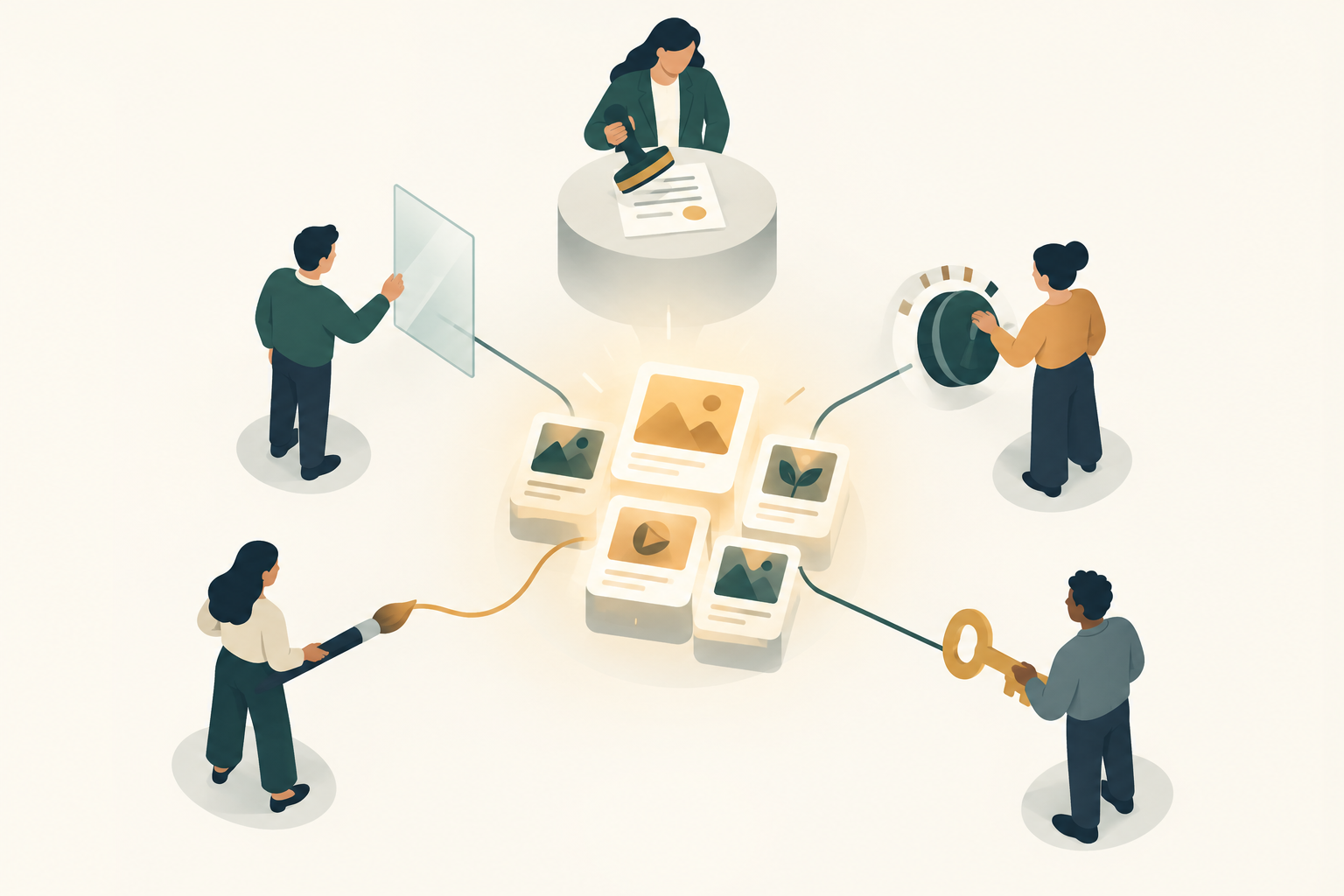
An AI-ready paid media team names one owner for each of four jobs: the AI workflows themselves, the data and measurement they rely on, the creative they produce, and the platform access they run through. Each owner can be a part of an existing job. What matters is that the name is written down, along with the hours to do it. Scalewell works with paid media leaders on exactly this shift, deciding which jobs AI takes on, who owns them and how the team's week changes once it does.
The idea is old and well documented outside marketing. The US National Institute of Standards and Technology's AI Risk Management Framework asks under GOVERN 2.1 that "roles and responsibilities and lines of communication related to mapping, measuring, and managing AI risks are documented" and clear to the teams involved, and under GOVERN 2.3 that executive leadership "takes responsibility for decisions about risks". A paid team doesn't need the whole framework. It needs those two sentences applied to four jobs.
| Owner | What they own | What they produce each week | Usually held by |
|---|---|---|---|
| AI workflow owner | The prompts, skills and agents the team runs, the connection to the ad accounts, the log of what ran | Working workflows with a review step, a changelog when one is edited | Head of paid media or a senior specialist |
| Data and measurement owner | Conversion definitions, the CRM match, which numbers the AI is allowed to read | A checked data source for every workflow, a note when a definition changes | Analyst or marketing ops |
| Creative owner | Briefs, AI-drafted variants, brand rules, variety across the test set | Approved creative and a record of which drafts were rejected and why | Creative lead or the specialist who briefs creative |
| Platform ops owner | Who holds which access level on each ad account, budget execution, the change history | An access list per account, a weekly read of the change history | Senior specialist or the head of paid media |
The approvals themselves sit on top of this table. Which decisions need a human signature, and whose, is covered in where humans must stay in the loop on ad spend, and we would keep that list separate from the ownership table so that a change in one doesn't quietly rewrite the other.
The AI workflow owner is the seat most teams leave empty
The AI workflow owner is the person who keeps the team's prompts, skills and agents working, and in most paid teams that seat is filled informally by whoever got excited first. Microsoft's 2025 Work Trend Index, a survey of about 31,000 knowledge workers in 31 markets, found 78% of leaders considering hiring for AI-specific roles, with AI Agent Specialist (30%) and AI Trainer (32%) among the roles named. Microsoft also coined a name for the job, the "agent boss", defined as "someone who builds, delegates to and manages agents to amplify their impact".
In a paid team of five or six, that is part of a job rather than a hire. The owner decides which recurring tasks get a workflow (the ranking method is in which paid media tasks to automate first), keeps each skill or prompt current when a platform changes, and decides how the AI client reaches the accounts.
That last decision has more options than it did a year ago. As of November 2026, Google, Meta and LinkedIn each offer their own MCP server for ad accounts (LinkedIn's is still in beta), and they differ in what they can read and write. The workflow owner should be the one person who decides which of these routes the team uses, so that six people don't each connect something different.
Give this owner protected hours, in the calendar, every week. A workflow owner who does the job "when there's time" maintains nothing, and the team's prompts soon drift back into personal accounts. Budget the hours in the same planning cycle as the headcount.
The creative owner's job shifts from writing to choosing and keeping variety
The creative owner on an AI-ready team spends less time drafting and more time briefing, selecting and checking that the test set still contains real differences. The best evidence comes from Harang Ju and Sinan Aral's field experiments on human-AI teamwork, which randomly assigned 2,234 participants to human-human or human-AI teams that produced 11,024 ads and then tested them on X across about 5 million impressions.
The human-AI teams "produced 50% more ads per worker and higher text quality, while human-human teams produced higher image quality". They also produced more self-similar ads, which the authors call "diversity collapse". In the field test, better text lifted click-through rates and view time, while better images improved cost per click.
For a B2B creative owner, that reads as a job description. AI raises the volume of copy, so somebody has to own the brief that keeps the variants meaningfully different, the visual standard the AI drafts fall short of, and the decision about what goes into the test. The same paper found that human-AI teams whose communication was task-oriented produced better ads with no diversity collapse, so a precise brief is the creative owner's main lever. How to run the tests themselves is in AI creative testing.
The data and measurement owner decides what the AI is allowed to believe
The data and measurement owner holds the conversion definitions, the CRM match and the list of sources each AI workflow may read, because an AI step repeats whatever the data says, faster and with more confidence. A weekly report drafted from the wrong conversion column looks exactly as polished as one drafted from the right column.
This owner matters more than it looks because of how the platforms assign rights. Google Ads' account access levels let any user with Standard access edit campaigns and also create conversions from Google Analytics events and key events. So the person who can change bids can, by default, also change what counts as a conversion. On an AI-ready team, the data owner is the only person who changes conversion settings, and everyone else, including any agent with Standard access, proposes and waits.
Platform permissions are the org chart the AI actually follows
The access levels on each ad account are the real org chart for an AI-ready team, because an AI connection that signs in through a person's login can do whatever that login can do. Map each owner to a level before anyone connects anything. As of November 2026 the three main platforms offer enough granularity to do this.
| Owner | Google Ads | LinkedIn Campaign Manager | Meta Marketing API task |
|---|---|---|---|
| AI workflow owner (for the AI connection) | Read-only: views campaigns, runs performance reports | Viewer: sees campaign performance, cannot edit | ANALYZE: run reports |
| Data and measurement owner | Admin or Standard, limited by team rule to conversion settings | Viewer, plus the CRM side | ANALYZE |
| Creative owner | Standard, limited by team rule to ads and assets | Creative manager: edits ads, cannot set up or modify campaigns | ADVERTISE, limited by team rule to ads |
| Platform ops owner | Admin: manages user access and account links | Account manager: controls access, sets up and modifies campaigns | Admin role (MANAGE, ADVERTISE, ANALYZE): campaigns, reporting, billing and permissions |
LinkedIn's Campaign Manager roles fit the four owners most neatly, because the Creative manager role already stops at ads. Meta's ad account tasks and Google's access levels are coarser. Where a platform's role is broader than the job, the team rule fills the gap, and the platform ops owner reads the change history weekly to check it held.
Job descriptions should name the AI work, the access and the sign-off
The fastest way to make a team AI-ready is to rewrite the job descriptions so each owner's AI work is a stated responsibility with an access level and an approval line. That closes the responsibility gap the DIGIT report found. Here are lines you can paste into the four roles and adjust.
AI workflow owner (part of: Head of paid media)
- Owns the team's library of AI prompts, skills and agents for recurring paid media work.
- Chooses and maintains how AI tools connect to ad accounts; keeps connections read-only
  unless the approver signs off a change.
- Reviews every workflow's output against its checklist at least monthly; logs edits.
- Protected time: [X] hours per week.

Data and measurement owner (part of: Marketing analyst / marketing ops)
- Sole owner of conversion definitions and conversion settings on all ad accounts.
- Maintains the CRM match that links ad spend to opportunities and pipeline.
- Approves the data source for every AI workflow before it runs for the team.

Creative owner (part of: Creative lead / paid media specialist)
- Writes the briefs that AI tools draft from, and approves every AI-drafted ad before launch.
- Checks each test set for real variation in message and visual, and records rejected drafts.

Platform ops owner (part of: Senior paid media specialist)
- Keeps an access list for every ad account; grants access at the lowest level the job needs.
- Reads the change history weekly and flags any change nobody approved.
Hiring changes too, though less than the headlines suggest. Before you open a role titled "AI marketing manager", apply the Shopify test to it honestly: write down which of the four jobs the hire would own and whether an existing person could own it with protected hours. BCG's June 2026 survey of 300 CMOs found around 80% making significant investments in AI-specific upskilling, and quotes several CMOs describing this as "talent that they cannot recruit but must create themselves". For most paid teams we would grow the workflow owner from inside and hire for channel depth, which is harder to teach.
Team shape depends on size, and nobody has published a credible ratio
No credible published ratio tells you how many people an AI-ready paid team needs per dollar of spend, or how many agents per person. We looked, and as of November 2026 the closest thing is Microsoft's "human-agent ratio", which the Work Trend Index frames as two questions for leaders to answer rather than a number: "How many agents are needed for which roles and tasks?" and "how many humans are needed to guide them?" Treat any vendor ratio you see as that vendor's opinion.
What you can decide is who holds which owner role at your size.
| Team | AI workflow owner | Data and measurement | Creative | Platform ops | Approver |
|---|---|---|---|---|---|
| One person | The paid media lead | The paid media lead, with marketing ops checking conversion changes | The paid media lead | The paid media lead | The marketing leader |
| Three to six people | Head of paid media | Analyst or marketing ops | One specialist | Another specialist | Head of paid media for spend, brand owner for launches |
| Agency runs the accounts | Agency, inside your written rules | In-house, always | Agency drafts, in-house approves | Agency, with access granted by your admin | In-house, always |
The one-person row looks like a joke, since one name fills four columns. It still helps, because writing it down shows where the person is checking their own work, which is exactly where a second pair of eyes (usually the marketing leader's) earns its keep. For the agency row, keep data and approval on your side, because those are the two jobs where the agency's incentive and yours can drift apart.
Federal projections still show marketing jobs growing as AI spreads
The best public evidence on whether AI will replace marketers says the jobs are still growing, while the work inside them changes. The US Bureau of Labor Statistics, in projections released August 27, 2026, expects employment of marketing managers to grow 7% from 2025 to 2035, from about 421,600 jobs to 450,800, while advertising and promotions managers shrink 4% from a much smaller base of about 33,200. For market research analysts and marketing specialists, BLS projects 7% growth, "much faster than the average for all occupations," with about 82,000 openings a year.
That growth comes with heavy exposure. A November 2026 BLS Career Outlook article rates market research analysts and marketing specialists "Very high" on AI exposure, and adds that "Exposure does not imply job loss, productivity gains, automation probability, or wage effects." A ten-year projection is an estimate, so treat it as the current best reading rather than a promise.
For a paid team, the practical answer is the one this article builds on: the roles stay, and the owners decide which work AI takes on inside them, which is the subject of our guide to the marketing operating model once AI runs part of the week.
Where AI team redesigns go wrong
AI team redesigns in paid media tend to fail in four predictable ways, and each has a plain fix.
- Hiring a title with no accounts. An "AI marketing manager" who owns no workflow and no account becomes a demo department. Attach every AI responsibility to one of the four owner jobs.
- Giving the workflow owner role to the most junior enthusiast. Their enthusiasm is useful, but they rarely have the standing to tell a senior specialist that a prompt is retired. Pair them with the head of paid media as the named owner.
- Reorganizing around agents you don't run yet. BCG found only 8% of CMOs running campaigns where multiple AI agents operate autonomously. Design for the assistants and read-only workflows you actually have, and revisit the chart when an agent earns write access.
- Dissolving channel expertise. Debra Andrews argues in CMSWire that teams should organize around workflows, with paid media treated as "a capability within workflows." We would go halfway in B2B. Run the four owner jobs across channels, and keep someone who knows LinkedIn's targeting and Google's search terms in depth, because that depth is what catches a fluent AI draft that is wrong about the platform.
Who should not reorganize yet? A team whose conversion tracking is broken or whose CRM cannot say which leads became opportunities should fix that first. The new owners would only be in charge of numbers nobody trusts, and the survey figures in AI adoption in marketing show how often teams buy ahead of that readiness.
How Scalewell helps the team you have put AI to work
Scalewell works with the paid team you already have, so the four owners above spend their week on the calls only people can make. The audit looks at what each person repeats, from pacing to creative drafts, and scores which job AI should pick up first.
That ranked list sets the build sprint, and the head of paid media or demand gen approves each job before AI takes it on. Expect typically 8 to 12 weeks. By the end, every owner knows what AI does for their seat, has a roadmap of the next jobs and can adjust what was built alone.
Where to start
Write the four owner names against your current team this week, with the hours each one gets, and compare them with the access list on each ad account. Scalewell sets this structure up with paid teams around how they already work, if you'd like a hand with it.
Frequently asked questions
Do I need to hire an AI specialist for my marketing team?
For most paid teams, no. The AI workflow owner role fits inside the head of paid media's job or a senior specialist's, given protected weekly hours. Hire a dedicated person when several teams share the same AI workflows and connections, because then maintaining them becomes a full job.
What skills does an AI-ready marketer need?
The core skills are writing a precise brief for a model, checking an AI answer against the source data, and knowing which account changes need a human signature. In Ryan Doser's October 2026 study, most job posts that asked for AI skills named no specific tool, so judgment and verification count for more than familiarity with one product.
Will AI shrink the paid media team?
The evidence so far points to more output per person rather than a fixed reduction. In Microsoft's 2025 survey, 33% of leaders were considering headcount reductions while 78% were considering hiring for new AI roles. In a paid team, we would move the hours saved to testing, analysis and creative work that was previously skipped.
Who should own AI governance in a marketing department?
The CMO owns the rules and names the people, and the work sits with the owners who run it: the head of paid media for spend, a data owner for measurement, a brand owner for launches. Company-wide AI decisions often sit higher: BCG's June 2026 CMO release notes that 72% of CEOs describe themselves as the primary decision maker on AI, so marketing's rules should sit inside theirs.