How to roll out AI across a paid media team in 90 days
A 90-day rollout plan for paid media teams that ends each month with something a CFO can read: a time baseline and one approved tool, three workflows on read-only access, then approved write access and a scorecard, with the failure modes the vendor playbooks skip.

How to roll out AI across a paid media team in 90 days: spend month one on a time baseline, an inventory of the AI your people already use and one approved tool with read-only access to ad accounts. Move three recurring workflows onto it in month two, then grant approved write access in month three, scored against that baseline.
The moment this plan is for usually arrives in a budget review. The CFO has seen the AI line item, has read that most corporate AI pilots show nothing on the P&L, and asks what the paid team got for it. You have a slide about adoption, which means logins, and nothing about hours, errors or pipeline. Nobody enjoys that slide.
This guide is for the CMO or VP of Marketing who wants a plan they can run before hiring anyone, with a concrete output at the end of each 30 days. It also covers the failure modes that the vendor playbooks leave out, and the cases where 90 days is the wrong promise to make.
Your team already uses AI, so the rollout starts with an inventory
Workers at most companies are already running AI through personal accounts, and we see no reason a paid media team would be different, so the first job is to find out what is in use before you buy anything. The MIT NANDA report The GenAI Divide: State of AI in Business 2025 (July 2025, built on interviews with 52 organizations, 153 survey responses and a review of over 300 public AI initiatives) found that only 40% of companies had bought an official LLM subscription, while workers from over 90% of the companies surveyed reported regular use of personal AI tools for work. Microsoft's 2024 Work Trend Index, a survey of 31,000 knowledge workers across 31 markets, put the share of AI users bringing their own tools to work at 78%.
So the real question is which prompts your analysts are already pasting campaign data into, and from which accounts. That has a security answer, because ad account exports are leaving the building, and a planning answer, because the tasks people have already automated for themselves are the ones they find tedious, which is where the first month of value sits.
The MIT report also found enterprise users describing vendor-pitched tools as "brittle, overengineered, or misaligned with actual workflows" while praising consumer tools for flexibility. Treat that as a design brief: the rollout should fit how your team already works, with tools your team would choose, rather than a platform bought for them. Scalewell takes on that fitting with paid media teams, so by the end of the 90 days AI is doing real jobs inside their existing week, from the first inventory to connected accounts.
Read access comes first, write access comes last
The safest order for an AI rollout follows the permission ladder every ad platform already has: read performance data first, draft changes second, and make changes with a named approver last. As of November 2026, each platform gives you a role for the read-only step. Google Ads account access levels include Read-only, which can view campaigns and run performance reports but cannot edit campaigns, alongside Standard and Admin. LinkedIn Campaign Manager's user roles include Viewer, which can view campaign performance and cannot make edits. In Meta's Marketing API, ad account user tasks separate ANALYZE (run reports) from ADVERTISE (create ads), with MANAGE added for a user who also controls billing and account permissions.
| Phase | Platform permission the AI connection gets | What the team can ask AI to do |
|---|---|---|
| Days 1 to 30 | Exports and reports only, no account connection | Summarize, check, draft text from data you paste in |
| Days 31 to 60 | Read-only (Google Ads), Viewer (LinkedIn), ANALYZE (Meta) | Pull data, write the weekly report, list search terms to review, flag pacing problems |
| Days 61 to 90 | Standard, Campaign manager or ADVERTISE, with a named human approver per change | Prepare changes as drafts; a person applies them, or an agent applies them after sign-off |
If someone connects an AI client straight to the Google Ads API instead of going through a vendor, note that Google now manages API access levels per Google Cloud project, since developer tokens were sunset on September 9, 2026. For a 90-day rollout the point is simpler: nothing that can change a bid or a budget gets connected until month three.
Days 1 to 30 end with a baseline, an approved tool and one page of rules
The first 30 days should produce four things you can hold up: a two-week time log, a list of approved tools and accounts, a baseline for each workflow you plan to change, and a one-page set of rules. None of it is glamorous, and it is the part most teams skip because it feels like admin work.
- Run a two-week time log. Ask each person to record, in 30-minute blocks, how long the recurring jobs take: search term reviews, weekly and monthly reports, pacing checks, bid and budget changes, creative briefs, QA of new campaigns. Add the error log too, meaning overspends caught late, wrong URLs, disapproved ads that sat for days. The output is a table of hours per task per week and a count of mistakes per month.
- Inventory the AI already in use. Ask without blame which tools and personal accounts people use, for which tasks, and what data goes in. Then decide which of them become official and which stop. One approved assistant with a business account, where your data is not used for training under the plan you chose, is enough for month one.
- Set the baseline numbers. For each workflow you intend to move, write down the current hours, the current error rate and the current turnaround, for example "the weekly report takes four hours and lands on Tuesday afternoon".
- Write the rules on one page. Which data may be pasted where, who approves anything that changes spend, what gets logged, and the sentence "AI output is a draft until a named person has read it". Keep it to a page so people read it.
The commercial reason for all this is that the CFO's question in month three is going to be "compared with what", and the time log is your answer.
Days 31 to 60 put three workflows into production for the whole team
The second 30 days should move three recurring workflows onto the approved tool with read-only access, for everyone on the team rather than for one enthusiast. Three is the number because one workflow proves nothing about the team and five spreads your attention too thin. Pick them with a rule: frequent, tedious, easy to measure against the baseline and reversible if the output is wrong. On a paid team that usually means the weekly performance report, the search term review that produces negative keyword candidates, and a daily pacing check against the monthly budget. We lay out the selection rule in detail in which paid media tasks to automate first.
For each workflow, write a short standard operating procedure: the data it uses, the prompt or skill that runs it, who reviews the output, and what "good" looks like. Then run it in parallel with the old method for two weeks, so you can compare the AI draft with what the analyst would have produced. The report that comes out of this should look like the one in automating weekly PPC reporting with AI: same numbers, same template, less of Tuesday.
Training belongs in this phase, and it needs more than a lunch session. BCG's AI at Work 2025 survey of more than 10,600 leaders, managers and frontline employees across 11 countries found that regular use among frontline employees had stalled at 51%, that regular usage was "sharply higher for employees that receive at least five hours of training", and that only one third of employees said they had been properly trained. Five hours per person in month two, spent on your three workflows and your own data, is a reasonable minimum. What the training should cover is the subject of AI training for marketing teams.
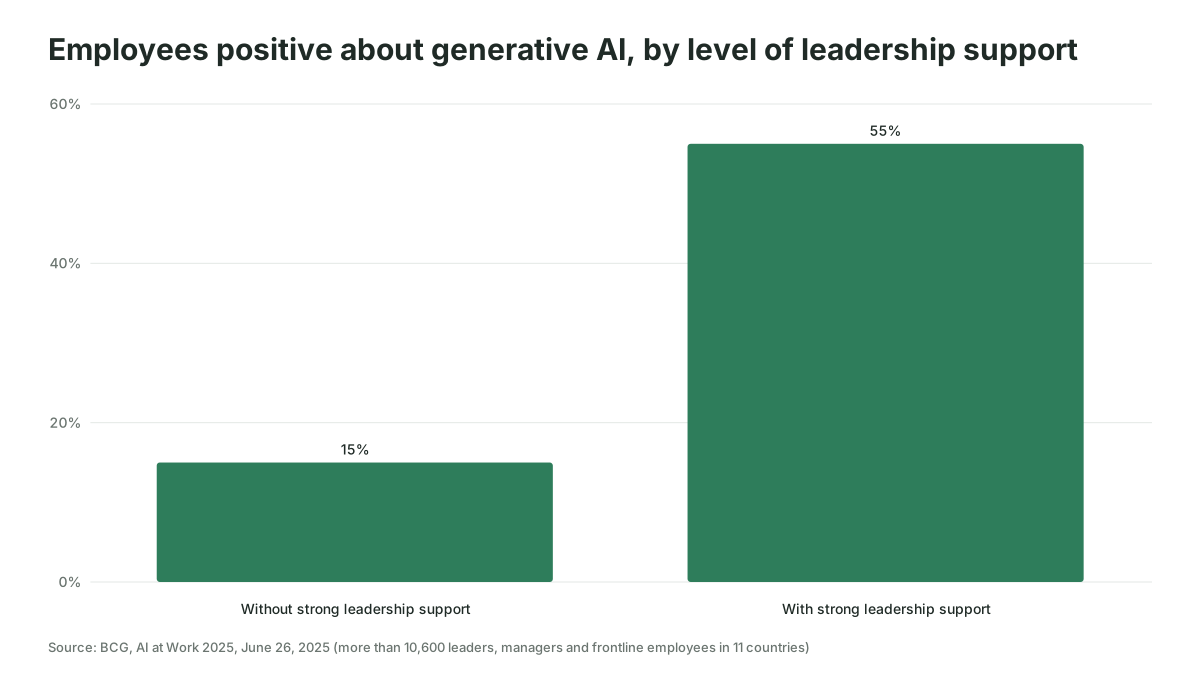
The leadership signal matters as much as the hours. The same BCG survey found the share of employees who feel positive about generative AI rose from 15% to 55% with strong leadership support. If the head of paid media still builds the weekly report by hand, the team will too.
Days 61 to 90 add write access with approval and a scorecard the CFO can read
The last 30 days should extend the AI from reading to proposing changes, with a person approving each one, and should end in a scorecard measured against the month-one baseline. A step up in permission is a step up in risk, so it comes last and it comes with rules. Your assistant or agent drafts the negative keyword list, the budget shift or the paused ad set; a named person approves it; the change is logged with who approved it and why. Where that approval line must stay for good, and where it can later be relaxed, is covered in where humans must stay in the loop on ad spend.
The scorecard has four rows, and none of them is "number of users". Hours per week on the three workflows, before and after. Errors per month, before and after. Turnaround, for example when the weekly report now lands. And the pipeline metrics you already report, cost per opportunity and pipeline from paid, shown so the CFO can see they did not get worse while the team changed how it works. Be clear with the CFO here: 90 days is long enough to show hours and errors, and rarely long enough to show a pipeline change you can attribute to the rollout.
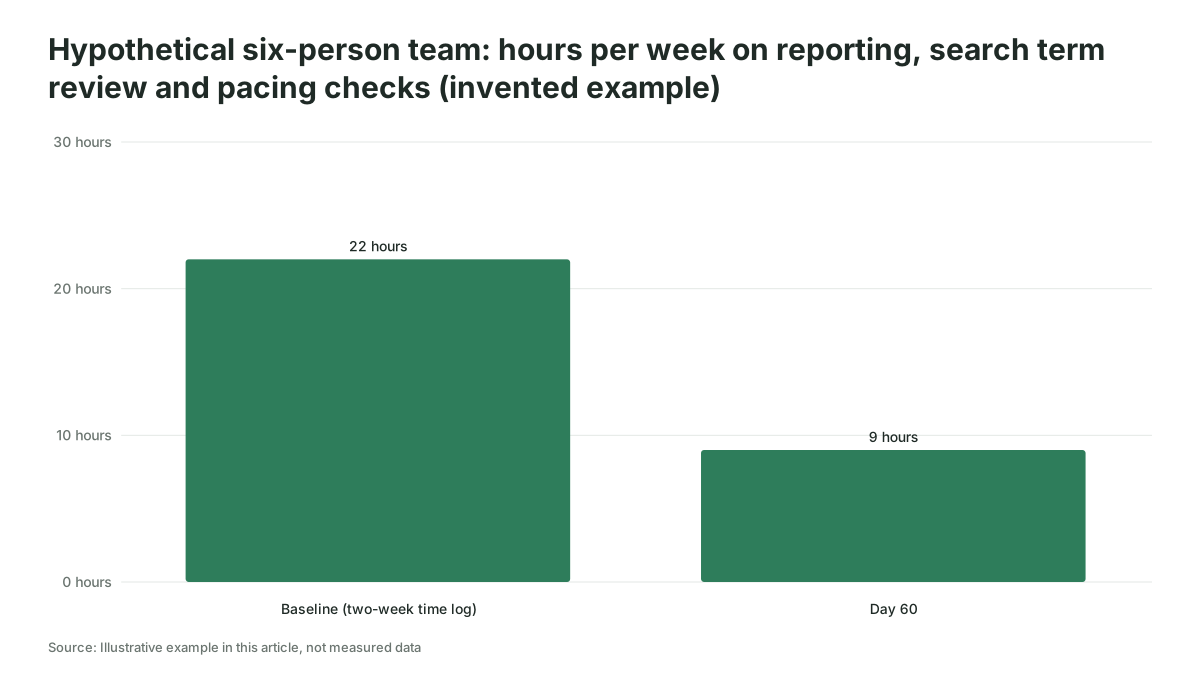
Here is a hypothetical to show the shape of it. Imagine a six-person paid team whose two-week time log shows 22 hours a week on reporting, search term reviews and pacing checks. By day 60 the three workflows take 9 hours a week including review, so 13 hours a week come back, about 56 a month. At a loaded cost of $75 an hour that is roughly $4,200 a month, which in the first quarter is about what the subscriptions and the setup time cost. The CFO case is therefore what the 13 hours are now spent on, for example one extra creative test a week and a monthly search term review that used to be skipped, and the number of overspends caught before month end. The hours pay for the program; the decisions are the return.
Most 90-day plans fail on four things the vendor playbooks skip
The MIT authors found that the divide between the few pilots that paid off and the rest "does not seem to be driven by model quality or regulation, but seems to be determined by approach", and in a paid team the organizational failures repeat. These are the four we would plan against from day one.
Buying the tool first. The MIT report found executives allocating between half and roughly 70% of a hypothetical $100 AI budget to sales and marketing, depending on which page of the report you read, and its authors argue this reflects how easy those outcomes are to measure rather than where the value is. A platform bought in week one decides your workflows for you. Run the time log first and let the three workflows decide the tool.
Punishing the slow adopters. Lilach Bullock, writing on AI change management for marketing teams, lists it under "Don't": "punish slow adopters in the first 60 days. Most people take that long to internalise new workflows." The skeptic on your team is usually the person who has been burned by a bad automation, and their objections are a free list of the checks your SOPs need.
Letting the AI touch spend early. A model that can read everything and change nothing is embarrassing at worst. A model with Standard access in week three can be expensive. Keep the permission ladder in the order above even when the pilot is going well, because it is going well precisely because nothing has gone wrong yet.
Expecting a pipeline story in 90 days. Gartner's survey of 418 marketing decision-makers, fielded between July and September 2024 and reported by Marketing Dive, found that 27% of marketing organizations had limited or no adoption of generative AI in marketing campaigns, and Gartner's Suzanne Schwartz noted that "many CMOs feel that their GenAI investments have yet to pay off". A paid team's first quarter with AI pays back in hours and avoided mistakes. Promise that, deliver it, and let the pipeline story come from what the team does with the hours.
Some teams should not promise 90 days
A 90-day rollout is the wrong commitment for a team whose data is not trustworthy, whose conversion tracking is broken, or who are mid-migration to a new CRM or ad platform setup. AI applied to a search term report that is missing half its conversions produces confident, wrong negative keyword lists faster than a person would. Fix the tracking first and start the clock afterwards.
It is also the wrong shape for a one-person paid team. The three-workflow phase and the training phase assume several people who can run the old and new methods side by side. One person should pick a single workflow, run it for 30 days, and skip the rest of the ceremony.
A team whose accounts are run by an agency should not promise 90 days until the contract says who does each job, because the agency usually holds the access. The time log covers the agency's hours on your accounts, so ask for it in writing before day one. The approved tool is either the agency's assistant, bound by your one-page rules, or yours, connected to accounts the agency manages, and the named approver for any change to spend should sit on your side.
As of November 2026, each platform treats agency access as a grant the advertiser controls. A Google Ads manager account links to yours only after someone with administrative access to your account accepts the link request, and that admin "can terminate the relationship with the manager account at any time". In LinkedIn Business Manager, only a Business Manager admin can share an ad account with a partner, choosing "the highest ad account role available to your partner", and stopping the share means contacting LinkedIn support. Meta's business-to-business asset sharing lets the business that owns an ad account give a partner business named tasks such as ANALYZE or ADVERTISE. The ladder therefore still holds: the agency's AI connection starts on the read-only rung, and the accounts stay owned in your company's name.
And if the goal is an agent that moves budgets on its own, 90 days is the start, not the finish. The MIT report found externally partnered, customized tools reached deployment about 67% of the time in its sample against about 33% for internal builds, with the caveat that these are self-reported outcomes. Either route takes longer than a quarter, and it should begin with the read-only phases above anyway.
You can tell it worked when the scorecard changes and nobody has gone back
The rollout has worked when the day-90 scorecard shows fewer hours and fewer errors against the day-one baseline, and when the team is still using the three workflows a month later without being reminded.
Two more signs are worth watching: the inventory of personal accounts has shrunk because the approved tool does the job well enough that people stopped routing around it, and someone on the team proposes the fourth workflow without being asked. When that happens, the 90 days are over and the ordinary work of running a paid team with AI in it has begun.
How Scalewell gets AI running real jobs in a paid team's week
Scalewell helps paid media leaders turn a rollout like this into jobs AI does every week, so the scorecard the CFO reads shows hours back and pipeline touched. It begins with a free call of 30 minutes and an audit of the team's week, which maps the recurring jobs and scores which one AI should take on first.
A ranked roadmap follows, then a build sprint where the first jobs get built in the tools your people already use. The work is typically 8 to 12 weeks, sometimes longer. Your team finishes with AI doing real work, a roadmap of what comes next and the training to adjust it all without leaning on Scalewell.
Where to start this week
Pick the two weeks for the time log and send the inventory question to the team today, because everything in month two depends on both. If you would like help setting up the time log, the three workflows and the approval rules around how your team already works, Scalewell does this with paid teams.
Frequently asked questions
How long does it take to roll out AI across a marketing team?
Plan on 90 days to get three recurring workflows running for a whole paid team, with read-only access in month two and approved write access in month three. Vendor playbooks put a first rollout at about 90 days, and some say 90 to 120. Habits take longer than tools, so budget a quarter for the rollout and another to settle.
Should we pick one AI tool for the whole team or let each person choose?
Pick one approved assistant for the shared workflows, so the prompts, the data rules and the review steps are the same for everyone, and let people keep a personal favorite for drafting and thinking. The inventory from month one tells you which tool most of the team already trusts, which is usually the right one to make official.
Who should own an AI rollout in a marketing team?
The head of paid media should own it, with one named owner per workflow who writes the procedure and signs off the output. We would not hand it to the most junior person because they have the time, and we would not leave it with IT, because the judgement calls are about search terms, budgets and bids.
What if part of the team refuses to use AI?
Treat the refusal as information, at least for the first 60 days. Ask what they do not trust and build that check into the standard operating procedure. Pair them with the colleague whose workflow is working, and measure them on the output quality the team agreed on, never on how often they open the tool.