AI readiness assessment for B2B paid media teams: a framework and scorecard
A six-dimension AI readiness assessment built for B2B paid media teams, with the full scorecard, the evidence to bring, and a rule that lets your weakest data score decide what AI does first.
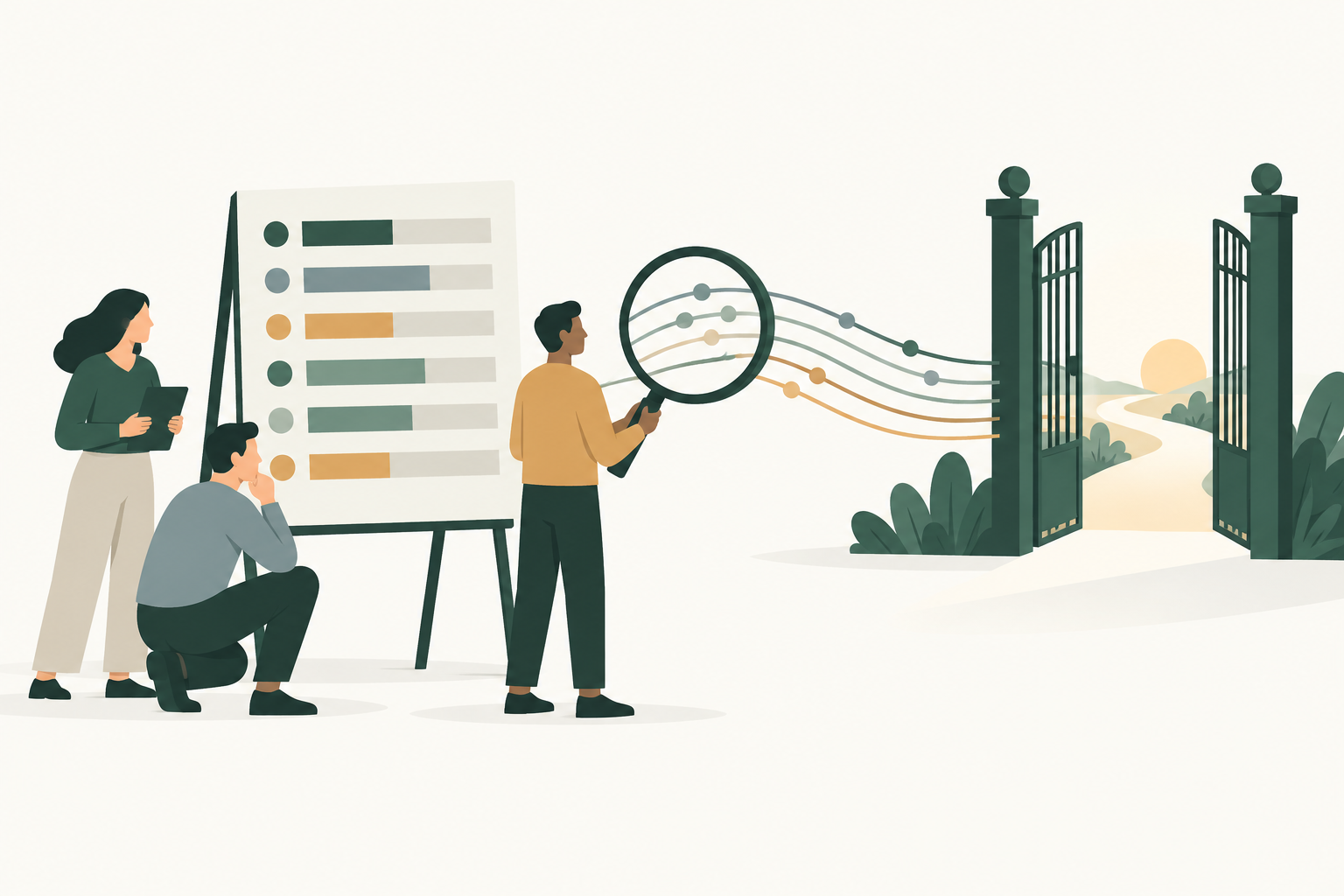
An AI readiness assessment for a B2B paid media team scores six things: conversion tracking, CRM and pipeline data, tools and access, skills, process and ownership, and governance. Score each from 1 to 5 in an afternoon. The lowest score decides what to fix first, and the total tells you which jobs AI can take on now.
The request usually arrives from above. The CEO has seen a competitor talk about AI agents running their campaigns, and someone asks whether the paid team is "ready for AI". You could send them one of the enterprise readiness quizzes that rank for the phrase, but it will ask about GPU capacity and model monitoring, and the answer it gives back says nothing about whether AI should be writing your search term negatives next month.
This article is for the CMO, VP of Marketing or head of demand gen who needs an honest answer to that question for the paid team. It gives you the framework, a scorecard with what 1, 3 and 5 look like on each dimension, the evidence to bring to the session, a decision rule for reading the result, and a hypothetical team scored end to end.
Enterprise AI readiness frameworks score the company, and a paid team needs less of them
The AI readiness frameworks that rank today were built for a CIO deciding whether the whole company can run AI systems, so most of their questions are about infrastructure a paid team never touches. Cisco's AI Readiness Index, now in its third year and built on a study of over 8,000 AI leaders across 30 markets and 26 industries published in October 2025, scores six pillars: strategy, infrastructure, data, governance, talent and culture. Microsoft's AI Readiness Assessment uses seven, including infrastructure for AI and model management.
A head of paid media will not be training a model or provisioning compute. The AI your team uses is an assistant, an ad platform's built-in automation or an agent connected to the ad accounts, and someone else runs the servers. So you can skip the infrastructure, network and model management sections entirely, and much of the strategy section, which asks whether the board has an AI vision. What a paid team needs from the enterprise versions is three ideas: data comes first, governance needs an owner, and readiness is a score you repeat.
The Cisco numbers also show that the ready companies measure. Only about 13% of organizations reached its top "Pacesetters" group, and 95% of those track the impact of their AI investments, three times the rate of the others. A paid team's version of that habit is a baseline of hours and pipeline taken before any AI job starts.
Marketing has the same gap as everyone else. In Gartner's 2026 CMO Spend Survey of 401 CMOs and senior marketing leaders, fielded from January to March 2026, CMOs put an average of 15.3% of their marketing budgets into AI, while only 30% said their organizations had mature or fully developed AI readiness capabilities. Most budgets are buying ahead of readiness, and an assessment is the cheapest way to find out what that spend is waiting on.
The framework for a paid team has six dimensions, and two of them are gates
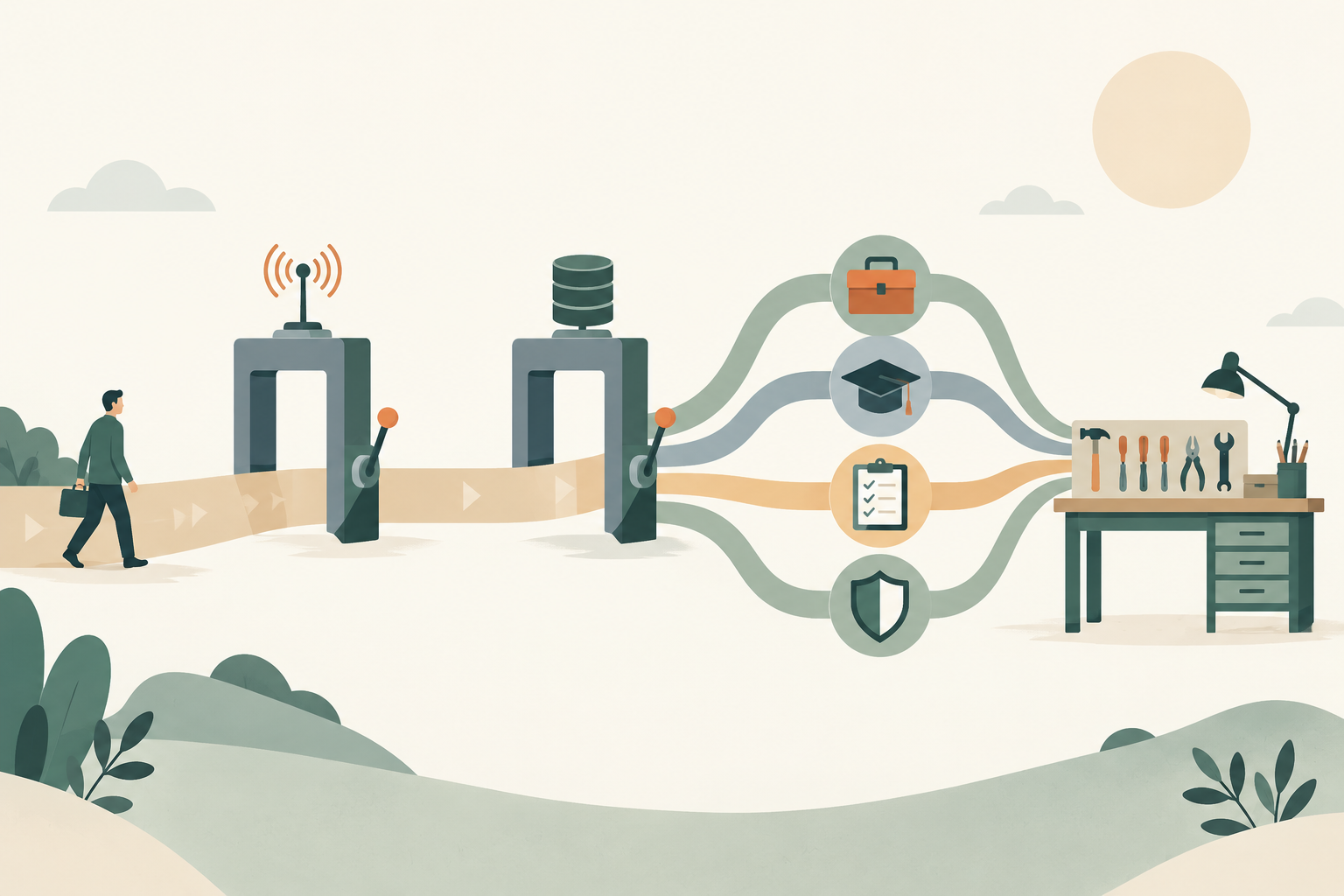
A B2B paid team's AI readiness assessment framework covers six dimensions, and the first two, conversion tracking and CRM pipeline data, are gates: if either is weak, AI will optimize toward the wrong outcome however good the other four are. The payoff of an honest score is a short list of jobs AI can take on next month and the hours they give back, and Scalewell works with paid teams on turning that list into work AI actually does.
The six dimensions, and the question each one answers:
- Conversion tracking and offline signals. Does each ad platform know which clicks became qualified pipeline, or only which became form fills?
- CRM and pipeline data. Can you tie an opportunity in the CRM back to the campaign that started it?
- Tools and access. Does the team have an approved AI tool, and can it read the ad accounts at the right permission level?
- Skills. Can the people who run the accounts write a prompt, check the output and spot a confident wrong answer?
- Process and ownership. Are the recurring jobs written down, timed and owned by a named person?
- Governance. Are there rules on what data goes where and who approves a change that touches spend?
Why are the first two gates rather than ordinary dimensions? Because B2B buying is long and crowded. Dreamdata's 2026 LinkedIn Ads benchmarks report, built on 66M+ sessions and 3.5M+ customer journeys, found buyers average 88 touchpoints with 10 stakeholders involved, and that revenue arrives an average of 281 days after the first LinkedIn ad impression. Any AI that judges a campaign on what happened in the platform this week is judging it on the first few of those 88 touches. If the only conversion the platform sees is a whitepaper download, an AI that writes your weekly commentary will praise the campaigns producing the most downloads, and Smart Bidding will buy you more of them.
The AI readiness assessment template: what 1, 3 and 5 look like
The scorecard below is the AI readiness assessment template in full. Score each dimension from 1 to 5, using 2 and 4 when a team sits between the descriptions, and write one line of evidence beside each score. A score without evidence is a mood, so leave the cell blank until someone has shown you the screen.
| Dimension | 1 looks like | 3 looks like | 5 looks like |
|---|---|---|---|
| Conversion tracking and offline signals | Platforms count form fills or page views; nobody is sure which actions are primary | Main platforms track a lead-quality action such as a demo request; no CRM stage is sent back | Qualified pipeline stages are sent back to Google Ads, LinkedIn and Meta on a schedule, inside each platform's upload window |
| CRM and pipeline data | Lead source is free text or blank; opportunities cannot be tied to campaigns | Source captured on most leads; opportunity link to campaign is manual or partial | Every opportunity carries a campaign or click ID; pipeline by campaign is a saved report |
| Tools and access | People use personal AI accounts; nothing connects to the ad accounts | One approved business AI tool; data is exported and pasted in | Approved tool connected to each ad account at a read-only role, with write access granted per job and logged |
| Skills | One enthusiast; the rest have tried a chatbot | Most of the team uses AI weekly on a real task and checks the output against the platform | Every account owner can brief, check and correct an AI job, and one person can adjust its instructions |
| Process and ownership | Recurring jobs live in people's heads; no one knows how long the weekly report takes | Main jobs listed with rough hours; owners informal | Each recurring job has a written procedure, a time baseline and a named owner who signs off the AI output |
| Governance | No written rules on AI or on what data may leave the building | One page of rules exists; not everyone has read it | Rules cover data, approvals and logging; anything that changes spend has a named approver |
Keep two calibration notes in mind. A 5 is rare and you don't need it to start, since AI jobs that judge performance can begin once both gates reach 3. And score what is true this week, not what is planned for next quarter, because the scorecard is a starting line and an inflated starting line makes every later improvement look smaller.
Score it in an afternoon with three people and six pieces of evidence
You can run the assessment in one afternoon with the head of paid media, the person who owns marketing operations or the CRM, and one specialist who runs an account day to day. Bring the evidence below and score each dimension in the room, with the screen open.
| Dimension | Evidence to bring | Where to find it |
|---|---|---|
| Conversion tracking | The list of conversion actions per platform, which are primary, and whether any CRM stage is imported | Google Ads: Summary in the Goals menu. LinkedIn: Ad Account, then Measurement, then Conversion tracking |
| CRM and pipeline | A report of last quarter's opportunities with campaign source filled in, and the share left blank | Your CRM's opportunity or deal report, filtered to paid sources |
| Tools and access | The list of who and what has access to each ad account, and at which role | Google Ads: Access and security in the Admin menu. LinkedIn: the ad account's user roles in Campaign Manager, or Business Manager if the account is claimed there |
| Skills | One recent AI-assisted piece of work per person, and whether they checked it | Ask each person to bring one |
| Process and ownership | A list of the recurring weekly and monthly jobs with hours per job | A two-week time log, or the best estimate if none exists yet |
| Governance | Your written AI rules, if any, and a candid answer on which personal tools people use | The policy page, plus an anonymous two-question survey sent the week before |
A few platform facts decide the conversion tracking score, as of November 2026. Google Ads will not import offline conversions uploaded more than 90 days after the associated last click, and the limit is 63 days for enhanced conversions for leads. So a team whose deals take six months needs to send an earlier stage, such as a sales-accepted lead or an opportunity created, rather than the closed deal. LinkedIn's Conversions API accepts events only from the past 90 days, lists marketing-qualified and sales-qualified lead as conversion types from its 202608 version, and warns that "only matched events can be used for attribution and optimization." A team whose qualified-stage events mostly fail to match should score a 3, not a 5.
For tools and access, the permission ladder already exists in each platform. Google Ads has a Read-only access level that can view campaigns and run performance reports without editing campaigns, and LinkedIn Campaign Manager has a Viewer role that can view campaign performance. A 5 on this dimension means the AI connection sits on those rungs by default. Which route connects an AI client to the accounts is a separate decision, so the assessment only asks whether access is approved and matched to the job.
The governance survey matters more than it looks. The University of Melbourne and KPMG's 2025 global study of over 48,000 people across 47 countries found that 57% of employees hide their use of AI and present AI-generated work as their own, and only 40% say their workplace has a policy or guidelines on generative AI use. If you ask in the room, you will hear the policy version. An anonymous question the week before gets you closer to which ad exports are already sitting in personal chatbots.
The lowest score decides what to do first, and the total decides how far to go
Read the scorecard in two passes: first the gate rule, then the total. A total of 20 out of 30 with a 1 on CRM data is a different team from a 20 with a 3 everywhere, even though the totals match.
Pass one, the gate rule. If conversion tracking or CRM and pipeline data scores 1 or 2, the first project is the data, and the AI jobs you start meanwhile should be ones that draft or check rather than judge: copy variants for a human to choose, campaign build QA against a sheet, alerts for a broken tag. Leave anything that ranks campaigns, writes performance commentary or moves budget until both gates reach 3.
Pass two, the total. With both gates at 3 or higher, the total tells you how much to take on. These bands are our rule of thumb, since we found no published benchmark for paid teams.
| Total (6 to 30) | What it tells you | First move |
|---|---|---|
| 6 to 12 | AI use is individual and unmanaged | Approve one business tool, write the one-page rules, run a two-week time log |
| 13 to 20 | Ready for AI on recurring jobs at read-only access | Pick three frequent, reversible jobs such as the weekly report, search term review and pacing checks, and run them in parallel with the old method |
| 21 to 26 | Ready for AI that prepares changes for approval | Add drafted changes with a named approver per change, and report AI jobs against pipeline as well as hours |
| 27 to 30 | Ready to let some jobs act on their own within limits | Promote the jobs with the cleanest track record, keep spend changes behind approval, and rescore quarterly |
The order of jobs inside each band is the subject of which paid media tasks to automate first, and the month-by-month plan for a team in the 13 to 20 band is in how to roll out AI across a paid media team in 90 days. If process and ownership is your lowest non-gate score, start with who owns what in an AI-ready paid team before adding tools, and if skills is lowest, the curriculum by seat is in AI training for marketing teams.
A hypothetical B2B SaaS team scores 15 out of 30
Imagine a hypothetical B2B SaaS company selling a $40,000-a-year product, with a three-person paid team spending about $90,000 a month across Google Ads and LinkedIn. Its afternoon session produces this scorecard.
| Dimension | Score | Evidence in one line |
|---|---|---|
| Conversion tracking and offline signals | 3 | Demo requests are the primary conversion on both platforms; no CRM stage is imported |
| CRM and pipeline data | 2 | Of last quarter's 60 paid-sourced opportunities, 27 had a campaign recorded |
| Tools and access | 3 | One approved business AI tool; two of three people also use personal accounts; nothing is connected to the ad accounts |
| Skills | 3 | All three use AI weekly; one checks numbers against the platform every time |
| Process and ownership | 2 | The weekly report takes "most of Monday"; no time log, no written procedures |
| Governance | 2 | A company AI policy exists; nobody on the team has read it, and it says nothing about ad data |
| Total | 15 |
The total puts this team in the 13 to 20 band, which on its own would say "start three recurring jobs at read-only access". The gate rule overrides that for anything that judges performance, because CRM data scores 2: with 33 of 60 opportunities untraceable, an AI writing the weekly commentary would be reading a pipeline column that is mostly missing.
So the team does three things in the next month. Marketing operations makes the campaign field required on new opportunities and sets up an import of the opportunity-created stage into Google Ads, which for this team usually happens well inside Google's 90-day window. The head of paid writes a one-page set of ad-data rules and moves the two personal accounts onto the approved tool. And the team starts the jobs that draft or check, a time log for the weekly report and a daily alert for broken conversion tags, so there is a baseline in place by the time the CRM gate reaches 3. Rescored after a quarter, the realistic target is a 3 on CRM data and a 3 on process, at which point the weekly report becomes the first AI job that reads pipeline.
Readiness assessments go wrong in four predictable ways
Scoring the tool instead of the data. A team with an excellent AI tool and a lead source field that is half empty scores well on the enterprise quizzes and badly on results. Gartner predicted in early 2025 that 60% of AI projects that run without AI-ready data would be abandoned by 2026, as CIO.com reported, and a paid team's AI-ready data is the pipeline link, so it carries the gate.
Averaging the scores. A 4 on skills does not make up for a 1 on conversion tracking. It just means your people will produce confident analysis of the wrong conversions faster.
Letting the session become self-report. People rate their own skills and process higher than the evidence supports, which is why each score needs one line of evidence.
Treating it as a one-off. An assessment filed in a deck in March is out of date by June, because the first jobs change the scores. Rescore every quarter against the same evidence, and keep the old scorecards so the board sees movement. The baseline it gives you is also the starting point for measuring AI marketing ROI later on.
There is one case where we would skip the full assessment. A one-person paid team should score the two gates, fix whichever is below 3, and pick a single recurring job, because six dimensions and a three-person session are more ceremony than one person needs.
How Scalewell turns a readiness score into AI doing real jobs
Scalewell helps paid teams get from a readiness score to AI doing weekly jobs, each judged on time saved and pipeline. It opens with a free 30-minute call, and an audit of your week then scores each recurring job to find the one AI should take on first, giving a ranked roadmap.
A build sprint builds the first jobs in the tools your team already uses, adding new systems where needed. The work typically takes 8 to 12 weeks, sometimes longer, and B2B paid media practitioners do it. By the end, AI is doing real jobs, the next jobs sit on a roadmap, and your people are trained to use and adjust what was built without depending on Scalewell.
You can tell the assessment worked when the next one scores higher on the gates
The assessment did its job when the following quarter's scorecard shows the gates moving up and at least one recurring job running with AI that was not running before, the first sign that readiness is turning into AI maturity. A higher total with the gates unchanged means the team bought tools and training while the data stayed where it was, which is the gap Gartner's 30% figure describes.
Watch for two other signs. The evidence column gets easier to fill, because the opportunity report and the time log now exist as saved reports instead of one-off pulls. And the guardrails for anything that touches spend, which we cover in AI guardrails for B2B paid media, are written down before the first job asks for write access.
Where to start
Book the afternoon, send the anonymous two-question survey a week ahead, and ask marketing operations for last quarter's paid-sourced opportunities with the campaign field shown. When the score is in, Scalewell is glad to help turn it into the first jobs AI runs for your team.
Frequently asked questions
What is the difference between AI readiness and AI maturity?
AI readiness measures whether a team has what it needs to start using AI on real work: data, access, skills, process and rules. AI maturity measures how far it has already gone, such as how many jobs AI runs and how much of the work it touches. A paid team can be ready and immature, which is a good place to start.
How long does an AI readiness assessment take?
For a paid media team, about half a day of preparation and a two to three hour session is enough, provided the evidence is gathered first. The slow part is usually the CRM report on opportunity sources. Enterprise assessments take longer because they cover infrastructure, security and every department.
Who should run an AI readiness assessment in a marketing department?
The head of paid media or demand gen should run it, with marketing operations or the CRM owner in the room, since the two gate dimensions sit with them. IT and security should review the governance and access rows afterwards. Avoid outsourcing the scoring entirely, because the team has to believe the result to act on it.
Is there a free AI readiness assessment I can use?
Yes, the scorecard in this article is free and ungated, and copying it into a spreadsheet takes a few minutes. Cisco and Microsoft also publish online self-assessments, but both score company-wide technology readiness, including infrastructure and model management a paid team does not run.
Do we need an AI policy before the paid team uses AI?
You need a page of rules before AI touches ad account data or spend, and it can be written in an afternoon. It should say which tools are approved, what data may be pasted or connected, who approves changes to spend, and that AI output stays a draft until a named person has checked it.