The marketing operating model once AI runs part of the week
A filled-in operating model for B2B marketing once AI runs part of the week, with one owner per AI job, the decisions people keep, and a rule for when an AI center of excellence earns its cost.

A marketing operating model for AI is the one-page agreement on which recurring jobs AI does, who is accountable for each, which decisions stay with people, and how often it is reviewed. For most B2B teams it changes handoffs and review rhythm far more than the org chart, and a center of excellence comes later, if at all.
The question usually arrives sideways: an AI step moves budget overnight, or a model-drafted pipeline report reaches the board with a number nobody recognizes. Picture the imagined exchange: "Who signed this off?" "The tool did it, within the limits we set." "Who set the limits?" Silence follows, because the limits live in three people's heads and one Slack thread.
If you run marketing or demand gen and are deciding how to organize once AI does part of the work, this guide gives you the decision behind each part of the model and a filled-in template. The four owners inside a paid team and their job descriptions are covered in our guide to the AI marketing team, and the spend approvals in where humans stay in the loop on ad spend. This article sits one level above both.
AI budgets are growing faster than the operating models around them
Marketing leaders are already funding AI at scale, and most say their organizations are not built for it. Gartner's 2026 CMO Spend Survey of 401 CMOs and other marketing professionals in North America, Europe and the UK, fielded January to March 2026, found that 15.3% of marketing budgets on average went to AI, as Marketing Dive reported on May 11, 2026. Seventy percent of CMOs called becoming an AI leader a key goal for 2026, but just 30% felt their organizations had the infrastructure to do so.
That gap is the case for writing the operating model down. Total budgets are close to flat, at 7.8% of company revenue in 2026 against 7.7% in 2025, so the AI line competes with everything else in the plan and a CFO will ask what it bought. Gartner's Ewan McIntyre put the risk plainly in the same report: "The risk is that CMOs invest in AI tools faster than they build the data foundations, processes, governance and talent" required to scale them.
The consultancy BCG goes further. Writing in August 2026, it said that in its experience "just 10% of the value from AI comes from algorithms and 20% from data", with the other 70% coming from operating model changes and new ways of working.
An operating model answers four questions before anyone buys a tool
A marketing operating model for AI has four parts: a list of the AI jobs, one accountable owner for each, the decisions that stay with people, and a rhythm that reviews all three. Scalewell helps marketing leaders reach the point where AI carries named jobs in the team's week and the people who own those jobs can change them without waiting on whoever built them.
Without the model, an unowned AI job degrades quietly: a stale prompt and a changed platform setting sit behind output that still arrives looking confident.
Each part settles a decision a leader would otherwise make case by case:
- The job list sets scope. Write each job as recurring work with an output, such as "drafts the Monday paid performance report from platform and CRM data", never as a tool name.
- The accountable owner answers for the output: one name per job, someone who uses the result.
- The human decisions mark where AI stops: calls that move money, change a public claim or redefine pipeline.
- The rhythm catches drift through a weekly review, a monthly scorecard and a quarterly re-rank.
Forrester's Mavis Liew wrote in October 2025 that ad hoc experimentation and tiger teams are "the two most common types we have observed" for organizing AI responsibilities in B2B marketing, and that ad hoc staffing "creates silos, duplicates effort, and introduces governance risks."
Every AI job needs one accountable owner in the marketing line
The accountable owner for an AI job should be the person whose decisions depend on its output, sitting inside marketing rather than in IT. The head of paid media owns jobs that feed weekly account decisions, marketing ops owns jobs that move data between systems, and the CMO owns the model itself.
This matters because, in many companies, AI is led from outside marketing. The executive search firm Spencer Stuart's December 2025 survey of top marketers found the most common leads for AI strategy and implementation are "the CTO/CIO (44%), followed by the CMO (32%)", with the CEO leading in 19% of cases. IT should own security, vendor approval and data access, but what counts as a sales-accepted lead, or which LinkedIn campaign gets next month's money, decides pipeline, and marketing answers for that.
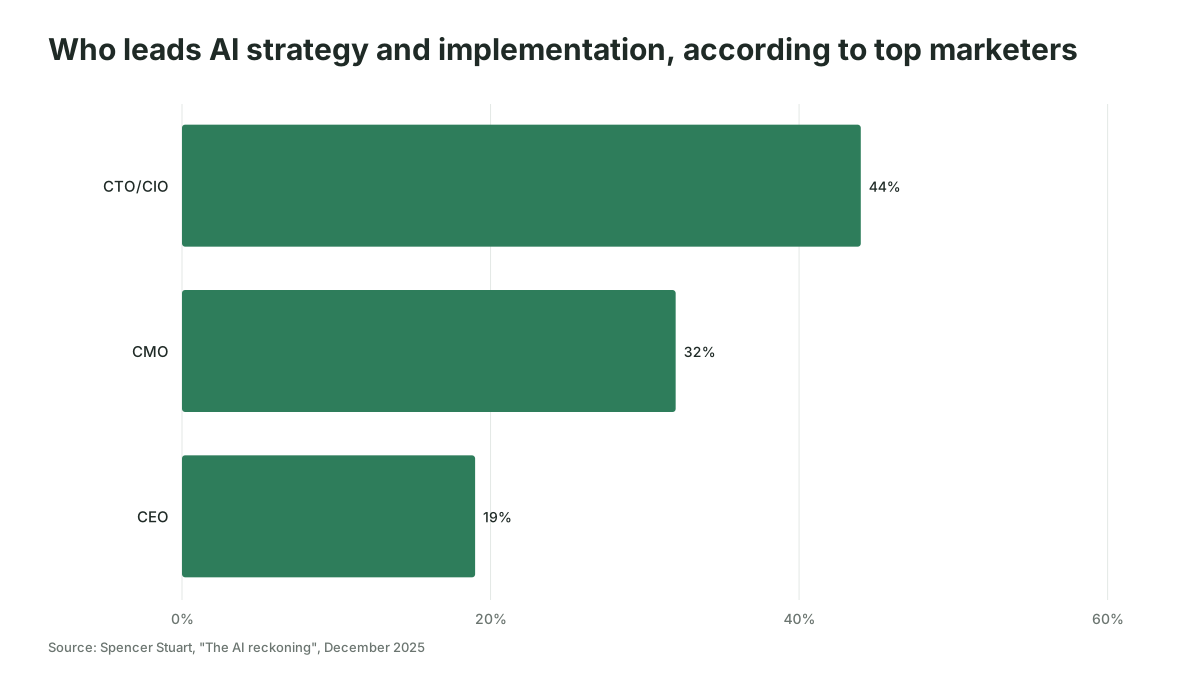
Marketing is already taking more of this ground. In BCG's 2026 CMO survey of 300 CMOs, published in June, "roughly half of CMOs say that the marketing organization now leads AI investment decisions in the function", and leading CMOs are investing in "AI product owners".
The operating model template for a B2B marketing team
The template below is an illustrative example: a filled-in RACI for ten common AI jobs in a B2B marketing team running paid media, not a standard any source prescribes. R runs and reviews the AI step, A answers for the result and signs off, C is consulted before changes, and I is told after. Map the generic roles to your own titles and delete what you don't run.
| AI job | What AI does | Decision that stays with a person | A | R | C | I |
|---|---|---|---|---|---|---|
| Weekly paid performance report | Drafts the report from ad platform and CRM data | What changes next week | Head of paid media | Paid specialist | Marketing ops | CMO, demand gen lead |
| Budget pacing | Flags campaigns running over or under pace each day | Moving money past the agreed ceiling | Head of paid media | Paid specialist | Finance | Demand gen lead |
| Bid and budget proposals | Proposes changes inside written limits | Approving any change above the limit | Demand gen lead | Head of paid media | Finance | CMO |
| Search terms and negative keywords | Proposes negatives from the search terms report | Blocking terms an ICP buyer might use | Head of paid media | Paid specialist | Sales development lead | Demand gen lead |
| Ad copy and creative variants | Drafts variants from an approved brief | Launch approval and any product or customer claim | Creative lead | Paid specialist | Brand and legal | Head of paid media |
| Pre-launch campaign QA | Checks naming, UTMs, tracking and policy | Go or no-go on launch | Marketing ops | Paid specialist | None | Head of paid media |
| Lead qualification and routing | Scores fit and intent, routes to the right rep | Changing the definition of a qualified lead | Demand gen lead | Marketing ops | RevOps and sales | CMO |
| Offline conversions to ad platforms | Sends CRM stage changes back to Google, LinkedIn, Meta and Microsoft | Which CRM stages count as conversions | Marketing ops | Marketing ops | RevOps, head of paid media | Demand gen lead |
| Competitor ad monitoring | Summarizes new rival ads and landing pages weekly | What, if anything, the team changes | Product marketing lead | Content lead | Head of paid media | CMO |
| Board pipeline report | Drafts the narrative and tables from CRM data | The final numbers and the story told | CMO | Demand gen lead | Finance | CEO |
| The operating model itself | Nothing | Adding, retiring or re-owning any job above | CMO | Demand gen lead | IT, legal | Whole team |
Three rules make it hold up. Each row has exactly one A, because two accountable people means none. The A for a job that touches spend or the definition of pipeline sits at demand gen lead or above. And no job goes live until its decision column is filled in.
Fill the decision and ownership columns in a meeting with the people named, because only they can say who answers for what.
Decisions that stay with people are about money, claims and definitions
The decisions an AI job should never take alone fall into three groups: committing money beyond a written limit, putting a new claim in front of buyers, and changing what the team counts as a lead, an opportunity or pipeline. The spend guide linked above covers the first two, so this section adds the third.
Definitions are the decision leaders forget to protect. When an AI job routes leads or sends CRM stages back to the ad platforms, it is acting on the team's definition of a qualified lead and of a conversion. Change either, and every bidding algorithm, report and forecast downstream changes with it. Because B2B sales cycles run for months, a quiet definition change can distort a quarter of budget decisions before a closed deal exposes it.
So name a definition owner, usually the demand gen lead with RevOps consulted, and log every change with a date. In a hypothetical case, Company A lets its routing model adjust lead scores weekly while Company B has the model propose changes the demand gen lead approves monthly. Company A's lead volume may look healthier for a while, but only Company B can explain its numbers when sales asks why opportunity rates fell.
B2B marketing team structure changes at the handoffs more than in the boxes
Adding AI jobs to a B2B marketing team mostly changes who reviews what and where work passes between people, and few teams need new boxes on the chart. Spencer Stuart found 69% of marketing organizations kept team numbers the same over the past 12 months while shifting capabilities toward AI, against 17% that reduced headcount.
In a typical demand generation team structure, the changes land in four places:
- Paid media specialists spend more time deciding which AI proposals to accept than pulling exports.
- Marketing ops becomes the role most likely to need more hours, because it holds the connections between systems.
- Content and creative briefs and approves more than it drafts.
- The demand gen lead gains a standing review job: the weekly exceptions, the monthly scorecard, and which AI jobs earn more autonomy.
The marketing to sales handoff needs its own line. Lead qualification and offline conversion jobs sit on that seam, so RevOps is consulted on both and any change is announced to the other side before it goes live.
If an agency runs your accounts, the template still works with one rule: the agency can hold R on execution jobs, and the A for definitions, budgets and launches stays in-house. The trade-offs of who does the work are covered in in-house, agency or consultant for AI in paid media.
An AI center of excellence helps once several teams share the same jobs
An AI center of excellence in marketing is a small central group that owns shared AI standards, connections and training, and it earns its cost once several teams run the same jobs on the same systems. For a single B2B marketing team whose AI jobs sit mostly in paid and demand gen, a CoE is usually overhead: a named owner per job plus a monthly review does the same work with fewer meetings.
The evidence on CoEs is mixed and mostly company-wide. The research firm Metrigy's AI for Business Success 2025-26 study of 1,104 companies across business functions, published in March 2025, found 38% had started an AI Center of Excellence and another 54.7% were planning to, and noted that a CoE "correlates with more layers of bureaucracy", a cost as well as a source of standards. BCG, describing company-wide AI hubs in August 2026, warns in both directions: "Waiting too long to distribute ownership creates a central bottleneck," while "Starting in a highly decentralized manner creates fragmentation." So choose the model by how many teams share the work. The table below is an illustrative guide, and teams tend to move down it as AI spreads.
| Model | Fits when | Watch for |
|---|---|---|
| Named owner per job, monthly review | One marketing team, AI jobs mostly inside paid and demand gen | The owner gets no protected hours and the jobs drift |
| AI council (leads from each team, monthly) | Two or three teams start running similar jobs, such as paid, lifecycle and content | The council discusses and nobody owns a decision |
| Marketing AI center of excellence | Several teams or regions share the same connections, prompts and data, and a company-wide AI group needs one marketing counterpart | Standards that slow launches, and a queue for every new job |
| Federated, with a thin central standards role | Teams already run their own AI jobs well and only need shared rules and training | Each team connecting tools differently to the ad accounts and CRM |
The review rhythm keeps the model honest week to week
An operating model without a review rhythm turns into a slide describing last quarter. Three short meetings keep it current, each with a fixed output.
- Weekly, 30 minutes, led by the head of paid media. Review what AI proposed and what people rejected, and why, ending with a short list of fixes to prompts, limits or data. A rising rejection rate on one job is an early sign something upstream changed.
- Monthly, led by the demand gen lead with the CMO. A scorecard per job with hours given back, errors caught and the pipeline its decisions touched, ending in keep, fix, give more autonomy or retire. Measuring the team this way is the subject of our guide to marketing team productivity.
- Quarterly, led by the CMO. Re-rank the next jobs, review access levels on every ad account and the CRM, and update the template. The scoring method for that re-rank is in the ranked AI roadmap for a B2B marketing team.

The reviews also surface the people side. When one person keeps rejecting a job's output that everyone else accepts, either the job is wrong for their work or they haven't been brought along, and leading AI change in a B2B marketing team covers how to tell which.
How Scalewell leaves a marketing team running its own AI jobs
The gain is ownership: the people named in the template run their AI jobs and change them when a platform or plan shifts. First comes a free 30-minute call, then an audit that maps each recurring job in the week and scores which one AI takes first, giving a ranked roadmap. A build sprint sets the top jobs up in the team's current software, with new systems only where nothing fits, usually over 8 to 12 weeks.
Practitioners from B2B paid media carry it out, judging each job on hours saved and pipeline. By the end, real jobs run on AI, the next ones are ranked, and the named owners adjust them without depending on Scalewell.
Operating models for AI fail in three predictable ways
Owning tools instead of jobs. A "ChatGPT owner" or an "agent owner" answers for software, and nobody answers for the Monday report it produces. Write every row as a job with an output.
Building the CoE before the jobs exist. A center of excellence with no running jobs produces policies and pilot decks. In BCG's CMO survey, only 8% of CMOs run campaigns in which multiple agents operate autonomously, so design for the assistants and proposing workflows you run today.
Reporting hours alone. Hours saved are easy to count and easy for a CFO to discount. Pair each job's hours with the pipeline decisions it fed, or the AI line looks like pure cost at the next planning cycle.
Where to start
This week, list every recurring job AI already touches in your team, put one accountable name and one human decision against each in the template above, and leave any row without both out of production until it has them. If you'd like help getting from that list to AI jobs your own people run and maintain, that's the work Scalewell does with B2B marketing teams.
Frequently asked questions
What is a marketing operating model?
A marketing operating model is the description of how the marketing function turns budget and people into results: which work it does, who decides what, how teams hand work to each other and to sales, and how performance is reviewed. Once AI runs recurring jobs, the model also has to say which jobs AI does and who answers for each.
What is the difference between an operating model and an org chart?
An org chart shows who reports to whom. An operating model shows how work and decisions flow across those boxes, including handoffs, approvals and review meetings. Two teams with identical org charts can have very different operating models, which is why adding AI usually changes the model long before it changes the chart.
Who should lead an AI center of excellence in marketing?
A senior marketer who already owns a large share of the AI jobs, often the head of demand gen or marketing operations, should lead it, with IT and legal as standing members. The lead needs authority to set standards across teams, and enough hands-on knowledge of the platforms to tell a useful standard from a slow one.
What does an AI product owner do in a marketing team?
An AI product owner is accountable for a group of AI jobs the way a product manager is for features. They decide what each job should do next, collect complaints from the people using its output, keep its instructions and data sources current, and retire it when it stops saving time or improving pipeline decisions.
Does a small B2B marketing team need an AI governance policy?
A small team needs a short written policy more than a committee. One page covering which tools are approved, what data may go into them, which decisions need a named approver, and who owns each AI job is enough for a single marketing team, and it gives legal and IT something specific to review.