AI change management in a B2B marketing team: what the CMO does so people adopt the new way of working
AI change management in a B2B marketing team comes down to five CMO decisions: sponsorship, owners, what happens to saved hours, what reviews reward, and how adoption is measured against pipeline.

AI change management in a B2B marketing team is the leader's work of making a new way of working stick after the tools arrive. The CMO decides five things: how visibly to sponsor it, who owns each AI job, what happens to the hours saved, what performance reviews now reward, and how adoption gets measured against pipeline.
You probably know the moment when this goes wrong. The licenses were bought in the spring, the vendor dashboard says most of the team logs in every week, and yet the Monday report is still built by hand, the search term review still takes a morning, and the analyst quietly pastes account data into a personal chatbot because nobody said whether that was allowed. When the CFO wants to know what that budget line changed, the honest answer is logins.
This article is for the marketing leader who owns that question. It covers the decisions only the CMO can make, the numbers behind each one, and a filled-in change plan for a hypothetical team. Training content, adoption surveys and team structure have their own guides, linked where they fit.
Most CMOs name staff fear as a barrier, and it grows as the redesign gets serious
Fear of what AI means for people's jobs is a barrier most CMOs name, and the data shows it rises as companies move from trying tools to redesigning work. In a Gartner survey of CMOs, as reported by Decision Marketing on May 19, 2026, "some 80% of CMOs say staff fear and anxiety is a barrier to AI experimentation".
The worry is broad and it is not irrational. In Pew Research Center's survey of 5,273 employed US adults, fielded in October 2024, 52% said they were worried about the future impact of AI use in the workplace, against 36% who felt hopeful, and 32% expected fewer job opportunities for themselves in the long run.
The awkward finding for a CMO is where that fear peaks. BCG's AI at Work 2025 survey of more than 10,600 leaders, managers and frontline employees in 11 countries and regions found that employees at companies undergoing comprehensive AI-driven redesign worry more about job security (46%) than those at less advanced companies (34%). Leaders and managers were more likely than frontline staff to worry about losing their job in the next ten years, at 43% against 36%. So anxiety goes up exactly when you start changing how the team works, and most among the managers who have to carry the change.
Fear also changes behavior in ways that hide the problem. In Slack's Fall 2024 Workforce Index, based on 17,372 desk workers surveyed in August 2024, 48% said they would be uncomfortable admitting to their manager that they used AI for at least one common task. Among those, the top reasons were that it felt like cheating (47%), and fear of being seen as less competent or lazy (46% each). Company policy was the least cited reason, at 21%. Those reasons point to unclear expectations far more than to rules, and closing that gap is a leadership job.
Scalewell helps marketing leaders get to the point where the team runs and adjusts its own AI jobs, so the new way of working is still in use after the first busy quarter.
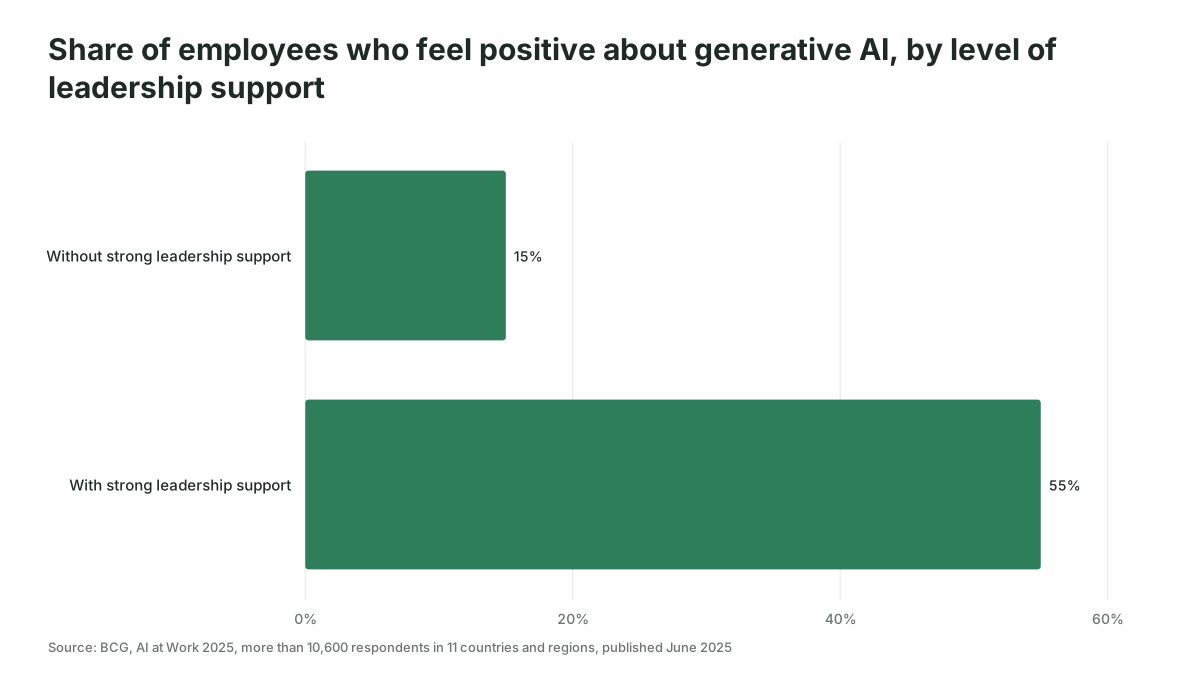
Positive sentiment rises from 15% to 55% with visible leadership support
Active, visible sponsorship from the leader is the change lever with the clearest published link to how employees feel about AI in this research. BCG found that the share of employees who feel positive about generative AI "rises from 15% to 55% with strong leadership support", yet only about a quarter of frontline employees say they receive that support. The same survey found regular use among frontline employees "has stalled at 51%", while more than three-quarters of leaders and managers use it several times a week.
Prosci, the change management research firm, puts the cost of absent sponsors plainly on its enterprise AI adoption page: "Leaders who approve AI budgets but remain invisible during rollout send a signal to the organization that AI is optional."
Visible sponsorship from a CMO looks like four habits, none of which needs a keynote:
- Use it where the team can see. Bring the AI-drafted first version of the quarterly board narrative to the leadership meeting and say which parts you rewrote and why. That one act answers the "is it cheating" worry better than any policy.
- Name the jobs, not the tools. Say which recurring jobs move to AI this quarter and who owns each one.
- Protect the time. Learning a new way of doing the weekly report costs hours in the first month. If the targets for that month don't move, people will learn that the AI work is extra work.
- Fund the boring parts. Data access, a sanctioned tool and someone's time to write the instructions all need budget, and they are what turns one enthusiast's habit into the team's process.
Sponsorship also runs through your managers. Prosci's adoption guidance notes that "employees judge AI based on the conversations they have with their immediate manager", so a CMO who sponsors loudly while the head of paid media stays silent has sponsored very little.
Answer the replacement question in writing before anyone asks
The decision that shapes adoption more than any other is what happens to the hours AI saves, and the CMO has to make it out loud. Left unsaid, people assume the worst.
There are three honest answers, and each one sends a different signal:
| What happens to the hours saved | What the team hears | Effect on adoption | When it fits |
|---|---|---|---|
| Moved to work that was being skipped: more tests, deeper pipeline analysis, account research for sales | "Doing this well makes my job more interesting" | People volunteer jobs for AI and report what breaks | Most B2B teams with a growth target and a backlog |
| Held as capacity: no backfill when someone leaves | "Nobody is fired, but the team will shrink over time" | Steady, with some slow-walking | Flat budgets with a clear plan for natural attrition |
| Taken as cost: roles cut in the same cycle as the rollout | "Automating my job well gets me replaced" | People hide use, sandbag estimates and protect their tasks | Rarely compatible with a team-wide change program |
Be candid about which one is true. A stated policy of the second or third kind is something people can plan around, even if they dislike it. What fails is the vague version, where the rollout is pitched as good news for everyone while the budget plan quietly assumes fewer people.
So write a one-page note that says which of the three you have chosen, what the hours will go to, and what will not change. If the budget is genuinely uncertain, say that too.
Change management for AI adoption means changing roles before the rollout
Change management for AI adoption works when every AI job has a named human owner before anything goes live, because a job nobody owns drifts back to the old way within weeks. The owner decides what the AI may do in that job, checks its output and fixes the instructions.
For a B2B marketing team, that usually means the head of paid media owns the AI jobs that touch spend, a marketing operations lead owns data and reporting jobs, and a content or brand lead owns anything that publishes. The full ownership model, including sign-off lines and a center of excellence, is in our guide to the marketing operating model once AI runs part of the week.
The change management part is what you do about incentives. Three changes matter most:
- Credit the person who moves a job, not the person who uses a tool most. The specialist who rebuilt the search term review so it runs every Monday has done more for the team than the one with the highest prompt count.
- Make checking a recognized skill. In B2B paid media, an AI that misreads a CRM stage or a conversion action can move budget toward cheap leads that never become opportunities. The person who catches that is doing the most valuable work in the new process.
- Give your enthusiasts standing. Pair the early adopter with a senior owner, so their instructions become the team standard.
Training sits under this, and what each seat needs to learn is covered in our guide to AI training for marketing teams.
Performance reviews should score the work AI changed
Performance reviews are where the team finds out whether the new way of working is real, because people work to what they are measured on. If reviews still reward the number of campaigns launched and reports produced, the hours AI saves will be spent producing more of the same.
Shopify made one of the most public moves here: CEO Tobi Lütke's internal memo, which he posted on X on April 7, 2025, framed using AI effectively as "a fundamental expectation of everyone at Shopify" and, as Fortune reported, said the company would add "AI usage questions to performance and peer review questionnaires". A usage question on its own ("how often do you use AI?") rewards opening a tool. Score the outcome of the changed work instead. The table below is a hypothetical example for four roles; adjust the wording to your own review form.
| Role | Old review line | New review line | Evidence the reviewer looks at |
|---|---|---|---|
| Paid media manager | Campaigns launched and budget pacing kept on track | Recurring jobs moved to AI with a check in place; tests run with the hours freed; cost per opportunity trend | The job list with owners; test log; CRM-matched pipeline report |
| Marketing operations | Reports delivered on time | Reports produced by the AI job without manual rework; data errors caught before they reached a decision | Rework count; error log |
| Content marketer | Pieces published | First drafts produced with AI and edited to the brand standard; time moved to research with sales and customers | Edit notes; interviews or call reviews completed |
| Demand gen manager | MQL volume | Pipeline sourced and influenced; speed from form fill to sales follow-up | CRM opportunity report; routing log |
Every new line ties back to pipeline or to the quality of the work. A CFO will not care that the team uses AI, but will care that the same budget now supports more tests and a cleaner read on which spend produces opportunities.
Communication runs on a fixed rhythm, with the rules published first
The communication that works for AI change is short, regular and specific about what is allowed, because the main source of hidden use is uncertainty about the rules. Slack's index found that 45% of desk workers lacked explicit permission to use AI, which means close to half your team may be guessing.
Start with a one-page AI use note before the first new job goes live: which tools are sanctioned, what data may and may not go into them, which outputs need a human check before they reach a platform or a customer, and who to ask. The legal and risk questions behind that note are covered in our guide to the AI risks a CFO or legal team will ask about.
Then keep a rhythm rather than a launch:
- Weekly, in the team meeting: one job that changed, and one thing the AI got wrong and how it was caught, so failures are safe to report.
- Monthly, from the CMO: the adoption numbers below, what the freed hours went to, and the next job on the list.
- Quarterly, to the leadership team: the same numbers next to pipeline, so the change is judged on what the business cares about.
Measure adoption by jobs changed, then by pipeline
AI adoption in a marketing team should be measured at three levels, in this order: whether people use the tools, whether recurring jobs have changed, and whether the change shows up in time and pipeline.
Prosci makes the same point on its adoption page: "adoption metrics only matter if they connect to what the organization is trying to achieve". For a marketing leader, that translates into four numbers:
| Measure | How to count it | What a good trend looks like |
|---|---|---|
| Active use | Share of the team using a sanctioned tool for work in the last 30 days | Rising in the first two months, then flat; this is a hygiene number |
| Jobs changed | Recurring jobs with an AI step built into the standard process, divided by all recurring jobs | Up by a few jobs each quarter, with no job slipping back to manual |
| Hours moved | Hours per week the changed jobs used to take, and what those hours now go to | Hours freed show up as named work: tests, analysis, sales support |
| Pipeline effect | Cost per opportunity and pipeline per dollar of spend, from the CRM | Judged over a full sales cycle, never in the first month |
The counting method for jobs changed is in our guide to AI adoption in marketing, and how to measure the team's output as a whole is in measuring a paid team's productivity.
The pipeline row needs patience in B2B. Dreamdata's benchmark release of March 10, 2026 puts the full B2B buyer journey at 272 days. A better-run paid program in March may not show up as closed revenue until the end of the year, so report jobs changed and hours moved every month and pipeline every quarter, and tell the CFO in advance which number arrives when.
A filled-in AI change plan for a hypothetical B2B marketing team
The plan below is a hypothetical example for a 12-person B2B marketing team moving three recurring jobs to AI in one quarter: the weekly performance report, the search term review and the first draft of the monthly pipeline narrative. Each row is a CMO decision, with an owner and a test for whether it is done.
| When | Change workstream | What the CMO decides or does | Owner | Done when |
|---|---|---|---|---|
| Before launch | Sponsorship | Announces the three jobs, why they were chosen and what the hours will go to | CMO | Note sent and discussed in the team meeting |
| Before launch | Hours saved | Writes the one-page answer on what happens to freed time and what does not change | CMO with finance | Note shared; questions answered in writing |
| Before launch | Rules | Approves the AI use note: tools, data, checks, contacts | Marketing ops lead | Note published; old personal-tool use moved to the sanctioned tool |
| Weeks 1 to 4 | Roles | Names an owner for each of the three jobs and gives them protected hours | Head of paid media, marketing ops lead | Each job has an owner and a written check |
| Weeks 1 to 4 | Managers | Briefs managers on how to talk about AI and jobs, using the hours note | CMO | Every manager has had the conversation with each report |
| Weeks 5 to 8 | Communication | Starts the weekly "one change, one miss" slot and the monthly update | Head of demand gen | Four weekly slots and one monthly update held |
| Weeks 5 to 8 | Measurement | Sets the baseline for jobs changed and hours per job | Analyst | Baseline recorded before the new process becomes standard |
| Weeks 9 to 12 | Reviews | Adds the new review lines for the affected roles | CMO with HR | Review form updated before the next cycle |
| Weeks 9 to 12 | Reporting | Reports jobs changed, hours moved and what they went to | CMO | Leadership update sent with the next quarter's job list |
| Next quarter | Reinforcement | Picks the next jobs; retires any job that slipped back to manual or fixes its owner | CMO and owners | Jobs changed rises with no job lost |
The order matters more than the dates: the hours note and the rules come before the first job goes live, and the review changes land before the next review cycle, which is when people decide whether you meant it. If you want a week-by-week rollout for the paid team itself, the 90-day AI rollout for a paid media team covers the build side.
Where AI change programs in marketing go wrong
AI change programs in marketing teams often stall on one of three leadership decisions. In a Prosci study of 1,107 professionals, 63% of organizations cited human factors as a primary challenge in AI implementations.
Announcing AI and cuts in the same breath. A rollout pitched in the same quarter as a reorganization teaches the team that doing the change well is risky. If cuts are coming, separate the conversations and be honest about both.
Counting logins as success. High tool usage with no change to recurring jobs means people are using AI for side tasks. Your monthly update should lead with jobs changed.
Judging the program on a timescale B2B can't meet. A 60-day verdict on pipeline in a business with a 272-day journey is unlikely to show anything, and the program gets cut for the wrong reason.
Where to start
Write the one-page note on what happens to the hours AI saves and share it with the team before the next job goes live, because that answer decides how honestly everything after it gets reported. Scalewell works with marketing leaders on this people side of AI, training the team to own, check and improve the jobs AI takes on.
Frequently asked questions
How long does AI change management take in a marketing team?
Expect the first few jobs to be stable in one quarter and the habits to settle over two or three. Prosci's 2026 State of AI Adoption research found that role-level gaps in trust, comfort and autonomy with AI "held steady across two survey waves", so plan reinforcement for at least two review cycles rather than treating launch as the finish line.
Which change management model works for AI adoption?
Any established model works if the leader actually runs it. Prosci's ADKAR model (awareness, desire, knowledge, ability, reinforcement) is common because its last step, reinforcement, covers the months after go-live when new habits slip. The model matters less than having named owners, a written answer on jobs and a measure tied to pipeline.
Do we need a dedicated change manager for an AI rollout in marketing?
Many marketing teams don't, as long as the CMO sponsors it and each AI job has an owner. Larger teams or company-wide programs benefit from a change lead who runs communication and measurement. Either way, the change manager supports the sponsor and never replaces the CMO's visible role.
What should a CMO tell the CFO about an AI change program?
Give the CFO three numbers on a schedule: jobs changed and hours moved every month, and cost per opportunity and pipeline per dollar every quarter. Say upfront that pipeline effects lag by a sales cycle. A CFO trusts a timescale agreed in advance far more than an early claim of savings.
How do you get skeptical senior marketers on board with AI?
Give the skeptic ownership of the check, not the tool. Experienced marketers often resist because they have seen automation make expensive mistakes, and their objections describe exactly what the AI's output must be tested against. Ask them to write that test, and judge them on the quality of the result.