AI training for marketing teams: what a paid team actually needs to learn
AI training for marketing teams only changes the work when it is built by role, run on the team's own ad accounts and measured against a baseline, so this guide gives a paid team's curriculum by seat, a six-week plan and a Kirkpatrick-based scorecard.

AI training for marketing teams works when it is built by role, run on the team's own ad accounts, and measured by what changes in the work a month later. For a paid media team that means four short curricula, one shared habit of checking what the model says, and a scorecard read from the ad platform and the CRM.
You've probably already sent the email. Something like "we expect everyone to be using AI by the end of the quarter", followed by a link to a prompting course. Three months on, the head of paid media still builds the weekly report by hand, one specialist pastes client data into a free chatbot, and the person who did the course cannot say what she does differently on a Monday. Nobody is being lazy. The training taught a tool, and the work is made of tasks.
This article is for the CMO or VP of Marketing who has to decide what to teach a paid team, in what order, and how to prove to the CFO that it worked. Upskilling a marketing team on AI is a budget line like any other, so it gets the same test: what changed, and what did it cost. It gives you a curriculum by role, a six-week plan that runs on live accounts, and a way to measure it that a finance team will accept. The sibling piece on AI adoption in marketing covers what the surveys say about who is using what; this one covers what to do about it.
Most marketers are told to use AI and never shown how
The gap between the mandate and the training is the best-documented fact in this whole subject. In a NewtonX study of 500 marketers for Adweek, published in August 2026, 69% said their companies mandate or "strongly encourage" using AI, and 43% said they received no formal training on it. The same study reached a blunt conclusion that Adweek printed as "The people making AI strategy decisions are the least equipped to evaluate them."
That pattern is older than the current wave of tools, and it is wider than marketing. Salesforce's generative AI research from June 2023, with 1,029 full-time marketers in the US, UK and Australia, found 70% saying their employer did not yet provide generative AI training, and 39% saying they did not know how to use it safely. Microsoft's 2024 Work Trend Index, from 31,000 knowledge workers, found that only 39% of people using AI at work had received training from their company, and that 78% of AI users were bringing their own tools to work. BCG's AI at Work 2025 survey of more than 10,600 employees found that only one-third said they had been properly trained.
So what does this mean for you? Your paid team is almost certainly using AI already, probably on personal accounts, probably without a rule about what data goes in, and probably in ways you cannot see. Training is less a question of introducing AI than of taking back control of how it is used. Scalewell helps marketing teams take that control back in practice, so people know which tool to use, what data it may see and which prompts already work on live accounts.
Prompting courses skip the part a paid team gets wrong
Most AI training guides agree on the shape: assess the team, build role-based tracks, practice on real work, add governance, measure something. Their role tracks are content, creative, analytics and sometimes "demand generation" defined as email and landing pages, and not one treats paid media as a role. The person who runs the Google Ads account is left to adapt a content writer's lesson plan.
That gap matters because a paid team's AI problem is different from a content team's. A content writer's risk is a bland paragraph. A paid specialist's risk is a confident recommendation built on the wrong conversion column, applied to a budget. The platform already runs AI inside the account: Google describes Performance Max as a goal-based campaign type that reaches its inventory across YouTube, Display, Search, Discover, Gmail and Maps, with Google AI mixing and matching assets and Smart Bidding setting bids per auction. Your specialist does not need a lesson in asking a chatbot for ad copy nearly as much as a lesson in feeding, auditing and overruling systems like that one.
So the curriculum for a paid team has two layers. The shared layer is the same for everyone and takes a few hours: what a model can and cannot do, what data may go into it, and how to check what comes out. The role layer is different for each seat and runs on the accounts those people already own.
A paid team needs three things in place before the first session
A paid team cannot be trained on AI until it has sanctioned tools, trustworthy conversion data and a named owner. Skipping any one of these turns the training into a demo.
- A sanctioned tool with business data terms. Pick the assistant the team is allowed to use and buy the business tier of it, so that client and account data is covered by the vendor's business terms rather than a consumer agreement. Then write the one-page rule: what may be pasted in, what may never be pasted in (customer lists, CRM exports with names, anything under a client NDA), and who to ask when unsure. Microsoft's 78% bring-your-own-AI figure above tells you what happens when you leave this step out.
- Conversion data the team trusts. If the account's conversion actions include a form fill that sales ignores, every AI analysis of that account will optimize toward it. Fix the conversion setup first, or at least agree which columns count, because the model will take the data literally.
- One owner with time in the calendar. Someone on the team runs the program, keeps the prompt library (the tested prompt for each recurring task, with the data it needs and the check a human runs on its output) and checks the scorecard. Give that person protected hours. BCG's finding that regular use is "sharply higher for employees that receive at least five hours of training" is a useful planning floor: five hours per person is the minimum, and it has to come out of real weeks.
Each seat on a paid team needs a different curriculum
The marketing leader, the head of paid media, the PPC specialist and the analyst each need to learn different things, and a single course for all four teaches each of them mostly the wrong material. The table below is the curriculum we would start from. Every row ends in a deliverable the person produces on a live account, because a module that ends in a quiz has taught a fact and not a behavior.
| Role | What they learn in the role layer | Hours | Deliverable that proves it |
|---|---|---|---|
| Marketing leader (CMO, VP) | How to read an AI-produced analysis critically; which questions to ask about data sources and conversion definitions; where humans must approve spend; how to set the scorecard | 3 to 4 | A one-page AI policy for the team and a list of decisions AI may recommend but never execute |
| Head of paid media | Mapping the team's weekly tasks and choosing which to automate first; connecting an AI client to ad account data; designing a review step for every automated output | 6 to 8 | A task inventory with a build/buy/leave decision per task, and one working weekly workflow |
| PPC specialist | Search term review and negative keyword proposals with AI; drafting ad variants against a brief; auditing Performance Max and Advantage+ outputs; writing a Google Ads script with AI help | 6 to 8 | A weekly search term review that runs in under an hour, with every proposed negative checked before it is added |
| Analyst or marketing ops | Pulling platform and CRM data into one table; using AI to draft the weekly narrative; building the checks that catch a wrong join or a changed conversion definition | 6 to 8 | A weekly report that lands by Monday 10:00 with a change log the team can audit |
The head of paid media's module leans on two sibling guides: which paid media tasks to automate first gives the ranking method, and how to roll out AI across a paid media team in 90 days covers the organizational side once the training is done.
Notice that the leader's curriculum is the shortest and the most often skipped. The Adweek finding that decision makers are the least equipped to evaluate AI is an AI skills gap at the top of the org chart, and it is the cheapest one to close.
Lesson one for everyone is checking what the model says
The single most valuable thing a paid team can learn about AI is how to verify its output before acting on it. Models produce fluent answers from whatever data they were given, and a fluent wrong answer about a conversion rate looks exactly like a fluent right one.
Here is a hypothetical to make it concrete. Imagine a specialist asks an assistant connected to the account why cost per lead rose 30% last week. The model answers, confidently, that a competitor entered the auction and recommends raising bids. The real cause is that a form on the landing page broke on Tuesday and conversions fell while spend stayed flat. Nothing in the model's answer was dishonest; it reasoned from the columns it had. A specialist trained to check the conversion count before accepting any cost-per-lead explanation catches it in two minutes. One trained only to prompt raises the bids.
So the shared layer teaches three habits, in this order:
- Ask what data the answer used. Before acting on any analysis, the person names the date range, the conversion action and the source table. If they cannot, the answer is a hypothesis.
- Check one number by hand. Pick the figure the recommendation depends on most and confirm it in the platform. This takes minutes and catches most bad joins and stale caches.
- Decide what the model may do alone. Reading, summarizing and drafting can run unattended. Anything that changes a bid, a budget or a status gets a human click, as the sibling piece on where humans stay in the loop on ad spend sets out in detail.
Anthropic's free AI Fluency course frames this as "Discernment" and "Diligence" in its 4D framework, alongside Delegation and Description, and at four hours it is a reasonable shared-layer baseline. The point is the habit, whichever vendor's course you use to introduce it.
Public courses cover the shared layer, and none covers your accounts
The free and vendor courses are good for the shared layer and almost useless for the role layer, because none of them knows your conversion setup. This is what the main providers showed on their pages in November 2026.
| Provider and course | What it covers | Length and cost as shown | Fit for a paid team |
|---|---|---|---|
| Anthropic, Claude Academy: AI Fluency: Framework and foundations | Collaborating with AI through the 4D framework | 4 hours, free | Shared layer |
| OpenAI Academy, Apply AI at Work track | Prompting and review habits, then repeatable workflows and directing agents | Price not shown on the page; no marketing-specific track listed | Shared layer |
| Google, AI Boost Bootcamp: Gemini for Marketing 201 | Marketing workflows in Gemini, NotebookLM, Sheets and no-code agents | Under 45 minutes; cost not stated in the June 23, 2026 announcement | Shared layer, for Workspace teams |
| Google Skillshop | Google Ads certifications by channel | No price and no AI course listed on the landing page | Platform knowledge for specialists |
| Meta Blueprint | Free online training for advertising on Facebook and Instagram | Free, self-paced; no Advantage+ or AI course listed on the hub page | Platform knowledge for specialists |
| LinkedIn Marketing Academy | Introduction to LinkedIn Ads, CRM Sync, Conversions API for retargeting | Self-paced; price not shown | Platform knowledge for B2B specialists |
Notice the split in that table. The platforms' own academies teach their platforms and say nothing about using an external AI assistant on the data, while the AI vendors' academies teach their assistants and say nothing about ad accounts. Your role layer sits in the gap, which is why you build it in-house, on your own accounts, with your own head of paid media as the instructor.
One thing to copy from the Google row is the format: short, specific and frequent beats a full-day workshop for a team that has accounts to run.
A six-week AI upskilling plan that ends in changed work
A six-week program with one shared session and one role session a week gets a paid team to the point where the work has changed, which is the only finish line that counts. Here is the plan we would run.
- Week 1: baseline and rules. Measure how long the weekly report, the search term review and the monthly audit take today, by asking each person to log hours for one week. Publish the one-page data rule. Everyone completes the shared-layer course of your choice, about four hours.
- Week 2: verification drill. The head of paid media runs a 90-minute session on a live account: three AI-produced analyses, each with one planted error (a wrong date range, a conversion action that includes a junk form, a join that double counts). The team finds the errors. This session is the whole program in miniature, so do not skip it.
- Week 3: the analyst's week. The analyst and the head of paid build the weekly data pull and the AI-drafted narrative, with a checklist of the numbers a human confirms before it goes out. Target: a report that takes an hour instead of a morning.
- Week 4: the specialist's week. Each specialist runs the AI-assisted search term review on their own account and proposes negatives. Every proposed negative is checked against search terms before it is added, and the team compares what AI proposed with what a specialist would have caught.
- Week 5: the head of paid's week. Complete the task inventory and the automate-first ranking. Choose one task to put on a schedule with a review step, and write down who approves its output.
- Week 6: the leader's week and the scorecard. The marketing leader reviews the policy, the approvals list and the first scorecard with the team, and sets the review date three months out.
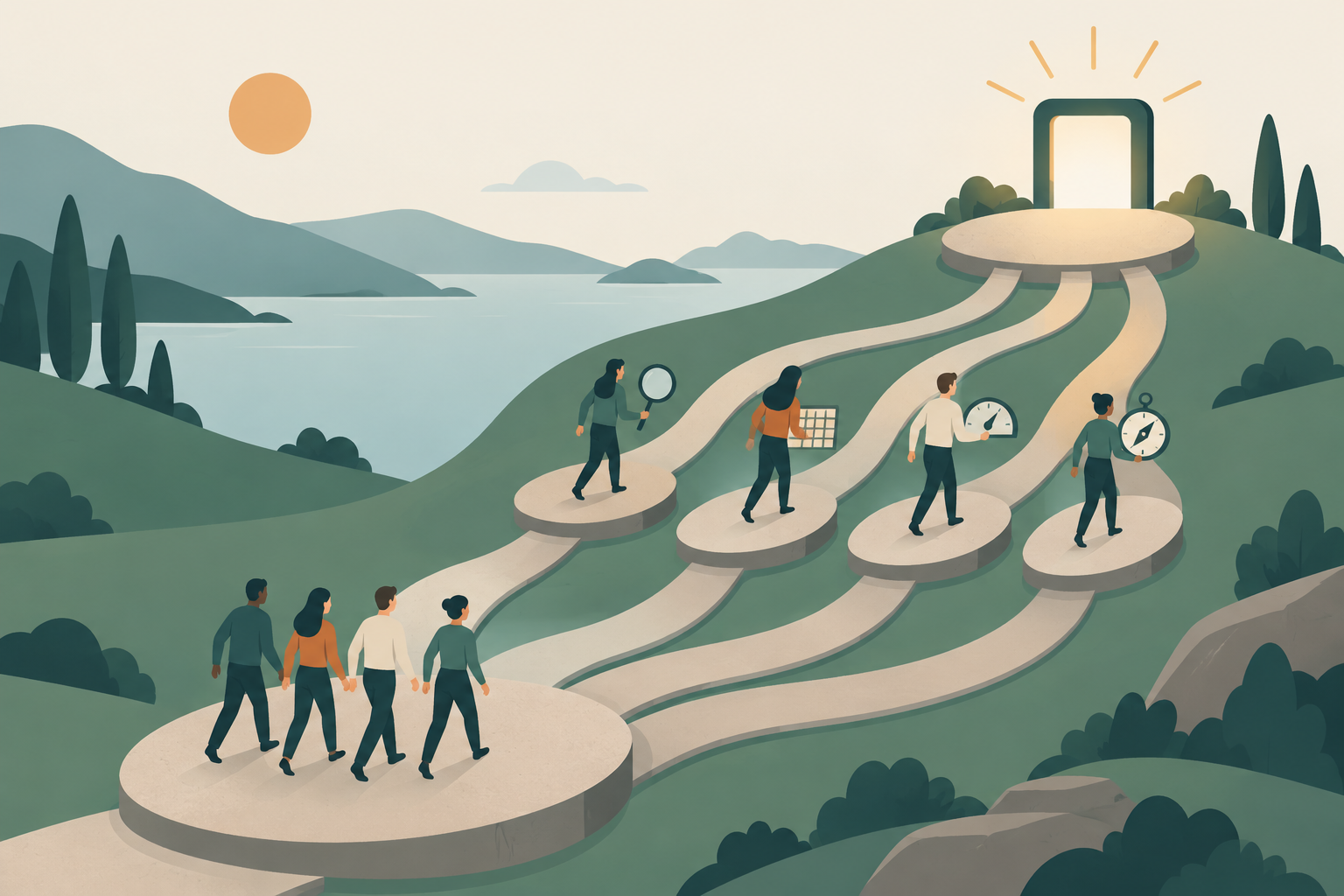
Expect week 4 to be messy. Specialists will disagree with the model's negatives, and some of their objections will be right. That argument is the training working, so let it run and write the conclusions into the prompt library.
Measure it on the account, not on the quiz
Training for a paid team is measured by what changed in the accounts and the hours, which is the third and fourth level of the Kirkpatrick model rather than the first two. Kirkpatrick's four levels are Reaction (did people find it relevant), Learning (did they acquire the knowledge and skill), Behavior (do they perform the critical behaviors on the job) and Results (did the targeted organizational outcomes occur).
For a paid team, the behavior and results measures are already sitting in your systems:
| Level | What to measure | Where it comes from |
|---|---|---|
| Behavior | Hours per week on the report, the search term review and the audit, compared with the week 1 baseline | The same hour log you ran in week 1, repeated in week 8 and week 12 |
| Behavior | Share of proposed negatives and ad variants that were checked before being applied, and how many were rejected | The review step's log |
| Behavior | Number of accounts where the weekly workflow runs without the head of paid touching it | The workflow owner's checklist |
| Results | Hypotheses tested per account per month, before and after | Change history in the ad platform |
| Results | Cost per opportunity by channel, read from the CRM, and whether the budget moved toward the cheaper channel faster than before | CRM and ad platform, joined |

Here is a worked example, with invented numbers. Imagine a six-person paid team: a head of paid, three specialists, an analyst and a marketing leader. Training costs about 57 hours in total (four hours of shared layer for six people, plus the role hours in the curriculum table at the low end). If the weekly report drops from four hours to one for the analyst, and each specialist's search term review drops from two hours to 45 minutes, the team recovers about 6.75 hours a week, and the training hours are repaid in eight to nine weeks. That is the arithmetic to put in front of the CFO. Whether the recovered hours become more tests per account, and whether those tests move cost per opportunity, is the results row, and it takes a quarter to show.
The CFO will also ask what it cost, so put a money line beside the hours, still with invented team numbers. Anthropic's pricing page listed a Claude Team standard seat at $25 per seat per month billed monthly, or $20 billed annually, as of November 2026, so six seats for the first quarter cost $450. For the hours we would use the Bureau of Labor Statistics employer cost for management, professional and related occupations in private industry, which was $78.88 per hour worked in June 2026, wages and benefits together. Rounded to $79, the 57 hours come to about $4,500, so the program costs about $4,950 in its first quarter. At the same rate the 6.75 recovered hours are worth about $530 a week, which repays the whole sum in nine to ten weeks. After that the seats run at $150 a month, less than two of the roughly 29 hours the team recovers each month. If you sanction a different assistant, swap in its business-tier price; the hours make up most of the total either way.
Be honest about what you cannot measure. We found no credible independent study that isolates the effect of AI training on paid media results, and the vendor pages that cite numbers like "156% higher adoption" or "340% ROI" link to sources that do not resolve. Until that study exists, your own baseline-and-repeat measurement is the only evidence you will have, which is a strong argument for running the week 1 hour log properly.
Where AI training for marketing teams goes wrong
AI training for a paid team fails most often when it is a single event, when it measures attendance, and when the leader exempts themselves. Each failure has a plain fix.
The one-day workshop. A full day of demos produces enthusiasm and no change, because the first time anyone tries the method alone is three weeks later on a live account with nobody watching. Shorter sessions spread over six weeks, each ending in a deliverable, fix this.
Training on sample data. Teaching with a demo account or a vendor's dataset teaches the tool and leaves the hard part, which is your account's quirks, for later. Every session should run on the accounts the people own.
No data rule, or a rule nobody can follow. A policy that bans every AI tool pushes the team onto personal accounts. A policy that sanctions one business-tier tool and names what may not go into it gets followed.
The leader skips it. When the CMO has not done the verification drill, the first confident AI analysis to reach the leadership meeting gets accepted or dismissed on instinct. The leader's four hours are the highest-return hours in the program.
Measuring completion. A dashboard showing 100% course completion tells you the videos played. If your scorecard has no row that reads from the ad platform or the CRM, you have measured level one and called it level four.
Treating it as finished. The platforms change their automation several times a year and the AI vendors change their tools faster than that. Put a refresh session in the calendar every quarter, and make it the owner's job to keep the prompt library current.
Who should not do this yet? A team whose conversion tracking is broken, or whose CRM does not record which leads became opportunities, should fix that first. AI trained on bad data learns to defend it, and so will the team.
Where to start
Run the week 1 hour log before you book anything, because that number is the one the whole program will be judged against. Scalewell sets this kind of role-based method up with paid teams, from the task inventory to the scorecard, if you'd like help getting it running.
Frequently asked questions
How long does AI training for a marketing team take?
Plan for about five hours per person as a floor, because BCG's 2025 survey found regular AI use sharply higher among employees who received at least five hours of training. For a paid team, four hours of shared material plus six to eight hours of role-specific work over six weeks is a realistic total.
Should we buy an external course or build training in-house?
Buy the shared layer and build the role layer. Free courses from Anthropic, Google and the ad platforms cover how models work and how the platforms work. Nothing public covers your accounts, your conversion definitions or your approval rules, so the head of paid media teaches that part on live accounts.
What should AI training for marketers cover first?
Learn to verify before learning to prompt. The highest-value skill is asking what data an answer used, checking one number by hand, and deciding which actions a model may take alone. Prompting technique matters less than the habit of catching a fluent wrong answer before it reaches a budget.
How do we know if AI training actually worked?
Compare hours and behavior against a baseline you took before training started: time spent on the weekly report and search term review, the share of AI suggestions checked before being applied, and tests run per account. Course completion and satisfaction scores measure the training session, not the work.
Do we need an AI policy before training the team?
Yes, and it should be one page. Name the sanctioned tool and its business tier, list what may never be pasted in, and say who approves anything that changes spend. Without it, Microsoft's 2024 finding applies: most AI users bring their own tools, with no visibility for you.