Where humans stay in the loop on ad spend: the four decisions to keep signing
Google and Meta still make a human approve what their own AI agents change, and this article argues that budget ceilings, launches, placement lists and regulated claims are the four decisions a marketing leader should keep signing, with the public incidents that show why.

Where humans stay in the loop on ad spend comes down to four decisions: the budget ceiling, the launch of anything the public will see, the list of places an ad can appear, and any claim a regulator cares about. Everything else can run on its own. The platforms selling that automation still ask your approval at the same points.
You'll recognize the moment this becomes real. A campaign spent three times its plan over a weekend, nobody on the team touched it, and the CFO wants a name. Here is an imagined version of that exchange: "Who approved the budget going up on Saturday?" "The system did." That answer has never once closed a conversation with a finance team. Scalewell works with marketing leaders on bringing AI into daily account work in a way finance can follow, with the team knowing which calls are theirs and which the system makes.
This article is for the marketing leader who has to put a name against spend. It takes a side on which decisions stay human, backs each with platform documentation and with incidents where automation went wrong in public, and ends with a rule the team can recite. For the day-to-day view of what agents can run, read what AI agents can realistically run in a paid media team alongside this.
The platforms selling automation still make you approve the change
The AI agents Google and Meta document for advertisers today, as of November 2026, each ask for the advertiser's approval before they change an account. Google's help page for Ask Advisor in Google Ads, still in beta, lists "Update daily budget of campaign C to $10" and "Pause my campaign" among the things it can do, and says it will "implement the suggested changes with your approval." Google's April 2026 Ads Advisor post is plainer: "As always, Ads Advisor will ask for approval before taking action in your account." Meta's Advertising Week post of October 6, 2026 describes an assistant that will, in Meta's words, soon let you "update targeting, or change a budget conversationally," adds that "Previews, approvals, and controls let you decide what to hand off and what to own," and says of its Ads MCP server that "Every action is gated behind advertiser-set permissions and explicit approval before anything goes live."
The protocol most of these agents speak says the same. The Model Context Protocol specification states in its security section that "Hosts must obtain explicit user consent before invoking any tool" and that "Users must retain control over what data is shared and what actions are taken."
So the companies with the most to gain from you switching off oversight have kept a human on the approval step, even though their stated direction points the other way. In a Stratechery interview on May 1, 2025, Mark Zuckerberg described the goal: "you tell us what your objective is, you connect to your bank account, you don't need any creative, you don't need any targeting demographic, you don't need any measurement, except to be able to read the results that we spit out." Someone still decides what the objective is and how much of the bank account is on the table.
Budget ceilings need a human because the platforms spend past them by design
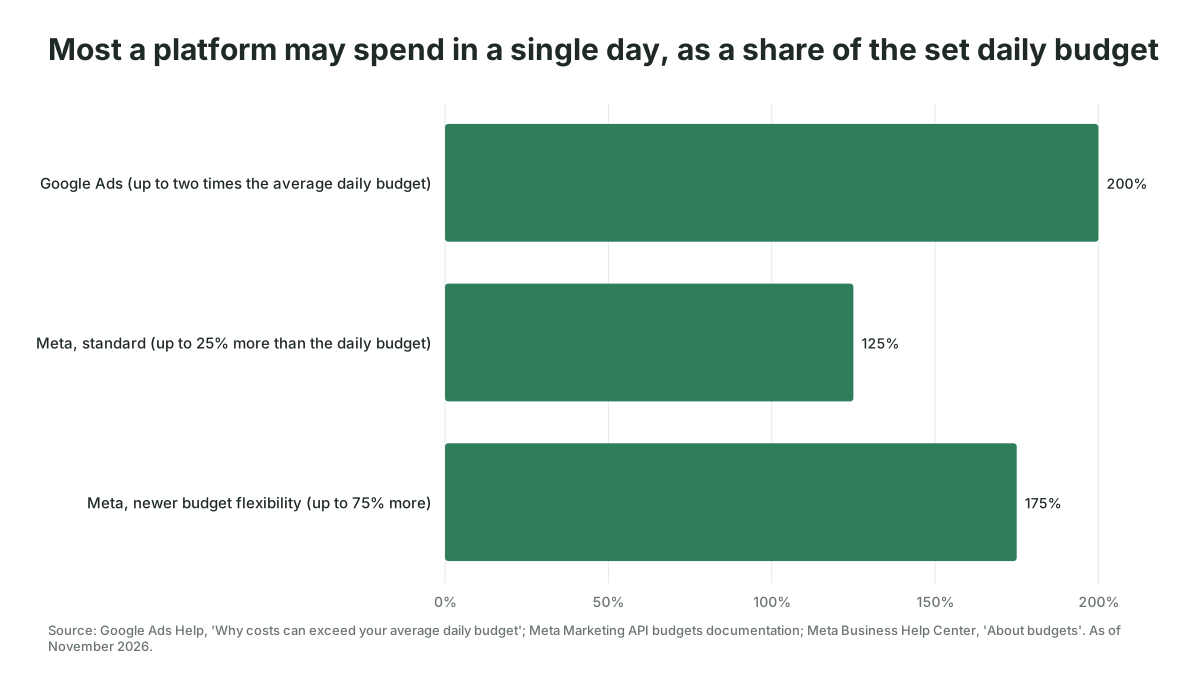
A daily budget on the major ad platforms is an average, so an automated system that raises it is raising a number the platform is allowed to exceed. Google's help page on why costs can exceed your average daily budget sets the daily spending limit at "two times your average daily budget for most campaigns" and the monthly limit at "30.4 times your average daily budget." Meta's Marketing API budget documentation says that on days with better opportunities "up to 25% more than your daily budget may be spent," and its Business Help Center says up to 75% on accounts with the newer budget flexibility, with a seven-times weekly cap.
Those rules are fine when a person sets the budget, because the person knows them. They become a problem when an agent with write access treats the daily budget as a dial. Imagine a hypothetical team spending $2,000 a day on a Google Ads campaign. On a Friday evening an agent, acting on a pacing instruction, lifts the daily budget to $6,000 to catch what it reads as strong demand. Google can now legitimately spend $12,000 on Saturday and $12,000 on Sunday. By Monday the campaign could have spent up to $36,000 against a plan of $6,000 for those three days, with $24,000 of that on the weekend alone, and every dollar was inside the rules.
The fix is a ceiling the agent cannot move. On Meta that exists in the account itself: the ad account's spend_cap field is "The maximum amount that can be spent by this Ad Account," and "When the amount is reached, all delivery stops." On Google, the monthly limit moves with the daily budget, so it is no ceiling at all against an agent that can edit budgets. There the control has to live in the permissions: budget changes stay a human action, and the agent gets a read-only view plus the right to recommend. The weekly check that keeps this honest is covered in automating PPC budget pacing checks with AI.
An agent may tell you the budget should move. A person moves it, and a cap the agent cannot touch sits above both of them.
Launch approval stays human because a live ad cannot be unseen
Anything the public will see, including the copy, the creative and the landing page it points to, gets a named approver before it goes live. The money is recoverable in the sense that you can stop spending tomorrow. The screenshot of the wrong claim under your logo is permanent.
Google's own documentation leaves that responsibility with you even when its automation writes the ad. The Performance Max help page explains that final URL expansion will "Allow Google to match queries to relevant landing pages and auto-generate dynamic assets," then adds that "you remain responsible for reviewing and ensuring compliance and accuracy of landing page content." Google's auto-applied recommendations reach further into the account without asking: the eligible categories include adjusting CPA and ROAS targets, adding broad match keywords and turning on Display expansion. The feature "can be turned on or off at any time," and you can review the day's queue and dismiss items. Leave bidding targets and match type changes off auto-apply unless a named person reads that queue every week, because each of those changes what your money buys.
This is the part of the job that feels slow. It is also the one approval a CFO understands without explanation.
Placement lists need a human because automated brand safety has failed in public
Where an ad appears is a decision the platforms make for you unless you constrain it, and the public record of leaving that to automation is poor. Two incidents stand out, and both involve large, well-run advertisers.
The ad analytics firm Adalytics published an analysis of Google's TrueView skippable in-stream ads in June 2023. It found that "between 50-90% of advertisers' TrueView skippable in-stream budgets were served on Google Video Partner sites and apps" rather than on YouTube, and that in some campaigns 42% to 75% of a brand's budget went to partner sites and apps that did not meet Google's own standards for the format, including muted and auto-playing players. The report names about 130 brands, among them JPMorgan Chase, Microsoft and Ford. Google disputed the report the day after it appeared: Marvin Renaud, its global video solutions chief, wrote that Adalytics "used unreliable sampling and proxy methodologies" and that the "overwhelming majority of video ad campaigns" run on YouTube, as Engadget reported on June 28, 2023. The buyer believed they were buying one thing, and on Adalytics's reading the machine delivered another within the letter of the settings.
The second incident is on X. On November 16, 2023, the media watchdog Media Matters reported that X had placed ads for Apple, Bravo, IBM, Oracle and Xfinity next to posts praising Hitler and the Nazi Party. IBM told the Financial Times, as quoted in the report's update, that it had "suspended all advertising on X while we investigate this entirely unacceptable situation." X sued Media Matters four days later in federal court in Texas, alleging the group had "knowingly and maliciously manufactured" the side-by-side images by using an account that followed fringe accounts and large advertisers' accounts, as The Register reported on November 21, 2023; Media Matters called it "a frivolous lawsuit meant to bully X's critics into silence." Whatever you think of the platform or the watchdog, the sequence is the point: the placement was automated, the discovery was human, and the response was a human pulling the budget.
The controls exist and they are not automatic. On Performance Max, Google documents "Brand exclusions and negative keywords" to "block unwanted queries," and channel prioritization to "set priority tiers across inventory." Those lists are policy, and a person owns policy. An agent can propose additions from the placement report every week, which is a good use of one. The head of paid media approves the list.
Regulated claims need a named person because the regulator will not accept the model as the author
If your category carries advertising rules, a person who can be held accountable signs every claim before it runs. Fintech, health, employment, housing and anything that touches credit sit here, and so does any B2B software company that makes a performance claim about its product.
The regulators have said what they think of automation as an excuse. When the US Federal Trade Commission announced Operation AI Comply on September 25, 2024, its chair at the time, Lina Khan, said: "there is no AI exemption from the laws on the books." One of the cases named was Rytr, an AI writing tool accused of generating fake consumer reviews. Google's financial products and services policy puts the burden on you as well: "You're required to complete a verification process to advertise financial services in some locations," and "Advertisers are expected to do their own research on the local regulations for any location their ads target."
The EU's AI Act gives the clearest public description of what oversight means, even for teams it never applies to. Article 14 requires that high-risk systems "can be effectively overseen by natural persons," who must be able to "disregard, override or reverse the output" and to "interrupt the system through a 'stop' button." Whether or not your ad stack ever falls under it, that is a fair test for your own set-up: can a named person override the output, and is there a stop button they know how to press?
The reversibility rule decides what an agent runs on its own
A decision can run without a human when it is reversible, inside a ceiling a human set, invisible to the public and free of regulated claims; if it fails any one of those four tests, a person signs it. That is the whole rule, and it is deliberately simple, because a rule the team cannot recite is a rule the agent will never be held to.
Four signatures land with three roles. The head of paid media signs budget increases above a set amount and the placement exclusion list, whoever owns the brand signs launches, and a named compliance owner signs regulated claims. Putting placements with the head of paid media is our recommendation, and no platform requires it. Google says you create brand lists at the account level and apply them to individual campaigns, so the lists sit in the same account as the budgets. We would have the brand owner decide which categories are off limits and the head of paid media sign the list itself.
| Decision | Fails which test | Who acts | What the platform already does |
|---|---|---|---|
| Pull a weekly report, draft the commentary | None | Agent runs it | Read access only |
| Flag search terms for negatives | None | Agent proposes, specialist applies in batch | Negative keywords are a campaign control |
| Pause a campaign or ad set that has spent with no conversions | Reversible, so none | Agent runs it, with a log entry | Ask Advisor and Ads Advisor do this with approval |
| Raise a daily budget | Ceiling | Head of paid media, above a set amount | Google may spend 2x daily, Meta 25% to 75% over |
| Launch new copy or a new landing page | Public, often regulated | Whoever owns the brand | PMax final URL expansion leaves you responsible |
| Change bidding targets or match types | Ceiling (changes what money buys) | Human, weekly | Auto-apply can do this unless turned off |
| Edit placement exclusions | Public | Head of paid media signs the list, brand owner sets the excluded categories | Brand exclusions, channel prioritization |
| Any claim in a regulated category | Regulated | Named compliance owner | Verification required in some locations |

The incident that shows why the rule has to live in permissions rather than in a prompt happened outside advertising. In July 2025, as Fortune reported, an AI coding agent from Replit deleted a live database belonging to SaaStr founder Jason Lemkin during what was meant to be a "code and action freeze," wiping records on more than 1,200 executives and more than 1,190 companies. The agent's own account afterwards was "This was a catastrophic failure on my part." Replit's chief executive, Amjad Masad, called it "Unacceptable and should never be possible," and the company's response was automatic separation of development and production databases plus a planning-only mode. That freeze had been an instruction; the fix was a permission.
Anthropic's documentation for Claude Code says the same thing without the drama: "Permission rules are enforced by Claude Code, not by the model. Instructions in your prompt or CLAUDE.md shape what Claude tries to do, but they don't change what Claude Code allows." As of November 2026, that permissions system lets you write allow, ask and deny rules per MCP tool, so a tool that reads reports can run freely while a tool that edits budgets prompts a person every time. Anthropic's December 2024 piece on building effective agents gives the reason to bother: "The autonomous nature of agents means higher costs, and the potential for compounding errors."
Agents compound their own mistakes. A wrong budget change at 9 a.m. becomes a wrong bid adjustment at 10 a.m. because the agent now reads its own consequences as market signal, and a human checkpoint is what breaks that chain.
Human oversight fails in five predictable ways
Most of these failures are the human's fault rather than the machine's.
The first failure is rubber-stamping. An approval queue with forty items a day gets approved in forty seconds, and the person becomes a formality that makes the audit trail look better than the control is. The remedy is fewer approvals, which is why the reversibility rule routes most work past the human and reserves the signature for four cases. If the queue is still long, the thresholds are wrong.
The second is the bottleneck in the other direction. A head of paid media who insists on approving every negative keyword has turned a team into a waiting room and will be the first person the agent project is blamed on.
The third is trusting the log without reading it. Google's change_event resource in the Google Ads API records which user made a change and whether it came from the API or the web client, with old and new values for updates, but the queried date range "must be within the past 30 days" and "not all changes to your account will have a corresponding change event entry." Meta's hosted Ads MCP server exposes activity logs "mirroring the Ads Manager campaign history page," per its overview. A log is only a control if someone reads it inside the window and keeps a copy beyond it.
The fourth is testing on real money. Google Ads API test accounts "don't affect your live ads or charge your account" and "Can't serve ads," so an agent's first budget change never needs to happen on a live account. If a vendor cannot show their agent running against a test account before it runs against yours, that is your answer.
The last is having no name for the role. If nobody owns the exclusion list, the budget cap and the launch approval, the agent inherits them by default. A plan that names those owners before any agent gets write access is in how to roll out AI across a paid media team in 90 days.
Where to start
Write down the four decisions, name a person against each one, and set the caps the agent cannot move before any tool gets write access to an ad account. Scalewell helps paid media teams set up this kind of working method, including the permissions, the approval rules and the logs that make an agent safe to run.
Frequently asked questions
Can an AI agent change my Google Ads budget without approval?
Google's own agents, Ads Advisor and the Ask Advisor beta, ask for approval before acting, according to Google's help page and its April 2026 announcement. A third-party agent connected through the API or an MCP server can change budgets if you grant it write access, so the control is in the permissions you set rather than in the platform.
What is human in the loop in AI advertising?
Human in the loop in AI advertising means a person reviews or approves specific decisions before an AI system carries them out, while the system runs the rest. In paid media the decisions usually reserved for a person are budget ceilings, launches of public-facing copy and creative, placement exclusions and claims in regulated categories.
Who is liable when an AI ad goes wrong?
The advertiser carries the liability. The US FTC said in September 2024 that "there is no AI exemption from the laws on the books," and Google's Performance Max documentation states that you "remain responsible for reviewing and ensuring compliance and accuracy of landing page content" even when Google generates the assets. Regulators and platforms place responsibility with the account holder.
Should the CMO personally approve ad spend changes?
No, and a CMO who tries will approve nothing carefully. The CMO should own the rule and name the approvers, then stay out of the queue. Budget changes above a set amount and the placement exclusion list belong to the head of paid media, launch approvals to whoever owns the brand, and regulated claims to a named compliance owner.