In-house marketing vs agency for AI in paid media: cost, speed, control and skills
How a B2B marketing leader should resource AI in paid media across in-house, agency and consultant, with real cost figures, a hybrid split and a filled-in decision table.

For most B2B companies, the answer to in-house marketing vs agency once AI enters paid media is a split. Keep strategy, conversion data, spend approvals and the AI workflows that touch pipeline in-house, buy channel execution or capacity from an agency, and buy any one-off AI build only on terms that end with your own people running it.
The question usually turns up at the budget review, in an exchange like this imagined one. The CFO asks, "If AI is doing more of the account work, why is the agency retainer the same as last year?" The CMO answers, "Because they're doing the work," and both of them know that answer won't survive the next quarter.
This article is for the CMO, VP of Marketing or head of demand gen who has to decide how paid media gets resourced now that AI does part of the work. It compares the three options on cost, speed, control, skills, knowledge transfer and lock-in, covers the build vs buy AI question for tools, and ends with a filled-in decision table you can take to finance.
Scalewell helps paid and demand gen teams hand the recurring reporting and checking work in their week to AI, so their people spend those hours on the decisions that move pipeline.
In-house, agency and consultant buy three different things
An in-house team, an agency and an independent consultant are three different purchases: an in-house team buys permanent capacity and knowledge you own, an agency buys ongoing operation of the accounts, and a consultant buys a defined piece of advice or a build that ends on a date. Most bad resourcing decisions come from comparing them as if they were the same product at different prices.
The marketing agency vs consultant distinction matters more with AI than it did before. An agency is paid to keep running your campaigns month after month, so any AI workflow it builds tends to live inside its own tools and process. A consultant is paid for a defined piece of work and then leaves, so the result is only worth something if your team can run it afterwards, and nothing in that model guarantees a handover unless the contract does.
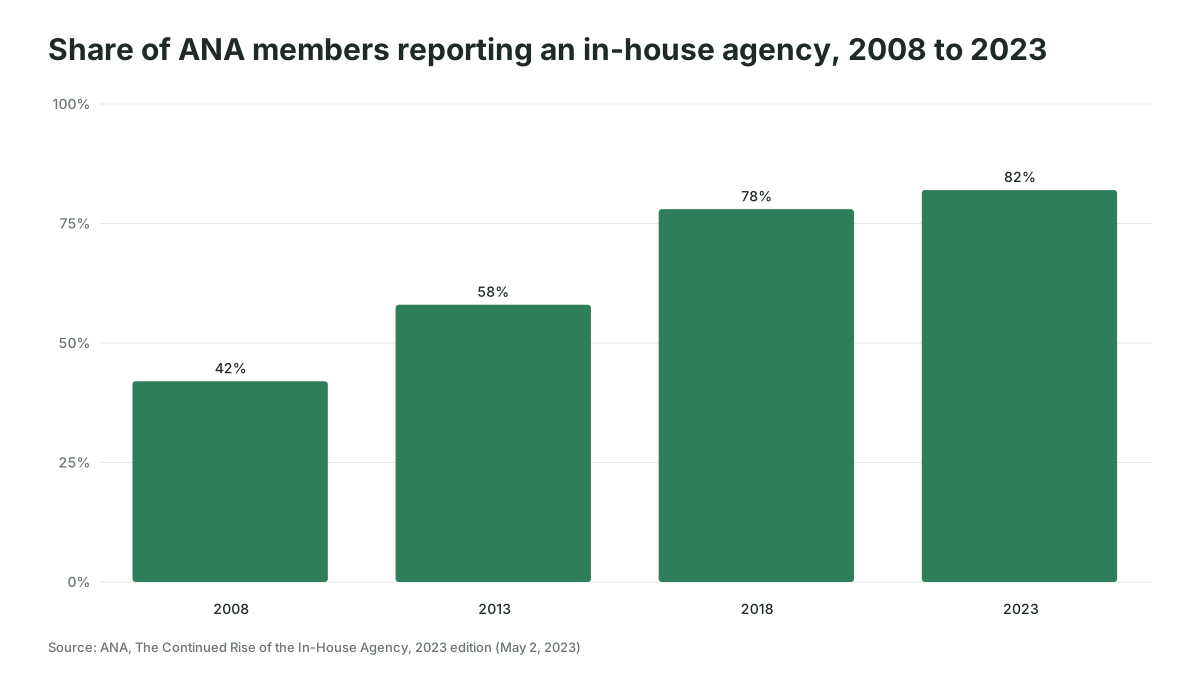
The trend data says companies are pulling work inside without dropping outside partners. The Association of National Advertisers' 2023 in-house agency study, with 162 respondents, found 82% of ANA members had an in-house agency, up from 78% in 2018, and 92% of respondents also worked with an external agency. Cost efficiency was the first benefit named, and external agencies were used "primarily for bandwidth/capacity reasons" or for capabilities the company didn't have.
Paid media follows the same line. The State of PPC 2026 survey of 1,306 PPC professionals, run by TrueClicks with industry partners, found that 73% of in-house teams were committed to keeping PPC fully internal and that 20% of clients planned to "replace agency work with AI" rather than switch agencies, according to Swydo's 2026 summary of the results. That second number is the one your agency is reading too.
In-house costs more than the salary line, agencies cost more than the hours
In-house paid media costs the salary plus about 43% more in benefits and payroll costs, plus weeks of hiring, while agency and consultant fees look higher per hour because the overhead is already inside the rate. You need all three on the same basis before the comparison means anything.
On salary, the US Bureau of Labor Statistics puts the median marketing manager at $166,790 a year in May 2025, and the median for market research analysts and marketing specialists, the broad category a paid media specialist falls into, at $78,760. In the BLS Employer Costs for Employee Compensation release of September 9, 2026, covering June 2026, wages and salaries were 70.0% of private-industry employer compensation costs and benefits the remaining 30.0%, so dividing a salary by 0.70 gives the cost with benefits included, before recruiting, software and office costs. A $78,760 specialist costs about $112,500 a year.
Time to hire comes on top. SHRM's 2026 recruiting benchmarking, drawn from more than 4,600 organizations, puts the median time to fill a nonexecutive role at 39 calendar days, and that's before the new hire learns your accounts, your CRM and your buying committee.
Agency rates are easier to find and harder to compare. Clutch's PPC pricing guide, updated September 21, 2026 and based on reviews from verified clients (it gives no sample size), says most PPC agencies charge $100 to $149 an hour. Independent consultant rates have no credible current survey. The most cited one, Credo's, puts the average digital marketing consultant at $141.67 an hour on a page last updated in March 2023 that gives no sample size, so treat it as dated.
Here is how that looks for one hypothetical company. Company A is a B2B SaaS firm spending $60,000 a month across Google Ads and LinkedIn, and it needs roughly 30 hours a month of hands-on account work plus a one-off AI build.
| Option | How the cost is built | Hypothetical annual cost | What the company owns at the end |
|---|---|---|---|
| Hire one specialist | $78,760 BLS median divided by 0.70 | About $112,500, every year | A person, their knowledge, any AI workflows they built |
| Agency at 30 hours a month | 30 hours x $100 to $149 x 12 | $36,000 to $53,640, every year | Account history, if the accounts are in your name |
| Consultant for a 120-hour build | 120 hours x $141.67 (dated Credo average) | About $17,000, once | The build, plus documentation and trained people if the contract requires them |
The cheapest line in that table misleads. On paper the agency costs less than the hire, but the hire is a full person with about 2,080 working hours who also covers reporting, CRM questions and internal meetings, while the agency's 30 hours cover the accounts and nothing else. The consultant line is the smallest, and it buys nothing ongoing unless someone inside owns what was built. Each option should be judged on what it does to cost per opportunity and pipeline, which is the case our guide to the business case for AI in B2B paid media builds out for a CFO.
Six criteria decide the comparison, and cost is only one
The comparison between in-house vs agency vs consultant comes down to six criteria: cost, speed to start, control, skills, knowledge transfer and lock-in. Cost is the one people argue about, and lock-in is the one they regret.
| Criterion | In-house team | Agency | Independent consultant |
|---|---|---|---|
| Cost | Highest fixed cost; about salary divided by 0.70 | Monthly fee or hours; the overhead is inside the rate | One-off fee for a defined scope; no current rate survey |
| Speed to start | Slow; 39-day median to fill a nonexecutive role, then ramp-up | Fast; a team already exists | Fast for a scoped project, if the right person is free |
| Control | Full; your people, your accounts, your rules | Shared; depends on the contract and who holds access | Yours over accounts and decisions; the quality of advice is hard to judge before you buy |
| Skills | Deep on your business, narrow across channels | Broad across channels and accounts | Varies widely; one person's experience, for a limited time |
| Knowledge transfer | Stays when people stay, leaves when they leave | Depends on the contract; by default the method lives with the agency | Depends on the contract; without a required handover it leaves with the consultant |
| Lock-in | Key-person risk | Account ownership, data and AI workflows held by the agency | Low on accounts; dependency if only the consultant can maintain the build |
Control is mostly settled by who owns the ad accounts. Google says in its manager account documentation that "users with administrative access to those accounts can terminate the relationship with the manager account at any time", so your admin can cut off an agency's manager account. LinkedIn is stickier: an ad account shared with a partner in Business Manager can only be shared by a Business Manager admin, and "if you need to stop sharing the ad account, you must contact support." In both cases the account should be created and held in your company's name, with the agency invited in.
Knowledge transfer is where AI changes the economics. A prompt library, a weekly reporting skill or a pacing check encodes how your team judges an account. If an agency builds it in its own workspace, you rent your own method back every month. If it is built in your tools and documented, whoever builds it, it stays when the contract ends. Who owns each of those workflows inside the team is covered in our guide to who owns what in an AI marketing team.
Build vs buy AI: buy the tools, build the workflows on top
The build vs buy AI question has a fairly clear answer from the evidence so far: buy the AI tools and platform features, and build only the thin layer that encodes your own rules, such as prompts, skills, checks and the connection to your CRM data.
MIT NANDA's State of AI in Business 2025 report (July 2025) found, in interviews with 52 organizations, that external partnerships, meaning tools bought from vendors and customized with them, "reached deployment ~67% of the time, compared to ~33% for internally built tools." The figures are self-reported, and the report itself says the gap "may reflect organizational capabilities rather than implementation approach alone."
For a paid media team, that points to a plain rule. Don't build your own bidding model, reporting platform or AI client, because Google, LinkedIn, Microsoft and the AI vendors ship and update those faster than any marketing team can. As of November 2026, Google, Meta and Microsoft each run their own MCP server for ad accounts, and LinkedIn's is in beta, so even the connection between an AI assistant and your ad data is now something you buy or switch on.
What you build is the part no vendor can sell you. That covers the definition of a qualified opportunity, the rules for when a campaign gets paused, the brief your creative drafts start from, and the checks a human runs before spend changes. Those are cheap to build and expensive to rent, and they're the reason knowledge transfer sits in the comparison table at all.
The hybrid model most B2B teams already run
A hybrid model keeps the jobs that decide pipeline in-house and buys capacity for the jobs that don't, and it's already the most common setup. In the ANA study, the companies that also used outside agencies did an average of 61% of their work in-house. Budgets are moving toward people too: in Gartner's 2026 CMO Spend Survey of 401 CMOs, labor rose from a mean 21.9% of the marketing budget in 2025 to 24.5% in 2026, as Chief Marketer reported on June 24, 2026.
The useful version of hybrid splits by job rather than by channel. A split by channel ("the agency does LinkedIn, we do Google") leaves two teams each owning half the pipeline story, and neither able to explain the whole of it. How that job split fits the wider team is covered in our guide to the marketing operating model once AI runs part of the week.
| Job | Who should hold it | Why |
|---|---|---|
| Pipeline target and budget split | In-house, always | It's the decision the CFO holds you to |
| Conversion definitions and CRM match | In-house, always | Whoever controls the numbers controls the story |
| Spend approvals and launches | In-house, always | The incentive to spend sits on the other side |
| AI workflows (reports, checks, prompt library) | Owned in-house, built by your team or an outside partner | The method should survive any contract |
| Daily campaign execution | In-house or agency | Depends on spend, channels and team size |
| Creative production and variants | Agency, freelancers or in-house | Volume work that scales with budget |
| Surge capacity (launches, new markets) | Agency or consultant | Paying for a permanent hire to cover peaks wastes money |
Conversion definitions and approvals stay inside because an outside partner is paid on activity while you are judged on pipeline, and the AI workflows stay owned inside because they now hold the method. Where humans must sign off on spend is covered in our guide to keeping humans in the loop on ad spend.
Decision table: which model fits your team
The right model depends on four facts about your team: how many paid media people you have, how many channels you run, whether someone owns the CRM data, and whether you need the work done or learned. The table below is filled in for common situations; the thresholds are examples for your team to adjust, not rules.
| Your situation | Best fit | What to keep in-house | What to buy |
|---|---|---|---|
| No paid media hire yet, one or two channels | Agency for execution | Pipeline target, approvals, account ownership | Account management and reporting |
| One paid media person, three or more channels | Hybrid | Strategy, data, approvals, AI workflow ownership | Execution on the channels the person can't cover |
| Paid team of three or more, solid CRM data | In-house, with outside help for one-off builds | Everything that runs every week | Fixed AI builds, an outside review once a year |
| Agency in place, team wants AI skills inside | Hybrid, moving in-house over time | Data, approvals, then the AI workflows | Execution while your people learn |
| Big launch or new market in the next quarter | Current model plus surge capacity | The plan and the pipeline target | Short-term agency or consultant hours |
| Conversion tracking or CRM match is broken | Fix the data first, under any model | The data owner role | A short, scoped data project |
The last row overrides the others. If your CRM can't say which leads became opportunities, none of the three options can be judged on pipeline, and you'll end up choosing on cost per lead, which is how a cheap agency wins a contract it shouldn't. If you're moving work in-house, the sequence in rolling out AI across a paid media team in 90 days shows the order to take it on.
Each model fails in a predictable way
Each resourcing model has one failure that shows up again and again, and naming it in advance is cheaper than discovering it at renewal.
In-house fails on one person. The AI workflows, the prompt library and the account history live with whoever built them, and when that person leaves, so does the method. The fix is documentation and a second named person who can run every workflow.
Agencies fail on who keeps the AI savings. If AI cuts the hours on your account and the fee stays the same, the saving goes to the agency's margin. No credible public data says how often agencies pass AI savings on, so ask directly: which hours on our account has AI removed, and what does the fee look like now? An agency that can answer with a time log is one worth keeping.
Consultants fail on handover. A build with no internal owner soon stops working, because platforms change and nobody adjusts the prompts, and a single consultant is a key-person risk of their own. Agree the owner before the work starts, and make the final deliverable your team running the workflow unaided.
Every model fails on lock-in written into the contract. Before you sign with anyone, settle five things in writing: the ad accounts are in your company's name; you hold admin access; conversion settings change only with your sign-off; any AI workflow built for your accounts is yours, with its prompts and documentation; and the exit includes a handover period.
Not every team should change model now. A team in the middle of a pipeline quarter with a working setup should wait for the next planning cycle, because switching mid-quarter costs weeks of learning on both sides.
Where to start
List the recurring paid media jobs in your team this week and write next to each one who does it today, who should own it, and whether AI could take part of it; that list settles most of the in-house vs agency question on its own. Scalewell offers paid and demand gen leaders a free first call on which of those jobs AI could take on first.
Frequently asked questions
Is it cheaper to hire an agency or build an in-house marketing team?
An agency is usually cheaper for a small amount of account work, and in-house is cheaper once the work fills a full role. A useful test is to compare the agency's annual fee with one salary divided by 0.70. If the fee is close to that figure, a hire who also learns your business tends to be the better buy.
What is the difference between a marketing agency and a marketing consultant?
A marketing agency runs work for you on an ongoing basis, usually across several specialists, and is paid monthly or by the hour. A consultant advises or builds something specific, then leaves. Hire an agency for capacity that keeps running, and a consultant for a decision, a plan or a build your team will own.
When should a B2B company move paid media in-house from an agency?
Move in-house when paid media is large enough to fill at least one full role, when your CRM can tie spend to opportunities, and when the agency can't explain results in pipeline terms. Keep the agency during the transition and move one job at a time, starting with data and approvals, so nothing breaks while your team learns the accounts.
Can AI replace a marketing agency?
AI can take over some agency work, such as report assembly, search term reviews and first-draft copy, but not accountability for spend. In the State of PPC 2026 survey, as summarized by Swydo, 20% of clients planned to replace agency work with AI. For most B2B teams the realistic outcome is a smaller agency scope, with AI and an in-house owner taking the routine work.
How long does it take to switch from an agency to an in-house team?
Plan for at least one to two quarters. Hiring alone takes a median of 39 days for a nonexecutive role in SHRM's 2026 data, and the new hire then needs time on your accounts and CRM. Run both in parallel for at least one full reporting cycle so you can compare results before ending the agency contract.