AI demand generation: what to hand to AI and what to keep human
AI runs demand capture well and drifts toward it by default, so here is how to split the five demand gen jobs between AI and your team.

AI demand generation means using AI to pick target accounts, read buying signals, produce content, run paid distribution and measure pipeline. AI is already good at the capture half, where buyers are searching and converting. On the creation half, which pays back months later, people have to set the audience, the message and the clock it is judged on.
You've probably seen the version where nobody set those things. The quarterly review shows cost per lead down by a third since the team switched on every automated setting, and the pipeline line hasn't moved. Sales says the new leads are students and competitors. Nothing broke, exactly: the AI found the cheapest conversions it could measure, which is the job it was given.
This guide is for the CMO or head of demand gen deciding where AI belongs in the program. It takes the five jobs inside demand generation, says what AI does well in each and what stays with your team, and gives one rule for deciding who owns a decision. If you want the planning cycle around it, our demand generation strategy guide covers the annual and quarterly view, and B2B paid media in 2026 covers the channels.
AI demand generation covers five jobs, each with a creation side and a capture side
AI demand generation is easiest to manage as five separate jobs, because AI's usefulness changes from one job to the next. Demand creation means building memory and preference among buyers who aren't in market yet. Demand capture means converting the ones who are. Every job below has a version of each.
| Job | Demand creation side | Demand capture side | How much AI can run today |
|---|---|---|---|
| Account selection | The Total Addressable List you keep advertising to all year | The accounts showing signs of buying this month | Drafts the list; people approve it |
| Buying signals | Engagement that builds over months | Intent spikes, site visits, demo-page views | Collects and summarizes; people decide what counts |
| Content | The point of view and proof buyers remember | Ad copy, variants, landing pages for searchers | Produces most drafts; people own the argument |
| Paid distribution | Reach and frequency on a fixed account list | Bidding toward qualified conversions | Runs most of capture; supports creation |
| Measurement | Long-window influence on pipeline | Cost per opportunity this quarter | Reconciles and flags; people set the windows |
One pattern runs down the table. As a job moves toward capture, more of it can be handed over, because the feedback arrives quickly and a bad call costs a week of wasted spend. As it moves toward creation, the more AI becomes an assistant to a decision someone on your team has to own. Scalewell works with demand gen teams on exactly that, deciding which decisions AI informs, who owns each one and how the week changes so the team spends more time on pipeline.
AI drifts toward demand capture because capture is what it can measure
Any AI system trained on recent conversions will move effort toward demand capture, because buyers who convert this month are the only ones it can see. That is a property of the data, and it applies to Smart Bidding, LinkedIn's optimization and an agent you build yourself.
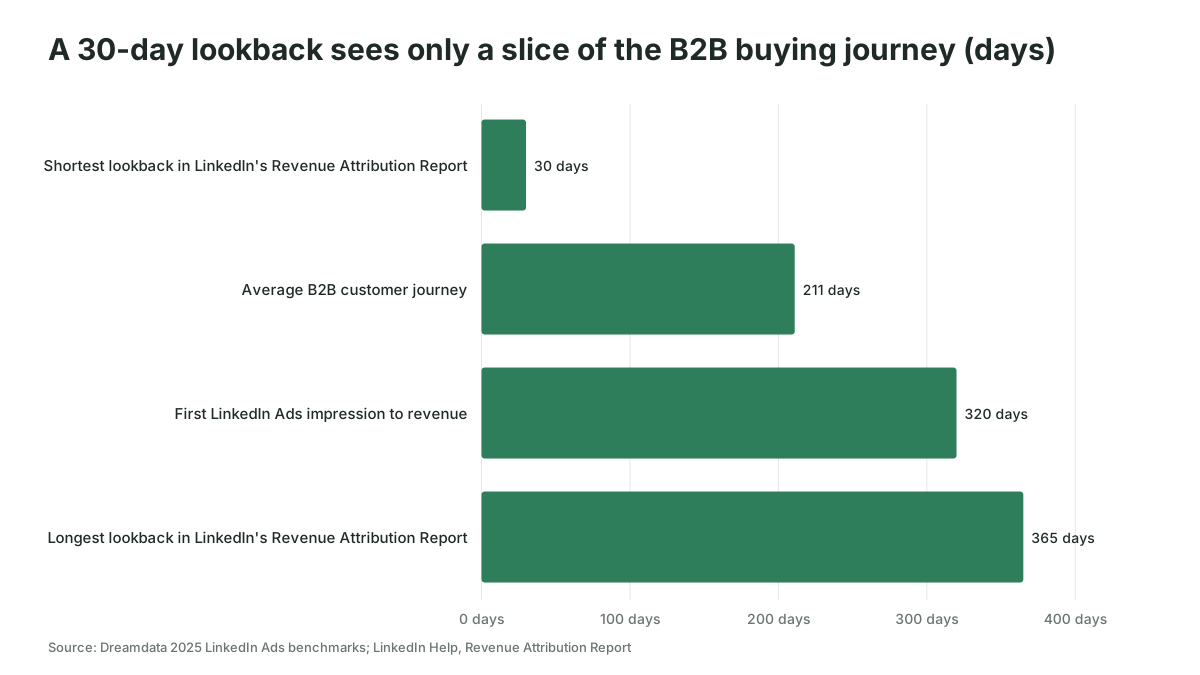
The arithmetic behind that is simple. LinkedIn's B2B Institute puts it plainly: "95% of your potential buyers aren't ready to buy today." Dreamdata's 2025 benchmarks put the average journey at 211 days, and 320 days from the first LinkedIn Ads impression to revenue. So an optimizer that learns from conversions inside a 30-day window is learning from the small slice of buyers who were nearly done when they met your ad.
Here is what the drift looks like in practice, as a hypothetical. Company A and Company B each spend $60,000 a quarter on LinkedIn and let AI reallocate budget weekly toward the lowest cost per qualified lead. A lets it move money freely, and within two quarters most of the budget sits on retargeting and lead forms aimed at accounts already talking to sales. Company B ring-fences 50% for a fixed account list judged on engagement and later pipeline. By the third quarter, A's dashboard looks better. B's pipeline looks better by the fifth, if the creation spend was any good, and the only way to know is to measure on the longer clock.
We call this capture drift, and nearly every decision below is a way of stopping it.
One rule decides whether AI runs a decision or recommends it
Let AI make a demand generation decision on its own when its payoff shows up inside the platform's conversion window and a bad call can be reversed within a week. When either condition fails, AI prepares the options and a named person decides.
The rule sorts most decisions quickly. Bids on a high-volume search campaign pass both tests, so the platform can run them. Rotating ad variants inside a fixed audience passes too. Choosing which 2,000 accounts you advertise to for the next year fails both: the payoff arrives in months and a bad list wastes a year of creation spend. Moving budget from a creation line to a capture line fails the first test, because the cost of starving creation won't show up until the following year's pipeline.
It also tells you what to automate first. Our post on AI marketing automation goes through the workflows themselves; this rule is just the filter in front of them.
Account selection is the best place to put AI to work first
Account selection is where AI saves the most thinking time, because building an ideal customer profile from closed-won and closed-lost deals is slow analysis that people tend to skip. Give a model a year of CRM opportunities with firmographics, and it will find the industries, sizes and tech stacks that win, plus the ones that waste sales time, faster than a spreadsheet session.
The platforms already accept the output. LinkedIn's Matched Audiences documentation describes uploading "a CSV list of companies or contacts" to target specific accounts, and it describes Predictive Audiences, which "combine their first-party or third-party data with LinkedIn's predictive AI modeling to build a high-intent audience." LinkedIn says that model identifies "members who are most likely to convert."
That last phrase is the catch. A predictive audience leans toward capture by design, which makes it a good audience for capture campaigns and a poor replacement for your Total Addressable List. Keep the list as the fixed creation audience, let AI propose additions and removals each quarter, and have sales sign off on the final version. If sales won't follow up the accounts on it, the list is a guess with a CSV attached.
Intent data tells you who is researching, and only sometimes who will buy
Intent data is a signal that an account is researching a topic, and AI is useful for turning a pile of those signals into something sales can act on. The sources are your own (site visits, demo-page views, LinkedIn Insight Tag retargeting), the ad platforms' engagement data, and third-party providers who infer research from content consumption across other sites.
A model can read all three and write a short brief per account each week: who engaged, with what, and how that compares with the account's last 90 days. That brief is genuinely useful, because nobody on the sales team reads raw intent exports.
What AI can't tell you is whether a given intent source predicts revenue for your business. We couldn't find an independent audit of third-party intent accuracy; the figures in circulation come from the vendors. So test it yourself before you pay for more of it. Split flagged accounts into a group sales works and a holdout it doesn't, and compare opportunity rates after 90 days. If the flagged accounts don't open opportunities at a higher rate, the signal is decoration.
There's a second reason to treat signals with care. Forrester's 2026 State of Business Buying research, based on nearly 18,000 buyers surveyed in 2025, found that "nearly all business buyers (94%) report using AI during their buying process" and that an average of 13 internal stakeholders and nine external participants influence buying decisions. A lot of that research now happens inside AI assistants, where no intent provider can see it. Your signals describe part of the buying group, at best.
AI speeds up content production, and the point of view still comes from you
AI cuts the time it takes to produce demand gen content, from ad copy to variants to landing pages, and the evidence for that is fairly solid. The part it doesn't supply is the argument buyers remember, which is what demand creation depends on.
The clearest public example comes from Anthropic's own growth marketing team. In a January 2026 write-up, growth marketer Austin Lau describes a Google Ads copy workflow built with Claude Code that exports 15 headlines and 4 descriptions per ad into "a CSV file ready to upload directly into Google Ads (after undergoing manual review)." The write-up says "what used to take 30 minutes per ad now takes 30 seconds." Lau's own caveat is worth keeping on the wall: "Claude is a great brainstorming partner, but sometimes it doesn't get it right on the first try."
The ad platforms are building the same thing in. In a July 1, 2026 announcement, LinkedIn said it is rolling out Draft with AI, Brand Kit, AI ad variants, Ads Personalization and Flexible Ad Creation in Campaign Manager, and that "advertisers who run five or more ad variants see over 20% higher click-through rates on LinkedIn," based on internal analysis it doesn't describe. That's LinkedIn's claim about its own product, and it measures clicks, which is a capture metric.
So split the content work by side. On capture, let AI draft, vary and test, and judge it on qualified conversions. On creation, a person decides the claim the company will stand behind, the customer proof behind it and the one idea a buyer should remember in six months. AI can draft from customer call transcripts and win-loss notes, which is a good use of it, but if the point of view came from the model, a competitor's model can produce the same one by Thursday.
Paid distribution works best as two budgets with different owners
Paid distribution in an AI demand gen program should run as two budget lines: a capture line where platform AI optimizes toward qualified pipeline, and a creation line where people fix the audience and the goal and AI handles the mechanics.
On the capture line, the most valuable step is giving the platform a better target than a form fill. Google Ads lets you import offline conversions from sales that happen "over the phone or through a sales rep" (since June 15, 2026, API developers who hadn't uploaded offline conversions since December 17, 2025 are directed to Google's Data Manager API instead). LinkedIn's qualified leads optimization goal, which LinkedIn says it is releasing gradually, becomes the default once you have a Conversions API integration set up, and with it "the only bidding strategy available is maximum delivery." Both let the AI chase the outcome you actually want.
That matters because a platform optimizing on cost per lead treats two ads with the same cost per lead as equals, even when one produces far more opportunities than the other.
| Budget line | Goal you give the platform | What people own | What you review |
|---|---|---|---|
| Capture | Qualified leads or offline opportunities from the CRM | Conversion definitions, budget caps | Cost per opportunity, weekly |
| Creation | Reach and frequency on the fixed account list | The list, the message, the share of budget | Account engagement monthly, pipeline from those accounts at 6 to 12 months |
The creation line needs a ring fence written down before the quarter starts, because no automated reallocation rule will ever choose to fund it. If you use an AI agent for media buying, give it pacing, frequency caps and creative rotation on that line, and leave the audience and the budget share out of its reach. Our post on keeping humans in the loop on ad spend covers the approval thresholds.
Measure demand creation on a longer clock than demand capture
Demand creation has to be measured over 6 to 12 months against pipeline from target accounts, while demand capture can be judged weekly on cost per opportunity. Using one clock for both is how capture drift gets approved in a budget meeting.
The longer clock is easier to run than it used to be. LinkedIn's Revenue Attribution Report connects Salesforce, Dynamics 365 or HubSpot and shows "revenue won, return on ad spend, and pipeline amount," with lookback windows of 30, 60, 90, 180 or 365 days. Set it to 365 for creation campaigns and 30 or 90 for capture, and report them on separate lines.
Self-reported attribution fills the gap that software attribution leaves. HockeyStack analyzed 8,528 "how did you hear about us" answers from prospects who booked demos at dozens of B2B companies and found social media was the second-largest answer at 20%, with LinkedIn making up 30% of the social mentions. It also found roughly 20% of responses unusable. Classifying thousands of messy free-text answers into channels is exactly the kind of dull, high-volume reading that AI does well, and it gives the creation line a number the CFO can question. The AI attribution guide goes deeper on combining the two.
Where it goes wrong
The failures in AI demand generation are mostly the same failure: an AI given a capture metric and a creation job. These are the versions we'd watch for.
- Creation judged on capture metrics. A brand video scored on cost per lead loses every time, and the AI will defund it correctly by the measure it was given.
- The audience chosen by a 30-day signal. Predictive and lookalike audiences narrow toward people already close to buying, which shrinks the market you're building memory in.
- Content volume without a claim. Five variants of a forgettable idea get more clicks than one variant of it, and nobody remembers any of them.
- Platform-reported conversions taken as the truth. Until CRM outcomes flow back, the AI is optimizing toward what the platform counts, which may be a form fill from a student.
- Intent data treated as a buying signal without a holdout. It may be one. You won't know until you test it.
- AI added before the CRM data is clean. A model can summarize a mess very quickly, and the summary is still a mess.
None of these is a reason to keep AI out of demand gen. Each is a reason to decide, before the AI starts, which metric it serves and who owns the decisions it can't see the result of.
How Scalewell helps a demand gen team judge AI on pipeline
Scalewell helps demand gen teams put AI to work on both halves of the program, so capture and creation are both judged on pipeline, the measure this guide argues for. The audit covers recurring jobs on each budget line, from search term reviews and reporting to account selection and content, and ranks the job AI should start with.
The head of demand gen owns those priorities and signs off each job. The build sprint follows, within what is typically 8 to 12 weeks, with every job weighed on hours saved and pipeline. Your team ends with working jobs and a roadmap of the next ones.
A first step for this quarter
Pull last quarter's paid spend and split it into a creation line and a capture line, then check which metric each line was judged on. If both were judged on cost per lead, that's the first thing to change, before any new AI tool. Scalewell helps paid and demand gen teams set up AI agents and workflows around how their program already runs.
Frequently asked questions
Is AI demand generation the same as AI lead generation?
They overlap, but lead generation is the narrower job. AI lead generation focuses on capturing contacts from buyers already looking, usually through forms, chat and scoring. AI demand generation also covers the creation side: choosing the accounts to build preference with before they're in market, producing the content they remember, and measuring the effect over months.
Can AI replace a demand generation team?
Not the part that decides pipeline. AI can take over drafting, list building, signal summaries, reporting and much of bid management. It can't decide which market to bet on, what the company believes, which accounts sales will commit to, or how much budget to protect for next year. Those are the decisions that set pipeline.
What tools do you need for AI demand gen?
You need a CRM with opportunity data linked to campaigns, conversion feedback to the ad platforms (offline conversion import for Google, Conversions API for LinkedIn), and an AI assistant or agent that can read your exports. Intent data and dedicated platforms are optional. Clean CRM data matters more than any tool on top of it.
How long does AI demand generation take to show results?
Capture improvements, such as better bidding on qualified conversions, can show within a few weeks once conversion data flows back. Creation work takes much longer, because the average B2B journey in the Dreamdata data above runs well past half a year. Plan on two to three quarters before judging creation spend on pipeline.
Does AI-generated content hurt B2B brand perception?
It can, if buyers recognize generic copy and associate it with your name. The bigger risk is sameness: if your message came from the same models your competitors use, it won't be remembered. Use AI to draft and vary, and keep the core claim, proof and customer stories human-chosen.