B2B intent data and AI: scoring intent signals into account tiers that update your ad audiences
A decaying intent score, three account tiers and one exit rule turn first, second and third party intent data into LinkedIn and Google audiences you can judge on pipeline.

B2B intent data is evidence that an account is researching a problem you solve: visits to your pricing page, views of your review-site profile, or a rise in reading about your category elsewhere. AI turns those signals into a decaying score per account, sorts accounts into tiers, and keeps your LinkedIn and Google audiences in step with the tiers.
Most teams meet buyer intent data as a dashboard. It lists 400 "surging" accounts on Monday, sales picks three it recognizes, and paid media gets asked to "warm up the rest." A quarter later nobody can say whether the surging accounts opened more opportunities than the ones that weren't surging, and the renewal quote arrives anyway.
This guide is for the paid media or demand gen lead who has to make intent data work in the ad accounts. It gives a scoring method you can run with an AI assistant this month, explains how predictive models learn the weights, shows where the audience uploads live in LinkedIn and Google Ads, and sets the rule that drops accounts whose intent never becomes pipeline. Tiering a named-account list is covered in our guide to AI for ABM advertising; this article supplies the intent half.
Intent data comes in three kinds, and you only control the first
Intent data comes from three places: your own properties (first party), another company's platform where buyers research you (second party), and networks of outside publishers or ad exchanges (third party). They differ in what they can see, how they identify the company, and how quickly they go stale, so a scoring model should never weight them as if they were the same thing.
| Kind | Example of the source | What it sees | How it names the company | How fresh it is |
|---|---|---|---|---|
| First party | Your website, product sign-ups, ad engagement, webinars | Pages, depth and repeat visits on your own properties | Reverse IP lookup for anonymous visits; email or CRM record once someone converts | As fresh as your tracking |
| Second party | A review site, for example G2 Buyer Intent | Views of your G2 profile, pricing, comparison, alternatives and category pages, plus competitors' pages in your category | G2's own matching; the LinkedIn integration maps companies by website domain | G2 updates buying stage and activity level daily |
| Third party | A publisher co-op, for example Bombora Company Surge; providers that read ad auction data | Topic-level reading across sites you don't own | The provider's own matching of readers to companies, rarely documented in public | Bombora compares the last three weeks with a 12-week baseline |
Second-party signals are the easiest to read, because the buyer was on a page about you or a named competitor; G2 lists nine signal types, from "A buyer viewed the pricing page of your G2 profile" to "A buyer viewed a G2 comparison page that included your product" (G2 documentation).
Third party intent data is the hardest to read. Bombora says it monitors "25,300+ topics" and that its scoring "compares the most recent three weeks of activity against a 12-week historical baseline" (Bombora). Its help center says accounts scoring 60 or more on a topic "are considered spiking" and recommends a topic threshold of at least 25% of the topics in a cluster (Bombora thresholding guide). So a surge is relative to the account's own past, which means a company that rarely reads anything can spike on very little.
Only 39% of marketers use intent data for targeting, according to a February 2025 survey of 466 B2B marketing decision makers that Anteriad, itself an intent data vendor, ran with Ascend2 (Anteriad). That leaves room for intent based marketing done carefully: a few signals, scored honestly and checked against pipeline.
First party intent data is the signal to score first
First party intent data is behavior on properties you own, and it should carry the most weight in your score because you can see exactly which page was viewed and when.
The signals worth scoring, roughly strongest first, are pricing, comparison and integration page visits; several people from one company; repeat visits within a few days; trial activity; and ad engagement such as clicks or Lead Gen Form opens without a submit. A single person reading the blog belongs at the bottom.
The weak point of first-party data is identification. Anonymous visits are tied to companies by IP address. HubSpot's buyer intent tool, for example, says it "connects anonymous web visitors to known companies' IP addresses" (HubSpot). Someone reading your pricing page from a home connection shows up as an internet provider, not as their employer, so first-party intent undercounts remote buyers. Treat a missing signal as unknown rather than as no interest.
Scored every week, these signals give you LinkedIn and Google audiences that follow the accounts actually moving, so the team decides what to do about them instead of reconciling exports. Scalewell sets intent scoring up as that weekly AI job for paid teams.
An intent score is a weighted, decaying sum checked against pipeline
An intent score adds up each signal an account produced, multiplies each by a weight for how much it matters, and shrinks older signals with a decay factor. AI earns its place here by doing the joining and arithmetic every week across exports that never line up by hand.
Three design choices matter more than the exact weights. Gate on fit, so an account outside your ICP gets no tier however much it reads. Reward breadth, because three people from one company on your pricing page say more about a buying committee than one person visiting three times. And decay every signal, because a pricing visit from two months ago says little about this week.
Here is a starting model, with hypothetical weights you will replace once you've tested them against your own opportunities:
| Signal | Points per event (hypothetical) |
|---|---|
| Pricing page visit (first party) | 10 |
| Comparison or alternatives page, on your site or a G2 compare signal | 8 |
| Integration or documentation page visit | 6 |
| Third-party topic surge at 60 or more, per core topic, per week | 5 |
| G2 category page signal | 3 |
| Ad click or video completion | 2 |
| Breadth multiplier | 1.0 for one visitor, 1.3 for two, 1.6 for three or more |
| Decay | Each signal's points halve every 14 days |
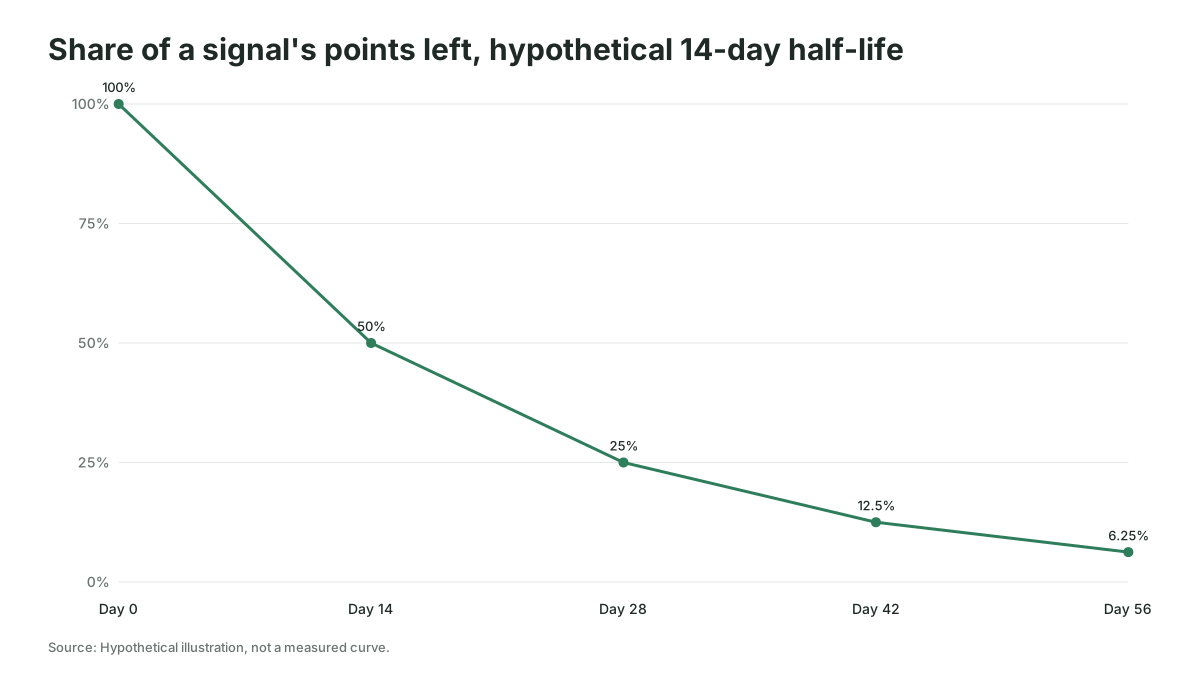
Here is how the tiers form on three hypothetical accounts. Company A had pricing visits 2, 5 and 9 days ago from three different people and a G2 compare signal 4 days ago: about 29.8 points, times 1.6 for breadth, is about 48. Two core-topic surges a week ago plus one documentation visit 20 days ago give Company B about 9 points. Company C was the hottest account on the list six weeks ago, with four pricing visits from two people, but has been silent since; decay and the 1.3 breadth multiplier leave it at about 6.5.
With tier cutoffs at 40 and 15 points, Company A is tier 1, and B and C are tier 3. The cutoffs are the part you calibrate: set them so tier 1 opens opportunities at clearly more than your baseline rate, as described in the section on dropping accounts below.
You can hand the weekly run to an AI assistant with a prompt like this one, attached to exports of web visits by company, G2 or other second-party signals, third-party surges and your CRM account list:
You are scoring B2B intent for a paid media team.
Files: web_visits.csv (company_domain, page_type, visitor_id, date),
g2_signals.csv (company_domain, signal_type, date),
surges.csv (company_domain, topic, score, week),
accounts.csv (company_domain, icp_fit yes/no, open_opportunity yes/no, customer yes/no).

1. Ignore any company with icp_fit = no, customer = yes or open_opportunity = yes.
   List the open-opportunity and customer domains separately as exclusions.
2. Score each remaining company with these points: pricing 10, comparison 8,
   docs or integration 6, surge >= 60 on a core topic 5 per topic per week,
   G2 category 3, ad click 2. Halve each signal's points every 14 days from
   its date to today.
3. Multiply by 1.0, 1.3 or 1.6 for 1, 2 or 3+ distinct visitor_ids.
4. Tier 1 = 40 or more, tier 2 = 15 to 39, tier 3 = under 15.
5. Output a table: domain, score, tier, last week's tier, and the two
   signals that contributed most, with their dates.
6. List every company whose tier changed since last week.
Show the arithmetic for the five highest scores. Do not guess missing values.
Spot-check the five worked scores by hand for the first few weeks.
Predictive intent learns the weights from closed-won and lost accounts
Predictive intent replaces your hand-set weights with weights a model learns from your own history: which combinations of signals, in which time windows, came before an account opened an opportunity.
If your history holds fewer than a few hundred opportunities, a predictive model mostly learns noise, so keep the points table and use your opportunities to test its cutoffs.
The training data is weekly snapshots: for each account and past week, its signals in the previous 7, 30 and 90 days, its breadth, its trend against its own baseline and its firmographics. The label is whether it opened an opportunity in the following 90 days. A logistic regression, or a gradient-boosted tree if you have plenty of data, then learns how much each feature predicts that label. Decay comes out of the same process: if 90-day-old pricing visits predict nothing, the model gives that window close to zero weight, and you no longer have to choose a half-life.
Two rules decide whether the model is honest. Train on earlier periods and test on later ones, never on a random shuffle, because intent drifts with the seasons and your product. And drop every signal recorded after an opportunity was created, since sales-driven visits to the pricing page will otherwise teach the model that pricing visits "predict" opportunities that already existed. Our guide to AI lead scoring explains this kind of leakage and how many closed outcomes a model needs before its weights mean anything.
ABM platforms sell this as a product, and 6sense, as one example of the type, says its Predictive Intelligence is "trained on your own closed-won history and back-tested against your real pipeline every month," with account stages "scored daily from first- and third-party intent, deanonymized traffic, and CRM/MAP activity" (6sense). Build or buy, ask for the back-test on your own pipeline and the inputs behind each score.
Account tiers update LinkedIn and Google audiences on a schedule
Each tier becomes a list in the ad platforms, rebuilt on a fixed schedule, with its own budget and message.
| Tier | Who is in it | Paid treatment | Refresh |
|---|---|---|---|
| Tier 1 | ICP accounts scoring 40 or more | Bottom-funnel offers on LinkedIn (demo, product tour, comparison page) and Customer Match on Google Search where eligible | Weekly |
| Tier 2 | ICP accounts scoring 15 to 39 | Problem-led content and proof, on LinkedIn mainly | Weekly |
| Tier 3 | ICP accounts below 15 | Your always-on awareness program, no extra spend | Monthly |
| Exclusions | Customers, open opportunities, accounts in cool-off | Excluded from all acquisition campaigns | Weekly |
LinkedIn. In Campaign Manager, click Plan, then Audiences, then Create audience, choose Matched Audience, then Company / Contact, and upload the list built on LinkedIn's CSV template (LinkedIn Help). LinkedIn says a list needs "at least 300 rows for a successful upload" and must match at least 300 member accounts before it can run in an active ad set; matching can take up to 48 hours, and an audience expires if no active or draft ad set uses it within 90 days (LinkedIn Help). A tier 1 list of 40 mid-sized companies will often miss that floor, so merge tiers 1 and 2 into one list with separate ads. Updating lists through the API without pausing campaigns needs the streaming method, whose permission, LinkedIn's API documentation says, "belongs to the Audiences program and is not granted automatically as part of the LinkedIn Marketing API Program" (LinkedIn API docs). Our ABM guide explains why replacing a CSV audience through the API can pause campaigns.
Some review-site intent products push segments into LinkedIn directly. G2's documentation, for example, says its segments appear under Plan, then Audiences labeled "Third-party: G2 Crowd," are "updated in LinkedIn every 24 hours," and must contain at least 300 members (G2 documentation).
Google Ads. Google's Customer Match takes contact data, not company names, so a tier becomes a list of the contacts you already hold at those accounts. The upload is under the Tools icon, then Shared library, Audience manager, the "Your data segments" tab, the plus button and Customer list; processing can take up to 48 hours (Google Ads Help). The contacts must have been collected first party, with consent where the law or Google's EU user consent policy requires it, and targeting with Customer Match needs "90 days of Google Ads history and more than USD $50,000 total lifetime spend," while every policy-compliant account can still use lists for observation and exclusions (Google Ads policy).
The tiers also feed retargeting: our guide to stage-based B2B retargeting uses the intent tier as one input to its stage map, and AI audience segmentation covers the seed and exclusion lists that sit beside these tiers.

Drop accounts whose intent never turns into pipeline
An account should leave the paid tiers when it has stayed in tier 1 or 2 for one full sales cycle without an opportunity, measured by your CRM's median days from first signal to opportunity. Without that rule, the same accounts surge every quarter, collect budget every quarter, and never buy, and the list quietly becomes a subscription to other people's research habits.
Move those accounts into a cool-off exclusion for a quarter, and let them re-enter only on a first-party or second-party signal. Then judge the signal sources the same way: every quarter, have the AI count how many accounts each source flagged and how many of them opened an opportunity within 90 days, then compare that rate with your baseline for all ICP accounts. Here is what that review might look like, with hypothetical numbers:
| Signal source | Accounts flagged in the quarter (hypothetical) | Opened an opportunity within 90 days | Rate | Against a 2% baseline |
|---|---|---|---|---|
| Pricing page, 2+ visitors | 60 | 6 | 10% | 5x |
| G2 compare or pricing signal | 45 | 3 | 6.7% | 3.3x |
| Third-party surge, 1 topic | 400 | 9 | 2.3% | About the same |
| Third-party surge, 3+ topics | 90 | 4 | 4.4% | 2.2x |
On numbers like these, the single-topic surge is noise and should drop to zero points, while the three-topic surge keeps a place. Counts of 3 or 4 opportunities swing on one deal, so act only after two quarters agree. The stronger test is a holdout of flagged accounts that see no ads, which our guide to incrementality testing sizes for small B2B audiences.
Intent data tools come in five types
Intent data tools fall into five types by the job they do, and most vendors sell more than one. Name the job before the demo. The examples below are illustrations of each type, in no order, from the vendors' own pages as of November 2026.
| Type | What it does | Example | Ask before buying |
|---|---|---|---|
| Website visitor identification | Matches anonymous visits on your site to companies by IP | HubSpot buyer intent | What share of your visits does it match, and how does it treat home and VPN traffic? |
| Review-site intent | Reports research on a review platform about you and your competitors | G2 Buyer Intent | Which signal types does your plan include? |
| Co-op topic intent | Detects topic surges across a network of publishers | Bombora Company Surge | Which topics are core to you, and how is consent collected on the publisher sites? |
| Predictive account platforms | Combine intent, CRM and web data into a model-driven stage or score | 6sense | Will you show the back-test on our own closed-won and lost accounts? |
| Audience sync | Push tiers from the CRM or a platform into LinkedIn and Google | CRM ad audience sync, G2's LinkedIn integration | Does it stream changes or replace the whole list? |
On a list of a few hundred accounts, website identification plus a weekly AI scoring run may cover most of the job. Third-party data earns its cost when buyers rarely reach your site before talking to sales, which your CRM can tell you before you sign.
Intent data is weakest on accuracy and privacy
No independent audit of B2B intent data accuracy turned up in a search for this guide in November 2026; the accuracy figures in circulation come from vendors. Demandbase, which sells intent data, calls it "probabilistic rather than definitive" (Demandbase). That is the right frame: a signal raises the odds that an account is in market, and your own pipeline is the only place to measure by how much.
Privacy depends on how the data was collected. Bombora describes its co-op as "consent-driven" and says it is designed to meet standards such as GDPR and CCPA, which is the vendor's own description (Bombora). Data taken from ad auctions raises a different question, because, as PPC Land puts it, the auction design "distributes personal data far beyond the winning bidder" (PPC Land). On your own site, IP-based identification still counts as collecting data on visitors; HubSpot's own help page says "you may need to install a cookie consent banner on your own website" (HubSpot).
Ask every provider in writing where the signal comes from, what consent sits behind it, and whether personal data reaches you or only company-level scores, and have your privacy lead sign off before the first list goes live.
Intent scoring works when tier 1 opens opportunities faster than the rest
The test of an intent program is that tier 1 accounts open opportunities at a clearly higher rate, and sooner, than ICP accounts with no intent tier. Check it monthly in the CRM: opportunity rate by tier, median days from tier entry to opportunity, and pipeline created per dollar of paid spend by tier.
If tier 1 converts at about the same rate as tier 3 after a full sales cycle, the scoring is decoration. If tier 1 converts at two or three times the baseline, the scores are steering spend toward accounts that buy, which is the only reason to pay for any of this; our piece on AI demand generation explains how to confirm it with a holdout.
Start with your own pricing page
Export the last 90 days of company-level visits to your pricing and comparison pages, score them with the decaying points table above, and check how many tier 1 accounts already have an opportunity in your CRM. That afternoon tells you whether your first-party signal is worth building on. Turning that check into a weekly AI job, from the scoring through to the audience lists, is the kind of build Scalewell takes on with paid teams.
Frequently asked questions
What is the difference between intent data and engagement data?
Engagement data records how people respond to your own marketing, such as ad clicks, email opens and webinar attendance. Intent data also covers research that happens without any contact with your marketing, such as review-site comparisons and topic reading on other publishers. Engagement is one first-party input to an intent score.
How fresh does B2B intent data need to be?
It needs to be fresh enough to act on within the same buying window. For paid audiences, a weekly refresh is a sensible default, with older signals discounted by decay rather than dropped on a fixed date.
Can you use intent data for Google Ads targeting?
Only through contacts, because Customer Match takes emails, phone numbers and addresses rather than company names, so you upload the contacts you already hold at tier 1 accounts. Accounts below the targeting threshold can still use that list to exclude customers and open opportunities.
Is intent data the same as lead scoring?
No, they score different things. Intent data scores accounts on research behavior, often before anyone fills in a form. Lead scoring scores individual people who have already identified themselves. Run them as separate models, so one keen lead at a poor-fit account doesn't promote the account, and one surging account doesn't inflate a weak lead.
Does third-party intent data work for small target markets?
It works less well in small markets. Surge scores compare each company with its own baseline, so in a niche market a handful of reads can trigger a surge, and many target accounts may be too small to show in publisher data at all. Test the source against your opportunities for two quarters before paying to scale it.