AI attribution for B2B: what it fixes and what it can't
AI attribution makes the credit split fairer, but it can't see untracked touches or prove cause, so B2B teams need three methods for three questions.

AI attribution uses machine learning to split credit for a conversion across the ad clicks, views and visits that came before it, instead of handing everything to the last click. In B2B it makes the credit split fairer, but it still only sees tracked touches, so it can't tell you whether your spend caused the pipeline.
That gap shows up at the worst possible moment. Here's an imagined exchange from a budget review: the CFO asks what would happen to new business if LinkedIn spend were cut by half, and the VP of Marketing opens a dashboard where Google, LinkedIn and the attribution tool each claim most of the same deals. Nobody in the room believes any of the three, and the budget gets set by whoever argues best.
This article is for the marketing leader who has to defend paid media spend. It covers what the AI inside Google, Meta and LinkedIn is actually doing with your credit, where every model runs out of road in a long B2B cycle, and a simple rule for which measurement method answers which budget question. It also covers the jobs where AI genuinely helps, which are mostly less glamorous than the vendor pitches suggest. Those jobs, such as matching CRM opportunities to ad touches, give the team a report the CFO can question, and they are jobs Scalewell takes on for paid teams adopting AI.
AI attribution divides credit among the touches it can see
An AI attribution model looks at the paths of buyers who converted and buyers who didn't, then estimates how much each touchpoint raised the chance of converting. Google describes its own version in exactly those terms: its data-driven attribution compares the paths of customers who convert with those who don't, and uses your conversion data "to calculate the actual contribution of each ad interaction across the conversion path."
That's a real improvement on last click, which gives a deal to whatever the buyer clicked just before filling in a form, often a branded search ad. So the LinkedIn campaign that warmed up the account for four months gets nothing, and the branded keyword that a buyer typed because they already knew your name gets everything.
But notice the limits built into the definition. The model shares out credit among interactions it recorded, using conversions it was told about. Whatever happened off the record, such as a podcast, a peer recommendation in a Slack community or a conversation at an event, gets no credit at all, and its share is handed to whichever tracked touch sat nearby.
Think of it like a referee who's very fair about dividing points among the players on the field and has no idea there's a second team playing on the field next door.
Platform data-driven attribution only sees its own ads
Every major ad platform reports conversions through its own attribution, and each one grades only its own ads. That's the single most important fact to explain to a finance team, because it's why the platform numbers can add up to more than your total pipeline.
Here's where the main platforms stand as of November 2026:
| Platform | Default model | What it can credit | Recent change worth knowing |
|---|---|---|---|
| Google Ads | Data-driven attribution for most conversion actions | Search (including Shopping), YouTube, Display and Demand Gen interactions | First click, linear, time decay and position-based models are no longer supported; only data-driven and last click remain |
| Google Analytics 4 | Data-driven attribution, with last-click options also available | Channels GA4 records on your site, paid and organic | The four rules-based models were removed in November 2023 |
| Meta Ads | Meta's own attribution settings on clicks and views | Meta ad interactions only | On January 12, 2026 the Ads Insights API stopped returning 7-day and 28-day view windows, which Meta's changelog says "will return no data" |
| LinkedIn Ads | Campaign Manager conversion tracking from the Insight Tag or the Conversions API | LinkedIn ad interactions, plus CRM conversions you send through the Conversions API | Imported offline conversions can take "24-48 hours and sometimes up to 1 week" to appear by manual upload, according to LinkedIn |
The Google row is the one to read twice. Its data-driven model is genuinely algorithmic, but it only decides how to split credit among Google ad interactions. It has no view of the LinkedIn ad the same buyer saw last month, so the conversion it credits to a Google search ad was also counted by LinkedIn, and probably by your attribution software too.
None of this makes the platforms dishonest. Each one is answering a narrower question than the one your CFO is asking, and a large part of the platform's answer exists to train its own bidding.
The B2B journey outlasts every attribution window
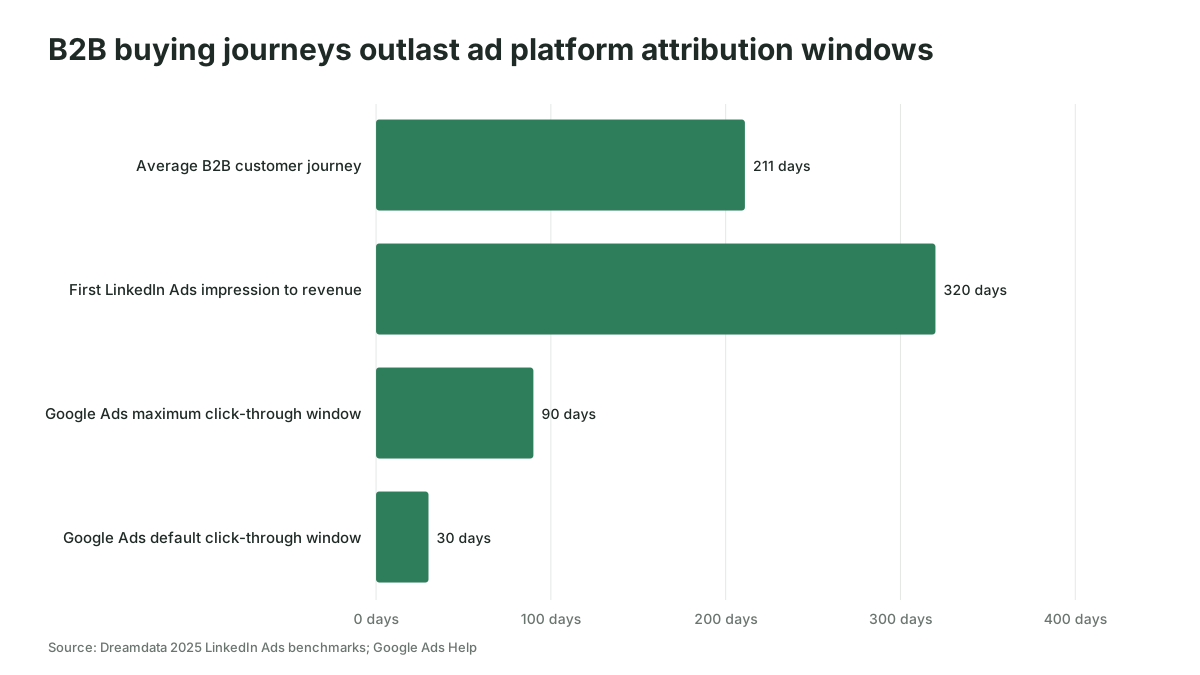
A typical B2B buying journey runs for longer than any ad platform's attribution window can look back. Dreamdata's 2025 LinkedIn Ads benchmarks, built from thousands of deals across hundreds of its B2B customers, put the average customer journey at 211 days and the time from the first LinkedIn Ads impression to revenue at 320 days.
Compare that with the plumbing. Google Ads lets you set a click-through conversion window of 1 to 90 days, with 30 days as the default. So if you optimize to closed revenue, a platform model can only connect a deal to clicks from the last quarter of a journey that often runs past half a year.
Volume is the other wall. Google says every conversion action is eligible for data-driven attribution regardless of volume, but it recommends "at least 200 conversions and 2,000 ad interactions in supported networks within a 30-day period" for the model to perform well. Imagine a B2B team that sets sales opportunities as its conversion and creates 40 a month. The model still runs on that, but it's learning from a small sample, which is why it's tempting to fall back to optimizing on form fills.
And that choice brings its own problem. If the model learns from form fills, it learns to find people who fill in forms, which is a different group from the buying committee that signs a contract. We covered how that plays out in lead quality in AI lead scoring.
Smarter credit splitting still can't prove cause
Credit and cause are different measurements, and the research on that gap is sobering. In a 2019 study in Marketing Science, Brett Gordon, Florian Zettelmeyer and colleagues compared 15 randomized advertising experiments at Facebook, covering 1.6 billion ad impressions, with the answers that observational models gave on the same data. Their conclusion was that the observational methods "often fail to produce the same effects as the randomized experiments, even after conditioning on extensive demographic and behavioral variables."
That matters because every attribution model, however clever, is an observational method. It sees who was exposed and who converted, and it can't see what those same people would have done without the ad. The buyers most likely to see your retargeting ads are the ones already on your site, who were more likely to buy anyway.
So a more sophisticated model can give you a more confident number without giving you a more correct one. A neural network trained on biased paths learns the bias along with everything else.
Self-reported attribution catches what software can't see
Self-reported attribution, the "how did you hear about us?" field on a demo form, captures channels that leave no tracking trail. It's crude, people misremember, and only one person in a buying group answers. It's also the only method that hears about the podcast and the colleague's recommendation.
The best public dataset on how it compares with software comes from HockeyStack, a vendor, which analyzed 8,528 self-reported answers from demo bookers across dozens of B2B brands. Search engines led with 45% of mentions, social media took 20% and word of mouth 18%. When the vendor matched those answers against its own last-touch tracking, "the majority of prospects' last touch and self-reported attribution did not overlap." Its own conclusion was that just asking people how they heard about you "is insufficient alone."
We'd read that as a case for running both and treating the disagreements as the interesting part. When software says direct traffic and the buyer says a podcast, the software is telling you how they arrived and the buyer is telling you why.
This is also the cleanest job for a language model in the whole attribution stack. Free-text answers are messy ("saw u on linkedin + my old boss uses you"), and sorting a quarter's worth by hand is tedious enough that nobody does it. An AI model can sort them into a fixed list in minutes, as long as you give it the list and ask it to flag what doesn't fit:
You are categorizing answers to "How did you hear about us?" from B2B demo requests.
Assign each answer one primary source and, if mentioned, one secondary source.
Use only these sources: Search engine, LinkedIn ads, LinkedIn organic, Other social,
Peer or colleague, Podcast, Event, Review site, AI assistant, Partner, Existing customer, Unclear.
Copy the buyer's words into a "quote" column. Mark "Unclear" rather than guessing.
Return a table: answer_id | primary_source | secondary_source | quote.
Then list any source that appears three or more times but is not on the list.
Run it on a sample of 50 answers first and check every row by hand. If the model is guessing "LinkedIn ads" when the buyer only wrote "LinkedIn", tighten the instruction before you trust it with the rest.
Lift tests and marketing mix modeling answer the budget question
The question a CFO actually asks, which is what you'd lose if you cut a channel, needs a method that compares exposed buyers with unexposed ones. That means an incrementality test or a marketing mix model, and the main ad platforms now offer the first kind themselves.
Google's Conversion Lift splits people into a group that sees your ads and a control group that doesn't, and reports the difference as lift. Its comparison page says the geography-based version can measure online and offline conversions and needs an account representative to set up, with a budget that "tends to be higher than users-based studies." LinkedIn's Conversion Lift Testing works the same way, splitting the target audience into control and test groups at account or campaign level, with the honest caveat that "conclusive results aren't guaranteed."
That caveat is worth taking seriously in B2B. Lift tests need enough conversions in both groups to detect a difference, which is easier with demo requests than with closed deals. A test that comes back inconclusive is still useful, because it tells you the channel's effect is smaller than the test could detect, which is rarely what an attribution dashboard implies.
Marketing mix modeling works at the level of weekly spend and outcomes, so it needs no user tracking at all. It has its own data demands, and we went through them, including whether you have enough history to fit one, in marketing mix modeling with AI.
AI does its most useful attribution work on the data plumbing
The jobs where AI saves a paid team real time are mostly about joining and checking data, rather than about building a cleverer model. Most attribution numbers are wrong because the CRM and the ad platforms never got connected properly, and the model on top inherits that.
Four jobs stand out:
- Sending CRM outcomes back to the platforms. Google's enhanced conversions for leads matches hashed lead details from your form with the deals you import later, so bidding can learn from opportunities instead of form fills. Google's help page notes that from June 15, 2026 these uploads move to the Data Manager API and are blocked in the Google Ads API, so any older script doing this job needs checking. An AI coding assistant can write and test that kind of integration with a marketing ops person, which used to need a developer sprint.
- Reconciling the numbers. An AI client connected to your CRM and ad accounts can pull spend by campaign, match it to opportunities, and show where platform claims and CRM records disagree. Our guides to HubSpot MCP and LinkedIn Ads MCP cover how to set those connections up.
- Sorting self-reported answers, as described above.
- Writing the explanation. A model can turn three disagreeing sources into a one-page note that says what each one measures and where they agree, which is the document the CFO wanted in the first place.
The reconciling step is where the money usually is. One anonymized B2B fintech company spent about $105k on LinkedIn over 90 days. Two of its ads had almost the same cost per lead, but once leads were matched to the CRM, one cost about $90 per opportunity and the other about $380, and the budget moved within a week. A join between two tables found that gap, with no attribution model involved.
Use three methods for three questions
The way out of the dashboard argument is to stop asking one tool to answer every question. Give each method the question it can actually answer, and say so in writing before the next budget review.
| Question | Method | How often | What it's good for |
|---|---|---|---|
| Which ad, keyword or audience should get the next dollar inside a channel? | Platform data-driven attribution, fed with CRM outcomes | Daily, through bidding | Optimization within one platform |
| Which channels and messages show up in won deals? | Multi-touch attribution in your CRM or attribution tool, plus self-reported attribution | Monthly | Direction and storytelling, with known blind spots |
| What happens to pipeline if we cut or grow a channel? | Lift tests on the channel in question, or a marketing mix model across channels | Once or twice a year per major channel | Budget size and the CFO conversation |
To see how this changes a decision, take two hypothetical companies with the same data. Company A sees its attribution tool credit 12% of pipeline to LinkedIn and cuts the budget, and two quarters later its sales team asks why late-stage deals have slowed. Company B sees the same 12%, notices that self-reported answers mention LinkedIn far more often than the tool does, runs a lift test before touching the budget, and makes its call on the result.
Company B spent more effort, but it also walked into the budget review with an answer a finance person could check. That's the real return on measurement, and it ties directly into how you'd frame the ROI of AI in marketing more broadly.
AI attribution software is the wrong buy for some teams
A dedicated AI attribution platform earns its fee when you have long journeys, several paid channels and enough closed deals for patterns to mean something. Some teams don't have those, and they're better off spending the money elsewhere.
Skip it, or wait, if any of these apply:
- You close a few dozen deals a year. No model can find reliable patterns in that sample, and the output will look precise anyway.
- Your CRM is a mess. If opportunities aren't linked to contacts and campaigns, an attribution tool will mostly report "direct" and "unknown" with expensive charts. Fix the data first.
- You need a budget answer this quarter. Attribution software won't tell you what a channel adds. A lift test will, if you have the volume.
- You're mostly running one channel. The platform's own reporting plus CRM matching will tell you most of what a multi-channel model would.
The harder failure is organizational. Teams buy a tool hoping it will end the argument, then each function picks the view that flatters its channel. No software fixes that. Agreeing in advance which method answers which question does, and it costs nothing.
Next steps for your attribution setup
Start by writing down which question each of your current reports answers, then plan one lift test on your largest channel. If you'd like help connecting your CRM, ad platforms and AI tools so those answers agree, that's work Scalewell does with paid media teams.
Frequently asked questions
Is GA4 data-driven attribution the same as AI attribution?
GA4's data-driven model is a machine learning model, so it fits most definitions of AI attribution. It distributes credit for each key event based on that event's data. It only sees channels GA4 can record on your site, though, so ad views on LinkedIn or Meta that never produced a visit don't appear in its paths at all.
Can ChatGPT or Claude do marketing attribution for me?
A general AI assistant can't measure attribution by itself, because it has no access to your journey data unless you connect or upload it. With exports or a connection to your CRM and ad accounts, it can reconcile numbers, sort survey answers and write summaries. It shouldn't be trusted to invent a credit model from a spreadsheet without checks.
How is an AI attribution model different from a rules-based model?
A rules-based model applies a fixed formula, such as all credit to the last click or equal credit to every touch. An AI model learns the split from your converting and non-converting paths, so the weights change with your data. Google and GA4 have dropped most rules-based options, leaving last click as the main alternative.
Does AI attribution work for account-based marketing?
AI attribution works for account-based marketing only if touches are rolled up to the account, not left at the level of individual leads. Several people from one company see ads, visit the site and talk to sales, and a person-level model splits them into separate journeys. Check whether a tool attributes to accounts and opportunities before you buy it.
How long before AI attribution results are reliable?
AI attribution results become usable once the model has seen enough complete journeys, which in B2B means at least one full sales cycle of clean data, often six months or more. Before that, treat the output as directional and compare it with self-reported answers and CRM outcomes rather than moving budget on it.