AI advertising for B2B: what it does at each stage of paid media
AI advertising now works in three layers with different owners, and this hub shows what each one does across strategy, planning, implementation and operations, with links to the detailed guides.

AI advertising is the use of machine learning and generative AI to plan, buy, create, measure and run ads. In B2B paid media it now works in three layers: the ad platforms' own AI, which sets bids and placements, your team's AI tools, which read, draft and check, and the people who decide what a good result is.
You've probably sat in the meeting where this gets confusing. A vendor says its product is "AI-powered", Google says Performance Max is AI, LinkedIn says its campaign automation is AI, and someone on the leadership team asks what your AI advertising plan is. All of them are using the same two letters for very different things, and the budget question underneath stays unanswered: which of these changes pipeline, and who in your team owns it?
This page is the map. It defines the term, splits paid media into four stages (strategy, planning, implementation and operations), and says briefly what AI does well at each one, what it gets wrong and where to read the full guide. It's written for the marketing leader who has to explain the plan upward, and it links down to the detailed articles the paid team will use. Scalewell works with B2B paid teams to use AI across all four stages, from planning the quarter to running the weekly report, so the plan shows up as changes to the team's real week.
AI advertising works in three layers with different owners
AI in advertising covers three different things, and a plan only makes sense once you separate them. The first layer is platform AI: Smart Bidding and Performance Max in Google Ads, Advantage+ in Meta, and the automation in LinkedIn Campaign Manager that LinkedIn sold as Accelerate until August 2026. These systems decide bids, audiences and placements in every auction.
The second layer is your own AI. That means general assistants such as ChatGPT, Claude and Gemini, connected to your ad accounts, CRM and files, plus any agents or scripts your team builds. This layer reads reports, drafts copy and briefs, flags problems and, if you let it, makes changes.
The third layer is people. They choose the conversion the platform optimizes toward, set the budget and the guardrails, approve claims in the creative, and answer to the CFO when the numbers don't add up.
| Layer | What it decides | Who controls it | Main risk in B2B |
|---|---|---|---|
| Platform AI | Bids, audiences, placements, some creative assembly | Google, Meta, LinkedIn | Optimizes hard toward a weak conversion signal |
| Your AI tools | Analysis, drafts, checks, and sometimes changes | Your team | Confident answers built on the wrong definitions |
| People | Goals, budget, guardrails, approvals | Your team | Too few hours left for the work only they can do |
Most confusion in AI advertising comes from mixing the first two layers. When Google reports that advertisers who switched on AI Max for Search saw "14% more conversions or conversion value at a similar CPA/ROAS" in its May 2025 announcement, that's platform AI measured by the platform. It tells you nothing about whether ChatGPT can run your account, and it counts whatever you told Google a conversion is.
Spending on AI is high and the results are still thin
Marketing teams already spend a large share of their budget on AI. Gartner's 2026 CMO Spend Survey of 401 CMOs and other marketing leaders found that 15.3% of marketing budgets go to AI on average, while just 30% felt their organizations had the infrastructure to become AI leaders, as Marketing Dive reported in May 2026. So the money is moving faster than the ability to use it.
Use inside the work is lower than the spending suggests. The CMO Survey's 2026 report, based on 308 US marketing leaders, puts AI at 24.2% of marketing activities, up from 13.1% in 2024. The same report shows where it goes: content creation leads at 73.9% of companies, ahead of content personalization at 65.4%, and programmatic advertising and media buying is the only widely used application that fell, from 35.0% of companies in fall 2023 to 32.4% in 2026.
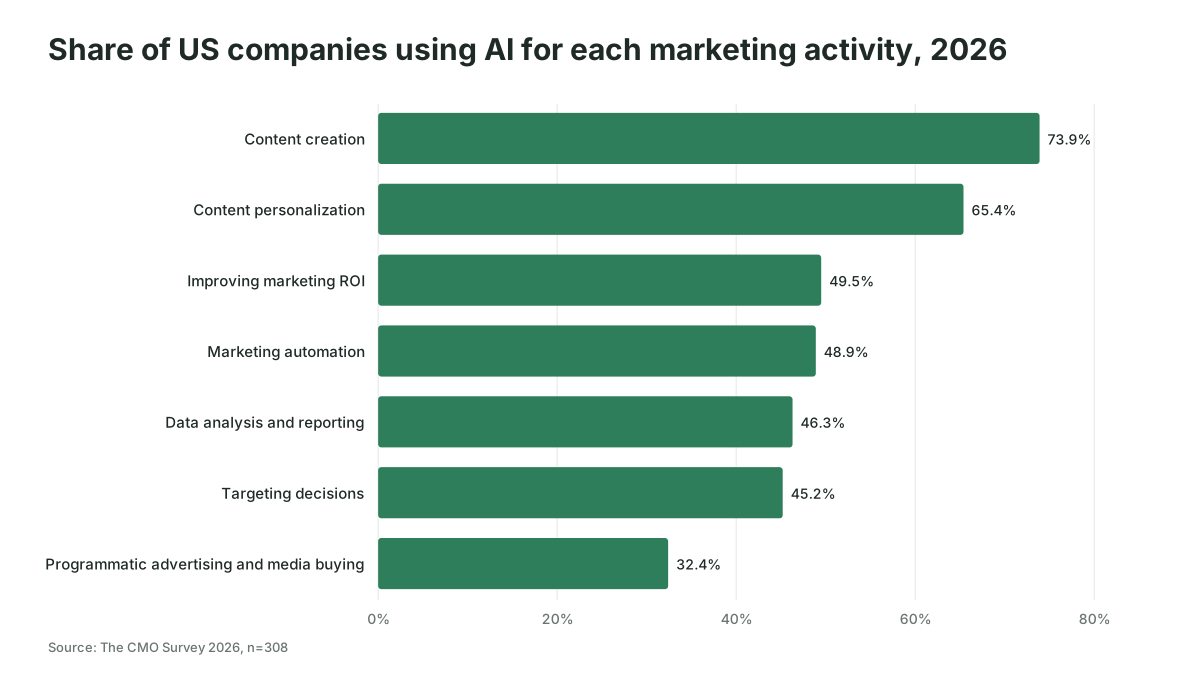
That drop in media buying makes sense once you remember the platforms took the buying over themselves. What's left for a paid team is the work around the auction, which is where the rest of this page spends its time.
Strategy: AI is good at research and poor at choosing the goal
At the strategy stage, AI is most useful for research and least useful for deciding what the paid programme is for. An assistant can summarize a competitor's ad library, tag their messages by offer and audience, and draft a positioning comparison. Competitor ad research with AI walks through that method, including what the public libraries will never tell you about spend.
The goal itself stays with you. Choosing between pipeline, closed revenue and cost per opportunity as the target, deciding how much budget LinkedIn gets against Google, and agreeing what counts as qualified with sales are judgment calls that shape every layer below. A model can lay out the trade-offs neatly. It can't know that your sales team ignores leads under 200 employees unless someone writes that down.
This is also where measurement strategy gets decided, and it matters more for B2B than most AI guides admit. The average B2B customer journey runs about 211 days (Dreamdata, 2025). Any AI that judges ads on this week's clicks is judging a different game. For the strategic frame, start with how to build a paid media strategy, and read what AI changes about B2B attribution before trusting any model's credit split.
Planning: AI drafts the plan and people check the assumptions
AI speeds up media planning by drafting budget splits, forecasts and audience lists from your past data. The quality of that draft depends on what you feed it: last year's spend by channel, cost per opportunity rather than cost per lead, and the deal sizes behind each segment.
The weak point is assumptions nobody states. Ask an assistant for a quarterly plan and it'll happily assume conversion rates it has never seen. A good habit is to make it list every assumption in a separate column, then have a person mark each one as known, estimated or guessed. AI media planning covers the full method, including a plan format to fill.
Here's a hypothetical example of why the inputs matter. Company A asks AI to split $300,000 a quarter using cost per lead, and the plan moves money toward the cheapest form fills. Company B gives it cost per opportunity from the CRM, and the same tool moves money toward the channel sales actually works. Same model, same prompt style, opposite budgets.
Implementation: platform AI buys the media and your inputs steer it
Platform AI now does most of the buying in Google Ads, Meta and LinkedIn, so implementation is mainly about feeding it the right signal. LinkedIn launched Accelerate as "our AI campaign creation and optimization offering" (LinkedIn, June 2024) and retired it as a standalone campaign type in August 2026, keeping the automation inside Classic campaigns (BrandRocket). Meta said in October 2025 that advertisers sending CRM data through its Conversions API with the conversion leads goal saw on average 19% lower cost per quality lead (Meta, 2025).
Read those as the platforms' own claims, because that's what they are. The useful part is the direction they share: each platform's AI gets better when you tell it which leads became pipeline. If you only send form fills, the platform will find you more people who fill in forms, which is a different group from the people who buy. AI performance marketing sets out what each platform automates and which inputs stay with your team.
Creative is the other implementation job, and generative AI has made it fast and risky in equal measure. In a study of more than 2 million daily ad observations, Jochen Hartmann's team found AI-generated images earned higher click-through rates only "if the AI-generated images do not look like AI" (Oxford Internet Institute summary). And in the IAB's January 2026 survey, 82% of ad executives thought young consumers felt positive about AI ads, while only 45% of those consumers did (IAB, 2026). For the B2B view of what works, read AI generated ads for B2B.
Operations: your own AI saves the most hours here
Operations is where a paid team's own AI pays back fastest, because the work is recurring, rule-based and slow by hand. Weekly reports, search term reviews, negative keyword lists, budget pacing checks and audits all follow a method someone could write down, which is exactly what an assistant needs.
Connection is what changed most recently. Google publishes a Google Ads MCP server that lets an AI client query account data. As of November 2026 its developer documentation lists its mode as "Read and partial mutate" with a "configurable read-only mode", and the GitHub README for version 0.0.6, released November 2, 2026, adds tools that create assets and manage labels behind a "Propose & Confirm" step, and those write tools can be switched off. Neither lists a tool that changes bids, budgets or campaign status. Meta's hosted Ads MCP server goes further and can "Create and edit ads, ad sets, and campaigns" (Meta for Developers). As of November 2026 LinkedIn's own MCP server, which reads and writes, is in beta and already in use but not yet publicly documented, and LinkedIn's plugin inside ChatGPT is a read-only beta, so most teams that want more use third-party routes, which the LinkedIn Ads MCP guide compares.
That difference between read and write access is the operational decision a leader actually has to make. We'd start every team on read-only connections, automate the reporting and checks first, and add write access only with a person approving each spend change. Which paid media tasks to automate first gives the order. For search accounts specifically, AI PPC management splits the PPC job between platform, assistant and people, and AI marketing automation covers the hand-offs between paid media and the rest of demand gen.
Where AI advertising goes wrong in B2B
AI advertising fails in B2B most often because the platform optimizes perfectly toward a goal that was never pipeline. A campaign that hits its cost per lead target while sales rejects the leads is the most common version, and it looks like success right up to the quarterly review.
The second failure is trusting vendor numbers as if they were your numbers. Every platform figure on this page comes from the platform that sells the feature, usually with no published sample. Treat them as a reason to run your own test, with a holdout or a before-and-after against CRM outcomes.
The third is buying "agents" that aren't. Gartner predicted in June 2025, as Reuters reported, that more than 40% of agentic AI projects will be canceled by the end of 2027, and estimated that only about 130 of the thousands of vendors selling agentic AI are real (Reuters via The Star). Before you sign, ask what the agent can read, what it can change and who approves the change. Agentic marketing for paid teams has the questions in full.
And some accounts are simply too small. Smart bidding and lookalike-style audiences need conversion volume, and a B2B account with, say, eight opportunities a month gives the platform very little to learn from. In that case your own AI, working on clean CRM data, will do more for you than another automated campaign type.
Measure AI advertising by cost per opportunity
The way to tell whether AI advertising is working is to track cost per opportunity and pipeline per dollar before and after each change, using CRM data rather than platform-reported conversions. Hours saved matter too, but only if those hours go back into work that moves pipeline.
For the full measurement method, read AI marketing ROI.
How Scalewell picks the stage where AI gives your team the most time back
Scalewell helps paid teams decide where in the four stages their own AI should start, so the first job built is the one that frees the most hours. The audit maps your recurring work across strategy, planning, implementation and operations, then scores each job for how soon AI should take it on.
The build sprint puts the top jobs to work as workflows, agents or skills. B2B paid media practitioners build them, in the tools you already use wherever that fits. Every job is weighed on time saved and pipeline, and the usual project is typically 8 to 12 weeks.
Start with one stage and one read-only connection
Pick one stage from this page, usually operations, and connect one assistant read-only to one ad account and your CRM before buying anything else. If you'd like help setting up the method and the AI tools around how your team works, Scalewell does that for paid media teams.
Frequently asked questions
Is AI advertising the same as programmatic advertising?
They overlap, but programmatic is the narrower term. Programmatic advertising is the automated buying of ad space through exchanges and demand-side platforms, and it has used machine learning for years. AI advertising is the broader term: it covers machine learning and generative AI at any step, including research, planning, creative, measurement and reporting, on every channel from Google Search to LinkedIn.
Will AI replace the paid media team?
Not as of November 2026. The platforms already automate bidding and placement, and assistants can take over much of the reporting and checking, but someone still has to choose the goal, send the right conversion data, approve claims in creative and answer for the budget. The job moves toward those decisions and away from manual work.
How do you use AI for B2B marketing on LinkedIn?
Use LinkedIn's own AI for delivery, and stream qualified conversions back through the LinkedIn Conversions API, which accepts types such as qualified lead and sales qualified lead, so delivery learns from pipeline. Use your own assistant to analyze campaign and demographic reports against CRM outcomes, draft ad variants for review and research competitors in LinkedIn's public ad library.
Do AI-generated ads need to be labeled?
Sometimes, depending on the platform and the market. Meta labels ads made or significantly edited with its own generative tools, Google watermarks the images its tools generate with SynthID, and New York has required disclosure of synthetic performers in ads since June 9, 2026. For B2B, avoid AI-generated people and customer quotes altogether.
How much should a B2B team spend on AI tools for advertising?
There's no reliable benchmark for paid teams specifically, because the published budget surveys measure AI across all of marketing, not ad tools alone. Most paid teams can start with business seats on one assistant and read-only connectors, and add paid tools only when a specific job justifies them.