AI generated ads for B2B: what works and what looks cheap
AI-made ads beat human ads only when viewers can't tell, so B2B teams should use AI for variants and sizes and keep people, screens and quotes real.

AI generated ads work in B2B when AI changes how an ad is made and leaves what it shows as real untouched. A field study of more than 2 million ad-days found AI-made display ads out-clicked human-made ones only when viewers couldn't tell. Use AI for copy variants, resizing and backgrounds, and keep customers, screens and quotes real.
You've probably had the meeting already. Someone shows a slide of forty new LinkedIn and Meta ads made in an afternoon, the cost per click looks lovely, and then the CEO forwards one of them with a single line: "Who is this person and why does she have six fingers?" The speed was real, and so was the damage to a brand that sells trust to finance teams.
This article is for the marketing leader deciding how far to let AI into the ad production line. It covers what the research says about performance and disclosure, what each platform labels as of November 2026, which uses hold up in B2B, which ones read as cheap, and a review checklist you can hand to your team. Scalewell helps paid teams use AI to make ads faster while customers, screens and quotes stay real, with review rules short enough that the team actually follows them.
AI ads match human ads on average and win when they don't look like AI
The strongest evidence on AI-generated ad performance comes from a quasi-experimental study by Yannick Exner, Jochen Hartmann, Oded Netzer and Shunyuan Zhang, titled "AI in disguise". They analyzed over 2 million ad-day observations from 7,074 advertisers across 49 product categories, covering more than 16 billion impressions and 116 million clicks, after an ad platform released an AI ad maker in 2023. Their headline finding is that "display ads in which the image was AI-generated outperform ads with human-made images in terms of click-through rates," but only if consumers can't infer that AI generated the images. Across all ads, their regressions found no significant click-through difference between AI-made and human-made images.
The split by perception is where it gets useful. In the paper's own cell averages, AI ads that looked human-made averaged a 0.79% click-through rate, against 0.67% for human-made ads that didn't look AI-made. AI ads that people identified as AI dropped to 0.62%, and human-made ads that looked AI-generated did worst of all at 0.55%.
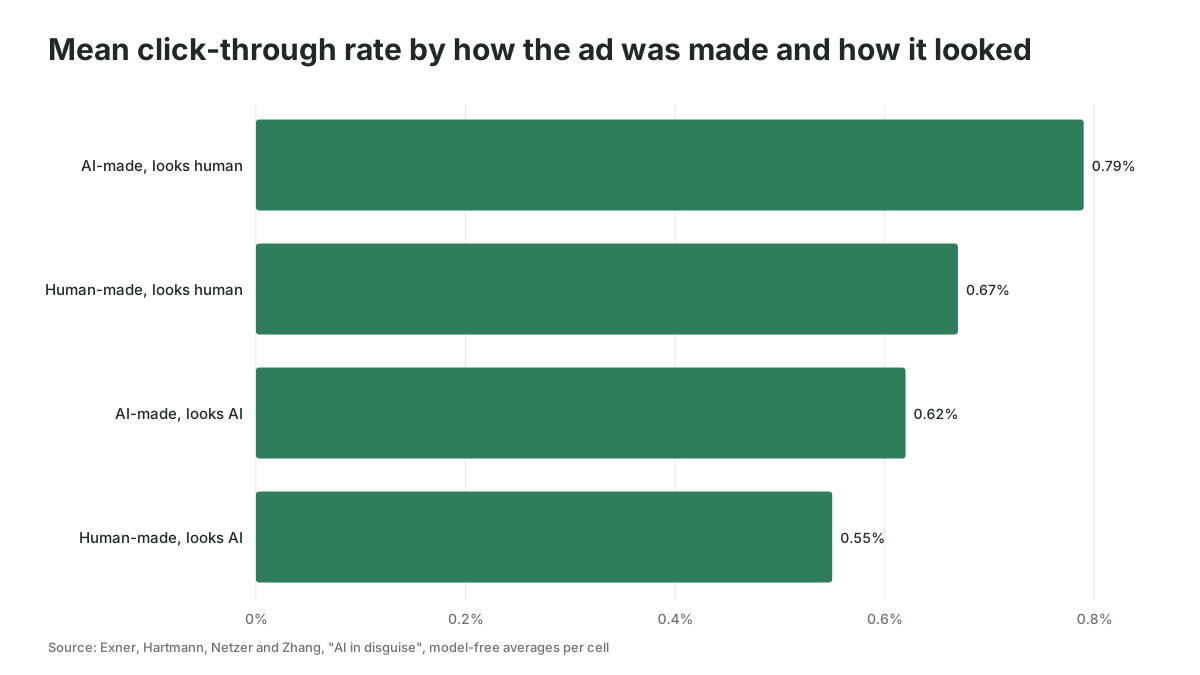
Read that last number twice. The penalty attaches to looking artificial, whoever made the ad, which means your in-house designer's over-polished stock composite can cost you as much as a lazy prompt. The same authors found that intense color saturation signals AI to viewers, while larger faces and more aesthetic images, which AI tends to produce, are things people associate with human work.
Two caveats before you take this to the board. The study measured clicks on display ads across many industries, and click-through rate is a long way from pipeline. We found no published study of AI-generated B2B ads judged on opportunities, so treat any vendor who claims one with suspicion until you see the method.
Viewers notice AI ads more often than advertisers think
Consumer research adds a second warning: the people approving AI ads like them much more than the people seeing them. The IAB's January 2026 study of 505 US Gen Z and Millennial consumers and 104 ad executives found 82% of executives think consumers feel positive about AI ads, against 45% of consumers who actually do. Seventy-one percent of those consumers believe they have seen an ad made with AI, up from 54% in 2024.
So the "nobody will notice" argument is weakening every quarter. Among Gen Z respondents, 30% would call a brand that uses AI in ads "inauthentic", against 13% of Millennials. That gap matters more each year as younger buyers move into B2B roles.
NielsenIQ's December 2024 neuroscience study points the same way. More than 2,000 participants watched low to high quality AI-generated ads, with EEG readings on about 150 of them, and most rated the AI ads as more "annoying," "boring," and "confusing" than traditional ads. Even the ads rated high quality produced weaker memory activation. NIQ sells ad testing, so read it as a vendor study, but the direction matches the click data.
Disclosure labels barely move ad performance
Labeling an ad as AI-made costs much less than looking AI-made, according to the best test available. The AI Labeling Impact Study by MediaScience and the Ehrenberg-Bass Institute, published in June 2026 with 900 US participants, found that "AI disclosure did not negatively impact ad performance across key metrics." Unaided brand recall was 54% in the unlabeled control and 60% to 61% in the text-label groups. The one weak format was a small AI icon, which scored lowest on ad liking at 56% against 63% for the control.
Duane Varan, MediaScience's founder, summed it up as "consumers are accepting of AI if they know." One study of 900 people won't settle the question. For a B2B brand the practical reading is that an honest label is cheap, and getting caught passing off synthetic material as real is expensive.
Sixty percent of the MediaScience participants said disclosure is needed when AI simulates humans, and only 21% when it adjusts coloring and lighting. That gap matches where the platforms and regulators have drawn their lines.
Meta, Google and LinkedIn each label AI ads differently
Every major platform now marks some AI-generated ads, and the rules differ in what triggers a label and where it shows. This is the position as of November 2026, from each platform's own documentation.
| Platform | What gets labeled | Where the viewer sees it | What you have to do |
|---|---|---|---|
| Meta (Facebook, Instagram) | Ads created or significantly edited with Meta's generative AI creative features; in a June 2026 update, Meta said it will also begin detecting third-party AI tools through industry-standard signals | "AI info" inside "About this ad" in the three-dot menu; next to "Sponsored" when the image includes an AI-generated photorealistic human | Political and social issue ads must disclose digitally created or altered content, including from third-party tools |
| Google Ads | Every image generated inside Google Ads carries identification mechanisms, including an invisible SynthID watermark | Depends on the surface and on any label you add | Google says laws in the EU, India, New York, California, South Korea and Vietnam require labels on certain AI ads, and offers an AI label setting |
| Images and videos carrying C2PA Content Credentials | A C2PA icon on single image and video Sponsored Content ads, showing whether AI was used | Only files that carry credentials get the icon, and LinkedIn says it can't yet identify all AI content |
Two details matter more than the rest. Meta moves the label up next to "Sponsored" when an ad contains an AI-generated photorealistic human, which is exactly the use most likely to read as fake. And Google's generator won't make people under 18 or prominent likenesses, and states that "Assets created by generative AI aren't guaranteed to be approved by Ads Policy."
AI earns its keep on volume, sizes and copy angles
AI is most useful in B2B ad production on the work where nothing is invented: more versions of a message you already trust, in more sizes, tested faster. The platforms' own data points here too, with the usual caveat that it is the platforms marking their own homework.
LinkedIn launched Brand Kit, Draft with AI, AI ad variants, Flexible Ad Creation and Ads Personalization in Campaign Manager on July 1, 2026, and its internal analysis says "advertisers who run five or more ad variants see over 20% higher click-through rates." Google reported in February 2024 that advertisers using asset generation in Performance Max were 63% more likely to publish with Good or Excellent Ad Strength, from US English campaigns in January 2024. Notice that neither figure is about pipeline.
Here is where we'd use AI ad creative tools, in rough order of safety:
- Copy angles. Ask for ten headlines that each push a different pain point, then cut to the three a salesperson would say out loud. Our guide to writing RSA copy with AI covers the prompt and review steps.
- Resizing and reformatting. Turning one approved 1:1 design into 4:5, 9:16 and 1.91:1 is the dullest hour in any designer's week, and AI cropping and outpainting do it well when there's no face to distort.
- Backgrounds behind real assets. A real product screenshot or a real customer photo on a generated backdrop keeps the part that has to be true intact.
- Concept roughs. Generated images are fine for showing an agency or designer what you mean before anyone produces the final ad.
- Variant pools for platform testing. Feeding Flexible Ad Creation or Advantage+ creative a pool of approved pieces lets the platform test combinations, which is the kind of volume LinkedIn's five-variant figure describes.
Planning which of those variants to test and how to read the result is its own job, covered in using AI to plan and read creative tests. If you want the variants to start from performance data rather than a blank prompt, the AI creative brief generator piece shows how.
Fake people, fake screens and fake quotes make B2B ads look cheap
AI generated ads look cheap in B2B when they show something as real that isn't: a person, a product, a number or a customer's words. We call this the real-things rule. Anything the viewer would assume is real has to be real, and AI can change everything else.
The usual offenders are easy to spot once you know them:
- Stock-like people. The generated woman in a blazer smiling at a laptop, with skin too smooth and lighting from nowhere. She's the case that moves Meta's AI label up next to "Sponsored", and she tells a CFO your company couldn't find one real customer to photograph.
- Fake product screenshots. A dashboard that doesn't exist, with charts that go up and to the right and text that dissolves into squiggles at full size. A technical buyer will zoom in, and so will a competitor.
- Invented testimonials. The FTC's rule on fake reviews and testimonials, announced in August 2024, covers reviews that "misrepresent that they are by someone who does not exist, such as AI-generated fake reviews," and lets the agency seek civil penalties against knowing violators. A generated "Head of Finance, Fortune 500 company" quote is now a legal problem as well as a credibility one.
- The saturated AI look. Glossy, over-lit, slightly too purple images are what the Exner study found viewers read as AI, so they pay the click penalty whether or not a person made them.
- Generic copy. Lines like "Transform your workflow with powerful insights" are what a model writes when nobody gave it your offer, your proof or your buyer's words.
There's a commercial reason to care beyond taste. B2B buying is a trust purchase, and an ad is often the first evidence a buying committee sees of how careful you are. If you'd fire a designer for faking a client logo, apply the same standard to the model.
Judge AI ads by pipeline, because click-through rate flatters them
Clicks are the metric where AI ads look best, so judge them on the metric where they have to prove themselves: opportunities per dollar. More variants and higher click-through rates can coexist with worse leads, and you only find that out in the CRM.
The two views can sit far apart, because two ads with almost the same cost per lead can differ widely in cost per opportunity. Run AI variants through a CRM match, or you'll end up scaling whichever one is best at attracting students and job seekers.
Imagine two hypothetical teams with the same budget. Company A ships 30 AI variants a month and reports click-through rate. Company B ships 12, half AI-assisted, tags each by angle and asset type, and reports cost per opportunity by tag. By month three Company B knows which angles create pipeline, and Company A knows which images get clicked.
The review checklist for AI-generated ads
Every AI-assisted ad should pass a short human review before it spends money, and the reviewer needs a list rather than a feeling. Here's the one we'd use, written so a coordinator can run it and escalate only the failures.
| Check | Pass when | If it fails |
|---|---|---|
| Real people | Every face is a real, consenting person, or the image has no people | Replace with a real photo or remove the person |
| Real product | Every screen, feature and UI element exists in the shipping product | Use an actual screenshot |
| Real words | Every quote, logo, rating and customer name is real and approved | Remove it; the FTC rule applies |
| Real numbers | Every statistic has a source you could show a journalist | Remove the number or add the source |
| The AI look | No heavy saturation, waxy skin, warped hands, garbled text or impossible lighting | Regenerate or hand to a designer |
| Brand fit | Colors, fonts, logo and tone match your brand kit | Fix in the design tool before export |
| Label | Platform labels are understood and any legally required label is added | Check the market's rules and the platform's AI label setting |
| Offer | The ad states your real offer in your buyer's language | Rewrite the copy from the brief |
| Tracking | The ad carries naming and UTM tags that let you read it by opportunity | Fix before launch |
Keep the review in a person's hands even if an AI agent pre-screens the batch. The reasoning behind that split, and where approval gates belong, is in humans in the loop on ad spend.
AI ad generators don't suit every B2B team
AI generated ads suit teams that already have a clear message and enough budget to test variants, and they suit teams with neither much less. If your positioning isn't settled, forty AI variants will produce forty versions of the confusion.
Small accounts are the other weak spot. A LinkedIn campaign spending a few thousand dollars a month often can't give five variants enough impressions to tell them apart, so the platform's 20% click-through claim never gets a chance to show up. In that case, use AI for copy drafts and resizing, run two or three ads, and spend the saved hours on the landing page.
Regulated industries need the strictest version of the checklist. In fintech, insurance or healthcare, a generated image that implies an outcome or a generated claim about returns can create compliance exposure on top of the brand cost. And the wider question of how generative AI fits across a paid team's work, beyond the ads themselves, is covered in our guide to generative AI in advertising.
Where to start
Pick one live campaign, use AI only for copy angles and resizing, run the checklist on every variant, and compare cost per opportunity against your current ads after a full sales cycle. Scalewell helps paid media teams set up AI creative workflows and the CRM reporting that shows which ads produce pipeline.
Frequently asked questions
Do I have to disclose AI-generated ads in the US?
It depends on the state, the asset and the ad type. Google's help center lists New York and California among places whose rules require labels on certain AI-generated or edited ad assets, the FTC's 2024 rule bans testimonials from people who don't exist, and Meta requires disclosure on political and social issue ads. Check each market with counsel before launch.
Can Meta tell if I used ChatGPT or Midjourney for an ad image?
Meta said in June 2026 that it would begin automatically detecting ads created or edited with third-party AI tools through industry-standard signals, and label them under "AI info". It hasn't published exactly which signals it reads, so assume a third-party AI image may be labeled.
Are AI-generated images allowed in Google Ads?
Google Ads allows AI-generated images and includes its own image generation, usable in Performance Max and other campaign types, which marks every generated image with an invisible SynthID watermark. Generated assets still go through normal ad review, aren't guaranteed approval, and can't depict minors or prominent likenesses.
Which AI ad generator is best for B2B?
There's no single answer, because the generator matters less than the inputs and the review. The built-in tools in LinkedIn Campaign Manager, Google Ads and Meta Ads Manager sit inside each platform's policy and labeling. Standalone tools give more control over the look. Judge any of them by cost per opportunity.
Will AI replace designers for B2B ads?
AI replaces the repetitive part of design work, such as resizing, background swaps and first drafts, and leaves the judgement with people. The Exner study's finding that human-made ads which look artificial perform worst suggests craft still matters. Expect fewer production hours and more time on concepts and review.