AI marketing ROI: how to measure it in a paid media team
Most paid teams measure AI by hours saved, which is why 59% of marketers cannot confidently prove its ROI; here is the three-part sum, with a hypothetical worked example, that a CFO will accept.

AI marketing ROI is the net value an AI set-up adds to a marketing team, divided by what it cost. In a paid team the value has three parts: hours that turned into cut spend or named work, mistakes that never reached the ad account, and a performance lift proven against a holdout. Cost includes set-up, training and review time.
You usually find out your numbers are weak at the budget review, when someone asks what last year's AI spend returned and the honest answer is a feeling that the team moves faster, a few saved screenshots of a good prompt, and a subscription line that has quietly doubled.
This article gives you a way to count it that a CFO will accept, a clearly hypothetical worked example for a five-person paid team, and a plain reading of what the public evidence on the ROI of AI in marketing does and does not support. It is written for the marketing leader who has to defend the line.
Most teams count hours saved, and that is why they cannot prove a return
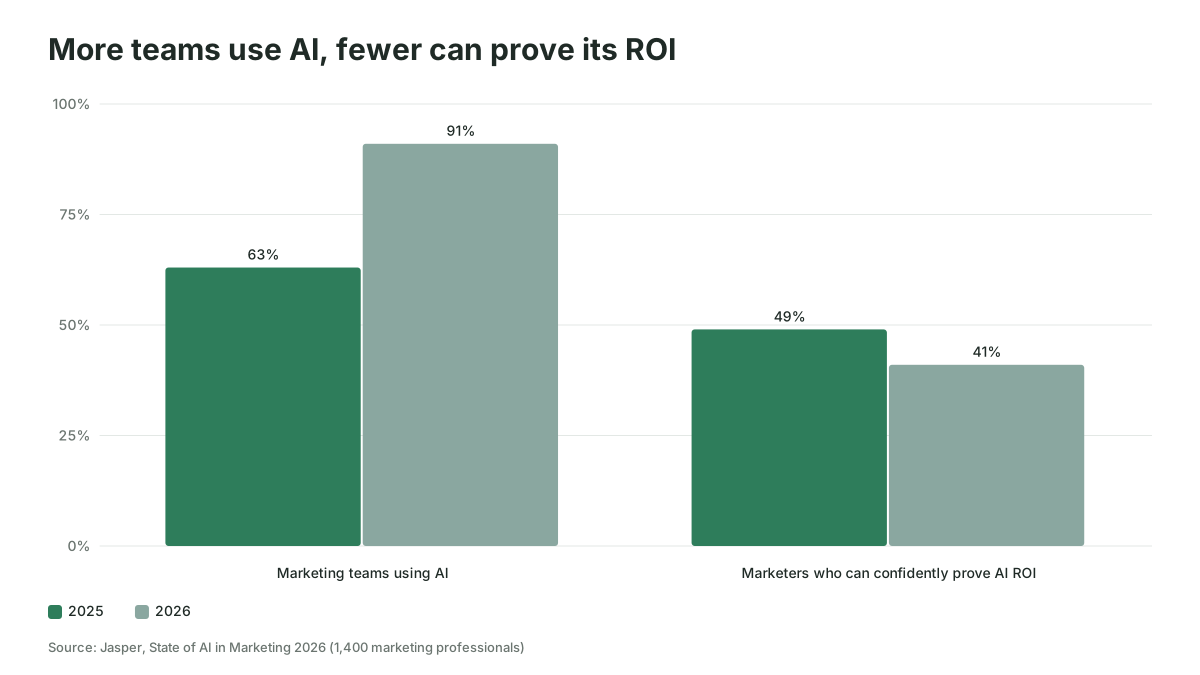
Fewer marketers could prove the ROI of AI in 2026 than a year earlier, even though far more of them were using it. Jasper's State of AI in Marketing 2026, a survey of 1,400 marketing professionals published in January 2026, found 91% of marketing teams using AI, up from 63%, while the share who said they could confidently prove AI ROI fell from 49% to 41%. The same report found 61% of CMOs confident in AI ROI against 12% of individual contributors, so the people doing the work are the least convinced it pays.
Gartner's 2026 CMO Spend Survey of 401 marketing leaders, fielded January to March 2026, found CMOs allocating an average of 15.3% of marketing budgets to AI initiatives, while only 30% said their organizations had mature AI readiness capabilities, as reported by MarTech and Marketing Dive. Spend is rising, proof is falling, and the measurement most teams fall back on is a self-reported estimate of time saved.
Time saved feels like money and mostly is not. If a specialist saves four hours a week and spends them on more of the same campaign hygiene, nothing changed on the P&L, and your CFO knows it. MIT's GenAI Divide report from July 2025 made the same point at enterprise scale, finding that general-purpose tools such as ChatGPT and Copilot "primarily enhance individual productivity, not P&L performance," and that 95% of organizations in its sample were getting no measurable P&L return on $30 to 40 billion of generative AI investment. Its authors added that sales and marketing take the largest share of generative AI budgets because attribution there is easier, a bias toward "easier metric attribution, not actual value." A slide that says "we saved 900 hours" is exactly that bias at work.
AI ROI in marketing is three value lines against one cost line
The return from an AI set-up in a paid team comes from hours, avoided errors and performance lift, and it is paid for by tools, set-up, training and review time. Costs look like the easy part, because invoices exist, though the review hours never appear on one. Each of the three value parts is harder to count than the one before it, and the hardest one is where most of the money is.
We would write the sum like this:
AI ROI = (counted hours value + errors avoided + proven performance lift − total AI cost) ÷ total AI cost
Three rules make it defensible. An hour counts only when it became cut spend or named work, an error counts only when you can point to the specific spend it would have wasted, and a performance lift counts only after a holdout or a before-and-after comparison with everything else held still. Anything that fails those tests goes in a second column labeled "pending," which is a column rather than a zero. Finance respects a pending column far more than an inflated total. Scalewell builds this counting into how a team uses AI from day one, so the hours it gives back and the pipeline it touches show up in numbers finance already trusts.
Measure the hours with a time log before the tool arrives, and discount what people tell you
The hours an AI set-up saves are measured by logging the same tasks before and after it arrives, because an estimate from memory runs high. Before the tool goes in, name the three or four jobs it will touch, such as the search-term review, pacing check and creative brief, and have each person log the minutes those jobs take for two weeks, written down each evening. Repeat the log a quarter after launch. The difference, per person per week, is the only version of "we save four hours" that survives a CFO's first question.
Discount anything that was only estimated. Two studies in the Bureau of Labor Statistics' Monthly Labor Review compared estimated working weeks with time diaries: a 2011 analysis of 2003 to 2007 American Time Use Survey data found estimates 5 to 10% above diary hours, and a 2014 reply found "usual" hours overstated by up to 3.7 hours a week while questions about the previous week came within 0.2 hour. So if you have to ask, ask about last week, never about a typical one. Better still, let a system count: a Microsoft Research field experiment across 66 firms and 7,137 knowledge workers measured with application telemetry and found that the 80% of treated workers who used Copilot spent two fewer hours a week on email, with no detected change in the quantity or mix of their tasks.
Hours only count when they became cut spend or named work
An hour saved is worth its loaded cost only if the hour was removed from the payroll, removed from an agency invoice, or moved to a piece of work you can name and value. That is the rule, and it removes most of the hours from most AI business cases.
Start with the loaded cost, because salary alone undercounts a person by nearly a third. The US Bureau of Labor Statistics' Employer Costs for Employee Compensation release for June 2026 put wages and salaries at 70.0% of private-industry employer costs and benefits at the remaining 30.0%, on an average total of $46.89 per hour worked. For a paid media specialist on a $95,000 salary, dividing by 0.70 gives a loaded cost of about $135,700 a year, or roughly $71 an hour across 1,900 working hours. Use your own payroll numbers if finance will share them.
Then decide what happened to the hours. There are three honest outcomes:
- Cut spend. You reduced agency hours, delayed a hire, or did not renew a contractor. Count the hours at loaded cost or at the invoice that disappeared, whichever is real.
- Named work. The hours went to a specific new job, such as a weekly search-term review that did not happen before. Count them at loaded cost and name the work, because the next question is what that work produced.
- Absorbed. The hours vanished into a less frantic week. Count them at zero and say so; it reads as honest rather than as a gap.
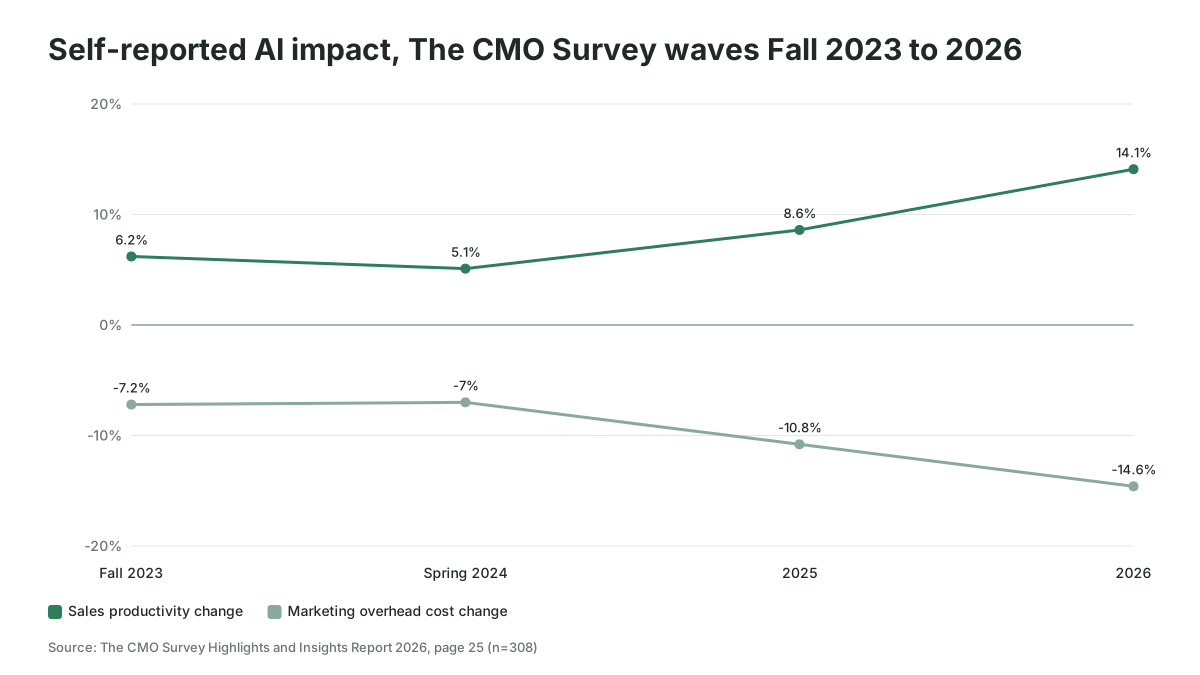
The CMO Survey's 2026 report, fielded in January 2026 across 308 US marketing leaders, 97% of them VP level or above, asked respondents to estimate the improvement AI had produced in their own companies. They reported a 14.1% gain in sales productivity, up from 8.6% in 2025, and a 14.6% reduction in marketing overhead costs, up from 10.8%. Those are self-reported estimates from senior people, so treat them as a ceiling and measure your own before you repeat them.
Errors avoided are real money with no public benchmark
Avoided mistakes are the most CFO-friendly part of the case and the one with the least public data behind it. As of November 2026 we could not find a credible, independently measured figure for how often paid media teams overspend through a broken pacing rule, a mis-set budget or a dead conversion tag, and we would not trust a vendor's number for it either. So you build this part from your own log.
The log itself is easy to keep. Each time an AI check catches something before it costs money, write down the date, what it caught, how much spend was at risk, and how long a person would have taken to notice. A pacing check that flags a campaign running at three times its daily budget on a Friday afternoon is worth the overspend between Friday and Monday, and a check that notices zero conversions on a live account is worth the days of bidding on bad signals it prevented. Ten of those entries over a year is a number finance can audit. We cover the mechanics of that first check in automating PPC budget pacing checks with AI.
Two cautions apply to that log. Value the error at the spend that would have been wasted, not at the total budget it touched. And put the errors the AI itself introduced on the other side of the ledger rather than counting them as zero.
Performance lift goes in the sum only after a holdout
A performance lift is the only part of AI ROI that can be large, and the only part you can get badly wrong by trusting your own impression. The cleanest design in paid media is a holdout: run the AI-assisted process on half the campaigns, or half the accounts, and keep the other half on the old process with the same budget and bidding settings. Two field experiments show why the impression is not enough.
The first is a Harvard Business School working paper on an experiment run with Boston Consulting Group, Navigating the Jagged Technological Frontier, published in September 2023 with 758 consultants. On tasks within the model's reach, consultants using GPT-4 completed 12.2% more tasks, finished them 25.1% faster and produced work rated more than 40% higher in quality. On a task chosen to sit just outside the model's reach, the same consultants were 19 percentage points less likely to produce a correct answer than colleagues working without AI. A paid media team sits on both sides of that frontier: drafting a search-term review is inside, deciding whether a dip in conversion rate is seasonality or a tracking fault is often outside.
The second is METR's randomized study of experienced open-source developers from July 2025. With 16 developers and 246 real tasks, the group allowed to use AI took 19% longer, having predicted a 24% speedup beforehand, and they still believed afterward that AI had sped them up by 20%. METR has since said those results no longer reflect current models, and its February 2026 follow-up found only weak evidence of a speedup. The durable lesson is the perception gap: skilled people misjudge their own AI uplift by tens of percentage points, and if a developer with a stopwatch cannot feel the difference, neither can your paid team.
So you run the holdout and measure opportunities or pipeline from paid rather than clicks, over at least one full sales cycle. If a holdout is impossible, use a before-and-after comparison and write down every other change in the period, because the platforms' own automation is improving your results in the background and will happily take the credit on your behalf.
The cost side is mostly review time, and the subscription is the smallest line
The full cost of an AI set-up is the tool, the usage, the build, the training and the hours people spend checking what it produced, and most business cases list the first one and stop.
Seat prices are public and small. As of November 2026, Anthropic's Claude pricing page lists a Team plan at $20 per seat per month billed annually or $25 billed monthly for a standard seat, for teams of 2 to 150 people, with premium seats at $100 or $125. Usage sits on top of seats: an agent that reads an ad account every day runs up API costs that grow with how much data it reads, so budget for both from the start.
Set-up and training are the lines teams forget, and the survey data suggests why. The CMO Survey's 2026 report found training and development spending down to 3.8% of marketing budgets, while respondents named lack of budget (20.1%) and technology integration and data architecture (19.1%) as the biggest barriers to getting value from marketing technology. A team that buys seats and skips the training is paying for the smallest line and starving the one that decides whether anything works. We go into what that training should cover in AI training for marketing teams.
Review time is the biggest hidden cost. Every output an AI produces for an ad account, from a negative keyword list to a budget change, needs a person to read it before it goes live, and that hour costs the loaded rate. A set-up that saves four hours and costs one hour of checking nets three.
A worked example: a five-person paid team, year one and year two
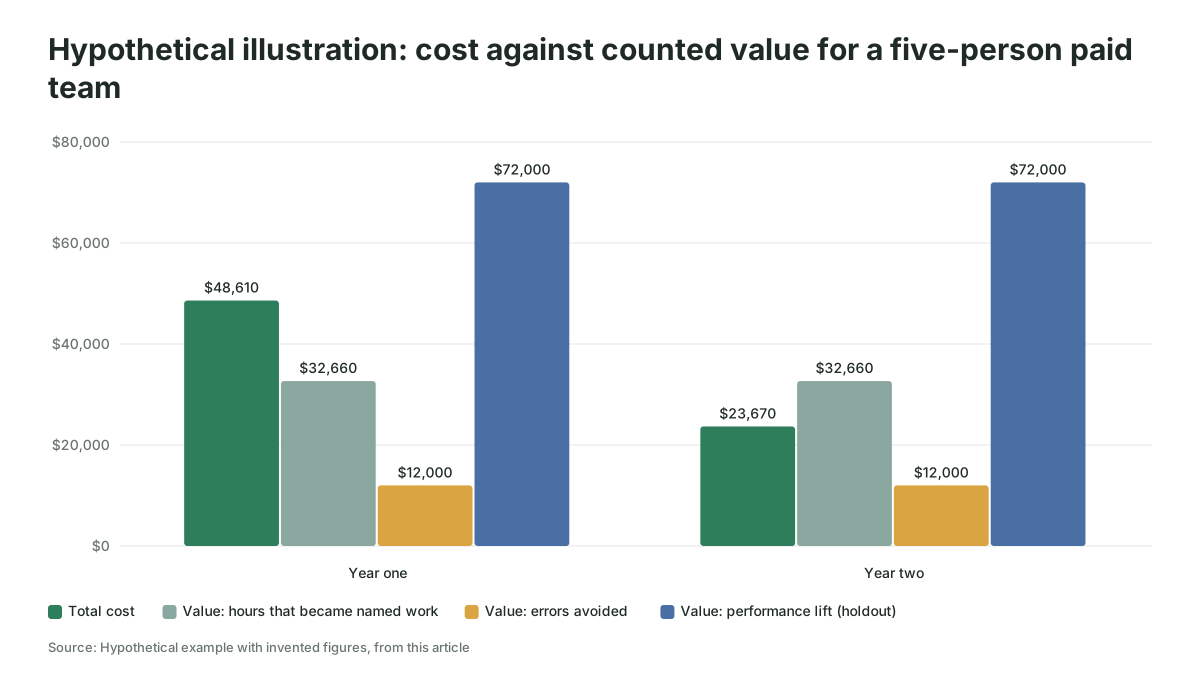
The example below is hypothetical, with invented figures chosen to be plausible for a mid-sized B2B SaaS company. Imagine a paid team of a head of paid media and four specialists, spending $1.5 million a year across Google Ads, LinkedIn Ads and Meta Ads, producing about 480 sales opportunities a year at a 25% win rate and a $30,000 average contract value. In year one they set up an AI assistant connected to the ad accounts for weekly search-term reviews, pacing checks and creative briefs, with outside help on the build. The four hours a week in the value table are the gap between two such logs: about six hours a week per person on those three jobs before the build, and about two a quarter later. Asked beforehand to guess the saving, the team had said six hours.
The inputs, using the loaded-cost method above with a $95,000 salary and a $71 hourly rate:
| Line | How it is counted | Year one | Year two |
|---|---|---|---|
| Seats | 5 standard seats at $25 a month | $1,500 | $1,500 |
| Usage | API calls for daily account reads (estimate) | $3,000 | $3,000 |
| Set-up | 100 internal hours at $71 plus $15,000 outside build | $22,100 | $0 |
| Training | 5 people, 16 hours each, at $71 | $5,680 | $0 |
| Review time | 1 hour a week per person, 46 weeks, at $71 | $16,330 | $16,330 |
| Maintenance | 40 hours a year at $71 | $0 | $2,840 |
| Total cost | $48,610 | $23,670 |
The value side, applying the three counting rules:
| Line | How it is counted | Value |
|---|---|---|
| Hours, named work | Each person saves 4 hours a week for 46 weeks (920 hours). Half went to a new weekly search-term review and a doubled creative test cadence: 460 hours at $71 | $32,660 |
| Hours, absorbed | The other 460 hours went into quieter weeks | $0 |
| Errors avoided | Logged catches over the year: a weekend overspend and a broken conversion tag found ten days earlier | $12,000 |
| Performance lift | Holdout on half the campaigns: 5% more opportunities on the test half (12 of 240). At a 25% win rate that is 3 deals, $90,000 in revenue, $72,000 at 80% gross margin | $72,000 |
| Total value | $116,660 |
With the performance lift proven, year one returns about 140% ($116,660 minus $48,610, divided by $48,610) and year two about 393%, because the set-up and training costs do not repeat. Without the performance lift, year one is roughly minus 8%, because $44,660 of counted hours and avoided errors does not cover $48,610 of cost, and year two is about 89%.
In this example, hours and avoided errors on their own roughly break even in the first year and pay modestly after that, and we would expect most real set-ups to land somewhere near that. The performance lift is where the return lives, and it is the one figure that the 59% of marketers who told Jasper they could not confidently prove AI ROI have almost certainly never measured. Build the holdout into the set-up from day one, or accept that your business case rests on the two smaller lines.
Where measuring AI ROI goes wrong
Most AI ROI cases fail on the counting rather than on the AI. These are the mistakes we would check for before any number reaches a board slide.
Counting the lift in the wrong currency. A 20% rise in leads from a cheaper source can be a fall in pipeline, so measure opportunities from the CRM and give sales the same report you give finance.
Ignoring the work outside the frontier. The jagged-frontier study's 19-point drop in accuracy on the wrong kind of task is the cost of letting an assistant make judgment calls it cannot make. Keep budget changes, bid-strategy switches and anything that touches live spend behind a human approval, and put the review hours in the cost column where they belong. Which paid media tasks to automate first is our view on where that line sits.
Measuring too early. A B2B sales cycle that runs for months means a creative lift in Q1 shows up as closed revenue in Q3 at the earliest. Report opportunities as the early signal, label revenue as pending, and set the review date for after the cycle closes.
Report three lines to the CFO: cash, capacity and lift pending
A CFO will accept an AI ROI report that separates cash effects from capacity effects and labels the lift as proven or pending. Give them three lines instead of one number.
The cash line holds the cut spend, the avoided errors with their log, and the full cost including review hours; it is small, auditable and usually positive by year two. Capacity holds the named-work hours at loaded cost with the work they went into, plus the absorbed hours at zero so nobody wonders where they went. Lift holds the holdout result with its design, sample and sales-cycle date, marked "proven" once the cycle has closed and "pending" until then.
Written that way, a weak year one reads as a plan rather than a failure, and when the holdout comes back, the lift line is the one slide in the budget review that nobody else in the room can produce. For the wider picture of what other teams report against what they actually do, see AI adoption in marketing.
How Scalewell makes the CFO conversation about AI easier
Scalewell helps paid teams build AI jobs that show up in the three lines above, so the next budget review has cash, capacity and lift to point at. Every job is judged on time saved and pipeline from day one. After a free call of 30 minutes, an audit of your recurring work points to the job AI should take on first.
The roadmap and build sprint follow, typically 8 to 12 weeks in all. The team finishes with AI doing real jobs, a list of the next ones and the skills to run them alone.
Where to start this week
Pick one workflow, write down its baseline this week, and decide now which half of the account will be the holdout. If you would like help designing the measurement alongside the set-up itself, that is the kind of work Scalewell does with paid teams.
Frequently asked questions
What is a good ROI for AI in marketing?
There is no reliable public benchmark. Jasper's 2026 survey found 60% of marketers who track AI ROI report at least a 2x return, but that is self-reported and covers only those who track it, a group Jasper does not size. A credible target for a paid team is a cash-positive year two with a holdout-proven performance lift.
How long does it take to see ROI from AI in a paid media team?
Hours and avoided errors show up within a quarter, but in a set-up like the worked example above they roughly cover year-one set-up and training costs rather than beat them. A performance lift takes at least one full sales cycle to prove, so for most B2B teams the lift line stays pending for six to twelve months.
Does time saved count as AI marketing ROI?
Only when the time became something else. Count hours that reduced agency or contractor spend, delayed a hire, or went into named work with its own result. Hours that were simply absorbed into a calmer week are a real benefit for the team but should be reported at zero value, with the gross hours shown separately as capacity.
Which costs belong in an AI ROI calculation?
Seats, API or usage fees, the internal and external hours spent on set-up and integration, training time at loaded cost, ongoing maintenance, and the hours people spend reviewing AI output before it goes live. In the worked example review time is the largest recurring line, and it is the one business cases most readily leave out.