AI PPC management: how AI fits into each part of the PPC job in 2026
A task-by-task map of the PPC job in 2026, showing what Google's and LinkedIn's AI already run, what your own AI should take on, and what stays with a person.

AI PPC management means splitting the paid search job between three owners. The ad platforms' AI sets bids, matches queries and picks placements in every auction. Your own AI, such as ChatGPT or Claude connected to your account data, reads, drafts and checks the work around it. People keep the inputs, the budget limits and the final calls.
You've probably had the message already. Someone senior forwards an agency pitch that says "fully AI-powered PPC" and asks, quite reasonably, why your team still spends Monday morning in spreadsheets. It's an awkward question, because the honest answer is that some of the job has been automated for years, some of it could be automated this quarter, and some of it shouldn't be automated at all.
This guide is for the head of paid media or the PPC lead who runs the accounts. It maps the whole job, task by task, to whoever should own it in November 2026, covers how AI is used in PPC today, how to start using it and what it's good for, and points to the detailed guide for each task.
AI PPC management splits the job between three owners
The PPC job divides cleanly once you ask one question of each task: is it decided inside a single auction, is it reading and writing about account data, or does a mistake change what you spend or what the platform learns? The first belongs to the platform, the second to your own AI with a person reviewing, and the third to a person.
| Part of the job | Platform AI | Your own AI | People |
|---|---|---|---|
| Bids per auction | Smart Bidding sets them | Explains changes in the results | Chooses the strategy and targets |
| Query matching | Broad match, AI Max, Performance Max | Reviews search terms, drafts negatives | Approves exclusions |
| Budget | Spends within the daily budget | Checks pacing, flags drift | Sets ceilings and moves money |
| Ad copy | Generates assets if you allow it | Drafts headlines and variants | Approves anything that goes live |
| Audiences | Expands targeting from signals | Summarizes who converted | Defines the ICP and exclusions |
| Conversions | Optimizes to whatever you send | Audits tracking for gaps | Decides what counts as a conversion |
| Reporting | Channel and asset reports | Assembles the weekly report | Explains it to leadership |
| Audits | Recommendations and optimization score | Runs a checklist across accounts | Decides which findings to act on |
| Account structure | Suggests consolidation | Models the options | Makes the call |
The table looks tidy, and real accounts aren't. But it settles most of the arguments in a team meeting, because it moves the conversation from "should we use AI" to "which owner gets this task". Once each task has an owner, Scalewell helps paid teams put the AI share of it to work, so weekly account jobs run on time and people spend their hours on judgment calls.
Google's AI already sets your bids and matches your queries
Google Ads Smart Bidding uses Google AI to optimize for conversions or conversion value in every auction, a feature Google calls auction-time bidding, according to Google Ads Help. Its list of bidding signals includes device, physical location, location intent, time of day, remarketing lists, browser, operating system and the actual search query.
That list is the reason you can't out-bid the system by hand. You see a campaign average the next morning, while Smart Bidding sees each query as it happens. So the work moved somewhere else: to the targets you set and the conversions you feed it.
Query matching went the same way. AI Max for Search, announced in May 2025, adds search term matching through broad match and "keywordless technology", text customization and final URL expansion to existing Search campaigns. Google says advertisers who switch it on "will typically see 14% more conversions or conversion value at a similar CPA/ROAS", rising to 27% for campaigns still running mostly on exact and phrase match. Both figures come from Google's internal 2025 data on non-retail advertisers, so treat them as the vendor's claim and test it in your own account. We cover that test in AI Max for Search: what changes and how to test it.
Performance Max became easier to supervise in 2025. Google's help page on Performance Max visibility and control says you can now "access search terms reporting for all Performance Max campaigns and through the API" and add campaign-level negative keywords, which apply to Search and Shopping inventory, as well as negative keyword lists. That matters for the desk-work layer, because a report your AI can read is a report your AI can review.
Google is also building its own assistant. Ads Advisor, a Gemini-based agent, was introduced in May 2025 and reached all English-language accounts by December 2025, and, per PPC Land's coverage, "required advertiser approval before implementing account changes". At Google Marketing Live on May 20, 2026, Google folded it into Ask Advisor, an agent that spans Google Ads, Google Analytics, Display & Video 360 and, soon, Merchant Center, and was in beta for English-language accounts at the time of that report.
LinkedIn's campaign automation does the same job for B2B audiences
LinkedIn Accelerate was the AI campaign creation and optimization mode in Campaign Manager until August 2026, when LinkedIn retired it as a standalone campaign type and kept its automation inside Classic campaigns, as BrandRocket reported from LinkedIn's help center. At its June 2024 launch, LinkedIn claimed a 52% lower cost per action than Classic campaigns.
Read the metric before you read the number. A "cost per action" is whatever conversion you told LinkedIn to count, which in most B2B accounts is a form fill. If that form fill is a student downloading your ebook, the automation will find you many more students, cheaply and with great enthusiasm.
This is where the human layer earns its salary. Two ads with the same cost per lead can produce very different numbers of opportunities, and neither LinkedIn's AI nor Google's can tell them apart, because neither can see the opportunities. Google offers a route for that data: enhanced conversions for leads imports CRM outcomes matched on hashed customer details. Google's page says these uploads were set to move to the Data Manager API and be blocked in the Google Ads API starting June 15, 2026, so check which route your integration uses.
Your own AI does the desk work around the platforms
AI is used in PPC by practitioners mainly for writing and research so far. The Global State of PPC 2026 survey of 1,306 PPC professionals by PPCsurvey.com, fielded in late 2025, found that 59% use AI for ad copy and 39% each for keyword research and for emails and proposals, while 22% are vibe coding custom tools and scripts and 21% actively use AI agents, according to PPC Chief's summary of the report.
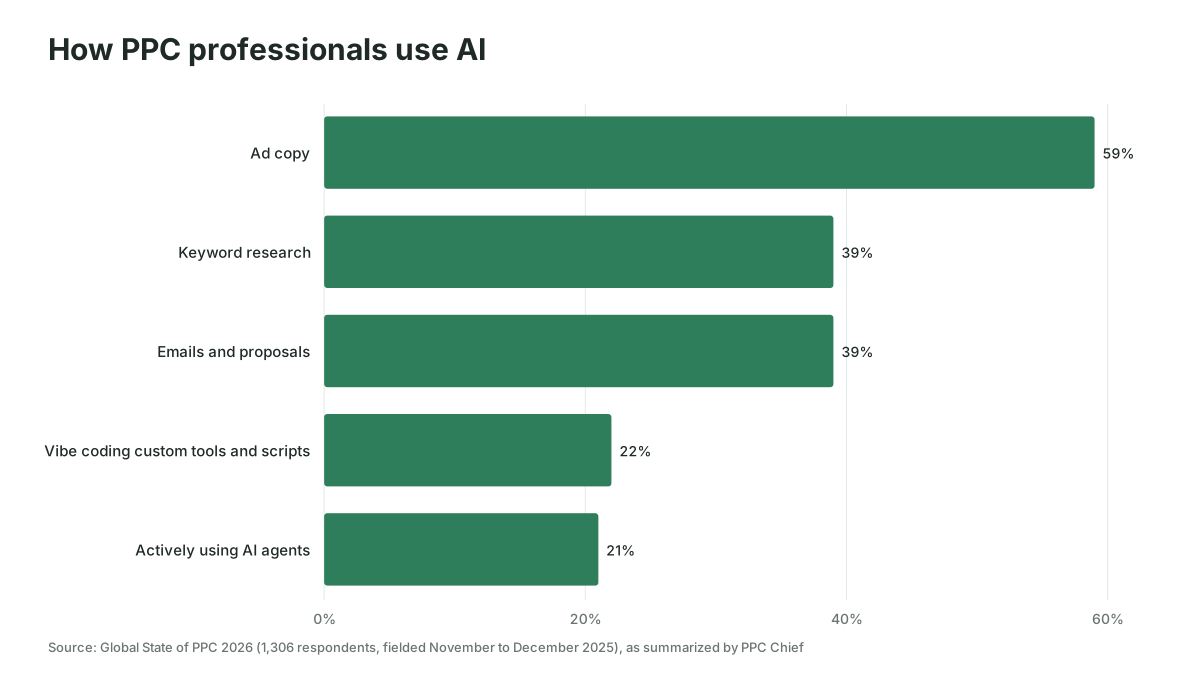
The same summary puts the average time saved at 5.2 hours a week. That's useful and nowhere near "AI runs the account", and it tells you where the remaining hours are: in the reviewing, checking and explaining that most teams haven't handed over yet.
Those are the tasks your own AI does well, because each one is reading a lot of account data and writing something a person can check:
- Search term review. An AI that knows your ICP and your exclusion rules can read every search term in a week, group the irrelevant ones and draft negatives for you to approve. The full method is in our guide to negative keywords in Google Ads.
- Audits. The same checklist run across every account every month, instead of the one account someone remembered. See the PPC audit guide for the checks and the prompts.
- Reporting. Pulling the numbers, writing the first draft of the commentary, and flagging what changed. The PPC reporting guide covers the structure.
- Copy drafts. Headline and description variants written against your messaging, for a person to cut down.
- Pacing and anomaly checks. A daily read of spend against plan that only speaks up when something drifts.
To do any of this on live data rather than pasted exports, the AI needs a connection to the account. As of November 2026, Google publishes an open-source Google Ads MCP server that lets an MCP client such as Claude query an account with GAQL through its search tool. Google's developer page now describes it as "Read and partial mutate" with a "configurable read-only mode", and the README for version 0.0.6, released November 2, 2026, adds write tools limited to creating assets and managing labels. They run a "Propose & Confirm" step that needs a checksum from an approved preview before anything changes, and they can be switched off for a read-only set-up. The routes and set-up steps are in our Google Ads MCP guide.
Using AI for PPC starts with one read-only task this week
Start with one recurring task that is read-only, repeats in the same shape every week and costs little when the AI gets it wrong. Search term review usually fits all three. Then work through these steps.
- List your recurring tasks with the hours each takes. A week of honest notes beats a vendor's estimate, and it gives you a baseline to measure against later.
- Pick the first task by the cost of a mistake. A bad draft negative that a person rejects costs a minute. A bad budget move costs real money, so it waits.
- Write down the context a new hire would need. That means your ICP, the terms you always exclude, what counts as a conversion and how you name campaigns. Save it as a reusable instruction file or project, so you never paste it again.
- Run the task with AI and a named reviewer. The AI drafts, a person approves, and nothing reaches the account without that approval.
- Compare after four weeks. Check the hours spent against your baseline and count the errors the reviewer caught. If both look good, the task stays automated.
- Add the next task. Reports and audits usually come next, and changes to bids and budgets come last, if at all.
It's slower than the pitch decks promise. It's also the order that survives the first time the AI gets something confidently wrong.
The benefits of AI for PPC are coverage and speed
The main benefit of AI for PPC is coverage: work that used to be sampled gets done in full. In a hypothetical account with 20,000 search terms a month, a person reviews the top 200 because there are only so many hours, while an AI can read all 20,000 and bring back the 40 worth discussing. The same goes for auditing every account instead of the biggest one.
Speed is the second benefit. The weekly report starts as a finished draft that someone corrects, instead of a blank spreadsheet, and the hours that frees go to the work that moves pipeline, such as the conversation with sales about which leads turned into deals.
What AI doesn't bring is judgement about your business. Optmyzr's CEO Frederick Vallaeys put it this way in a quote on Optmyzr's blog: "The systems are smart, but they aren't strategic." So the benefit only shows up in revenue if a person decides what the systems should aim at.
In B2B PPC management, people keep the inputs, the limits and the final calls
The human part of AI PPC management is everything that changes what the platform learns or how much you spend. These tasks stay with a person, whatever the tools promise:
- Conversion definitions. Smart Bidding and LinkedIn's automation optimize to whatever you count. Counting form fills when you want opportunities trains both to find cheap leads.
- Budget ceilings and reallocation. AI can recommend a move, and a person makes it.
- Auto-applied recommendations. Platform recommendations are written by the platform, which also sells the clicks. Review them like any other supplier's suggestion.
- Brand, legal and final creative sign-off. Generated copy goes live only after someone who knows the product reads it.
- Strategy and the conversation with sales. Which accounts matter, which deals are worth chasing, and what the CFO hears about it.
We'd add one more: a person owns the numbers in any report. An AI summary that misreads a column will state the wrong figure in perfect prose, and your leadership team won't know the difference until the quarter closes.
AI in PPC goes wrong in four predictable ways
The most common failure is automating on top of bad conversion data. If the platform is optimizing to raw leads, every layer of AI above it speeds up the same mistake. Fix the conversion signal before you add anything else.
The second is low volume. An account with only a few dozen real conversions a month gives automated bidding little to learn from, and in an account like that the desk-work layer usually pays off sooner than the bidding layer, and we'd spend the effort there first. Count qualified opportunities rather than form fills, and a B2B Google Ads account can fall into that group quickly.
The third is letting an assistant act without a reviewer. Google's Ads Advisor asked for approval before changing an account, and your connected tools should too. Read-only first is the rule.
The fourth is buying "AI-powered" as a label, when the tool behind it may be little more than a rules engine with a chat box. Ask any vendor what the AI decides, what data it sees and what it can change, and expect a specific answer.
Where to go from here
Pick the one recurring task that costs your team the most hours, hand it to AI with a named reviewer, and measure it for four weeks before adding the next. If you'd like help setting up that method around how your team works, Scalewell builds the agents, skills and checks with you.
Frequently asked questions
Will AI replace PPC managers?
AI is changing what PPC managers spend their time on more than removing the role. In the Global State of PPC 2026 survey, 27% of respondents expected AI to hurt PPC hiring, and 20% of clients planned to replace some agency work with AI. We'd expect assembly work such as reports to shrink first, while setting conversion goals and budgets stays with people.
Can ChatGPT or Claude manage my Google Ads account?
ChatGPT or Claude can analyze a Google Ads account and draft changes, but a person should still approve anything that touches bids or budgets. The simplest start is pasting or uploading a downloaded search terms or campaign report, which needs no set-up at all. A live connection comes later, and even Google's own MCP server only writes assets and labels.
Is AI PPC management worth it for a small account?
AI PPC management pays back mostly in hours, so it's worth it once someone spends several hours a week on repeated tasks such as search term review or reporting. A single small campaign rarely clears that bar. Start with a general AI assistant and a written checklist before buying any dedicated tool, and measure the hours saved after a month.
How do I know whether AI improved my PPC results?
Measure AI in PPC on two things: hours saved on the tasks you handed over, and changes in cost per qualified opportunity in your CRM. Compare four weeks before and after, and keep a control where you can, such as one campaign without the change. A lower cost per lead on its own proves little in B2B.
Should I let Google auto-apply its recommendations?
Turn off auto-apply for any recommendation that changes budgets, bidding or keyword match types, and review those by hand each week. Low-risk ones, such as adding missing assets, are easier to accept after a review. Google's recommendations aim to improve performance by the platform's measure, so judge each one against your own conversion data and budget.