How to build a paid media strategy when AI does half the work
How to build a paid media strategy when AI drafts the plans and reports: the four foundations, six steps in order, the decisions only a person should make, and the ways it goes wrong.

A paid media strategy is the set of decisions that say where your ad budget goes, what it has to return, and how you will know. When AI does the research, drafting and reporting, the strategy becomes the decisions you keep: who you sell to, your ceiling per opportunity, each channel's job, and what counts as success.
You usually find out whether you have one at the budget review. The CFO asks what paid media returned last quarter, and the honest answer is a cost per lead by channel, a remark that LinkedIn seems to be working, and a request to hold the budget flat. That is a media plan read aloud, and it leaves the CFO's question where it was.
This guide is for the marketing leader who owns that answer, in a team that already uses AI for parts of the work. It covers what to have in place first, six steps in order, where AI does the work in each step and where a person decides, and the ways this goes wrong. A PPC strategy, the plan for one channel, sits inside it, so we start with that distinction.
A paid media strategy decides more than a PPC strategy does
A paid media strategy covers every channel you pay for and the decisions above them: the customer you target, the pipeline target, the budget ceiling, the role each channel plays and how the whole program is measured. A PPC strategy is the plan for one channel, usually paid search, and it answers narrower questions about keywords, match types, bids and campaign structure.
The two get confused in exactly the place it costs most. A team can have a tidy Google Ads account, a falling cost per lead and a strong PPC strategy, and still have no answer to whether paid media as a whole produces qualified pipeline at a price the business can afford. Paid media planning, the exercise of putting budget, channels and timing into a document, is the output of the strategy, and most guides start at the plan.
Our test for which one you have: if every item in the document could be changed by a platform's automation or an AI tool without anyone noticing, it is a plan. The strategy is the part only a person can change. Scalewell helps marketing leaders hand the planning work to AI where it fits, so the people on the team spend their hours on the strategy only they can change.
Four things to have in place before you plan a dollar
Before you plan spend you need a named customer, a definition of a qualified opportunity that lives in the CRM, a ceiling on what one opportunity may cost, and a way for closed outcomes to flow back to each ad platform. Without those four, every later step runs on leads, and leads are the wrong unit for a strategy.
A named customer. Write the ideal customer profile as a list of facts you can check, such as industry, headcount band and region, and turn it into a Total Addressable List of accounts. AI is good at the drafting here: give an assistant your closed-won list from the last two years and ask it to describe what those companies have in common, then correct it. Who is in and who is out stays with you and sales.
A CRM definition of qualified. Agree with sales on the stage that counts as an opportunity and on who may move a record into it. Every later calculation uses this number, so the definition has to hold still for at least a year.
A ceiling per opportunity. Work back from what the business can afford to pay for a customer. The worked example in step 1 shows the arithmetic.
Outcomes flowing back to the platforms. Each major platform documents a route for sending CRM outcomes back so that its bidding learns from opportunities rather than form fills, and each route has conditions you should know before you promise the CFO anything.
| Platform | The route, as documented in November 2026 | Conditions that matter |
|---|---|---|
| Google Ads | Enhanced conversions for leads, which Google describes as "an upgraded version of offline conversion import that uses user-provided data". Uploads moved to the Data Manager API from June 15, 2026, and the old Google Ads API upload call now fails for any integration that was not already uploading before that date, so a team setting this up today has one route. | Keep sending the GCLID alongside the hashed email; Google says to include it "whenever possible". |
| Meta | The Conversions API for CRM integration, which sends lead stages from your CRM back to Meta for the Conversion Leads performance goal. | As of November 2026 the performance goal only works with Lead Ads (Instant Forms), not website forms. Meta's documentation gives three guidelines for a good fit: at least 200 leads a month, the stage reached within 28 days of the lead, and a lead-to-stage conversion rate between 1% and 40%. It then estimates a 2 to 4 week learning phase before the full lift arrives. |
| The Conversions API, which LinkedIn describes as "a direct connection between marketing data from an advertiser's server and LinkedIn", with access tokens generated in Campaign Manager. | Matching runs on hashed email plus any other identifiers you hold, such as LinkedIn's click id or name and company, and LinkedIn deletes the uploaded data after 180 days. The qualified leads optimization goal bids toward events you mark as qualified leads, shared within 30 days, with a two-week learning phase and a recommendation of five or more qualified leads in that fortnight. |
Read Meta's conditions twice before you plan around them. A B2B team generating 60 leads a month from Meta falls well under Meta's own guideline, so it should not plan on that feedback loop. Meta can carry awareness for that team, and it should not be judged on opportunities. The same team clears LinkedIn's threshold of five qualified leads in two weeks with room to spare, which is one reason LinkedIn tends to carry the opportunity measure in B2B.
Six steps, with the AI work and the human decision in each
The order below runs from the number the business cares about down to the operating rhythm, and each step ends in something written down. One rule sets the split inside each step: AI does the work when the inputs are data you already hold and the output can be reversed, and a person decides when the step commits money, changes what the business promises, or defines what success means.
Step 1: set the pipeline target and the ceiling per opportunity
The first decision is how much qualified pipeline paid media must produce this year and the most you will pay for one opportunity. Everything after that is arithmetic.
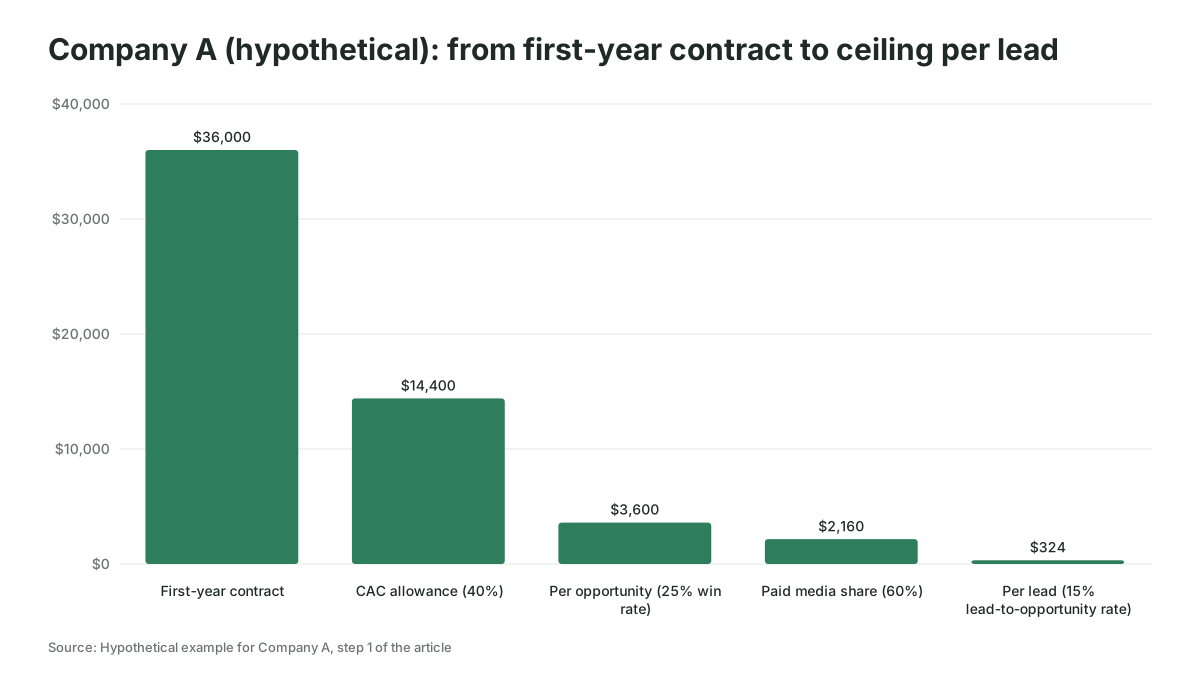
Imagine a hypothetical software company, call it Company A, with an average first-year contract of $36,000. Finance has agreed that acquiring a customer may cost up to 40% of first-year value, so $14,400. Sales closes one in four qualified opportunities, so one opportunity may cost $3,600 all in. Sales time and tooling take about 40% of that, which leaves paid media a ceiling of roughly $2,160 per opportunity. If 15% of leads become opportunities, the most Company A should pay for a lead is about $324, and a cheaper lead is only good news if the 15% holds.
AI handles the arithmetic and the scenarios well. Give an assistant your CRM export and ask for the same calculation under three win rates and two contract sizes, and you have a page the CFO can argue with. The inputs, the CAC allowance and the win rate, come from finance and sales, and you write the ceiling into the strategy as a number with a date next to it.
For a sense of scale, Gartner's 2025 CMO Spend Survey put marketing budgets at 7.7% of company revenue and paid media at 30.6% of marketing budgets, or 2.4% of revenue. If your company sits near those averages, paid media is about 2.4% of revenue, and that is the figure your CFO is holding when they ask what it returned.
Step 2: give each channel a job across the 95% and the 5%
Each channel gets one job and one measure, and the jobs split along who is buying now and who is not. The LinkedIn B2B Institute's 95-5 rule, from its research with the Ehrenberg-Bass Institute, holds that 95% of your potential buyers aren't ready to buy today. Professor John Dawes of the Ehrenberg-Bass Institute put the consequence plainly in a conversation with Dreamdata: "If there are potential buyers out there who basically know nothing about us they have almost zero chance of buying from us."
So paid search and retargeting take the 5%, judged on cost per opportunity against the ceiling from step 1. LinkedIn and other paid social take most of the 95% on your Total Addressable List, judged on reach and frequency into the right accounts and on whether those accounts later turn into opportunities, which takes quarters to show. The same B2B Institute page reports that 96% of B2B marketers expected to see the main effect of their ad campaigns within 2 weeks, and that expectation is the quiet reason awareness budgets get cut in month two. How the awareness half sits inside the wider plan is the subject of demand generation strategy: where AI fits in the planning cycle.
AI can draft the channel map from your Total Addressable List, your search demand data and last year's channel results, with the reasoning for each role. The decision that a channel's job is awareness, and will therefore not show opportunities for two quarters, is yours, because you are the one defending it in month two. Our companion piece on B2B paid media in 2026 goes channel by channel on where AI saves time and where it does not.
Step 3: split the budget and write the test allowance down
The budget split follows the channel jobs, and it includes a fixed share for tests that nobody may raid for the quarter. You will find guides that offer a percentage split between capturing demand and creating it. We looked for a published, sampled source behind those splits and did not find one, so treat any such figure as the author's habit rather than evidence, and set your own from the ceiling in step 1 and the size of your Total Addressable List.
AI earns its keep in the pacing and the reforecasting: a model can read daily spend on the 10th of the month and tell you where you will land on the 31st, and it can rebuild the plan when finance moves the total. The split itself, and the decision to protect the test budget when a channel runs short, stay with you, because they are the strategy. For what the planning tools do well and where they still need a person, see AI media planning.
Step 4: let the platforms' AI bid, and give it signals worth learning from
The platforms' own automation is better placed than a person to run the auctions, provided the conversion it optimizes toward is the one you defined in step 1. Google's help page on Target CPA bidding says to evaluate performance over "the last 30 days, including at least 30 conversions". Thirty opportunities a month is more than many B2B accounts produce, which is why so many end up optimizing to form fills: the volume is there, and the platform learns to find more of whatever you feed it.
Performance Max is the clearest case. Google describes it as "a goal-based campaign type that allows you to access all Google Ads inventory", across YouTube, Display, Search, Discover, Gmail and Maps, and your inputs are goals, budget, assets, audience signals, brand exclusions and search themes. Those inputs are your strategy typed into an interface. If the goal is a lead and the brand exclusion is missing, the campaign will do exactly what you asked, and your own branded searches will fund the result.
The person decides the conversion to optimize toward, the ceiling and the exclusions, and the platform's AI does the bidding. Your own AI tools sit beside both: an assistant connected to the account can read search terms, placements and conversion lag and tell you whether the signal the platform is learning from is clean.
Step 5: set the operating rhythm and who reads what
The rhythm is weekly for operations, monthly for reallocation and quarterly for the strategy itself. Weekly, an assistant pulls spend, search terms, placements and CRM-matched outcomes and writes the review, flagging anything outside the ceiling. Monthly, the head of paid media moves budget between channels inside the roles set in step 2. Quarterly, you reopen the roles and the ceiling with finance and sales.
Gartner's survey of 418 marketing leaders, run from July to September 2024, found that among organizations that had adopted generative AI, 47% reported a large benefit for tasks such as campaign evaluation and reporting, as reported by Marketing Dive. Reporting is where AI saves a paid team the most hours, and it is also where AI is most dangerous, because a well-written weekly report that measures leads will be believed. The method for mapping those weekly jobs is in mapping your paid team's workflows for AI.
Step 6: write the decision rights on one page
The last step is a page that names each recurring decision, who makes it, and what AI prepares for it. It is the part of the strategy that survives staff changes and vendor changes.
| Decision | Who decides | What AI prepares |
|---|---|---|
| Who is in the ICP and the Total Addressable List | Marketing leader with sales | A draft profile from closed-won data and a list of accounts matching it |
| The ceiling per opportunity | Marketing leader with finance | Scenario tables from CRM data under different win rates |
| Each channel's job | Marketing leader | A proposed map with reasoning from list size, search demand and past results |
| Budget split and test allowance | Marketing leader | Pacing, reforecasts and the plan rebuilt when the total changes |
| Conversion to optimize toward, and exclusions | Head of paid media | Signal checks: lag, volume, share of conversions matched to the CRM |
| Monthly reallocation inside channel roles | Head of paid media | A reallocation proposal with the expected effect on cost per opportunity |
| Campaign structure, keywords, negatives, creative tests | Paid media team, AI-assisted | Drafts, search term reviews, briefs built from performance data |
| Pausing, or raising spend above a set threshold | A named person | Nothing, it waits |
That last row is deliberate. As of November 2026, AI clients such as Claude and ChatGPT can connect to an ad platform through the Model Context Protocol, and where a server exists those connections can take actions as well as read. Decide now which actions are allowed without a person. For spend changes above your threshold, the answer should be none, and we set out the reasoning in where humans must stay in the loop on ad spend.
The finished strategy is six written pages
The finished paid media strategy is the six pages that the foundations and steps produce, kept together and dated. Check your document against the list before the next budget review, because a missing page is a decision that software or habit is making for you.
- The customer page: the ideal customer profile as checkable facts, the Total Addressable List, and who agreed the list with sales.
- The ceiling page: the pipeline target, the ceiling per opportunity with the CAC allowance and win rate behind it, the CRM stage that counts as qualified, and the date written next to the ceiling.
- The channel map: one job and one measure per channel, and the quarter in which each awareness channel is expected to show opportunities.
- The budget page: the split by channel, the test allowance as a fixed share, and the rule for when a channel runs short.
- The signals page: the conversion each platform optimizes toward, the exclusions, and which CRM feedback routes are live.
- The rhythm and decision rights page: the weekly, monthly and quarterly reviews, who reads each, the table above, and the actions no tool may take without a person.
Six pages is long enough to hold a team to and short enough that a CFO will read it. Everything else, the budgets by flight, the timing and the campaign detail, is the media plan, and AI can rebuild it from these six pages whenever the total changes.
Four ways this goes wrong
Most failed paid media strategies fail in one of four ways, and good AI tooling makes each of them worse by making the wrong thing faster.
The program optimizes to the cheap lead. An anonymized B2B fintech company spent about $105,000 on LinkedIn over 90 days. Two ads had almost the same cost per lead. Matched to the CRM, one cost about $90 per opportunity and the other about $380, and the budget moved within a week of the match being made. Without the CRM match, every report, human or AI-written, would have shown two equally good ads.
The platform's definition of success becomes yours. When the conversion a campaign optimizes toward is a form fill, every automated recommendation, every AI-drafted report and every agent proposal inherits that definition. Nothing in the chain is broken, and the result is still wrong.
The agent arrives before the data does. Gartner's survey of 413 marketing technology leaders, run from June to August 2025, found that 45% of those with AI agents in pilots or production said the vendor's agent capabilities did not meet their expectations of promised business performance, and half of all respondents said their organizations lacked the technical and data stack readiness required, according to Gartner's release. Benjamin Bloom, a VP Analyst at Gartner, said that "business value is the yardstick CMOs should use to evaluate these investments, rather than vendor hype." If the four foundations above are missing, an agent automates the gap.
The strategy is a list of channels. A document that says Google, LinkedIn, Meta and retargeting with a budget beside each has skipped steps 1 and 2. You can tell because it contains no number a CFO could hold you to.
The strategy is working when three numbers move
The strategy is working when cost per qualified opportunity from paid media sits at or under the ceiling, the share of spend with a CRM-matched outcome is rising, and the pipeline target is being met. Three measures are enough for the leadership view.
- Cost per qualified opportunity by channel against the ceiling from step 1, on the CRM's definition of qualified, read monthly and judged quarterly for the awareness channels.
- The share of paid spend whose outcomes are matched back to the CRM. If it is under half, your reports are mostly describing leads, whatever the column headings say.
- Pipeline created from paid media against the quarterly target, next to the hours the team spent producing that view. The second number is the one that shows what AI changed.
How Scalewell hands the work around your strategy to AI
Scalewell helps paid teams give AI the research, pacing, reforecasting and channel reporting that sit around a strategy, so your head of paid media can spend those hours on the six pages of decisions. The audit maps that recurring work and scores which job AI should take on first, and a ranked roadmap sets the order for the build sprint.
The decisions stay with your team, and so does the sign off on everything AI takes on. Time saved and pipeline are the tests for each job, the same lens the strategy itself uses, over a project of typically 8 to 12 weeks.
Where to start
Write the ceiling per opportunity first, with finance in the room, and check how much of your paid spend has a CRM-matched outcome today. Those two facts tell you which of the six steps needs attention before anything else. Scalewell works with paid teams on exactly this, setting up the decisions and the AI-assisted method around how the team already works.
Frequently asked questions
What is the difference between a paid media strategy and a media plan?
A paid media strategy is the set of decisions: the customer, the pipeline target, the ceiling per opportunity, each channel's job and how success is measured. A media plan is the document that follows, with budgets, channels, flights and timing. AI can build the plan in an hour once the strategy exists, and cannot build a useful one without it.
How much should a B2B company spend on paid media?
No published figure fits every company. Gartner's 2025 CMO Spend Survey of 402 marketing leaders found paid media averaged 30.6% of marketing budgets, or about 2.4% of company revenue, mostly at companies above $1 billion in revenue. Work back from your ceiling per opportunity and your pipeline target, and treat the average as context for the CFO conversation.
Can AI write a paid media strategy on its own?
AI can draft every document in a paid media strategy, from the customer profile to the channel map, budget scenarios and the weekly review. It cannot own the decisions, because the ceiling, channel jobs and definition of success commit money. We found no credible study showing an AI-written strategy beating one a person decided, so treat drafts as drafts.
Should a PPC strategy be written separately from the paid media strategy?
Write the PPC strategy as a chapter inside the paid media strategy, never as a separate document. It inherits the ceiling, the conversion to optimize toward and the exclusions, and adds the channel-specific decisions: campaign structure, match types, negative keywords, bidding and the testing plan. A separate document drifts toward cost per lead within a quarter.