AI tools for B2B marketing: the paid media stack, sorted by the job each does
A neutral survey of AI tools for B2B paid teams, sorted by the eight jobs they do, with prices checked in November 2026 and a rule for what to buy first.

The AI tools for B2B marketing that matter to a paid team fall into eight jobs: competitor research, planning, copy and creative, ad personalization, bidding, reporting, agents and connectors, and ABM. Most jobs have a free starting point inside the ad platforms. Pay for a tool only when it reaches your CRM or saves hours you can name.
Picture the quarterly tools review: a renewal for a creative platform nobody has opened since March, a trial invite for an "AI media buyer", and a note from the CMO asking whether the team uses AI enough. The question that matters, which of this week's jobs a tool would take off your plate, never makes the agenda.
This guide is for the head of paid media or PPC lead building a shortlist, and for the marketing leader who signs it off. It names two to four examples per job with what they do and cost as of November 2026, and what to check before you buy. If you only run Google Ads, our survey of Google Ads AI tools goes deeper on that one platform.
B2B teams already use AI that makes work faster, and rarely better
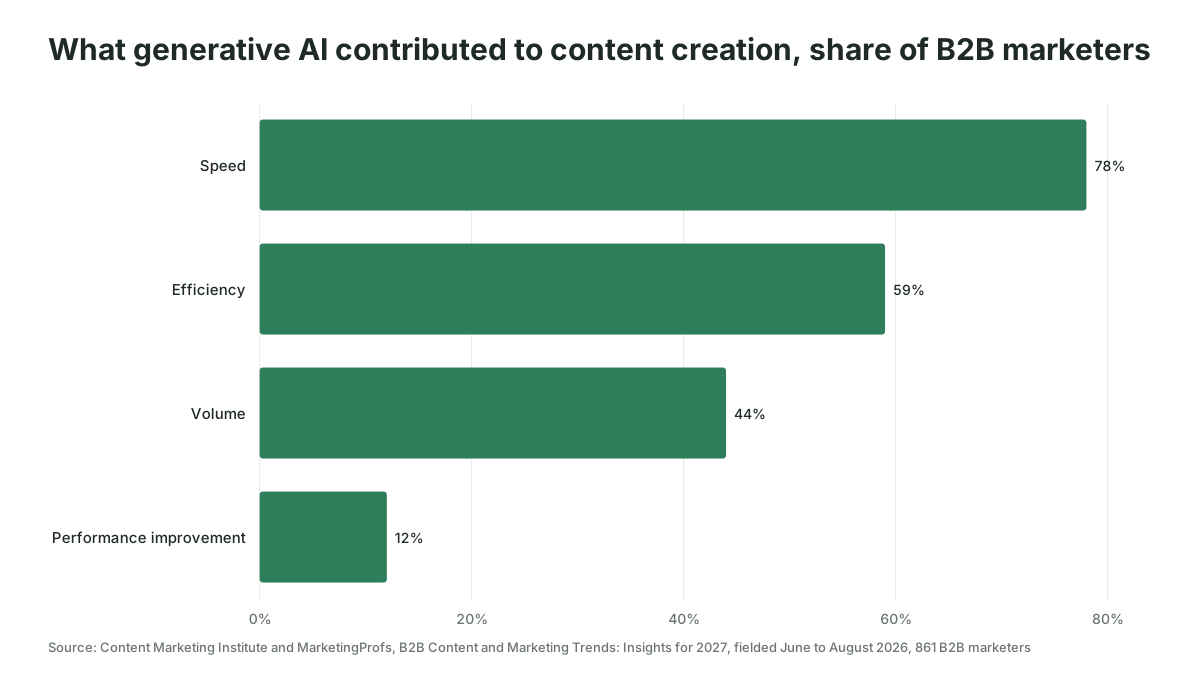
Nearly every B2B marketing team now runs some AI, and very few say it has improved results. In the Content Marketing Institute and MarketingProfs B2B Content and Marketing Trends: Insights for 2027, a survey of 861 B2B marketers fielded in mid-2026, 88% said their organization uses AI-powered content creation tools. Asked to pick up to three things generative AI had contributed, 78% picked speed, 59% efficiency and 44% volume. Only 12% picked performance improvement.
The market has sold speed, and more output has not turned into more pipeline for most teams. The same report found 30% of marketers named AI-powered marketing tools as a top investment area for 2027, down 15 percentage points on the year before.
Racheal Bates of the B2B agency The Starr Conspiracy put the buying rule in five words in her 2026 guide to B2B AI tools: "Buy the motion first, then the tool." For a paid team, the motion is the weekly job: the audit, the report, the new LinkedIn variants, the budget shift. Hours come back when AI is built into those jobs the way the team already works, and Scalewell helps paid and demand gen teams decide which jobs come first, so the next tool is bought for a job rather than a demo.
We judged every tool on five questions
We compared each job's tools on the five things that decide whether a B2B paid team gets value or a clean-up job:
- The job. One recurring task it takes over, named in a sentence.
- What it can see. A pasted file, one platform's live account, several platforms, or the CRM as well.
- What it can change, and where you approve it. Nothing, staged suggestions, or direct edits, and whether approval happens in a chat or on a preview of the exact change.
- Whether it reaches pipeline. A tool that never sees opportunities can only optimize toward clicks and form fills, which in a long B2B sales cycle is the wrong scoreboard.
- What it costs as of November 2026, from the vendor's own pricing page.
No tool here is ranked above another, because the right pick depends on your channels, spend and who will own the tool.
| Job | Free starting point | Paid examples (November 2026) | Check before you buy |
|---|---|---|---|
| Competitor ad research | Meta, Google and LinkedIn ad libraries plus an assistant | Foreplay, Atria | LinkedIn coverage |
| Media planning | Google Performance Planner, LinkedIn forecasted results | A general assistant on a paid plan | Whether forecasts exist for small B2B audiences |
| Copy and creative | AI drafting inside Google Ads, LinkedIn and Meta | Canva, Jasper | Who approves the claims |
| Ad personalization | LinkedIn ad personalization macros | Demandbase, Metadata.io | Segment sizes against platform floors |
| Bidding and optimization | Platform bidding | Optmyzr, Metadata.io | What it optimizes toward |
| Reporting and analytics | Platform reports, Windsor.ai free plan, Dreamdata free plan | Supermetrics, Windsor.ai, Dreamdata, HockeyStack | Whether it joins ad spend to CRM opportunities |
| Agents and connectors | Google's and Meta's own MCP servers | Windsor.ai, Pipeboard | Where write approval happens |
| ABM | None worth the name | 6sense, Demandbase, AdRoll ABM | Target list size and a holdout plan |
Competitor ad research starts with three free libraries
Competitor research tools collect rivals' ads so an assistant can tag hooks, offers and formats across hundreds of them. The free layer is strong: Meta, Google and LinkedIn each publish an ad library, and LinkedIn's help page says its library covers ads that ran after June 1, 2023 and keeps them "one year after their last impression." None of the three shows spend or results for ordinary US ads, as we cover in AI competitor analysis for paid ads.
Paid tools save the collecting and the tagging:
- Foreplay. Basic $59 a month ($49 billed annually), Workflow $175 ($149), Agency $459 ($389), per its pricing page. Its Chrome extension saves ads from the Meta, LinkedIn and TikTok ad libraries, and it connects to Claude and ChatGPT "via MCP or API."
- Atria. Core $129 a month billed annually, Plus $343, Business $959, per its pricing page, with AI concepts, scripts, ad copy and image generation. Its FAQ puts LinkedIn on the roadmap and says you may need supplemental tools for it today.
Both lean toward Meta and TikTok creative teams. If your rivals spend most of their budget on LinkedIn, the free LinkedIn library and a tagging prompt may beat either subscription.
Media planning tools are mostly free and built into the platforms
Media planning with AI means forecasting what a budget buys per channel, and the forecasting is free inside the platforms. Google's Performance Planner forecasts conversions for Search, Performance Max, Demand Gen and other campaign types and suggests budget changes at the same spend. In LinkedIn Campaign Manager, the forecasted results pane opens on the right of the window when you create an ad set, with audience size, projected 1-day, 7-day and 30-day spend, and an estimate of key results.
The B2B catch is in LinkedIn's own fine print: forecasts may be missing when there aren't enough similar ad sets to train the model, which happens with narrow ICP targeting. Google's planner has eligibility rules too, including a stable bid strategy and minimum clicks or conversions, so a new or low-volume B2B campaign may not qualify at all.
The paid layer is usually a general assistant that reads the forecasts and writes the plan. As of November 2026, Claude's pricing page lists Pro at $20 a month ($17 billed annually) and Team at $25 per standard seat billed monthly; check ChatGPT's and Gemini's own pages before you budget seats. Give the assistant the platform forecasts as inputs, because left to itself it will fill a plan with numbers nobody forecast.
Copy and creative tools are built into every platform and need the strictest review
Every major ad platform now drafts B2B ad copy and creative for you. Google Ads' conversational experience generates keywords, headlines, descriptions, sitelinks and images when you build a Search campaign, at the "Keyword and asset generation" step. LinkedIn's single image ad page lists an AI ad creation option that drafts headlines, intro text and suggested visuals for you to edit, plus AI-powered variations generated from a drafted ad. Meta's Marketing API documents three generative features: text generation, image expansion and background generation.
Standalone tools add brand control and production volume:
- Canva. Pro $144 a year for one person, Business $250 a year per person, each with a larger AI allowance than the free plan, per its pricing page. It suits teams that need every size of every LinkedIn and Meta asset.
- Jasper. Pro $69 a month per seat ($59 billed yearly), with two brand voices and "agents for core marketing workflows," per its pricing page. Business pricing is custom.
The risk is the claim. An AI draft for a B2B ad will reach for a statistic or a customer outcome it can't support, and LinkedIn's advertising policies say "Any claims in your ad must have factual support." Keep a person on approval for every claim, and judge the variants on cost per opportunity, as we set out in AI-generated ads for B2B.
Tools that use AI to personalize B2B ads work best at the segment level
Tools that use AI to personalize B2B ads match the message to an account, segment or buying stage, and the most widely available one is free inside LinkedIn. LinkedIn's ad personalization help page says conversation and message ads, Spotlight and follower ads, and single image and video ads can pull a member's first name, company name, job title or industry, and show the plain version when personalization isn't available. LinkedIn's own advice is to "use ad personalization sparingly and strategically."
The paid tools personalize by account and by stage:
- Demandbase. Demandbase Ads "puts target accounts and buying groups at the center of your advertising strategy," and campaigns "continuously adapt based on account and buyer activity," per its advertising page. Its pricing page shows no prices, only a platform fee plus a per-user fee.
- Metadata.io. Its homepage says it runs campaigns across 12 channels, builds audiences "from firmographics, technographics, intent signals, and retargeting" and creates landing pages and ad creative. No prices are shown.
Check what a personalization vendor sells today, because the category moves. Mutiny still turns up in 2026 roundups of B2B personalization tools, yet as of November 2026 its homepage describes a sales assistant that drafts follow-ups and proposals. Also check segment sizes: LinkedIn needs a company list to match at least 300 members before an ad set can run, which caps one-to-one ads, as our guide to AI for ABM advertising explains. Personalize to the problem a segment shares, and leave company-specific facts to the account team.
Bidding and optimization tools add rules on top of platform AI
Every ad platform already runs AI bidding at no extra cost, so a paid optimization tool earns its fee by adding rules, alerts and an approval trail across accounts. For Google-only teams, the Google Ads AI tools survey linked above compares Optmyzr, Adalysis and Opteo, all of which run rule-based checks.
For B2B teams that also run LinkedIn, the options narrow:
- Optmyzr. Its help page lists LinkedIn tools including Budget Alerts, Spend Projection and Reallocate and Optimize Budgets, plus its Sidekick assistant. Changes requested through MCP are "raised as Change Requests, which you review and approve before anything goes live."
- Metadata.io. Its "optimizers adjust bids and budget allocations toward your goals within your account settings," and your team sets goals, budgets and approval requirements.
Before you buy, ask the vendor one question: what conversion does the optimizer push toward? If the answer is the platform's lead event, the tool will get very good at cheap form fills that sales never calls back.
Reporting tools only reach pipeline when they read the CRM
Reporting and analytics tools pull spend from every ad platform into one place, and only the ones that join that spend to CRM opportunities can tell you what LinkedIn bought.
| Tool | What it does (vendor's page, November 2026) | Price |
|---|---|---|
| Supermetrics | Moves ad data into AI chats, Google Sheets, Data Studio (formerly Looker Studio) and, on Enterprise, a warehouse; lists campaign management "straight from your AI chat" | No US dollar price published; Enterprise on quote |
| Windsor.ai | Connects ad and CRM sources to destinations including Claude and ChatGPT; "Access to Windsor MCP for AI analysis" on all plans | Free; Basic $23 a month ($19 billed annually) up to Professional $598 ($499) |
| Dreamdata | B2B analytics and attribution; free plan includes company identification and an ad spend report; paid plans add an analytics agent and an MCP server | Free; attribution and activation on custom pricing |
| HockeyStack | Custom plans with GTM and CRM integrations and ROI reporting | Custom; startup pricing available |
Supermetrics and Windsor.ai solve the export problem and leave the CRM join to you. Dreamdata and HockeyStack are built around the account and the opportunity, and price like it. If your weekly report still stops at cost per lead, fix that join first; our guide to an AI marketing dashboard shows the view that links spend to pipeline.
Agents and connectors give an assistant the live ad account
Agents and connectors link ChatGPT, Claude or another assistant to your ad accounts through the Model Context Protocol (MCP), so it reads current data instead of a stale export. As of November 2026, the platforms' own routes look like this:
- Google. The free, open-source Google Ads MCP server runs account queries and adds asset and label write tools that commit only "after explicit user approval." As of November 14, 2026, Google's developer page gives its mode as "Read and partial mutate (asset creation, video uploads, and label management with propose-and-confirm validation, or configurable read-only mode)." The same page says it cannot change campaigns, ads, budgets or bids, and the write tools can be switched off for a read-only deployment.
- Meta. Meta announced its ads AI connectors, including a hosted ads MCP server, on April 29, 2026. They are in open beta, cover reporting and campaign management, and since July 16, 2026 let anyone with full control of a business portfolio set rules for what agents can change.
- LinkedIn. LinkedIn's own MCP server, which reads and writes ad accounts, is in beta and already in use, but not yet publicly documented. LinkedIn also lists a read-only beta LinkedIn Ads plugin inside ChatGPT.
Connector services handle sign-in and cover several platforms at once. Windsor.ai lists read and write functions, "including actions like pausing campaigns or adjusting budgets," are on every plan, free included. Pipeboard's pricing page lists a free plan with 30 AI tool executions a week, Pro at US$29.90 a month and Agency at US$199, with ad account slots covering Meta, Google Ads, TikTok and LinkedIn.
The check that matters is where approval happens. A "yes" typed into a chat is a weak control on a budget change. Our guide to MCP for marketing sets the order we'd connect things in, starting with the CRM, and our setup for AI agents in B2B PPC shows an approval step that sits outside the chat.
ABM platforms are the expensive end, and none publishes a price
ABM platforms pick in-market accounts from intent data, advertise to them across channels and report engagement by account, and the main ones price on request.
- 6sense. Its pricing page lists Revenue Marketing with "advertising that puts spend behind in-market accounts and key personas," an AI assistant called RevvyAI, and an MCP server in every package. Pricing is a custom quote.
- Demandbase. As above, account-based ads across display, video, CTV, social and web, priced by quote.
- AdRoll ABM. The old RollWorks pricing address now redirects to AdRoll's pricing page, which lists four ABM packages. Three ask for a demo; Account-Based Retargeting has no fee to get started and you pay only for media.
These platforms are built for target lists in the hundreds or thousands; with a list of 80 accounts, much of the fee buys a dashboard. Plan a holdout of accounts before you sign, so the renewal can be judged on opportunities opened rather than engagement scores.
The best AI tools for B2B marketing are the ones that fix your slowest job
The best AI tools for B2B marketing are attached to the job that cost your team the most hours last month, with a free option tried first:
- List the five jobs that ate the most paid media hours last month, from the team's calendar or ticket history. Our guide to which paid media tasks to automate first helps you sort them.
- Take the slowest of the five, find its row in the overview table and run its free starting point for two weeks.
- Buy a paid tool only where the free option fell short on a named point, such as no LinkedIn coverage, no CRM join or no approval trail.
- Write down the hours the job took before and after, and the pipeline metric it should move, before the trial ends.
Take a hypothetical team spending $60,000 a month across LinkedIn and Google. If the slowest job is producing LinkedIn variants, Canva Pro and LinkedIn's own AI drafting may cover it for a few hundred dollars a year. If the slowest job is explaining to the CFO what LinkedIn returned, no creative tool helps, and the money belongs in the CRM join.
Most AI tool purchases go wrong in the same three ways
AI tools fail B2B paid teams in predictable ways, and most of them are buying decisions:
- Buying the demo. The vendor shows its best workflow on clean data. Run the trial on your own account, with your own naming conventions and your own messy CRM.
- Overlap. A creative tool, a reporting tool and an ABM platform can each ship their own AI assistant, and you pay three times for the same chat window. Give each job one owner and one tool.
- Vendor drift. Products change shape fast, as Mutiny and RollWorks show, so check what you're paying for at every renewal.
If you run one account with a few thousand dollars a month of spend, skip most of this list. The platform features and one assistant will cover you until there are more accounts, checks or questions than one person can handle.
Where to start
Pick the job that took the most paid media hours last month, find its row in the overview table, and run the free option for two weeks before you price anything else. Once that job is picked, Scalewell can turn it into something AI does every week alongside your paid and demand gen team.
Frequently asked questions
Are there free AI tools for B2B marketing that are good enough?
For drafting, forecasting and basic connections, yes: the ad platforms' own features cost nothing, and Windsor.ai, Pipeboard and Dreamdata each list a free plan as of November 2026. The free options run thin on CRM joins and approval trails, which is where paid tools earn their fee.
How much do AI tools for B2B marketing cost?
As of November 2026, a Claude seat runs $20 to $25 a month, creative tools from $144 a year (Canva Pro) to $69 a month per seat (Jasper Pro), connectors from free to $598 a month (Windsor.ai Professional), and ABM platforms publish no prices at all. Budget per job, and count setup time as a cost.
Is ChatGPT or Claude enough on its own for B2B paid media?
A general assistant covers writing, analysis of exports and planning drafts, and with an MCP connection it can read live ad accounts. It does not hold your CRM data, enforce approvals or run checks on a schedule unless you build those around it. Most small teams should start there and add tools only for gaps they can name.
Which AI tools work with LinkedIn ads?
Of the tools in this survey, as of November 2026, Campaign Manager itself, Foreplay, Optmyzr, Windsor.ai and Pipeboard all list LinkedIn support, and Atria does not cover it yet. Coverage changes often, so ask for a trial on your own LinkedIn account before you sign.
Can AI tools replace a B2B paid media agency or specialist?
AI tools replace tasks, such as drafting variants, pulling reports and flagging budget overruns. They do not decide which accounts matter, which claims are true or when a campaign should stop. Those calls need a person who knows the ICP and the sales team. Use the tools to give that person their hours back.