AI adoption in marketing: what the surveys say and what teams actually do
The 2026 surveys say 75% to 91% of marketers use AI, while the studies that measure work done land at about a quarter; here is why both are true and how to count adoption in your own team.
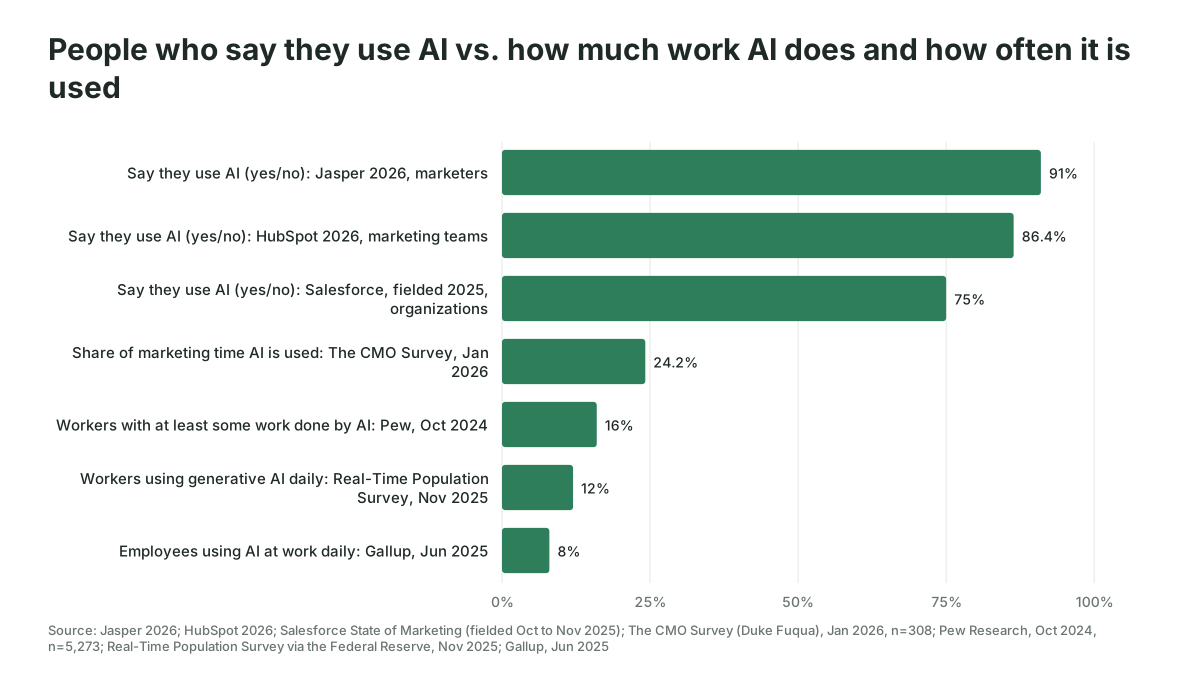
AI adoption in marketing sits between 75% and 91% of marketers in the 2026 surveys from Salesforce, HubSpot and Jasper. Measured as the share of marketing work AI touches, the figure is about a quarter: The CMO Survey put AI at 24.2% of marketing activities in January 2026. Counting people instead, only 12% of US workers use generative AI daily.
You have probably seen the first number on a slide already, possibly your own. Someone in the budget review asks whether the team is behind on AI, the 91% comes out, and everyone nods. Then the CFO asks what the AI budget line produced last quarter, and the slide after it is about content volume.
This article lines up the named surveys with their samples and fielding dates, separates the questions that count people from the questions that count work, and shows what the gap means for a paid media team's plan. It is written for the marketing leader who has to defend an AI line item, and it ends with three numbers you can track in your own team instead of quoting someone else's.
Survey headlines put AI adoption in marketing at 75% to 91%
The widely quoted adoption figures come from five surveys published between February 2025 and June 2026, and each one asked a different question. The table lists them with their samples, because a 1,400-person vendor survey and a 308-person academic survey do not deserve the same weight, and because the wording of the question explains most of the spread. Gartner's and BCG's rows ask different questions and sit there for contrast.
| Survey | Fielded | Sample | What respondents were asked | Headline figure |
|---|---|---|---|---|
| Jasper, The State of AI in Marketing 2026 | Not stated by the source | 1,400 marketers | Whether they actively use AI in their work | 91%, up from 63% a year earlier |
| HubSpot, 2026 State of Marketing | Not stated by the source | 1,500+ B2B and B2C marketers | Whether their team uses AI in at least a few areas | 86.4%; 1.7% neither use it nor plan to |
| Salesforce, State of Marketing, tenth edition | Oct 8 to Nov 17, 2025 | 4,450 marketing professionals, 26 countries | Whether the organization uses at least one form of AI | 75%; 13% say they use agentic AI |
| BCG, CMO survey, June 2026 | Not stated by the source | 300 CMOs plus 50 interviews | Whether AI is driving an end-to-end transformation of their function | 96% agree; 8% run campaigns where multiple agents operate autonomously |
| Gartner, generative AI in marketing, Feb 2025 release | Jul to Sep 2024 | 418 marketing decision-makers | How broadly the team uses generative AI | 27% report limited or no adoption; 4% say their entire team uses it |
Read across the "what was asked" column and the spread stops being mysterious. Jasper asked individuals whether they use AI, and almost everyone who has pasted a brief into ChatGPT says yes. Salesforce asked whether the organization uses any form of AI and got 75% from a much larger sample across 26 countries. Gartner asked how much of the team uses it, and the answer collapsed to 4% for "all of them".
So the honest summary of the stated-adoption surveys is this: nearly every marketer has used an AI tool, most teams use one somewhere, and very few teams use AI throughout. All three statements are supported by the same data. Scalewell helps paid media teams close that gap by giving AI the recurring jobs, such as the weekly report and search term reviews, so the week has more room for decisions.
Two counts of firms rather than marketers belong in the same yes/no family, and they show how much the base moves the answer. The US Census Bureau's Business Trends and Outlook Survey found 19.8% of US businesses had used AI in any business function in the previous two weeks as of May 3, 2026, after it broadened the question on November 17, 2025. The Ramp AI Index, built from card and bill-pay transactions at more than 85,000 US businesses, shows 55.9% of businesses on Ramp with a paid AI transaction in September 2026. That is a real money trail, and Ramp's customers skew to younger, tech-heavy companies, which probably explains most of the gap to the Census figure.
Measured use is about a quarter of the work, and most workers are not daily users
When a survey measures the share of work AI does, rather than the share of people who have used it, the figure drops to roughly a quarter of marketing activity, and the worker surveys add that only about one worker in eight uses it daily. These sources are the ones to quote when someone asks how much AI is really doing.
The CMO Survey, the Duke Fuqua study now in its 35th edition, was in the field from January 7 to 29, 2026, with 308 responses from 2,111 marketing leaders at for-profit US companies, 97% of them VP level or above. It asks what percentage of the time a company uses AI or machine learning to optimize and automate marketing, and the 2026 answer was 24.2%, up from 13.1% in 2024 and 17.2% in 2025. Generative AI specifically was used 22.4% of the time, up from 7.0% in 2024.
The US Census Bureau's working paper on its AI supplement, covering more than 117,000 firms between November 2025 and January 2026, measures scope rather than a yes/no: among the firms that do use AI, sales and marketing is the most common function at 52%, and 57% of AI-using firms run it in three or fewer functions.
Worker surveys agree on the depth, and the table below carries their figures. The Federal Reserve's April 2026 note on AI adoption cites the Real-Time Population Survey for November 2025, Gallup surveyed US employees in June 2025, and Pew Research surveyed 5,273 US workers in October 2024. The figure to remember from them is Gallup's: leaders at 33% frequent use against 16% for individual contributors.
| Measure | Source and date | What it measures | Figure |
|---|---|---|---|
| AI or machine learning used in optimizing and automating marketing | The CMO Survey, January 2026, n=308 | Share of time | 24.2% |
| Generative AI used in marketing activities | The CMO Survey, January 2026, n=308 | Share of time | 22.4% |
| Workers who say at least some of their work is done with AI | Pew Research, October 2024, n=5,273 | Share of workers | 16% |
| Workers using generative AI for work daily / at least weekly | Real-Time Population Survey, November 2025, via the Federal Reserve | Share of workers, by frequency | 12% / 35% |
| Employees using AI at work daily | Gallup, June 2025 | Share of employees, by frequency | 8% |
| AI-using firms that use it in sales and marketing | Census working paper, Nov 2025 to Jan 2026, 117,000+ firms | Share of AI-using firms, by function | 52% |
| AI-using firms running AI in three or fewer functions | Census working paper, Nov 2025 to Jan 2026, 117,000+ firms | Share of AI-using firms, by scope | 57% |
The two numbers measure different things, and both are true
A yes/no question about a person and a percentage question about the work can be answered honestly by the same team and land 60 points apart. Think of a gym membership. Asking whether you belong to a gym gets a 91% yes in January. Asking how many hours you trained last week gets a very different answer, and the second one is the one that changes your shape.
Imagine two companies with the same survey result. Company A has 20 marketers who all use ChatGPT to tidy emails and draft first versions of copy, so it reports 100% adoption. At Company B, six of the 20 marketers have rebuilt their weekly reporting and search term review around an AI tool connected to the ad accounts, so it reports 30% adoption. Only the second CFO can see something on the cost line, and the survey ranks them the other way round.
This is also why the 2025 MIT NANDA report could find both high adoption and low return at once. Its researchers reviewed more than 300 public AI initiatives, interviewed 52 organizations and surveyed 153 senior leaders between January and June 2025. Only 40% of the companies said they had bought an official LLM subscription, while workers from more than 90% of them reported regular use of personal AI tools for work. The same report concluded that 95% of organizations were getting zero measurable return. Adoption was near universal and results were rare, because the adoption was individual and the results needed workflows.
The Census working paper found the same split in the general population of firms: in 36% of firms where workers use AI, there is no sign of formal firm-level adoption. So the behavior is already in your building, and the open question is whether the company has organized it into anything that changes a number.
Paid media is the one marketing job where AI use has not grown
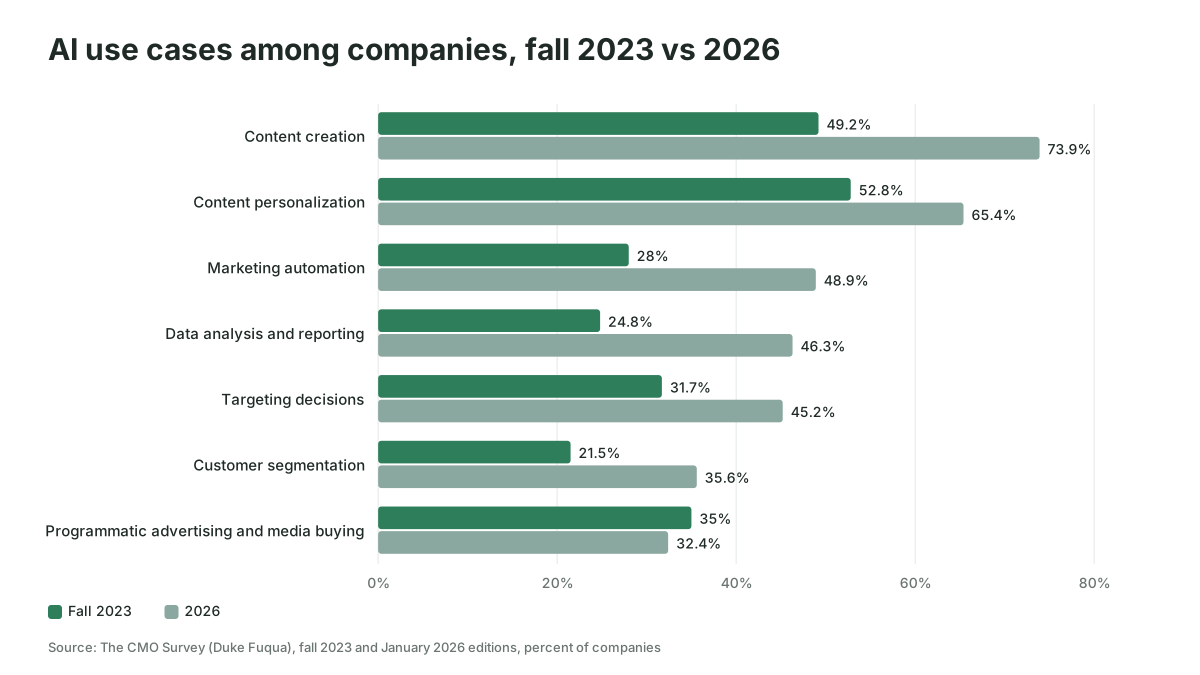
Among the AI use cases The CMO Survey tracks, programmatic advertising and media buying is the only mainstream one to fall, from 35.0% of companies in fall 2023 to 32.4% in 2026. Over the same period content creation rose 24.7 points to 73.9%, marketing automation rose 20.9 points to 48.9%, and data analysis and reporting rose 21.5 points to 46.3%.
That pattern makes sense once you look at what the platforms already do. Google, Meta and LinkedIn moved bidding and much of targeting onto their own machine learning years ago, so a paid team does not experience "adopting AI" when it switches to automated bidding, and does not report it as such. The AI adoption that surveys pick up is the generative kind: text, images, summaries, analysis. In a paid team, that work is the brief, the search term review, the weekly report, the audit, the budget pacing check and the creative request, and most of it is still done by hand.
Gartner's 2024 fielding adds a hint from the other side: among the marketing organizations that had adopted generative AI, 47% reported a large benefit for tasks such as campaign evaluation and reporting, as reported by Marketing Dive. Reporting is where a paid team is most likely to find its first measurable win, because the inputs are already numbers sitting in a platform export. We have mapped the recurring jobs this covers in AI for marketing operations, and the short version is that the paid team is behind the content team on adoption and ahead of it on the size of the prize per hour.
Budgets are moving faster than readiness
CMOs now put 15.3% of the marketing budget into AI on average, while only 30% of them say their organization has mature AI readiness. Both figures come from Gartner's 2026 CMO Spend Survey of 401 CMOs and senior marketing leaders, fielded from January to March 2026 and reported by Marketing Dive and MarTech. The organizations that rated themselves ready spent more, at 21.3%, which is the right way round, but it leaves most teams buying ahead of their ability to use.
The CMO Survey tells the same story from the practitioners' side. No marketing technology activity scored above 5 on its 7-point performance scale in 2026, and the ratings had not improved in two years. The barriers respondents named were lack of budget at 20.1%, technology integration and data architecture at 19.1%, bandwidth and focus at 14.1%, and talent at 13.1%. The report's own phrasing is that "technology adoption is consistently outrunning execution".
The MIT NANDA interviews add where the money goes: when executives were asked to split a hypothetical $100 of generative AI budget across functions, sales and marketing took roughly 70% of it (the report's summary box rounds this to 50%), which the authors attributed to easier metric attribution rather than to where the return was. And Jasper's 2026 survey found that only 41% of marketers could prove AI return on investment, down from 49% the year before, even as stated adoption climbed from 63% to 91%. More people are using it and fewer can show what it did. If you need the method for the second half of that sentence, start with how to measure the ROI of AI in your paid team.
Most AI adoption challenges in marketing sit in the workflow around the tool
The reasons why AI projects fail in marketing are mostly outside the model: nobody owns the workflow, nobody recorded a baseline, and the data the tool needs was never connected. Gartner put a number on the agentic end of this in a forecast published June 25, 2025: over 40% of agentic AI projects will be canceled by the end of 2027, due to escalating costs, unclear business value or inadequate risk controls. That forecast covers agentic projects in every function, so read it as a warning about how projects are run, the same way as the MIT NANDA finding above that, among the organizations its researchers studied in the first half of 2025, 95% were getting zero measurable return.
In a paid team, the AI adoption challenges are specific and show up early.
- The pilot lives outside the weekly process. A demo one person runs when they remember never becomes coverage. Our guide to taking an AI pilot to production covers why pilots stall there.
- Nobody owns it. When the person who built the workflow moves on, its prompts break at the next platform change.
- There is no before number. Without hours logged or a cost per opportunity from before the change, the project has nothing to show at budget time, which is what "unclear business value" looks like in practice.
- The data was never connected. An assistant reading a stale export with the wrong conversion column produces a confident report that is wrong.
- Spend has no ceiling. Agent runs and API calls are often billed per use, and a project without a monthly limit and a stop rule is how costs escalate.
An AI adoption strategy that avoids these is short: pick one recurring job, name its owner, record the baseline, connect the data it needs, and agree in advance which result keeps it and which result stops it. Run every later job through the same five checks and you have an AI adoption framework, which is also why the three numbers in the next section count jobs rather than people.
Measure adoption in your own team with three numbers
The useful adoption metric for a marketing team is the share of recurring workflows where an AI step runs in production every week, backed by a depth number and a proof number. None of the published surveys will give you this for your team, and none of them needs to, because you can count it yourself in an afternoon.
- Coverage. List every recurring job the team does at least monthly: the weekly performance report, the search term review, the budget pacing check, the creative brief, the quarterly audit, the media plan, the landing page review, the competitor check. Mark each one where an AI step is part of the standard process rather than something one person does on the side. Coverage is the marked jobs divided by the list. A strict count usually lands far below the yes/no survey figure, and The CMO Survey's 24.2% is a fair expectation for a team that has not yet planned this.
- Depth. For each covered job, ask how many of the people who do it use the AI step every time. Gartner's 4% whole-team figure is the warning here: a job covered by one enthusiast is a dependency rather than adoption.
- Proof. For each covered job, ask whether you can show one measured result, such as hours saved per week, a mistake caught, or a change in a cost per opportunity. Jasper's 41% is the benchmark to beat, and it is a low bar.
Take a hypothetical paid team. Twelve recurring jobs, three with an AI step in the standard process: coverage 25%. Of the five people who build the weekly report, two use the AI draft every week and three ignore it: depth 40% on that job. One of the three covered jobs has a logged time saving of about four hours a week; the other two have nothing: proof 33%. That team would tick "yes, we use AI" on every survey in this article, and the three numbers tell its leader exactly what to do next, which is to get the other three reporters onto the draft and to log the other two jobs.
We found no published survey that gives a target for these three numbers as of November 2026, because none of them measures a team this way. The figures on this page are market-wide readings: The CMO Survey's 24.2% of activities, Gartner's 4% of whole teams, and Jasper's 41% who can prove a return. So the targets that follow are our own judgment call, and no benchmark stands behind them. After a year of deliberate work, we would aim for coverage of about half the list, depth of everyone who does a covered job, and a measured result on every covered job.
The reasoning sits in the numbers above. Half the list is roughly double the measured baseline, which we think a team that picks its jobs on purpose can reach in a year, given that the market-wide figure grew 85% in the last two years, and it stays well away from the 91% nobody should chase. Depth is the number a plan controls most directly, because an AI step in the standard process means everyone who does the job runs it, and Gartner's 4% shows how rare that is when nobody has decided it. Proof should reach every covered job, because a logged hour count is enough and costs little to keep, and MIT NANDA's finding that 95% of organizations were getting zero measurable return shows how far adoption can run ahead of proof. For the hypothetical team above, that means six covered jobs, all five reporters on the draft, and a logged result on each.
A paid team's plan should be a short list of recurring jobs
A paid media team should plan its AI work as a short list of recurring jobs with a measured step in each, because that is the form of adoption that moves the measured figures and survives a budget review. The surveys above tell you four things worth building the plan around.
First, your people are already using AI, with or without a policy, so the first step is to find out what the team is doing on personal accounts with client data, and then to give them a sanctioned route. Second, the gap between content and paid media use in The CMO Survey means your content colleagues have templates, habits and a vocabulary that your paid team does not yet have, so borrow from them rather than start from a blank page. Third, Gartner found 70% of CMOs calling AI leadership a critical 2026 goal while the same share say their internal processes are not mature enough to scale AI, which in a paid team we would expect to show up first as a missing CRM match or conversion import; fix those before buying anything with "agent" in the name. Fourth, training is where the measured numbers move: Gallup's leaders use AI frequently at twice the rate of individual contributors, which suggests access and permission matter as much as skill. We cover what to teach in AI training for marketing teams and the sequence in how to roll out AI across a paid media team in 90 days.
Which teams should not chase the headline number at all? A team of two running a single Google Ads account with no CRM connection has one recurring job worth automating, the weekly report, and should do that and stop. The survey benchmark of 91% is not a target for them, and it is not a target for anyone else either.
Where the benchmark numbers mislead you
The adoption statistics in this article are honest within their own definitions and misleading the moment they are compared with each other or applied to your team. Five problems come up repeatedly.
The samples are not the same population. Jasper and HubSpot survey marketers who are reachable by a marketing software vendor, which probably skews toward people already comfortable with software. The CMO Survey's 308 responses came from 2,111 invitations, a 14.6% response rate, and leaders who respond to a long survey on marketing practice may be more engaged with new tools than those who do not. Gartner's 2026 respondents mostly work at companies with over $1 billion in revenue.
"Use" is undefined in most of them. A marketer who asked ChatGPT one question in the last year and a marketer whose reporting runs on an AI pipeline are the same tick in a yes/no question. The CMO Survey's percentage-of-time measure and the Census Bureau's function counts are the exceptions, and that is why their numbers are lower.
The dates span two years of fast change, so Gartner's "27% limited or none" from the second half of 2024 overstates how far behind the laggards are today.
Self-reported outcomes are soft numbers. The CMO Survey's respondents report a 14.1% improvement in sales productivity from AI and a 14.6% reduction in marketing overhead costs in 2026. Those are the respondents' estimates rather than measurements, and in a year when more than half of the same respondents said they were less optimistic about the economy, a claimed overhead cut deserves a second look.
And the forecasts run on mood. The CMO Survey's respondents expect 55.9% within three years, which would need the measured figure to grow 131% after growing 85% over the previous two years, so plan on the measured series and treat the projection as a description of how people feel.
How Scalewell moves AI from one enthusiast to the whole team
Scalewell helps paid teams raise the number that matters in this article, the share of recurring work AI actually does, so the answer to the CFO is a list of jobs and the hours behind them. Following a free call of 30 minutes, the audit maps those jobs and scores the order AI should take them on. The ranked roadmap doubles as your coverage list.
Depth comes from training. During the build sprint the paid media team tests every job, and once the project wraps, typically 8 to 12 weeks later, the people who do each job know how to use and adjust it.
The next step
Count your own three numbers before the next budget review: coverage, depth and proof across the team's recurring jobs. The published surveys will keep moving, and your own figures are the only ones a CFO can act on. If you would like help mapping the recurring jobs in a paid media team and setting up the AI steps that move those numbers, that is the work Scalewell does.
Frequently asked questions
What percentage of marketers use AI in 2026?
Between 75% and 91%, depending on the survey. Jasper's 2026 survey of 1,400 marketers reports 91% actively using AI, HubSpot's 2026 report of 1,500+ marketers reports 86.4% of teams, and Salesforce's tenth State of Marketing, with 4,450 respondents, reports 75% of organizations. The CMO Survey measures the share of marketing activities instead and finds 24.2%.
How much of marketing work is actually done with AI?
About a quarter, on the best available measure. The CMO Survey's January 2026 edition found AI or machine learning used 24.2% of the time in marketing, and generative AI 22.4% of the time. Worker surveys add frequency rather than a work share: the Real-Time Population Survey found 12% of US workers using generative AI daily in November 2025.
Which marketing tasks use AI the most?
Content creation leads at 73.9% of companies in The CMO Survey 2026, followed by content personalization at 65.4%, marketing automation at 48.9%, data analysis and reporting at 46.3% and targeting decisions at 45.2%. Programmatic advertising and media buying, at 32.4%, was the only mainstream use case to fall since fall 2023.
How much of the marketing budget goes to AI?
Gartner's 2026 CMO Spend Survey of 401 CMOs found an average of 15.3% of marketing budgets directed to AI, rising to 21.3% among organizations that rated their AI readiness as mature. Only 30% of CMOs said their organization had that level of readiness, so most of the spend is landing ahead of the capability to use it.