AI pilot to production in a B2B marketing team: why pilots stall and how a fixed build sprint gets one live
Most marketing AI pilots stall on ownership, demo data and a missing finish line, and a fixed six-week build sprint with four production tests gets one job live.

Moving an AI pilot to production in a B2B marketing team means one recurring job runs on a schedule, on live ad account and CRM data, with a named owner, monitoring and human sign-off. Most pilots stall because nobody defined that finish line. A fixed six-week build sprint in the tools the team already uses usually gets one there.
You probably know the pilot this is about. It looked excellent in the spring demo: an assistant that wrote the weekly paid media report in four minutes instead of four hours. It's now November, the analyst who built it has moved on to the next campaign launch, the report is still written by hand on Tuesday mornings, and the AI line is still on the budget. When the CFO asks what it returned, the honest answer is a screen recording.
This guide is written for the marketing leader deciding what to do with a pilot like that, whether that's the CMO, the VP of Marketing or the head of demand gen. It gives you the decision first (fund a sprint, keep testing or stop), then the base rates behind it, the five reasons pilots stall, what production means for a paid team job, and a filled-in six-week sprint plan you can hand to whoever will run it.
Most AI pilots never reach production, and marketing teams pilot more than they scale
The base rate for any AI pilot program is low: most never become a job that runs every week. The figures come from different methods, so read them as a range rather than a single number.
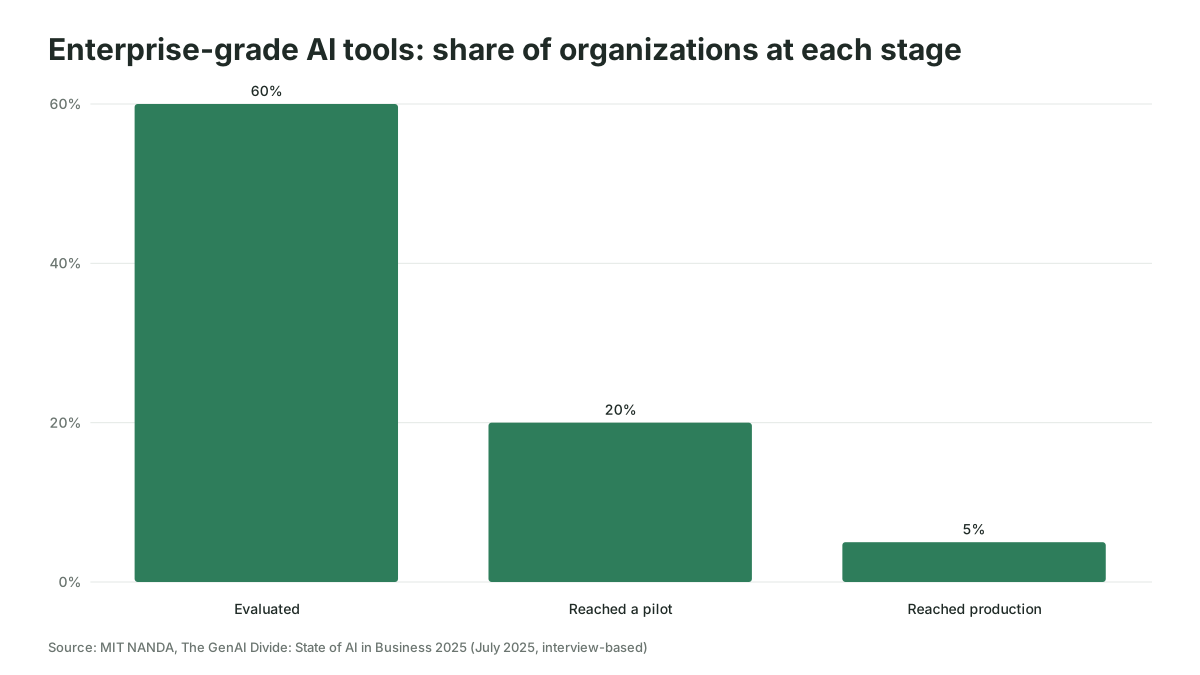
- MIT NANDA, The GenAI Divide (July 2025). For enterprise-grade AI tools, custom or vendor-sold, 60% of organizations evaluated them, 20% reached a pilot and 5% reached production, where production means users or executives reported a marked and sustained productivity or P&L impact. The same report is the source of the widely quoted "95%", as reported by Fortune, which counts organizations getting no measurable P&L return and rests on 52 interviews, 153 leader surveys and a review of 300 public initiatives that the authors call "directionally accurate".
- IDC with Lenovo (reported March 2025). "For every 33 AI POCs a company launched, only four graduated to production," IDC found, as reported by CIO.com, which is where the widely quoted 88% comes from.
- S&P Global Market Intelligence (reported March 2025). In a survey of more than 1,000 respondents in North America and Europe, the average organization scrapped 46% of AI proofs of concept before they reached production, as reported by Construction Dive, and 42% of businesses scrapped most of their AI initiatives, up from 17% a year earlier.
- Marketing AI Institute, 2025 State of Marketing AI. In a survey with 1,882 respondents, fielded from February to April 2025, 46% said their team was in the piloting phase and 14% in the scaling phase, so roughly three marketing teams are running pilots for every one that has scaled.
Scalewell helps B2B paid and demand gen teams get a stalled pilot running as a weekly job in the tools they already use, so the hours the demo promised actually come back to the team.
What the numbers change for you is the default assumption. If a pilot has been "nearly ready" for three months, the odds say it will stay that way unless someone changes how it is run. Gartner predicted in July 2024 that at least 30% of generative AI projects would be abandoned after proof of concept by the end of 2025, as reported by Intelligent CIO, citing "poor data quality, inadequate risk controls, escalating costs or unclear business value". Most of those four are decisions about how the project is run, and in a paid team even the cost tends to follow from the other three.
The same MIT report found that the top mid-market performers reported "average timelines of 90 days from pilot to full implementation", while enterprises "took nine months or longer". A pilot that drifts is usually a sign that nobody fixed a finish date.
Five AI implementation challenges stall most marketing pilots, and the model is rarely the deciding one
A marketing AI pilot usually stalls on ownership, data, a missing definition of done, access reviews or an unchanged job description. The model gets blamed because it's the visible part. MIT's respondents ranked "unwillingness to adopt new tools" as the most common barrier to scaling and model output quality second, and the authors put the quality complaints down to tools that lack context and don't adapt to the workflow.
| Why the pilot stalls | What it looks like in a paid team | What a build sprint does about it |
|---|---|---|
| No owner | The analyst who built it has moved on, and nobody's objectives mention it | Names one owner whose week includes the job, plus a sponsor who signs off |
| Demo data | It ran on last quarter's export, and live data has naming gaps and missing UTMs | Connects to the live ad accounts and CRM in week one and fixes what breaks |
| No definition of done | "It works" means the demo impressed, so there is no point at which it ships | Writes four production tests before building starts |
| Access and security reviews | Legal or IT sees it for the first time when someone asks to connect an ad account | Books the review in week one with the exact access needed |
| Nobody's job changes | The old manual report keeps running beside the new one, so nothing is saved | Retires the manual version on a fixed date after a parallel run |
The review problem is not a marketing quirk. Jasper's State of AI in Marketing 2026, the AI vendor's own survey of 1,400 marketers, ranks "brand, legal, and compliance reviews" as the top scaling challenge, ahead of output quality and data and privacy risks. Treat the review as a scheduled task with a date, because meeting it as a surprise in week five is what costs the quarter.
Funding is the quieter cause. IDC's Ashish Nadkarni told CIO.com that many generative AI proofs of concept are "highly underfunded or not funded at all", which in a marketing team means the pilot lives on someone's spare Friday afternoons and ends the week a big launch lands.
Production means a job that runs, is owned, is watched and is signed off
An AI job is in production in a paid team when it passes four tests: it runs on schedule on live data, one person owns it, someone notices when it breaks, and a named person signs off what it produces before anyone acts on it. If any of the four is missing, you still have a pilot, however good the output looks.
| Production test | What passes | What fails |
|---|---|---|
| Runs on schedule on live data | The weekly report builds itself every Monday from the live Google Ads, LinkedIn Campaign Manager and CRM data | Someone pastes an export into a chat when they remember |
| Owned | A named person has the job in their objectives and adjusts it when the business changes | "The team" owns it, which means nobody does |
| Monitored | A failed run or a missing data source raises an alert the same day | The first sign of a problem is a wrong number in the board pack |
| Signed off | A named reviewer approves the output, and anything that would change spend goes through a person | Output goes straight to the CRO or straight into the account |
The sign-off row matters more in B2B than in ecommerce. A paid team with a 90-day sales cycle and a few dozen opportunities a month can't see a bad AI decision in the numbers for weeks, so a human check on anything touching budgets or bids is the control that stands in for fast feedback.
Decide in one meeting whether the pilot earns a build sprint
A pilot deserves a fixed build sprint when four things are true: the job recurs at least weekly, you know how many hours it takes today, the data it needs is reachable in your live systems, and a named person will own it. When one is missing, fix that first or stop the pilot. Running a fourth month of testing is the most expensive of the three options, because it spends the same hours with no finish date.
| What you find | Decision | Why |
|---|---|---|
| All four are true | Fund a fixed sprint of about six weeks | The conditions for production are already in place, so the remaining work is build and hand-over |
| The job is monthly or rarer | Stop, or fold it into a weekly job | Too few runs to repay the build, and too few to trust the output |
| No baseline hours | Run a two-week time log first, then decide | Without a baseline nobody can show a saving at the end |
| Data only exists in exports | Fix tracking and CRM fields first | AI on incomplete conversion data produces confident, wrong answers faster |
| No owner volunteers | Stop | A job nobody wants to own will not survive the first change in the business |
If several pilots pass, pick the one where a mistake is cheapest and the hours are largest, and use a ranked AI roadmap for a marketing team to order the jobs that come after it. Scaling AI across a team is a sequence of these single decisions, one job at a time, and the sprint below is the unit of that sequence.
A six-week build sprint plan, filled in for the weekly paid media report
A fixed build sprint takes one job from pilot to production in about six weeks: a week of access and data, two weeks of building on live data, two weeks of parallel running, and a week of hand-over and sign-off. The example below is hypothetical, built for a team whose weekly cross-channel report takes an analyst four hours every Monday and Tuesday. Your own team sets the numbers.
The sprint charter (hypothetical, one page, signed before week one)
- Job: the weekly paid media report across Google Ads, LinkedIn Ads and Microsoft Advertising, joined to CRM opportunities by campaign.
- Owner: the paid media manager, who reviews every report and adjusts the job when campaigns or naming change.
- Sponsor: the head of demand gen, who signs off the production tests at the end of week six.
- Baseline: 4 hours a week of analyst time, report delivered Tuesday at about 3pm, from a two-week time log.
- Definition of done: the four production tests above, plus the report delivered by Monday noon for four weeks in a row.
- Access needed: read-only access to the three ad accounts and read access to CRM opportunity and campaign fields; no write access in this sprint.
- Stop rule: if live data cannot be joined to the CRM by the end of week two, the sprint pauses and the tracking fix becomes the project.
| Week | Goal | Who does the work | Exit check |
|---|---|---|---|
| 1 | Access, data and review | Builder and owner, with IT or legal | Security review booked or passed; live data from all three platforms and the CRM in one place |
| 2 | First build on live data | Builder | A draft report from this week's real numbers, with every gap in naming or UTMs listed |
| 3 | Finish the build and the checks | Builder and owner | Report builds on a schedule; an alert fires when a source fails to load |
| 4 | Parallel run, first week | Analyst and owner | AI report and manual report compared line by line; differences explained or fixed |
| 5 | Parallel run, second week | Analyst and owner | Two clean weeks in a row; the reviewer's edits are small enough to log |
| 6 | Hand-over and sign-off | Owner and sponsor | Manual report retired; owner can change the job without the builder; sponsor signs the four tests |
Two weeks of parallel running is where the trust gets built. The analyst sees the AI version catch the anomalies they would have caught, or sees exactly where it doesn't, which persuades far better than any demo. The manual report retires on the date in the charter, because a team that keeps both running has doubled its work. Our guide to leading AI change in a B2B marketing team covers the adoption work around it, from what happens to the freed hours to what reviews reward.
Build in the tools the team already uses. If the report lives in the CRM or Data Studio (formerly Looker Studio) today, keep it there with AI doing the assembly and the first draft of the commentary, rather than adding a platform that needs its own security review and training. For the wider team rollout that follows a first job, rolling out AI across a paid media team in 90 days covers the time log, the permission ladder and the scorecard.
The sprint pays back in hours first, and the CFO case is what the hours buy
A first production job in a paid team repays its build cost through hours returned to the team, and the case to the CFO rests on what those hours are spent on afterwards. A weekly report won't change pipeline on its own in six weeks, and promising that it will is how the next budget request gets harder.
Here is the arithmetic for the hypothetical sprint above. The report took 4 hours a week, and after the sprint it takes 45 minutes of review, so about 3.25 hours a week come back, or roughly 170 hours a year. At a loaded cost your finance team might put at $80 an hour, that is about $13,500 a year from one job. If the build took 60 hours of internal time at the same rate, $4,800, the payback is a little over four months before any tool costs. Your finance team's own rates replace every number here.
That is a modest figure, and it should be. The return a CFO cares about is what the analyst's Tuesday afternoon now goes on, such as the skipped search term review or an extra creative test, judged on cost per opportunity. Our guide to the business case for AI in B2B paid media shows how to put that second half to a CFO without overclaiming.
A fixed sprint is the wrong move in four situations
A build sprint is the wrong tool when the data underneath is broken, when the job is really an autonomous agent, when the team is mid-migration, or when the pilot exists mainly because someone senior asked for "an AI project". In each case, six weeks of building produces a working job on top of a problem the job can't fix.
Broken conversion tracking comes first. If offline conversions aren't flowing back to Google Ads and LinkedIn, or half your opportunities have no campaign source, an AI report will present those gaps with great confidence. Fix the tracking, then run the sprint.
An agent that moves budgets or bids on its own is a longer project than six weeks, and it should start from a read-only job like the one above. The guide to AI agents for marketing covers what platform agents can safely run today.
A CRM or ad account migration in progress means the live data will change under the build. Wait until the new fields and naming have held for a month.
And a pilot that started from a board request with no job attached has nothing to put into production. Go back to the team's week, find the recurring job that hurts most, and start there instead. IDC's Nadkarni made the point that many of these initiatives "are born at the board level", which explains a lot of pilots that never found a user.
How Scalewell gets a stalled pilot running as a weekly job
Scalewell's part here is the build sprint, which turns a promising pilot into a weekly job with an owner who can change it. Before the sprint, an audit scores each recurring job in the team's week for AI, so the sprint starts on the right one and a ranked roadmap holds the rest. Things start with a free 30-minute call.
The first jobs are built inside the software your team already uses, with new systems added only where nothing fits. Most engagements run 8 to 12 weeks, sometimes longer, led by practitioners from B2B paid media, who hold each job to two tests, hours saved and pipeline. Your people leave able to run and tune the jobs themselves.
The pilot is in production when nobody has to remember to run it
A pilot has reached production when, 30 days after the sprint ends, the job has run every scheduled time, the owner has changed it at least once without calling the builder, and the baseline hours have actually fallen. Check those three in the first monthly review and you have your answer.
Two further signs are worth watching: decisions now get made from the output, such as a budget moved because of what the Monday report showed, and someone on the team asks which job is next. When that happens, run the decision meeting again with the next job on the roadmap.
Where to start
Take the pilot you already have and write its one-page charter this week: the job, the owner, the baseline hours, the four production tests and a stop rule. If you'd like a partner to run the build sprint with your team and leave the people trained to keep the job running, that is the work Scalewell does.
Frequently asked questions
What is the difference between an AI pilot and a proof of concept?
A proof of concept shows that something can work, usually on sample data in a demo. A pilot runs it with real users on real data for a limited period to see whether it holds up in the team's actual week. Production comes after both, when the job runs on schedule, with an owner, monitoring and sign-off.
How long should an AI pilot program run before you decide?
Long enough to see the job run on live data several times, which for a weekly job is four to six weeks. Set the decision date before the pilot starts. A pilot that has run for three months without a decision has usually lost its owner or its data, and more time won't fix either.
How do you measure whether an AI pilot succeeded?
Measure it against a baseline taken before the pilot: hours per week on the job, turnaround time and errors caught or missed. For paid media, add whether decisions changed, such as budgets moved on the output. User satisfaction scores and logins tell you people tried it, not that it saved anything.
Should a marketing team build AI tools in-house or bring in outside help?
It depends on whether anyone on the team can build and maintain the job after launch. In-house builds keep control and knowledge, while outside help is faster and brings patterns from other teams, as the in-house, agency or consultant comparison sets out. Either way, decide who maintains the job before the build starts, because that person is the owner.
How many AI pilots should a marketing team run at once?
One build at a time for most B2B marketing teams, because the same few people own the data, the reviews and the tools. Running several pilots in parallel spreads that attention thin and is a common reason none reaches production. Finish one sprint, then start the next.