AI for marketing operations: the jobs it takes off a paid team's plate
A job-by-job list of the marketing operations work AI handles in a paid team today, scored on rule, record and reversibility, with the evidence behind each one.

AI for marketing operations works today on the jobs that have a written rule and a checkable answer: naming and taxonomy checks, tracking QA, tagging, data normalization, change audits and the commentary on reports. It does badly on the jobs where the rule lives in someone's head. This article lists both, with the evidence as of November 2026.
You know the Thursday version of this. A campaign launched on Monday under a name nobody recognizes, the UTM on half its ads says "Linkedin" with a capital L, and the budget that was supposed to stop on the 30th is still spending. Nobody broke their own rules. The team simply has four sets of them, and no one whose job is to notice.
Most articles on AI in marketing operations list software categories. This one lists the jobs, says what a model does well on each, what still needs a person, and what public evidence exists. Every figure below comes from a named source you can open. It is written for the marketing leader who signs off the hours. Handing these jobs to AI, from the naming check and tracking QA to the Monday change digest, gives the hours back to work only people can do, and Scalewell helps set it up.
Operations work takes a measurable share of a paid team's week
The surveys that exist put operations friction at several hours per person per week, though none of them measures naming, tagging and tracking QA on their own. Smartsheet's 2025 Pulse of Marketing report, fielded in September 2024 among 1,242 US marketing, creative and creative operations professionals at companies with more than 200 employees, found respondents lose an average of 7.3 hours a week to switching between tools, and 94% said they face challenges demonstrating the business impact of their work. Adobe's Workfront productivity study, published in January 2026 and surveying more than 1,000 full-time US employees according to PPC Land's report on it, found marketers automate 18% of their daily tasks and estimate another 29% could be automated but is still done by hand. Adverity's July 2026 survey of 300 senior marketers across the UK, US, Germany, Austria and Switzerland found that long reporting times remain the biggest barrier to turning insight into action, cited by 33%, and that 91% take at least several days to respond to a clearly underperforming campaign.
Operations is a cost line that never appears in the media plan. A five-person paid team losing seven hours each a week to tool switching has lost most of a full-time person before anyone writes a line of ad copy. All three figures are self-reported and two come from vendors with a product to sell, so treat them as the size of the problem rather than a measurement of it. We found no survey that isolates the hours spent on naming, tagging and tracking checks, which says something about how invisible this work is.
The jobs worth handing over share a written rule and a checkable answer
The test for whether a marketing operations job is ready for AI has three questions: can you write the rule on one page, is there a system record to check the answer against, and can a wrong answer be undone before any spend moves. We call these rule, record and reversibility. A job that passes all three can run on a model with a person sampling the output. One that passes two should run as a proposal a person applies. One that passes fewer stays with a person, however tedious it is.
Here is how the common operations jobs in a paid team score.
| Job | Written rule | System record | Reversible | Verdict as of November 2026 |
|---|---|---|---|---|
| Naming and taxonomy checks | Yes | Yes (platform API or export) | Yes (a flag, not a rename) | Model runs, person samples |
| Tracking and UTM QA | Yes | Yes (final URLs, GA4) | Yes (a flag) | Model runs, person samples |
| Tagging creatives and search terms | Yes (a fixed label list) | Yes | Yes (tags can be re-run) | Model runs, person samples |
| Data hygiene and field normalization | Partly | Yes (CRM) | Partly (merges are hard to undo) | Model proposes, rule applies |
| Change audits | Yes | Yes (change history) | Yes (read-only) | Model runs |
| Pre-launch QA and policy checks | Yes | Yes (ad copy, landing page) | Yes (before launch) | Model runs, person approves |
| Monitoring and alerts | Yes | Yes | Yes (an alert) | Rule fires, model explains |
| Report commentary | Yes | Yes (the facts table) | Yes | Model writes, person reads |
| Budget changes and bid changes | Partly | Yes | No (spend has moved) | Person decides |
| Deciding what a campaign is for | No | No | No | Person |
The table says what can be handed over, and the set-up each job needs depends mostly on what is already written down. We found no public benchmark for set-up time on any of these jobs, so this list gives what each one needs before it starts and who runs it. The naming check needs one export and one page of convention, and whoever owns the convention reviews the flagged names. Tracking QA reuses the naming check's value table, so it comes second, run by whoever owns GA4. Tagging needs a label list with a definition and an example per label, plus a person who tags the weekly 5% sample blind.
Data hygiene needs the CRM owner to approve each mapping table before an import applies it. Change audits need one query on the change history and a reader for the Monday digest, usually the head of paid media. Pre-launch QA needs the launch checklist written as a prompt, and whoever launches the campaign runs it. Monitoring needs platform rules with limits in place before the model explains anything, and report commentary needs the facts table to exist first. Budget changes and deciding what a campaign is for need no set-up, because they stay with people.
If you want the full scoring method for every repeated task in the team, including frequency and risk, the inventory in mapping your paid team's workflows for AI does that job, and which paid media tasks to automate first turns the scores into an order. The rest of this article takes the top rows one at a time.
Naming checks run on every new campaign before it spends
A naming convention only works when something checks every new campaign against it, and that check is the first job to hand to a model. Rob Allanach, a senior solutions architect at the data standards vendor Claravine, put the problem this way in a September 2026 piece: "Every convention we inherit is correct in the document and wrong in about a third of the rows." That is a vendor's observation rather than a study, but anyone who has counted the distinct channel values in a report will recognize it. Google's GA4 documentation states the mechanism plainly: "Parameter values are case sensitive, e.g. utm_source=google is different from utm_source=Google."
The set-up is less exotic than it sounds. Pull the names of every campaign, ad set and ad once a day: Google Ads scripts can "schedule automated executions to run hourly, daily, weekly, monthly, or on demand" and write to Google Sheets, and Meta and LinkedIn names come from their APIs or a scheduled export. A short script tests each name against your pattern, which needs no AI at all. The model's work starts where the pattern check ends: it reads the failing names, proposes the corrected name in your format, and flags the ones where it cannot tell which region or product was meant. Ask for the proposals as structured JSON so they land in a review sheet rather than a chat window.
Keep the rename decision with a person, because renaming a live campaign changes the join key in every report that used the old name. The right output is a daily list of flagged names with proposed fixes, applied by whoever launched them. Fix the launch template too, or you will review the same mistake every morning.
Tracking QA finds the broken UTM on day one instead of at month end
Checking every final URL for complete, correctly cased UTM parameters is the second job, and the one with the most direct line to money. GA4's guidance is that you should "always use utm_source, utm_medium, and utm_campaign", that you should "maintain a strict, case-sensitive naming convention", and that "missing UTM parameters will result in (not set) values being present in reporting". Each of those failures hides spend from the person who has to defend it.
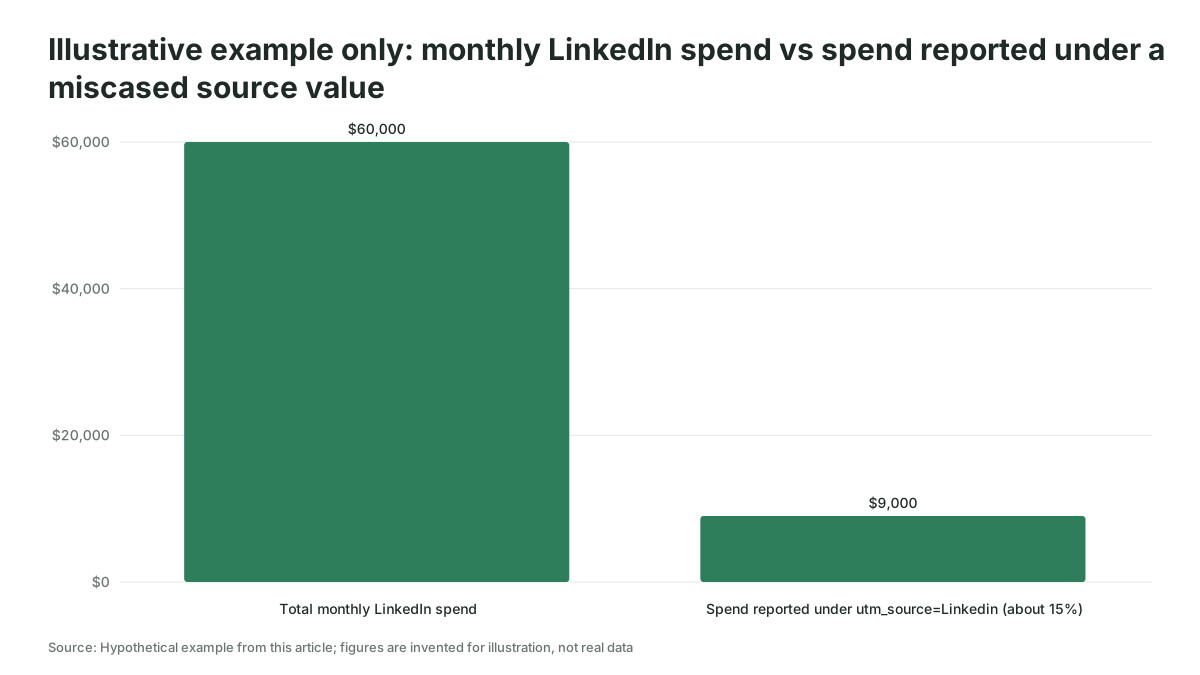
Imagine, as a hypothetical, a team spending $60,000 a month across 40 LinkedIn campaigns of about the same size, with six of them tagged utm_source=Linkedin instead of linkedin. About $9,000 of that month's spend reports under a second source value, the LinkedIn row understates traffic and pipeline by roughly 15%, and the conversation with the CFO about whether LinkedIn is working happens on the wrong numbers. The error cost nothing to make and took one afternoon to find, three weeks too late.
The automated version expands every final URL once a day, parses its parameters, and compares each value against the same table your naming check uses. The model earns its place on the exceptions: it reads a URL whose source value is "li" or "linked-in", decides which canonical value it maps to, and writes the mapping for a person to approve. Google described an agent for part of this problem at Google Marketing Live on May 21, 2025: Marketing Advisor, a Chrome side panel that could identify a missing tag and offer to install it with the advertiser's permission. As of November 2026 we found no public confirmation that it rolled out, so treat tag installation by an agent as a promise rather than a tool you can switch on.
Tagging creatives and search terms is classification, and models do that well
Applying a fixed set of labels to thousands of ads or search terms is the job with the best public evidence behind it. In a 2023 study, Fabrizio Gilardi, Meysam Alizadeh and Maël Kubli found that on a sample of 2,382 tweets, ChatGPT's zero-shot accuracy exceeded that of crowd workers on four of five annotation tasks, its intercoder agreement exceeded that of both crowd workers and trained annotators on all tasks, and the per-annotation cost was under $0.003. Tagging an ad with its hook, offer and format against a label list you wrote is the same shape of task.
The method matters more than the model. Write the label list first, with a one-line definition and one example per label, and keep "unclear" as a legal answer. Ask for the output in a fixed schema: OpenAI's Structured Outputs documentation says the feature "ensures the model will always generate responses that adhere to your supplied" JSON schema, so a tag never arrives as a sentence. Then sample 5% of the tagged rows every week, have a person tag them blind, and track the agreement rate; when it drops, look at the label definitions first, because an ambiguous definition is the usual cause. The weekly search terms review is the same job with three labels, relevant, irrelevant and competitor, and a negative keyword list as the output for a person to approve.
Data hygiene is a proposing job for the model and an applying job for a rule
Normalizing the free-text fields that paid media depends on, job titles, company names, industry and country, is the data hygiene work a model does well. The problem is real: Adverity's September 2025 survey of CMOs across the US, UK, Germany, Austria and Switzerland found respondents believe 45% of the data marketers use to make business decisions is incomplete, inaccurate or out of date. Adverity publishes no sample size for that survey, so treat the figure as how CMOs feel about their data.
Give the model the 400 distinct job title strings in your CRM and the six seniority bands your targeting uses, and it will produce a mapping table in minutes that would take a person a day. Give it company names and it will tell you that "IBM", "I.B.M." and "International Business Machines" are one account. What it should not do is write any of this into the CRM: the table goes to a person who approves it, and the CRM's own rules or an import apply it. Merging duplicate records stays with a person, because a merge is hard to undo and often depends on sales history the model cannot see.
Change audits turn the change history into a Monday digest
Reading the change history of every ad account each week and summarizing who changed what is a job a model can run on its own, because the data is authoritative and the model never writes anything back. Google Ads change history lists changes to the account, campaigns and ad groups from the past two years, with the email of the person who made each change in the User column for changes made in the interface, and changes made through the API by a third-party tool may show the tool's name. For automation, the Google Ads API's change_event resource returns the old and new values of each change, with a date range limited to the past 30 days and a maximum of 10,000 rows per query.
The digest you want is short: every budget change above a threshold you set, every change made outside working hours or by a tool nobody recognizes, and every campaign whose status flipped twice in a week. The query produces the rows and the model writes the three paragraphs that explain them. Few teams read the log by hand, because it is long and nothing is on fire, and it is where you discover that an automated rule has been raising a budget every Tuesday since March.
Pre-launch QA and policy checks happen before review, not after disapproval
Checking ad copy and landing pages against your launch checklist and the platform's policies before you publish is a job a model can run on every launch, because the rule is written and nothing has spent yet. Google says most ads are reviewed within one business day, and an ad that fails review becomes Disapproved, which "means it can't show anywhere". A disapproval on launch day costs you that day, and the days after it if nobody notices.
Your checklist is the prompt: does every claim in the copy appear on the landing page, does the destination match the product in the ad, and is there a date or price that will be wrong before the flight ends. The model reads the ad, the final URL and the checklist, and returns a pass or a list of failures for the person launching. Google is building its own version. On April 21, 2026 it announced Real-Time Policy Reviews in Ads Advisor, described as "instant, in-workflow guidance as you create and edit campaigns", adding that "as always, Ads Advisor will ask for approval before taking action in your account". Google began switching Real-Time Policy Reviews on in late May 2026 for text assets in responsive search ads, in the Google Ads interface and Google Ads Editor, with Performance Max and Demand Gen due in the second half of 2026, as Search Engine Roundtable reported from Google's announcement, so check which of your campaign types it covers.
Monitoring belongs to rules, and the model writes the explanation
Pacing and anomaly alerts should fire from the deterministic rules the platforms already provide, with the model writing the message that explains each alert, and that split is the most important design decision on this list. Google Ads automated rules can "change your ad status, budget, bids, and more" and "trigger automated emails when specific conditions occur". Meta's Marketing API ad rules support execution types including PAUSE, NOTIFICATION and CHANGE_BUDGET, with two safety settings a careful team wants: execution_count_limit caps how many times a budget or bid change can hit one object, and action_frequency sets a minimum gap between repeats, with Meta's own example of 10080 minutes stopping the same budget increase from firing twice in a week.
So the rule pauses or alerts, and the model does the part the rule cannot: it reads the triggered rows and last week's figures, writes the two sentences that say what probably happened, and lists what to check first. The weekly report runs on the same split, where the numbers are computed and only the words are generated, and automating weekly PPC reporting with AI covers that set-up in full.
Written procedures become instructions the model follows every time
The operations documents nobody reads, the launch checklist, the naming convention and the QA steps, are the raw material for the last job on this list: turning procedures into reusable instructions the model loads when the task comes up. Anthropic's Agent Skills documentation describes a skill as a folder with a SKILL.md file of instructions plus optional scripts and reference files, loaded only when a request matches the skill's description, with scripts run so that "only their output enters context". The same documentation warns that skills uploaded to one surface do not sync to the others, so keep one source file and upload it where it is needed.
For an operations lead this means the naming check, the UTM check and the launch checklist each become a skill with the convention table bundled inside, and the person launching asks for the check instead of remembering the steps. The result is only as good as the written procedure, which only your team can supply.
Hours saved are the weakest proof you can bring to the CFO
Self-reported time savings are the number everyone quotes and the one a finance team should trust least. Smartsheet's respondents said AI saves them "over nine hours per week on average", and that is a survey answer rather than a measurement. The sharpest check on that kind of answer comes from software: in METR's randomized trial published in July 2025, 16 experienced open-source developers took 19% longer on 246 real issues when allowed to use AI tools, yet afterwards believed the tools had made them about 20% faster. METR says a February 2026 follow-up with newer tools means that result no longer reflects current impact; the lesson that lasts is the gap between what people felt and what the clock said. The large field study that did find a gain, Erik Brynjolfsson, Danielle Li and Lindsey Raymond's NBER paper on 5,179 customer support agents, found productivity rose 14% on average and 34% for novice workers, with minimal impact on the most experienced. Operations work in a paid team looks a lot like that: the junior who follows the checklist gets faster, and the senior who wrote it does not.
Measure the things a clock cannot argue with. Count the share of live campaigns that pass the naming check, the share of paid sessions landing as (not set) in GA4, the days between a tracking break and its fix, and the number of disapprovals on launch day. Those move within a month of switching the checks on, they appear in reports the CFO already reads, and how to measure the ROI of AI in your paid team explains how to put a dollar figure on the errors they prevent.

Where AI in marketing operations goes wrong
The common failure is letting the model do arithmetic or take an action that a rule or a person should own. A language model will produce a figure whether or not it worked it out: Adam Tauman Kalai and his co-authors argue in their September 2025 paper Why Language Models Hallucinate that "the training and evaluation procedures reward guessing over acknowledging uncertainty". In operations that looks like a pacing summary quoting a spend total the model estimated from a partial export, which is why every number above comes from a query and the model only reads it.
The second failure is governance the model has never seen. In Adverity's July 2026 survey, 24% of marketers said AI tools fail to comprehend or abide by internal data governance and quality rules, which is what happens when the convention table lives in a wiki the model cannot reach. Bundle the rules with the task.
The third is write access granted too early. Anthropic's guidance on custom connectors warns that "malicious MCP servers may include hidden instructions that try to make Claude perform unintended actions" and advises disabling tools that can take write actions during research tasks. Start every job on this list read-only, and keep the jobs that move money with a person for as long as the table above says so.
And the quiet failure is drift. A convention changes, the skill file does not, and the check starts flagging correct names. Put a named owner and a review date on every rule the model enforces, as you would for the automated rules in the ad account.
How Scalewell gets AI running the checks your ops team repeats
Marketing operations is a natural first home for AI in a paid team, since so many of its checks already follow a written rule. Scalewell helps the team move naming checks, tracking QA and the Monday change digest onto AI, so the broken UTM shows up on day one and people spend their Thursday fixing it. The audit scores which check should go first.
A ranked roadmap and a build sprint follow, over typically 8 to 12 weeks. Your team ends up trained to review and adjust every check itself, with a list of the next ones ready to build.
Where to start this week
Pick the naming check, because it needs one export, one page of convention and an afternoon, and within a week it tells you how much of your reporting was built on names that did not match. The rest of the list follows the same shape, and the table above says which jobs the model can run and which it should only propose. Scalewell sets these checks up with paid teams, built around the conventions and tools they already use.
Frequently asked questions
Will AI replace the marketing operations role?
The evidence points the other way. The field study with the clearest gain, 5,179 support agents in the NBER paper, found most of the benefit went to novices and little to experienced staff. In a paid team, AI removes the checking and tagging from the ops role, and the person who writes the conventions and decides edge cases matters more.
Do we need API access or an MCP server before we start?
No, you can start without either. Naming and UTM checks run on scheduled exports or Google Ads scripts writing to a sheet, tagging runs on a CSV, and change audits start from the change history export. API or MCP access matters when you want checks running every hour without anyone exporting, which is a second step.
How do we stop an AI tool from changing the account on its own?
Grant read access only, and keep write actions behind platform rules with limits. Google Ads automated rules and Meta ad rules take the action, and Meta's execution_count_limit and action_frequency settings cap how often a budget change repeats. Google says Ads Advisor asks for approval before acting in an account, and any tool you add should meet that standard.
What is the difference between marketing automation and AI in marketing ops?
Marketing automation follows rules you wrote in advance, such as pausing an ad set when cost per lead passes a threshold. AI reads unstructured material, a job title, an ad, a change log, and produces a judgment, a label or an explanation. The reliable set-ups in this article use both: the rule acts, and the model classifies, proposes and explains.