MCP for marketing: the connections a paid team actually needs
A map of the official MCP servers for ad platforms, CRM, GA4, warehouses and documents, with what each can change and the order to connect them.
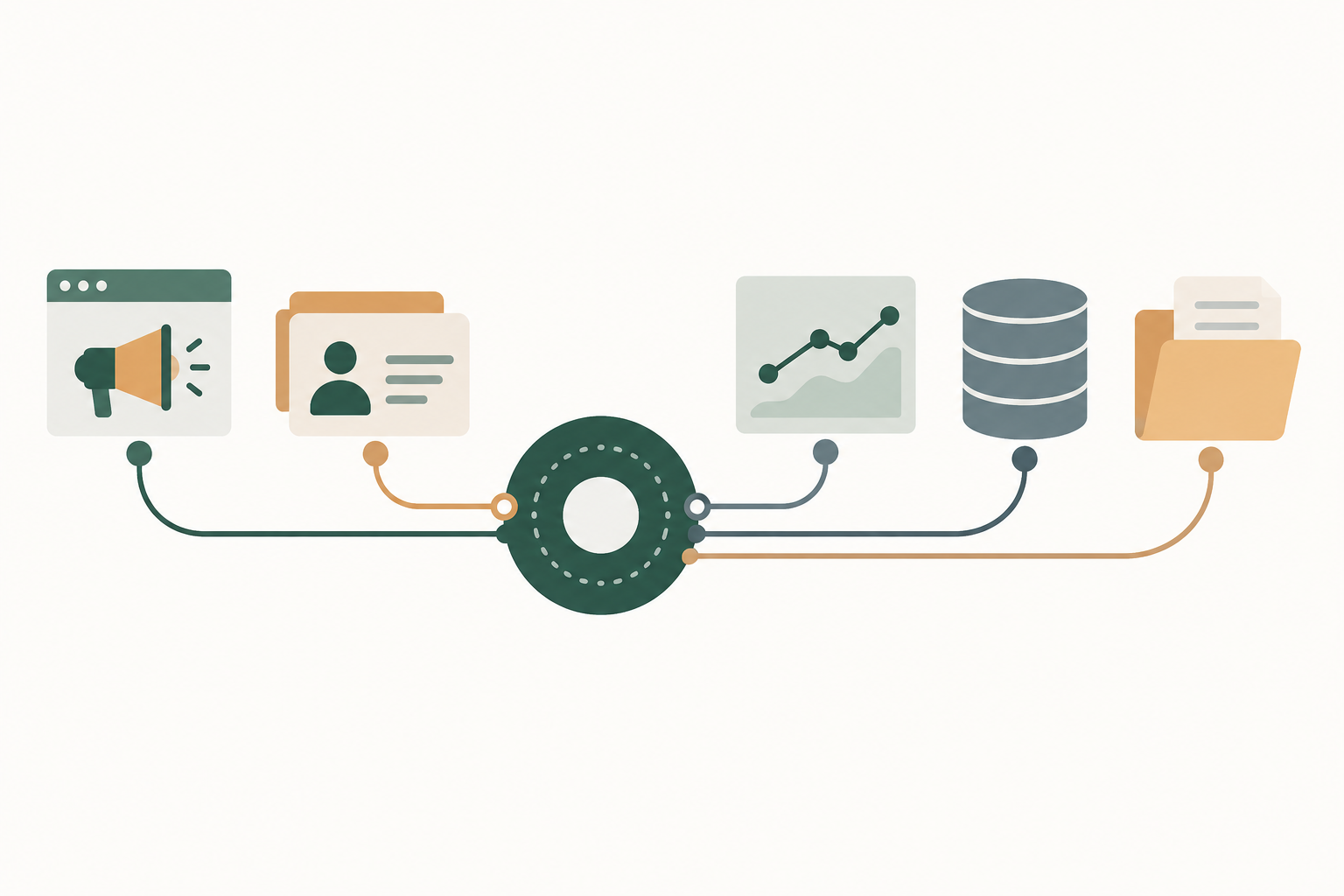
MCP for marketing means connecting an AI client such as Claude or ChatGPT to the systems your team already runs: ad platforms, CRM, analytics, a data warehouse and shared documents. As of November 2026, most of those systems publish an official MCP server, and the order you connect them decides whether the AI answers pipeline questions or only click questions.
Picture the first week after someone on your team connects Claude to Google Ads. The demos are good: spend by campaign in seconds, search terms summarized, a tidy table of cost per conversion. Then the CFO asks which campaigns produced sales opportunities last quarter, and the AI has no way to know, because the opportunities live in your CRM and nobody connected it. The team that connects the CRM gets answers about pipeline, and Scalewell helps marketing teams decide what to connect first and how AI fits into the week once it is.
This article is the map for a marketing leader deciding what to connect. For each system it covers whether an official server exists as of November 2026, what it can read and change, and what can go wrong. It ends with the order we'd connect them in. The step-by-step set-up for each platform lives in our separate guides, linked where they fit.
MCP is a standard plug between an AI client and your software
The Model Context Protocol (MCP) is an open standard, published by Anthropic on November 25, 2024, that lets an AI assistant read from and act in other software through one common interface. A vendor builds one MCP server, and any compatible AI client can use it, so you don't need a separate integration for every pairing of AI tool and marketing tool.
That's the whole idea, and Salesforce's own documentation puts it in one line: "think of it as USB-C for AI integrations" (Salesforce hosted MCP README). Anthropic described the problem before MCP plainly: "Every new data source requires its own custom implementation." For a buyer, the useful consequence is that MCP no longer belongs to one AI vendor. The Linux Foundation took over its stewardship on December 9, 2025, counted more than 10,000 published MCP servers, and listed Claude, ChatGPT, Gemini, Microsoft Copilot, Cursor and VS Code among the platforms that support it. A connection you set up today should survive a change of AI client next year.
Each marketing MCP server answers a different budget question
Every connection gives the AI one slice of the picture, and only the CRM slice contains revenue. The table below summarizes the official route for each system a B2B paid team usually runs, as checked on November 9, 2026.
| System | Official MCP server (November 2026) | What the AI can read | What the AI can change | Main risk | Question it answers |
|---|---|---|---|---|---|
| Google Ads | Yes, open-source, run by you | Any Google Ads Query Language (GAQL) report | Assets and labels only, after a confirm step | Quota and permission errors | What did we spend and on what? |
| Meta Ads | Yes, hosted by Meta, launched in open beta in April 2026 | Reporting and performance insights | Campaigns, ad sets and ads | Spend starting from a chat | What did we spend and on what? |
| LinkedIn Ads | Official server in beta, not yet publicly documented, as of November 2026; a read-only beta plugin in ChatGPT | Ad set performance in the ChatGPT plugin; more through third-party routes | Depends on the route | A third party holds the token | What did we spend and on what? |
| HubSpot | Yes, hosted by HubSpot | CRM records, campaigns, content, attribution | CRM records, campaigns, segments, drafts | Writes to the system of record | Which deals did marketing touch? |
| Salesforce | Yes, hosted by Salesforce | Standard and custom objects | Nothing on the read-only server; read, write and delete on the full one | Deletes on the full server | Which opportunities came from paid? |
| Google Analytics 4 | Yes, open-source, run by you | Reports, funnels, realtime, Google Ads links | Annotations, custom dimensions, key events, if enabled | Low | What happened between click and form? |
| BigQuery | Yes, hosted by Google | Your warehouse tables | Governed by your BigQuery IAM roles | Query cost and access sprawl | All of the above, joined |
| Snowflake | Yes, managed by Snowflake | Semantic views, search, SQL | Read-only SQL by default | Low with defaults | All of the above, joined |
| Google Drive and Docs | Yes, developer preview | Drive files and Workspace content | Not confirmed while in preview | Hidden instructions in files | What are our rules? |
Many "best MCP servers for marketers" lists rank these by tool count. Tool count tells you almost nothing about value, because the question that matters to your CFO, cost per opportunity by campaign, needs two rows of this table at once: an ad platform and the CRM.
Ad platform servers tell you what you spent, never what it bought
All three ad platforms a B2B team leans on now have a route into an AI client, but they differ sharply on who built it and what it can change.
Google Ads. Google's server, googleads/google-ads-mcp, is free open-source software that you run on a laptop or in your own Google Cloud project. It reads anything the Google Ads API can report. Google's developer page lists its mode as "Read and partial mutate" as of November 2026: its v0.0.6 release on November 2, 2026 added the first write tools, for assets and labels, behind a "Propose & Confirm" step that validates a change before committing it, and the README shows how to switch those tools off for a read-only set-up. Our Google Ads MCP guide covers the set-up for Claude and ChatGPT.
Meta. Meta went further. It announced its ads AI connectors in open beta on April 29, 2026, and its developer documentation describes "a Meta-hosted Model Context Protocol server" at mcp.facebook.com/ads whose tools create and edit campaigns, ad sets and ads and pull performance reporting. You sign in with your Facebook account through Facebook Login for Business, and Meta's get started page says plainly: "Owning a Meta app is not a prerequisite on using the ads MCP server." That convenience is also the risk: a server that can activate a campaign can start spending money from a chat window. The Meta Ads MCP guide covers the portfolio rules that cap it.
LinkedIn. LinkedIn's developer site has a "Develop with MCP" page, which points coding agents at API documentation, and LinkedIn is the listed developer of a read-only beta LinkedIn Ads plugin inside ChatGPT. LinkedIn also has its own MCP server that reads and edits ad accounts. As of November 2026 it is in beta and already in use, but LinkedIn hasn't documented it publicly. Every publicly documented Claude route is a third-party server or connector service sitting on the LinkedIn Marketing API, which our LinkedIn Ads MCP guide compares. For B2B teams this matters more than it sounds, since LinkedIn is often the largest line in the paid budget and the one the CFO questions first.
Even with all three connected, the AI can tell you cost per lead and nothing past it. Ad platforms record the form fill. What sales did with that form fill lives somewhere else.
The CRM connection turns ad spend into pipeline
The CRM is the only connection on the list that knows which leads became opportunities and closed revenue, so it's the connection that makes the others worth having. Both major B2B CRMs now publish official servers with sensible guardrails.
HubSpot. HubSpot runs a remote MCP server. Per its developer documentation, authentication uses OAuth with PKCE, and the permission rule is short: "All actions respect your existing HubSpot user permissions." The server reads CRM records, campaigns, content and attribution, and it can write to CRM records, campaigns and segments. The record tool, manage_crm_objects, "requires explicit user confirmation before executing any create or update." Two limits are worth knowing before you promise anything: attribution reports through the server are "scoped to closed-won deal attribution only," and the page lists no tools for HubSpot's ads data. Our HubSpot MCP guide covers how to tie paid spend to pipeline with it.
Salesforce. Salesforce's hosted MCP servers are generally available, per its GitHub README, and Salesforce's availability notes say they require Enterprise Edition or above, with Developer Edition orgs also eligible. An admin switches each server on in Setup. The design choice we like is the split between servers. The sobject-reads server exposes only read operations, and Salesforce's own security wiki says "there is physically no tool available that can create, update, or delete a record." The sobject-all server reads, writes and deletes. Either way, the agent inherits the signed-in user's permissions, and any record it edits shows that user's name in the audit trail.
Why does this matter so much? Two ads can have almost the same cost per lead and very different costs per opportunity, and an AI connected only to LinkedIn will call them equal, because it never sees the opportunities.
GA4 fills the gap between the click and the form
Google's official Google Analytics server, googleanalytics/google-analytics-mcp, reads GA4 reports and is free open-source software that you run yourself. Its README lists read tools including run_report, run_funnel_report, run_realtime_report and list_google_ads_links. It also has three write tools, for property annotations, custom dimensions and key events, which only work when you start the server with an --allow-write flag and grant the analytics.edit scope. Google lists no hosted endpoint for it as of November 2026, so you run it on your own machine or deploy it to your own cloud, for example Cloud Run.
GA4 answers the middle of the journey: which landing pages convert, where paid sessions drop out, whether the conversion your ad platform reports matches the one GA4 saw. It doesn't know about opportunities, so treat it as a diagnostic connection rather than a source of truth for budget calls. Our GA4 MCP guide covers the set-up and the questions it handles well.
A warehouse is where the join belongs once the questions repeat
A data warehouse server lets the AI query tables your team has already joined, instead of matching ad and CRM records itself inside a chat. Both large warehouses now offer managed servers.
Google lists a remote BigQuery MCP server at bigquery.googleapis.com/mcp on its supported products page, and its set-up documentation requires the MCP Tool User role on the Google Cloud project on top of normal BigQuery permissions. Snowflake made its managed MCP server generally available on November 4, 2025, and its documentation says the SQL tool's read_only option defaults to true, allowing only SELECT queries.
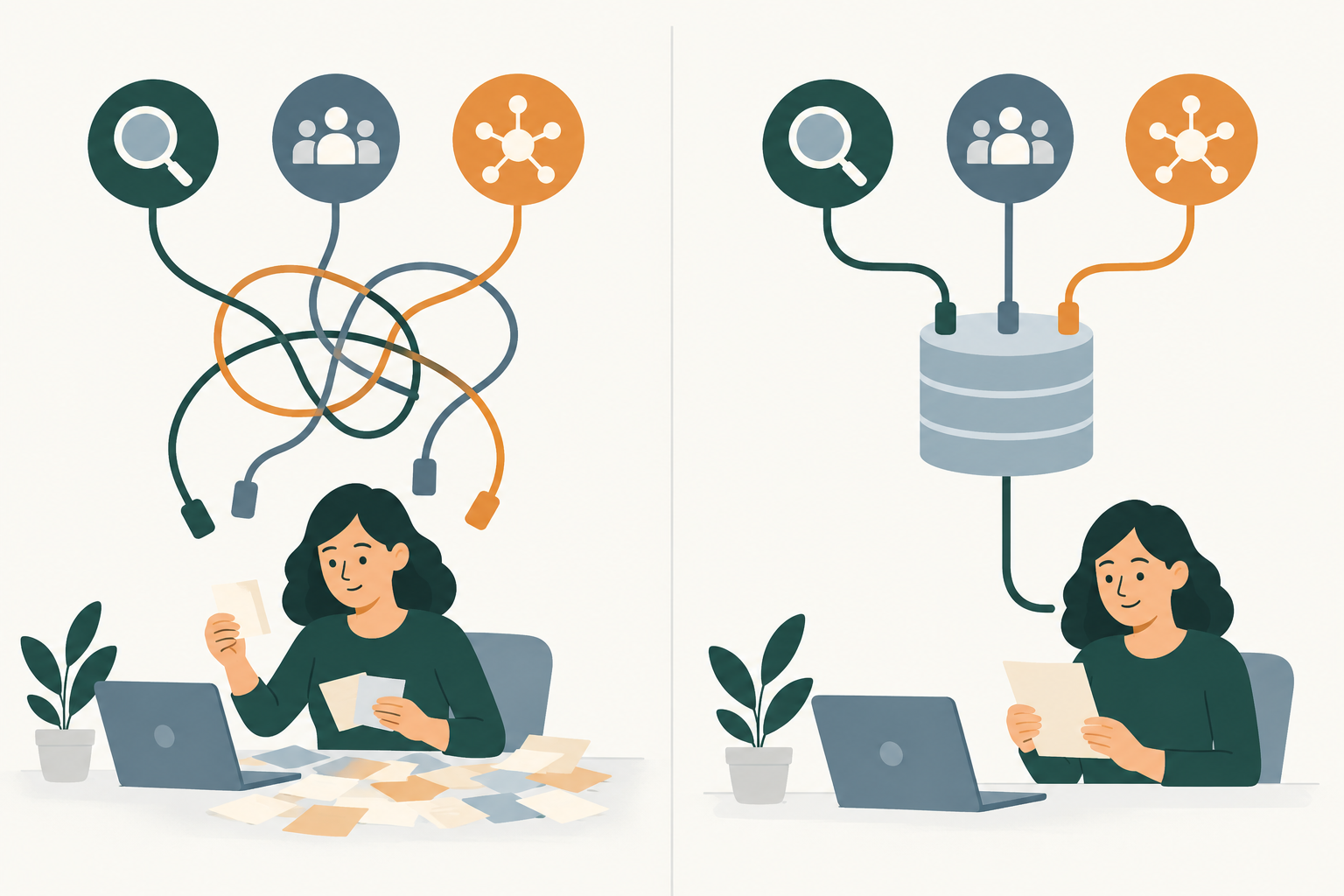
Here's a hypothetical to show the difference. Company A connects Google Ads, LinkedIn and HubSpot separately and asks the AI every Monday for cost per opportunity by campaign. Each week the model has to match campaign names to UTM values to CRM records again, and each week it can match them slightly differently. Company B has an analyst build one table in BigQuery that joins spend to opportunities by campaign ID, and connects the AI to that table. Company B's answer is the same on Monday as on Friday. If you're asking the same cross-system question more than a couple of times a month, the join belongs in the warehouse.
Documents give the AI your rules at the lowest risk
A documents connection lets the AI read your media plan, naming conventions, brand rules and past reports, which turns generic answers into answers that follow how your team works. Google lists MCP servers for Drive, Docs, Sheets and other Workspace apps on its supported products page, all marked developer preview as of November 2026.
Documents carry one risk that ad platforms don't. Anthropic's custom connector guidance carries this warning: "Malicious MCP servers may include hidden instructions that try to make Claude perform unintended actions." A shared folder full of files from outside the company raises the same concern. Connect the folders your team owns, and keep them separate from the folder where vendors drop their decks.
Connect in this order: CRM, ad platforms, analytics, warehouse, then writes
The order below puts the questions your CFO asks first and the changes that cost money last. Each step should end with something your team can check against a number it already trusts.
- Connect the CRM read-only. Use Salesforce's
sobject-readsserver or HubSpot with a user whose permissions you're comfortable with. Ask for last quarter's opportunities by original source and check the count against your CRM report. - Connect each ad platform read-only. Start with the platform that takes the most budget. Ask for last week's spend by campaign and reconcile it with the platform's own interface before asking anything harder.
- Ask the joined question. With both connected, ask for cost per opportunity by campaign for one quarter, and have someone check five campaigns by hand. Where the AI can't match records, you've found a tracking gap worth fixing regardless of AI.
- Add GA4 when you need to explain a gap. Use it to diagnose why a campaign's leads don't convert, not to decide the budget.
- Move the join to the warehouse once the question repeats. Build the table once and connect the AI to it.
- Turn on writes last, one platform at a time. Start with changes that cost nothing to reverse, such as labels, and keep a person approving anything that starts or raises spend.
One more decision sits across every step: who holds the login token. Official servers keep it with you or with the platform. Connector services, which cover several platforms behind one sign-in, hold the token themselves, which can be the right trade for a team with no engineer, as long as your security lead has reviewed the vendor first.
Most marketing MCP set-ups go wrong on permissions and joins
The common failures are dull ones, which is partly why they get missed. None of them is a reason to wait, but each is a reason to start read-only.
Broad permissions. The MCP security guidance lists the risk of broad scopes in one line: "Expanded blast radius: stolen broad token enables unrelated tool/resource access." Sign in with the narrowest role that answers the question, such as a viewer role on ad accounts.
Clicking "Allow always". Anthropic advises using it only for "a server and tool that you trust to run unsupervised." For any tool that can change an ad account, approve each call by hand until you've watched it behave for a few weeks.
Campaign names that don't match. If your UTM values, campaign names and CRM source fields follow three different conventions, the AI's joined answer will be confidently wrong in places. That's a tracking problem the AI exposes; it can't fix it from a chat.
Plan limits. Free Claude accounts are limited to one custom connector, and on Team plans only Owners and Primary Owners can add one. A pilot run on someone's personal account won't survive contact with procurement.
Who shouldn't bother yet? A team whose CRM doesn't record which campaign created an opportunity. Connect the ad platforms by all means, but the pipeline question has to wait until the CRM can answer it for a human first.
The first connection to make this month
Pick the CRM, connect it read-only, and ask it one question you already know the answer to. If the number matches, add your largest ad platform the following week. Scalewell sets up these connections and the joined reporting behind them for paid media teams, if you'd rather have the order handled for you.
Frequently asked questions
Do I need a developer to set up MCP for marketing?
You don't need one for the hosted servers. Meta's, HubSpot's and Salesforce's servers are hosted by the vendor, so set-up is mostly signing in and approving access, though Salesforce needs an admin to switch servers on. Google's Ads and Analytics servers run on your own machine or cloud, which is easier with someone comfortable at a command line.
Is an MCP server the same as an API?
They're related but different. An API is the interface a platform exposes to software, and an MCP server is a layer on top that describes those API calls as tools an AI client can choose from. Google's Ads server, for example, calls the Google Ads API underneath. The API's rules, quotas and access levels still apply through MCP.
Can ChatGPT use the same MCP servers as Claude?
Yes, MCP is client-neutral, so the same remote server can connect to both. ChatGPT lets you add a custom remote server, and OpenAI's developer documentation puts the condition in one line: "Account and workspace policies apply to adding and using custom MCP servers." Plan availability differs between the two clients and changes often, so check your plan's current help pages before a pilot.
What does MCP for marketing cost?
Google's Ads and Analytics servers are free open-source software, and the vendor documentation we read lists no separate charge for the hosted servers as of November 2026. Your costs come from the AI client plan, the underlying platform subscriptions, any cloud hosting you run, and warehouse compute when the AI queries BigQuery or Snowflake. Third-party connector services charge their own subscriptions.