AI implementation roadmap for B2B marketing: how to score and order AI jobs over 12 months
A scoring model, a filled-in hypothetical 12-month roadmap and the gate and board number for each quarter, so a B2B marketing leader can defend the order of AI work to finance.

An AI implementation roadmap for a B2B marketing team is a ranked list of recurring jobs, scored on value, effort, risk, data readiness and dependency, then placed into four quarters with a gate between each. The first quarter takes the safe, frequent jobs. Pipeline jobs follow once CRM data reaches the ad platforms.
You'll know why this matters if you've sat through the planning meeting where every idea gets a slot. Someone wants an agent that moves budgets, someone else wants AI-written ads, the ops lead wants the CRM cleaned first, and the slide that comes out of it has eleven pilots, no order and no end dates. Six months later the CFO asks which of them paid back, and the honest answer is that most never finished.
This guide is written for marketing leaders, from the CMO to the head of demand gen, who have to decide what order to do AI in, defend that order to finance, and change it when the facts change. It gives you a scoring model, a filled-in hypothetical 12-month roadmap, the gate that ends each quarter and what the board should see at each one. It starts where a list of opportunities already exists and stops short of the build itself.
A 12-month AI roadmap is a ranked list of jobs with a gate between quarters
The roadmap that holds up in a budget review names the jobs AI will take on, the order they go in, and the result that has to show before the next quarter starts. Most enterprise AI roadmap templates draw phases (assess, pilot, scale, optimize) and leave out the order of the actual work, which is the one decision a marketing leader gets judged on.
The evidence says finishing a few jobs matters more than starting many. McKinsey's state of AI in 2026 survey of 1,719 people, fielded from May to June 2026, found that 80% of respondents say AI has improved their own productivity, while only 37% attribute any EBIT impact to it. The small group McKinsey calls high performers, about 6% of respondents, were twice as likely as others to have defined processes for measuring the impact of their AI initiatives. Personal speed is easy to get; company results come from an order of work with a measured result at each step.
Scalewell helps marketing leaders get to a ranked roadmap like this one, so the team spends the year building the jobs that pay back first rather than debating which pilot to try next.
The list you rank comes from somewhere. If you haven't yet audited the team's week to find the recurring jobs and the hours behind them, work through an AI opportunity assessment of the team's week, then come back with the list.
AI use case prioritization scores five things: value, effort, risk, data readiness and dependency
AI use case prioritization works best as a shared scoring model that everyone, including finance, can read. Gartner's Melanie Freeze, discussing a survey of 782 infrastructure and operations leaders published in April 2026, put it plainly: "A shared scoring model makes it easy to compare and rank all use cases" (Gartner). The same survey found only 28% of AI use cases in that function fully succeeded and met ROI expectations. That's IT, not marketing, but the lesson about scoring travels.
Score four factors from 1 to 5, with 5 always the good end, and treat the fifth as a rule rather than a number.
| Factor | 1 looks like | 3 looks like | 5 looks like |
|---|---|---|---|
| Value (hours back and pipeline touched) | Under 5 hours a month, no pipeline decision | 10 to 20 hours a month, or feeds a reporting decision | 30+ hours a month, or changes where budget goes or what sales receives |
| Ease (effort to build) | A new system, three months or more | 4 to 6 weeks, one new connection | Runs in tools you already own within two weeks |
| Safety (cost of a mistake) | Moves spend or reaches buyers with no review | Changes something you can undo | Output is read by a person; a mistake costs nothing |
| Data readiness | The data isn't captured, for example opportunities not tied to campaigns | Data exists but needs manual exports | Data is clean and reachable through a connector |
| Dependency | A rule: a job can't be scheduled before the jobs it relies on are live |
The example weighting below doubles value, so a job's score is (2 × value) + ease + safety + data readiness, out of 25. Doubling value is a choice your team can change, and here's why it's worth making: without it, a cheap, safe job that nobody would miss climbs to the top of the list. Product teams will recognize the shape from Intercom's RICE framework, with data readiness playing the part RICE gives to confidence.
Dependency stays outside the sum on purpose. A high-scoring job that needs another job finished first simply waits, and the job it depends on moves earlier even if its own score is middling. That one rule explains most of the sequencing decisions in the roadmap below.
A hypothetical B2B team scores ten marketing jobs
Here's how the scoring looks for an imagined B2B software company with a five-person paid team, spend across LinkedIn, Google and Meta, and a 6-month sales cycle. Every score is hypothetical and belongs to that team, not to a benchmark.
| Job | Value | Ease | Safety | Data | Score | Depends on |
|---|---|---|---|---|---|---|
| Weekly paid performance report | 4 | 5 | 5 | 4 | 22 | None |
| Pacing and tracking alerts | 3 | 5 | 5 | 5 | 21 | None |
| Search term review and negative keyword candidates | 3 | 4 | 4 | 5 | 19 | None |
| Opportunity stages synced from CRM to ad platforms | 5 | 2 | 4 | 2 | 18 | None |
| Budget reallocation recommendations (a person moves the money) | 5 | 3 | 3 | 2 | 18 | Opportunity sync |
| Competitor ad monitoring digest | 2 | 5 | 5 | 4 | 18 | None |
| Creative pre-check against brand and legal rules | 3 | 4 | 4 | 3 | 17 | None |
| Lead qualification and routing | 5 | 2 | 2 | 3 | 17 | Opportunity sync (shared stage definitions) |
| Monthly board pack with pipeline from paid | 4 | 2 | 4 | 2 | 16 | Opportunity sync |
| Agent moves budget within set limits | 5 | 1 | 1 | 2 | 14 | Recommendations passing their gate |
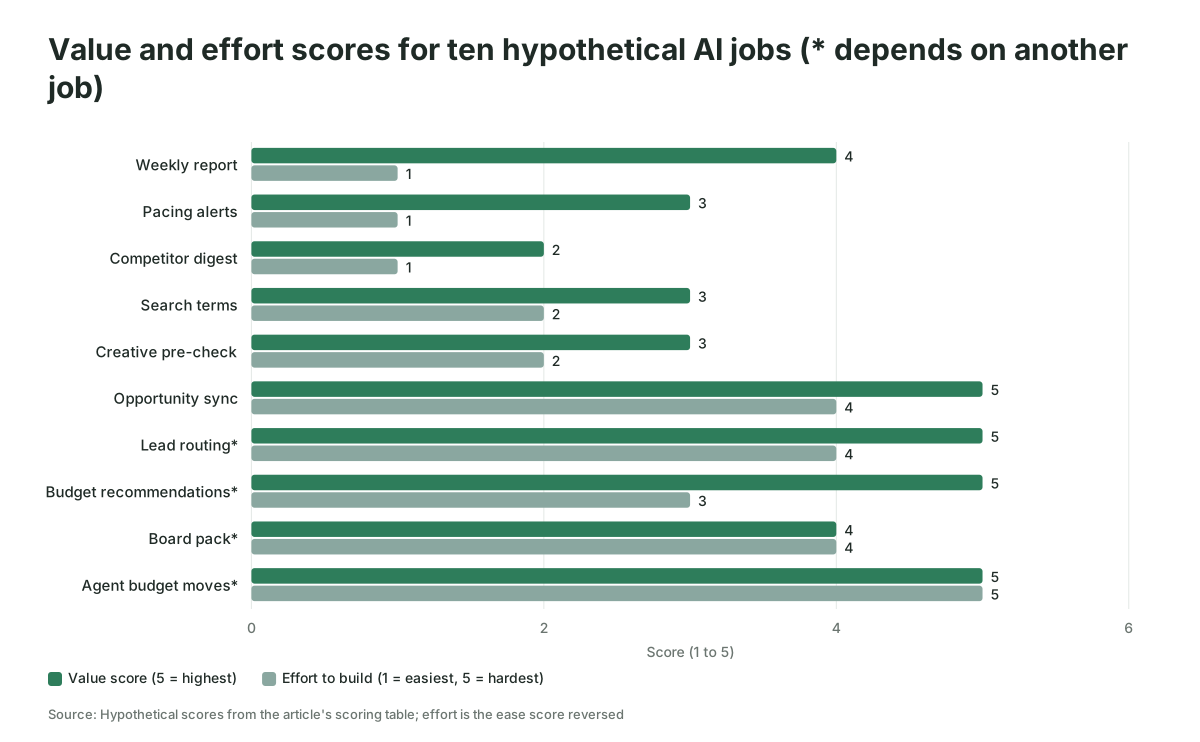
Three things stand out. The opportunity sync scores only 18, yet three later jobs depend on it, so it starts building in the first quarter. The competitor digest ties with it on score with a value of 2, which makes it the filler you run when someone has spare capacity, never the headline. And the agent that moves budget alone sits at the bottom, which fits Gartner's forecast of June 25, 2025 that over 40% of agentic AI projects will be canceled by the end of 2027, due to escalating costs, unclear business value or inadequate risk controls (Gartner).
For the paid-media-only version of this ranking, with ten account tasks ordered by the cost of a mistake, see which paid media tasks to automate first. This roadmap sits one level up, across reporting, data, sales handoff and the board.
The filled-in 12-month AI implementation roadmap, quarter by quarter
The 12-month roadmap below takes the ranked list and fixes the order, starting the slow dependency early and leaving the riskiest job for a decision at month ten. It's hypothetical, and the gate numbers are examples the imagined team chose.
| Quarter | Jobs that go live | Why this order | Gate to start the next quarter |
|---|---|---|---|
| Q1 (months 1 to 3) | Weekly report, pacing and tracking alerts, search term review; opportunity sync starts building | Highest scores, no dependencies, mistakes cost nothing; the sync is slow, so it starts now | The three jobs run for the whole team for four straight weeks at a third fewer hours than the baseline, with no spend errors traced to them |
| Q2 (months 4 to 6) | Opportunity sync live, creative pre-check; competitor digest if capacity allows | Three later jobs need the sync; the pre-check is safe and frees review time | Opportunity stages reach Google, LinkedIn and Meta weekly for the campaigns that carry most of the spend, and sales agrees the stage definitions |
| Q3 (months 7 to 9) | Re-rank, then budget reallocation recommendations, lead qualification and routing, monthly board pack | Their data readiness rises once the sync is live, so they move up | Cost per opportunity holds or improves for two months while the new jobs run, and the routing meets the speed-to-lead target sales set |
| Q4 (months 10 to 12) | All jobs running with named approvers; decide on the budget agent; draft next year's ranked list | Autonomy follows the recommendations' record, whatever the date | The team accepted about nine in ten budget recommendations unchanged over the quarter before any agent acts within limits |
The first quarter is covered step by step in our 90-day guide to rolling out AI in a paid media team, so it isn't repeated here. What matters for the year is that Q1 also starts the opportunity sync, because a slow job that three others depend on can't wait for the quick wins to finish.
Why does the Q3 re-rank move three jobs up? When the opportunity sync goes live, the data readiness of the three jobs that depend on it rises to about 4. Budget recommendations reach 20 and the other two reach 18, level with or above every job not yet live.
Gates written in advance decide when the next quarter starts
A gate is a result written down before the quarter begins, and the next quarter's jobs don't start until it shows. If the Q1 gate fails, Q2 waits while you fix the cause, which is usually a workflow only one person uses or a report the team still checks by hand.
Gates protect the roadmap from its most common failure: piling new jobs onto ones that never settled. Gartner's I&O survey found that among leaders reporting at least one failure, many "expected too much, too fast", and 38% of the I&O leaders surveyed named poor data quality or limited data availability as a direct cause of AI project failure. A gate on data (Q2) before the jobs that need data (Q3) is the cheapest insurance against both.
Moving a job from pilot to everyday use is its own problem, with its own reasons for stalling. Our guide to getting from AI pilot to production covers the build sprint that gets one job across that line. The roadmap's job is to say which one goes next.
The board sees a different number each quarter
The board update for an AI program should change with the roadmap, because the evidence a quarter can produce changes. Promising pipeline in month three is how a good program gets judged a failure.
| Quarter | Headline number for the board | What it proves | What not to claim yet |
|---|---|---|---|
| Q1 | Hours per week on the three jobs, before and after; errors caught | The team can run AI jobs reliably | Any pipeline effect |
| Q2 | Share of paid spend whose campaigns now receive opportunity data; what the freed hours were spent on | The data foundation for pipeline decisions exists | Cost per opportunity changes |
| Q3 | Cost per opportunity and pipeline from paid, plus speed to lead | AI-assisted decisions aren't hurting pipeline, and early signs of improvement | Full revenue impact |
| Q4 | Pipeline trend, the program's cost against hours and pipeline, next year's ranked list | Whether to fund year two, and which jobs | A closed-revenue return on journeys still in progress |
The caution in Q3 and Q4 has a number behind it. Dreamdata's 2026 benchmark, announced on March 10, 2026, put the full B2B customer journey at 272 days (PR Newswire). A decision changed in month seven may not show in closed revenue until well into year two. Funding year two is a budget decision, and B2B marketing budget planning covers how to split and reforecast the paid budget around results like these.
Enterprise AI roadmaps go wrong in four predictable ways
AI roadmaps fail for organizational reasons far more often than technical ones, and the four below are the ones to plan against.
Too many jobs at once. McKinsey's authors describe the trap for every organization as "simply accumulating tools or pilots" instead of building a repeatable way to turn them into new ways of working. If more than three jobs go live in one quarter, nobody owns the fourth.
Ranking by excitement. Agents that act alone are the most interesting job on every list and, in the scoring above, the least ready. Gartner's Anushree Verma described most agentic projects in 2025 as "mostly driven by hype and are often misapplied". Let the score put them where they belong.
Building on data the team doesn't trust. In Gartner's 2026 CMO Spend Survey, only 30% of CMOs felt their organizations had the infrastructure to become AI leaders, as Marketing Dive reported on May 11, 2026. Score data readiness honestly, because a job built on data the team doesn't trust ends up being checked by hand.
Treating the roadmap as finished. The order set in January is a forecast. The data, the platforms and the team all change, and a roadmap nobody re-ranks becomes a list of commitments to jobs that no longer score.
How Scalewell turns a long list of AI ideas into an order of work finance can follow
Scalewell gives marketing leaders a roadmap that ranks each AI job on time saved and pipeline, so the year's order is settled before anything is built. It begins with a free 30-minute call; next, an audit of your team's week maps every recurring job and scores which one AI should handle first.
That scoring becomes the ranked roadmap, and a build sprint then sets up the highest-ranked jobs in the tools your team already runs, with new systems only where needed. Expect 8 to 12 weeks, sometimes longer, with B2B paid media practitioners doing the work. Your people finish with AI handling real jobs, the next ones queued, and the skills to run and change it without relying on Scalewell.
Re-rank the roadmap every quarter and whenever one of four things changes
Re-score every job on the list at each gate, and do it out of cycle when one of four triggers fires. Gartner's survey of 360 organizations, published in November 2025, found that those running regular assessments of AI system performance and compliance were over three times more likely to achieve high generative AI value (Gartner). A quarterly re-rank is the planning version of the same habit.
The four triggers are worth writing into the roadmap itself:
- A dependency goes live. Jobs waiting on it gain data readiness and usually move up, as the Q3 example shows.
- A platform ships the job for you. When an ad platform or your CRM releases a native feature that does a job on your list, drop the job or rescore its value, because building your own version of a free feature is money spent twice.
- A job fails its gate twice. Lower its ease or data score to reflect what you learned, and let the next job through.
- The team or the target changes. A new head of paid, a new sales motion or a new pipeline target changes what value means, so the value column needs rescoring.
Keep the old rankings. A year of quarterly scores shows the board how decisions were made, which is often more persuasive than any single result.
Where to start
Take your list of recurring jobs, score each on the five factors with your head of paid and your ops lead in one session, and circle the dependency that has to start building in the first quarter. Scalewell helps teams do that scoring, build the first jobs and keep the order honest as the year goes on.
Frequently asked questions
What should an AI roadmap for business include?
An AI roadmap for business should include the ranked list of jobs, the score behind each rank, the quarter each job goes live, the named owner, the gate result that ends each quarter, and the date of the next re-rank. Add the budget per quarter and what the board will see. A phase diagram without these is only a timeline.
How long does an AI transformation roadmap take in a marketing team?
Twelve months is a sensible first horizon for a marketing team, because it leaves room to build the data foundation and then run pipeline-facing jobs on it. Closed-revenue evidence usually arrives in year two, given B2B journeys of around 272 days, so plan the second year's ranked list before the first year ends.
Who should own the AI adoption roadmap in marketing?
The CMO or VP of Marketing should own the order of jobs and the gates, because those are budget decisions. Each job then needs its own owner, usually in paid media or marketing operations, who answers for whether it passes its gate. Finance should review the scoring once a year so the value column means the same to both sides.
What is the difference between an AI roadmap and an AI implementation plan?
The AI roadmap sets the order of jobs across a year and the gates between quarters. An implementation plan covers how one stretch of that roadmap gets done: who logs time, which tool is approved, what access each job gets. Most teams need the roadmap first and a detailed plan for the coming quarter only.
What are the phases of an AI adoption roadmap?
Most AI adoption roadmaps name four phases: assess, pilot, scale and optimize. In a marketing team they map onto quarters: safe operational jobs first, then the data foundation, then pipeline-facing jobs, then decisions about autonomy and next year's list. The phase names matter less than the gate result that ends each one.