The AI business case for B2B paid media: costs, returns and how to put it to a CFO
A filled-in AI business case for a B2B paid team, with November 2026 prices, a breakeven-hours test, payback, sensitivity and the questions a CFO will ask.

An AI business case for a B2B paid media team is a one-page argument that one named AI job will pay back its full cost within a stated period. It lists every cost line, counts only the returns finance can check, shows the hours needed to break even, and says when the money stops if it does not.
You usually write one because the CFO has already asked. Picture the exchange, imagined but familiar: the CFO asks what the $50,000 for AI buys and when it comes back, and the answer starts with how much faster the team will feel. That conversation ends with "come back with numbers," and most marketing leaders then go looking for an ROI calculator that was built to sell software.
This guide is for the CMO, VP Marketing or head of demand gen who has to make that case before any money is spent. It gives you the cost lines with prices as of November 2026, the return lines a CFO will accept, a filled-in template for a hypothetical four-person paid team, a sensitivity test and the questions finance will ask. Measuring the return after launch is a different job, covered in our guide to AI marketing ROI.
Fund one AI job first, not an AI program
The safest business case for AI asks for enough money to put one recurring job into production, with a review date and a rule for stopping, because the record on larger AI bets is poor. IBM's 2025 CEO Study, a survey of 2,000 CEOs run between February and April 2025, found that only 25% of AI initiatives had delivered their expected ROI over the previous few years and only 16% had scaled across the enterprise.
The cancellations tell the same story from the other end: Gartner forecast on June 25, 2025 that over 40% of agentic AI projects will be canceled by the end of 2027, due to escalating costs, unclear business value or inadequate risk controls (Gartner). The first two are business case failures, because nobody wrote down the full cost or said what value would count.
So shrink the ask. A program-sized request ("AI across the marketing team") forces the CFO to judge something nobody can measure, while a request to automate the weekly cross-channel report gives them a baseline, a cost and a date. Scalewell helps marketing leaders take a case built on their own team's measured week into that budget meeting, choosing with them the job AI takes on first and the test it will be judged by.
To pick that first job, rank candidates by what a mistake would cost before you rank them by hours, as our list of which paid media tasks to automate first sets out, and get the hours from an AI opportunity assessment of the team's real week rather than from memory.
The cost of AI implementation is mostly people time
The full cost of an AI implementation in a paid team has six lines: tools, model usage, data connectors, the build, training and the hours people spend reviewing what the AI produces. Seats and usage are the lines everyone remembers, and they are usually the smallest.
Here is what each line costs, with public prices checked in November 2026 and every hour priced at the loaded rate described below.
| Cost line | What it covers | Price or method (as of November 2026) | One-off or recurring |
|---|---|---|---|
| AI assistant seats | The chat client the team works in | Claude's Team plan, as one example: $20 a standard seat a month billed annually, $25 billed monthly, for 2 to 150 people | Recurring |
| Model usage | API calls when an agent reads accounts on a schedule | Claude Sonnet 5.5, as one example: $2 per million input tokens and $10 per million output tokens | Recurring |
| Data connector | Getting ad platform data to the AI | Supermetrics Starter, as one example: €52 a month billed monthly or €39 billed yearly, for 2 data sources, 1 destination and 1 user | Recurring |
| Build | Designing and building the job, inside or with outside help | Internal hours at loaded cost plus any outside fee | One-off |
| Training | Teaching people to use and adjust the job | Hours per person at loaded cost | One-off, with a small refresher |
| Review and upkeep | Checking outputs before they go live, fixing what breaks | Hours a week at loaded cost | Recurring |
Model usage surprises people by how small it is. A hypothetical agent that reads 200,000 tokens of account data and writes 10,000 tokens of summary every day costs about $0.50 a day at those Sonnet prices, roughly $180 a year. Budget more for retries and growth, but this line rarely decides the case.
Connectors are where plans quietly change price. The Supermetrics Starter tier above covers two data sources, so a team that runs Google Ads, LinkedIn Ads and Microsoft Advertising needs extras or the next tier, which the same page lists as Growth, with 7 data sources, at €159 a month billed yearly or €199 billed monthly. Check the source count against your channel list before the number goes in the case.
People time needs a loaded rate, because a salary leaves out what the company pays on top of it. In the Bureau of Labor Statistics' Employer Costs for Employee Compensation release of September 9, 2026, covering June 2026, wages and salaries were 70.0% of private-industry employer compensation costs and benefits the remaining 30.0%. Dividing a $100,000 salary by 0.70 gives about $142,900 a year, or about $76 an hour across 1,880 working hours. Ask finance for its own figure if it has one, because the CFO will trust their number over yours.
Add a contingency line for risk. Builds run long, a platform changes its API, and a job sometimes needs a second pass before people trust it. Twenty percent of the build cost is a reasonable hypothetical allowance, and listing it yourself takes the question away from finance.
The return lines are hours back, decisions made on pipeline and tests that conclude
The returns from an AI job in a paid team come in three kinds, and only the first belongs in the base case. Hours back are measurable within weeks. Decisions made on pipeline and a higher test throughput are often worth more, but they take a sales cycle to show and they go in a separate upside column.
Hours back count at the loaded rate only when they turn into cut spend or named work. A specialist who saves five hours on the weekly report and spends three of them running a new search-term review has produced three hours of value you can name; the other two vanished into a calmer week and count as zero. In the template below, 60% of saved hours are redeployed, a hypothetical share you should replace with your team's own plan.
Decisions made on pipeline are the reason most leaders want AI in the first place: budget moved because one LinkedIn campaign produced opportunities and another produced form fills. That value is real and very hard to price in advance. Dreamdata's 2026 LinkedIn benchmarks release of March 10, 2026 put the whole B2B buyer journey at 272 days, so a better budget call made in month three may not show as closed revenue inside year one at all.
Tests that conclude are the third line. If AI takes over test setup and readouts, the team may finish six tests a quarter instead of two, and some of those will find a better ad or audience. Write the test count into the case as a target and leave its revenue effect in the upside column.
That split is the point of the exercise. A case that only pays back if the pipeline line comes good is a bet, and a CFO is entitled to price it as one.
A filled-in AI business case template for a four-person paid team
The template below is filled in for a hypothetical company, and every figure in it is invented to show the arithmetic. Imagine a B2B SaaS company with a paid team of four, a head of paid media and three specialists, running Google Ads, LinkedIn Ads and Microsoft Advertising. A two-week time log shows each person spends about seven hours a week on the weekly cross-channel report, pacing checks and search-term reviews.
| Field | Filled in (hypothetical) |
|---|---|
| The job | AI drafts the weekly cross-channel report, flags pacing problems daily and proposes search-term exclusions for a person to approve |
| Baseline | 7 hours a week per person on those tasks, from a two-week time log |
| Expected saving | 5 gross hours a week per person once live, 46 working weeks a year |
| Hours counted | 60% of saved hours, redeployed to a new weekly test readout; 40% absorbed at zero |
| Loaded rate | $76 an hour ($100,000 salary divided by 0.70, over 1,880 hours) |
| One-off costs | Outside build $18,000; internal build 80 hours, $6,080; training 4 people at 10 hours, $3,040; contingency at 20% of the build, $4,816. Total $31,936 |
| Recurring costs a year | 4 seats at $25 a month, $1,200; model usage allowance, $600; connector covering three platforms, treated as $2,200; review 1 hour a week per person, $13,984; upkeep 50 hours, $3,800. Total $21,784 |
| Monthly value once live | 4 people x 5 hours x 60% x $76 x 46 weeks, divided by 12: $3,496 |
| Monthly recurring cost | $21,784 divided by 12: $1,815 |
| Monthly net | $1,681 |
| Payback period | $31,936 divided by $1,681: 19 months after go-live |
| Year-two net | $1,681 x 12: $20,168 on $21,784 of recurring cost |
| Breakeven | 2.6 gross hours a week per person covers recurring costs; 6.4 would also recover the one-off costs within 12 months |
| Upside, not counted | Budget decisions made on opportunities rather than leads; test count rising from 2 to 6 a quarter |
| Stage gate | Release the build budget after a four-week pilot on the report alone shows at least 3 gross hours saved per person |
| Kill rule | Stop if logged savings are under 2.6 hours a week per person at month four after go-live |
| Owner and review dates | Head of paid media; reviews at 30, 90 and 180 days after go-live |
The breakeven row is the one to lead with in the meeting. It turns "will AI save time" into a narrower question: will this job save more than about two and a half hours a week per person, against a baseline of seven? The CFO can judge that, and you can test it in a month.
A 19-month payback is also an honest result. Deloitte's AI ROI survey of 1,854 executives in Europe and the Middle East, fielded in August and September 2025, found most reached satisfactory ROI on a typical AI use case within two to four years, against the seven to 12 months expected of technology investments. Only 6% reported payback in under a year.
Sources on this disagree, and a CFO may raise the more cheerful one. Google Cloud's 2025 study of 3,466 senior leaders, commissioned by Google Cloud, found 74% of executives reporting ROI within the first year. Both are self-reported, and neither is about paid media, which is why your own breakeven number carries more weight in the room than either.
Payback and sensitivity: what happens if the hours saved are half
An AI cost benefit analysis is only as good as its worst plausible case, so run the same template with the assumptions a skeptic would choose. The table changes one input at a time from the hypothetical base case above.
| Scenario (hypothetical) | Monthly net | Payback after go-live | Year-two net |
|---|---|---|---|
| Base case: 5 hours saved, 60% counted | $1,681 | 19 months | $20,168 |
| Hours saved are half (2.5 hours) | minus $67 | Never | minus $808 |
| One-off costs run 50% over ($47,904) | $1,681 | 28.5 months | $20,168 |
| 80% of saved hours counted | $2,846 | 11.2 months | $34,152 |
| Review time halves after the first quarter | $2,263 from month four | 14.9 months | $27,160 |
| A $1,500 a month reporting contractor is not renewed | $3,181 | 10 months | $38,168 |
Three things stand out. Halving the hours sinks the case entirely, because 2.5 hours sits just under the 2.6-hour breakeven, which is why the pilot gate asks for 3 hours before the build money is released. Review time is the largest recurring cost in the template, so a job whose outputs need less checking pays back faster than one with a cheaper tool. And one real cash line, such as a contractor the team stops paying, does more for payback than any amount of capacity.
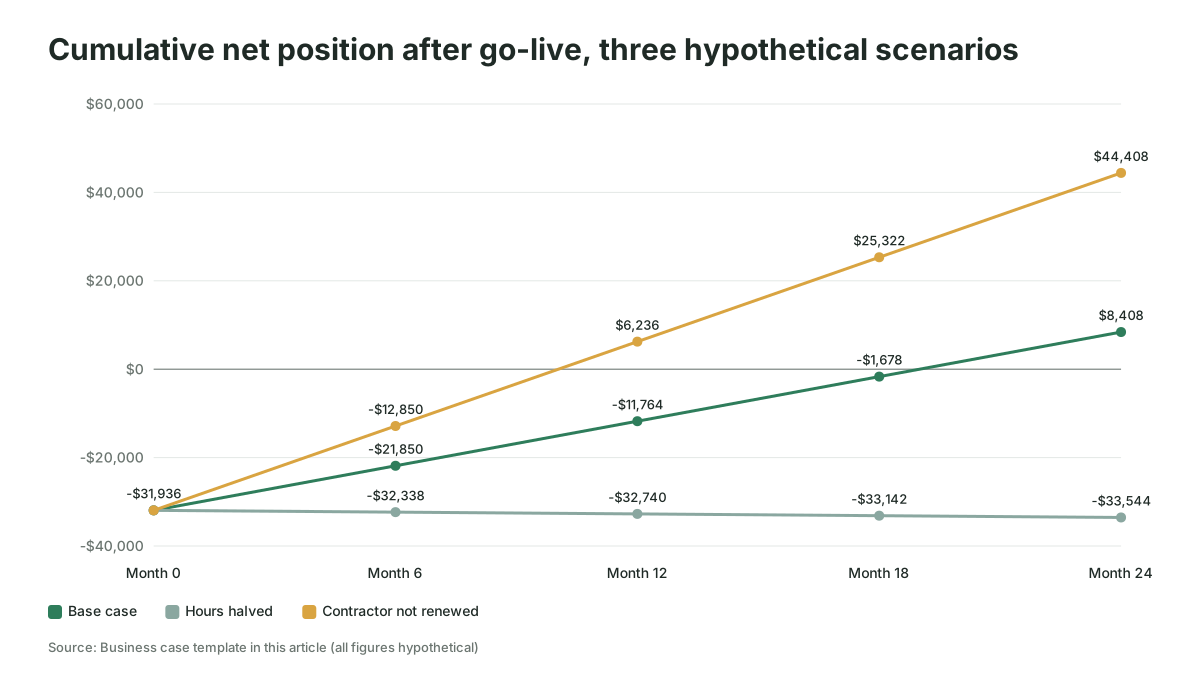
That last finding should shape which job you propose first. If two candidate jobs save similar hours and one replaces an invoice, put the invoice job first, and let the capacity job follow once the first has earned trust.
A CFO will test the case on cash, evidence, cost growth and the exit
Every challenge a CFO brings to an AI business case has a short answer you can prepare in advance. The table lists the questions finance teams ask most about cases like this one.
| The CFO asks | The answer that holds up |
|---|---|
| Where is the cash? | Point to the cash lines, such as a contractor or agency hours cut, and label the rest as capacity at loaded cost, with the redeployed work named |
| Your hours are guesses | The baseline is a two-week time log, the pilot measures the saving before the build budget is released, and the kill rule uses the same log |
| What if usage costs grow? | Model usage is a $600 allowance in the case; a tenfold rise to $6,000 would stretch payback from 19 to about 26 months, which is worth testing but does not sink the case |
| Why 19 months when software pays back in under a year? | Deloitte's survey puts typical AI payback at two to four years; this case beats that, and the pilot gate caps the money at risk until the saving is proven |
| The ad platforms already have AI. Why pay twice? | Platform AI runs bidding and placement inside each platform; this job covers the reporting and checks across platforms that the team does by hand today |
| What happens if it fails? | Spend stops at the gate or the kill rule, and the one-off cost already spent is the maximum loss, stated in the case |
| Who is accountable? | One named owner, with review dates at 30, 90 and 180 days |
Two questions deserve more care than a table allows. The risk question, covering data access, errors that reach live spend and what legal will ask, has its own answers in our guide to AI risks for marketing leaders. And if the job touches budgets or bids, say who approves each change before it goes live, because "the AI did it" is not an answer finance will accept after an overspend.
AI business cases fail on the ask, more often than on the AI
Most rejected or regretted AI business cases share a handful of mistakes, and every one of them sits in the case itself rather than in the technology. Remove them before the meeting.
Three of them have come up already. Asking for a program gives the CFO nothing to judge, so the answer is no or a token amount. Putting pipeline in the payback promises something a buyer journey near 272 days cannot deliver inside year one. And leaving out review time overstates every saving, because a job that saves five hours and needs one hour of checking saves four.
The fourth is choosing the tool before the job. A case that starts from a subscription works backward to a use for it, and the CFO can tell.
How Scalewell gives you a business case built from your own week
Scalewell's starting point is the evidence most AI business cases lack: your team's own hours, measured before anyone asks finance for money. The free 30-minute call is step one; an audit then maps the recurring jobs in your paid team's week and ranks the one AI should own first, so the case rests on logged work and a ranked roadmap, not a vendor's estimate.
Once the case is approved, a build sprint puts those first jobs into the systems your team runs today, in 8 to 12 weeks, sometimes more. The work is done by B2B paid media practitioners, each job is scored on hours saved and on pipeline, and your people finish able to run and adjust it themselves.
AI value realization starts at the first review date
AI value realization means checking the approved case against what happened, on the dates the case set, using the same time log and cost lines. The 30-day review compares logged hours against the baseline and the breakeven. By 90 days, add the actual recurring costs and the review hours people really spent, and at 180 days report payback progress and the upside lines, such as tests concluded and budget moved on opportunity data.
Report misses as plainly as wins. A case that came in at 3 hours instead of 5 and still clears breakeven is a success the CFO will remember when you ask for the second job. For the reporting format a board expects once AI spend is running, see our guide to reporting marketing ROI to the board.
Where to start
Log two weeks of hours on the three paid media jobs you would hand to AI, then fill in the template above for the one with the lowest breakeven. Scalewell can help you run that audit of the team's week and choose the first job with you, so the number you bring to finance is your own.
Frequently asked questions
How much does it cost to implement AI in a marketing team?
For one recurring job in a small paid team, the hypothetical case above comes to about $32,000 one-off and $22,000 a year, and most of that is people time. Seats and model usage come to under $2,000 a year of that. A larger build with outside agencies or custom software can cost many times more, so price your own job line by line.
What should an AI business case include?
One named job, a measured baseline, every cost line split into one-off and recurring, returns split into a base case and an upside column, a payback period, a breakeven point, a sensitivity table, a stage gate, a kill rule, a named owner and review dates. If it fits on one page, finance will read all of it.
What is a good payback period for an AI investment?
Judge it against AI evidence rather than the payback expected of ordinary software, which for most AI use cases is far longer, as the Deloitte survey above shows. For a single operational job in a paid team, aim for payback inside 24 months on hours alone, and treat anything under 12 months as a sign the case includes a real cash saving.
Should hours saved count in an AI business case?
Yes, but only the hours that turn into cut spend or named work, priced at the loaded rate rather than salary. Hours absorbed into a quieter week are a real benefit to the team, so show them as capacity, but give them zero value in the payback. Finance will ask what the hours were used for.
How do I make an AI business case when the benefits are uncertain?
Lead with the breakeven point rather than a forecast. Work out how many hours a week the job must save to cover its costs, compare that with the measured baseline, and ask for a small pilot that tests the gap before the full budget is released. Uncertainty then becomes a four-week question.