How to use an AI ad copy generator for responsive search ads
A slot plan, a copyable prompt and a review checklist that keep AI-written responsive search ads varied, accurate and testable.

An AI ad copy generator can draft a responsive search ad in seconds, but the copy only earns its place once you plan the asset set. Give each of the 15 headlines and 4 descriptions one job, generate against that plan, review each line for claims, policy and brand, then test one message at a time.
You know the Monday version of this. Twelve ad groups need fresh copy, you paste a landing page into ChatGPT, and back come 15 headlines that are really four ideas in different outfits: "Automate Invoice Approvals", "Invoice Approvals, Automated", "Automated Invoice Approval". Ad Strength turns green anyway, and three weeks later nothing in the asset report has moved.
This guide is for the paid media lead who writes or approves RSA copy. It covers the slot plan we'd build before touching any tool, a copyable prompt, a review checklist, what Google's own generator does as of November 2026, and how to read the test. For prompts across keywords, search terms and reporting, see our ChatGPT prompts for Google Ads; this article stays on RSAs.
AI writes similar headlines unless you give each slot a job
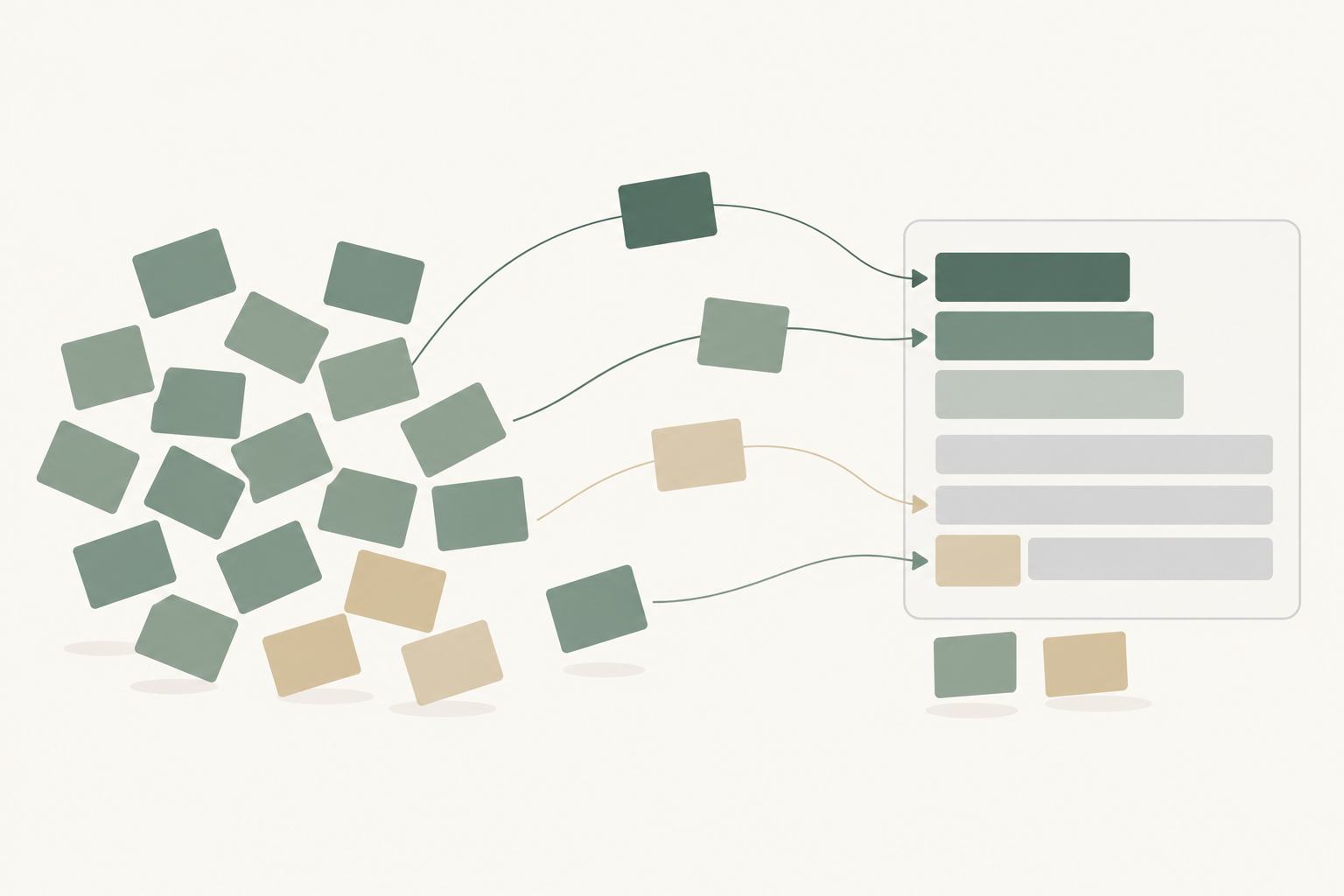
AI models drift toward sameness when they write many variations, and an RSA is the one ad format where sameness costs you directly. Google assembles the ad from your assets, so 15 near-identical headlines give the system nothing to choose between.
The best evidence on the drift comes from a field experiment by Harang Ju and Sinan Aral. They randomly assigned 2,234 people to human-only or human-AI teams that produced 11,024 ads, then ran them on X for about 5 million impressions. The human-AI teams produced 50% more ads per worker and higher-quality text, and that better text raised click-through rates. They also produced "more homogeneous outputs (diversity collapse)" because their ads were more self-similar.
So the model helps with the writing and hurts the range. You keep the first benefit and avoid the second by deciding what each slot says before the model writes a word. Once this planning becomes a shared habit, every ad group starts from a clear brief, and Scalewell helps teams get there with whichever writing tool they already use.
Here are the format rules the plan has to fit, from Google's RSA help page:
| Element | Minimum | Maximum | Character limit |
|---|---|---|---|
| Headlines | 3 | 15 | 30 each |
| Descriptions | 2 | 4 | 90 each |
| Display path fields | 0 | 2 | 15 each |
| Headlines shown at once | 3 |
One more rule changes how you write. In a February 2025 update, Google confirmed that an RSA headline can show at the start of a description line and that up to two headlines can serve in the space that used to hold sitelinks. Every headline therefore has to make sense alone, in any order, next to any other headline.
Four inputs make the output usable
Most bad AI copy comes from a thin brief. Before you open any generator, have these four things in one document:
- The ad group's keyword theme. The top five to ten keywords by impressions, plus the search terms that convert. Ad Strength mainly looks at whether your assets include the keywords you target, so the model needs the real list.
- The landing page text. Paste the copy itself. A URL alone invites the model to guess.
- An approved proof library. Every number, customer count, rating, certification and offer that legal or marketing has signed off, each with its source. The model may only use claims from this list.
- A banned list. Competitor names, words your brand never uses, claims you can't make in regulated markets, and anything the last disapproval taught you.
The proof library does the most work. If you've written a creative brief for the campaign, most of it already exists there, and our AI creative brief generator guide shows how to build one.
A slot plan gives every headline one job
A slot plan is a table that assigns each headline and description a role before any copy exists. The model then writes to the role, which forces range, and you can see at a glance when a slot is missing.
Below is a filled-in example for a hypothetical accounts payable software company, Company A, in an ad group targeting "invoice approval software". The proof points are invented for the example and would come from the proof library in real use.
| Slot | Role | Example headline | Characters |
|---|---|---|---|
| H1 | Keyword, exact | Invoice Approval Software | 25 |
| H2 | Keyword, verb form | Automate Invoice Approvals | 26 |
| H3 | Keyword, close variant | AP Approval Workflows | 21 |
| H4 | Outcome, speed | Approve Invoices in Minutes | 27 |
| H5 | Outcome, business result | Close the Month Faster | 22 |
| H6 | Proof, customer count | Used by 1,200 Finance Teams | 27 |
| H7 | Proof, third-party rating | Rated 4.7 Stars on G2 | 21 |
| H8 | Differentiator, integration | Syncs With NetSuite and Xero | 28 |
| H9 | Differentiator, workflow | Approve From Slack or Email | 27 |
| H10 | Pain point | Stop Chasing Invoice Sign-Off | 29 |
| H11 | Audience | Built for Mid-Market Finance | 28 |
| H12 | Risk reducer | SOC 2 Type II Audited | 21 |
| H13 | Offer | Watch a 20-Minute Demo | 22 |
| H14 | Call to action | Book Your AP Demo Today | 23 |
| H15 | Brand | Company A for AP Teams | 22 |
| Slot | Role | Example description | Characters |
|---|---|---|---|
| D1 | Keyword plus what it does | Invoice approval software that routes every bill to the right approver and logs each step. | 90 |
| D2 | Proof plus differentiator | 1,200 finance teams approve invoices from Slack or email, with a NetSuite and Xero sync. | 88 |
| D3 | Objection handling | Set approval rules without IT. Most teams go live in under 30 days with onboarding help. | 88 |
| D4 | Offer plus call to action | Watch a 20-minute demo and see your own approval chain built live. No credit card needed. | 89 |
Two details in this plan are deliberate. Only three headlines carry the keyword, which keeps keyword coverage up without filling the ad with repeats. And any three of those headlines read sensibly together, which you can test by picking three at random and reading them aloud.
Keep the roles and change the examples for each ad group. A brand ad group needs more brand and proof slots, while a competitor ad group needs more differentiator slots and no competitor names.
Copy this prompt and run it once per ad group
The prompt below works in ChatGPT, Claude or Gemini. It asks for copy by slot, a character count per line and a self-check, and it forbids claims outside the proof library.
You are writing assets for one Google Ads responsive search ad.

CONTEXT
Ad group theme: [paste theme]
Top keywords: [paste 5 to 10 keywords]
Converting search terms: [paste]
Landing page copy: [paste the page text]
Approved proof library (the only claims you may use): [paste numbered list]
Banned words and claims: [paste list]
Brand voice: [three adjectives and one example sentence we like]

SLOT PLAN
Write one headline per slot, 30 characters or fewer, including spaces:
H1 keyword exact | H2 keyword verb form | H3 keyword close variant
H4 outcome speed | H5 outcome business result
H6 proof (from library) | H7 proof (from library)
H8 differentiator | H9 differentiator | H10 pain point
H11 audience | H12 risk reducer | H13 offer | H14 call to action | H15 brand
Write one description per slot, 90 characters or fewer:
D1 keyword plus what it does | D2 proof plus differentiator
D3 objection handling | D4 offer plus call to action

RULES
- Every headline must make sense on its own and next to any two others.
- No two assets may share the same idea or the same three-word phrase.
- Use a number, rating or customer claim only if it is in the proof library, and give its library number in brackets.
- No exclamation marks, no words in all caps, no symbols used for emphasis.
- No prices or offers that are not in the context.

OUTPUT
A table with columns: slot, text, character count, proof number used.
Then list any slot you could not fill honestly and say why.
Then pick the three headlines you would pin, if any, and explain what pinning costs.
Run it once per ad group and paste the table into your build sheet. Then count the characters yourself, because models miscount at the edges: in Google Sheets, =LEN(B2) next to each line catches anything over 30 or 90.
The "slots you could not fill honestly" line matters more than it looks. A model told to fill 15 slots will fill 15 slots, and that instruction gives it a legitimate way to say the proof library is too thin.
Review every asset for claims, policy and brand before upload
AI-written RSA copy needs a human review against a fixed checklist, because Google holds the advertiser responsible for what serves. Its own conversational tool says plainly that "Google AI may not generate responses that are accurate or relevant" and that checking suggestions is your responsibility. Run each asset through these checks:
| Check | What fails | Where the rule comes from |
|---|---|---|
| Claim traced to proof library | A number, rating or customer name with no library entry | Your legal sign-off |
| Probable result | "Cut AP costs by 90%" style promises | Google's misrepresentation policy bans claims that entice the user with an improbable result |
| Offer is live | A free trial or discount that has ended | Same policy, unavailable offers |
| No repetition | Two assets with the same words or phrases | Google's editorial policy bars asset text that repeats words or phrases within the same asset or another asset in the same ad group |
| Capitals and punctuation | ALL CAPS, emphasis symbols, stray characters | Same editorial policy |
| Character limits | Anything over 30 or 90 | The =LEN() column |
| Stand-alone sense | A headline that only works after another one | Read three random headlines aloud |
| Brand voice | Words on the banned list, a tone your brand never uses | Your banned list |
Expect the review to take longer than the generation. That's the right balance: drafting takes a minute, and a disapproved ad or an unapproved claim in a regulated market costs far more than the time spent checking. If you want a rule for which AI outputs go live without a second person, our piece on humans in the loop for ad spend sets one out.
Pin only what legal or the brand requires
Pinning fixes an asset to one position, and Google says it isn't recommended for most advertisers and can affect Ad Strength. When you must pin, for example a required disclaimer or a brand name in position one, Google suggests pinning two or three different assets to the same position so the system still has a choice.
Independent data points the same way. Optmyzr analyzed roughly 20,000 Google Ads accounts in a 2026 study and found partially pinned ads had the lowest cost per acquisition at $13.68, while fully pinned ads were the worst at $32.57. Optmyzr notes its customers are experienced practitioners and calls the results "directional, not population-wide absolutes", so treat it as a strong hint rather than a law.
For AI copy, the practical rule is to let the prompt suggest pins but approve none unless there's a compliance or brand reason you could explain to a client.
Ad Strength measures coverage, and conversions measure the copy
Ad Strength is a pre-launch checklist score, and Google says it isn't used to calculate Ad Rank, Quality Score, or auction wins. Google says it primarily evaluates how your assets relate to the keywords you target, and the score also rises with more headlines and descriptions and with six or more sitelinks.
Google also reports that advertisers who move RSAs and sitelinks from Poor to Excellent see 15% more conversions on average, based on its internal data from August 2025. Optmyzr's study found the opposite pattern in its accounts: ads rated Excellent had the highest CPA at $28.68, while ads rated Average had the lowest at $12.43.
Both can be true at once. Filling all 15 slots with relevant, varied copy tends to help, and stuffing keywords into every line to turn the score green does not. We'd aim for Good or Excellent through a full slot plan, then stop polishing the score and judge the ad on conversions that reach your CRM as qualified pipeline.
Google's own generator is a second writer you still review
Google Ads now writes RSA copy itself in two places, and both need the same review as any other AI ad copy generator.
The first is the conversational experience inside Google Ads, a chat tool that summarizes your landing page and suggests headlines and descriptions when you create or edit an RSA. As of November 2026, Google's help page lists it for campaigns in English, French, Spanish or German.
The second is text customization, formerly called automatically created assets, which runs inside AI Max for Search. According to Google's help page, it generates extra headlines and descriptions from your domain, landing page, existing ads and keywords, and those assets "only serve if they are predicted to perform better" than yours. Google also says campaigns using text customization will be upgraded to AI Max automatically from September 2026.
Your controls are text guidelines, an experimental beta that allows up to 25 term exclusions and up to 40 messaging restrictions per campaign. Your banned list from the inputs step becomes your term exclusions, and the tone rules become messaging restrictions. Our guide to AI Max for Search covers how to test the wider feature set.
Test one message change at a time
An RSA test is only readable when the versions differ by one idea. Google's ad variations tool, under Experiments, lets you find and replace text across RSAs and split traffic between the original and the variation, which suits a single change such as a new proof headline or a different offer.
Reading the asset report has also changed. Google has retired the asset "Performance label" column in favor of full statistics per asset, and it warns that asset-level CTR, CPC, CPA and ROAS "should be used as directional indicators only". Its practical advice is to replace assets that get zero impressions after several weeks.
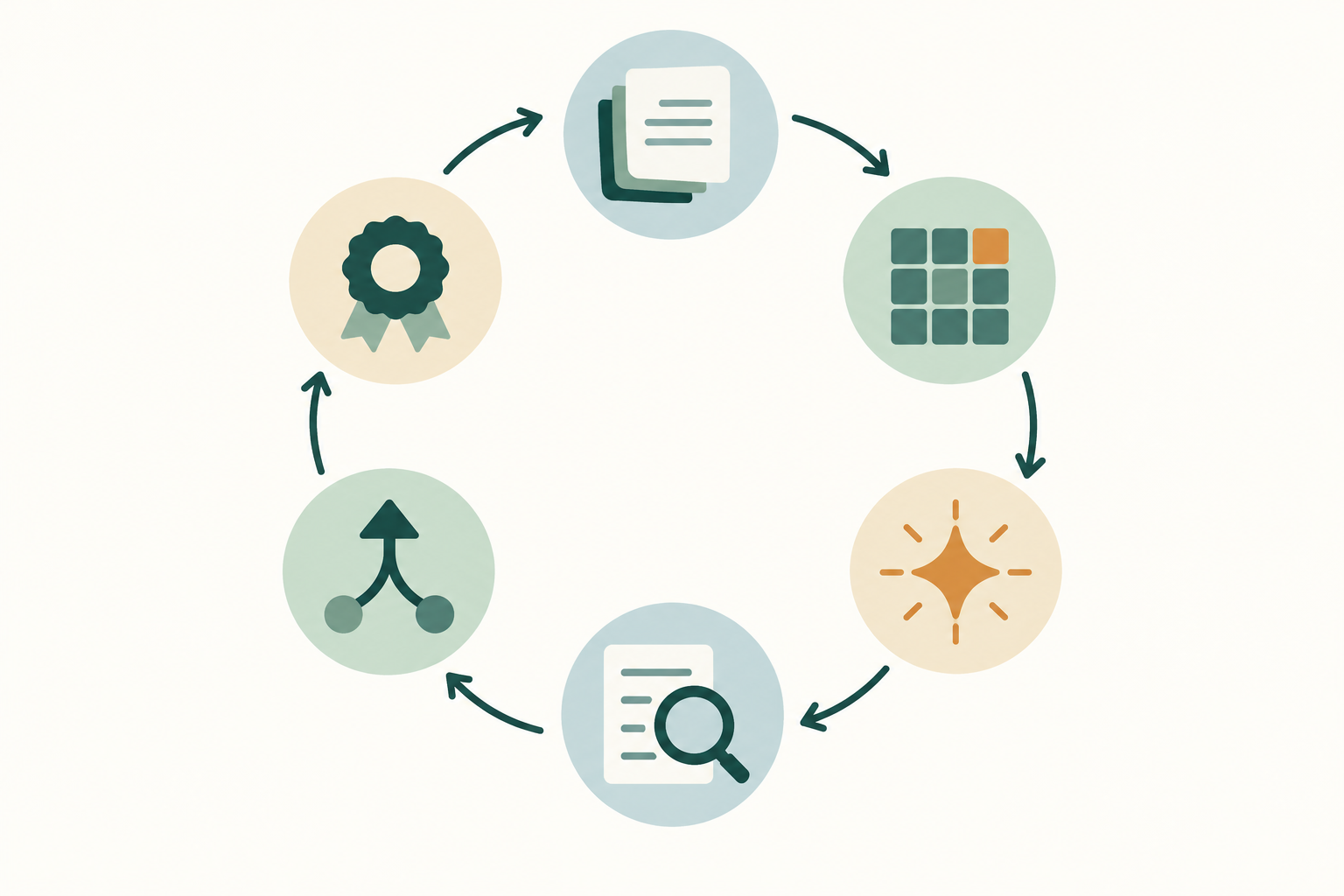
Google recommends at least two RSAs per ad group, which gives you a control and a variant. A simple loop for that pair:
- Keep RSA one as the control, built from the slot plan.
- In RSA two, change one slot role at a time, for example swapping the customer count proof for a third-party rating.
- Read the result on conversions and, where your CRM import allows it, qualified opportunities, after enough volume to trust it.
- Add the winning line to the proof library notes so the next prompt starts from it.
Our guide to planning and reading creative tests with AI goes further on sample sizes and when to call a result.
Where AI-written RSAs go wrong
Most failures come from trusting the output because it looks finished. Watch for these:
- Invented proof. Models fill a "proof" slot with a plausible statistic when the library is empty. The library-number column in the prompt exists to catch this.
- Diversity collapse. Fifteen rewrites of one benefit. The slot plan prevents it, and a quick read of the table shows it.
- Score chasing. Adding the keyword to every headline to reach Excellent, which also risks the editorial rule on repetition.
- Stale facts. An offer or integration the model saw on an old page. Paste current page text every time.
- No owner. Copy that goes live because nobody was named to approve it.
This process suits accounts with enough search volume to test. If an ad group gets a handful of clicks a week, you'll never read a variation, so write one strong RSA from the slot plan and spend your time on keywords and landing pages instead.
The same slot plan feeds your LinkedIn ads
B2B teams rarely run search alone, and the proof library and roles carry straight over to LinkedIn. LinkedIn's own guidance for single image ads is to keep introductory text within 150 characters and headlines within 70 to avoid truncation, with hard maximums of 3,000 and 200.
Your RSA proof and pain-point slots usually make the strongest LinkedIn introductory text, and your offer slot becomes the headline. Keep one proof library for both channels so a claim legal approved for search doesn't get rewritten into something it didn't approve on LinkedIn.
Where to start this week
Pick your highest-spend ad group, build the proof library and slot plan for it, run the prompt, and put the result through the review table before it goes live. If you'd like this set up as a repeatable method across your accounts, Scalewell builds that kind of AI workflow for paid media teams.
Frequently asked questions
Is there a free AI ad copy generator for Google Ads?
General assistants such as ChatGPT, Claude and Gemini all write RSA copy on their free tiers, and Google Ads includes its own conversational experience for creating and editing RSAs. The free part is the drafting. The value comes from the inputs you give it and the review you run afterward, which no tool does for you.
Does Google penalize ads written with AI?
Google's ad policies judge what the ad says, and the policy pages we read set no separate rule for AI-written text. An AI-written headline that makes an improbable claim, repeats another asset or misuses capitals fails the same misrepresentation and editorial policies as a human one, and Google states that checking AI suggestions is the advertiser's responsibility.
How many responsive search ads should each ad group have?
Google recommends at least two RSAs with Good or Excellent Ad Strength per ad group. Its help page reports that ad groups adding a second RSA saw a 6.6% increase in conversions at a similar cost per conversion on average, based on Google's internal data from August 2025.
Can ChatGPT count characters for Google Ads headlines?
Language models don't count characters reliably, because they process text in chunks rather than letters and often miscount near the 30 and 90 character limits. Ask the model for a count as a first pass, then check every line with a spreadsheet formula such as =LEN() before upload, because Google's headline fields support only 30 characters and description fields only 90.
Should I write RSA headlines in title case?
Google's editorial policy only bars capitalization that isn't used correctly or for its intended purpose, so title case and sentence case are both acceptable. Pick one per account and tell the model which in the prompt, because mixed casing across 15 headlines looks careless when three of them appear side by side.