Generative AI in advertising: where it belongs in a paid team's workflow
A seven-stage map of generative AI in advertising, with an owner and risk level for each stage, the platform features and 2026 disclosure laws, and why more variants can mean less learning.
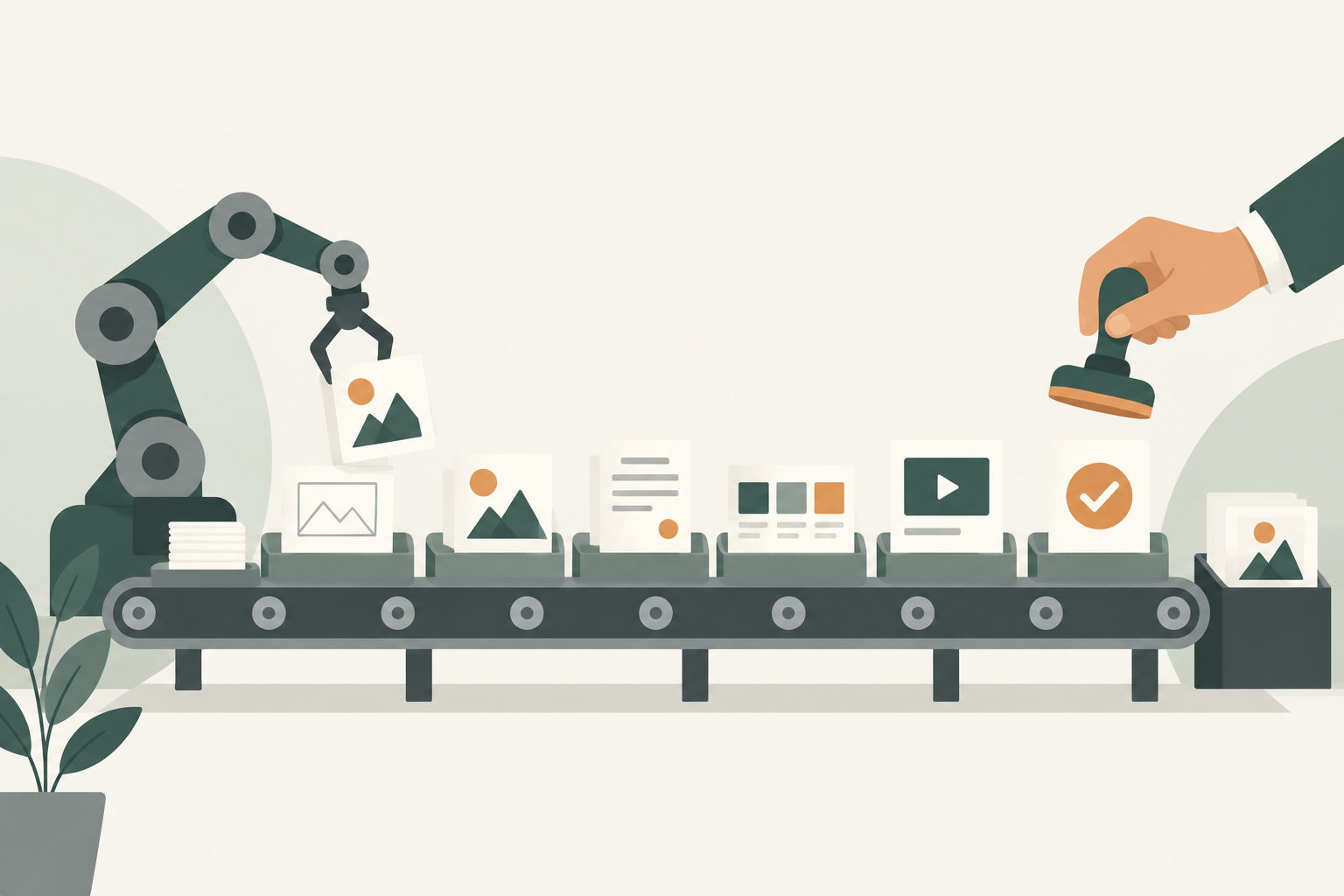
Generative AI in advertising means using models that produce text, images, video and audio to draft the research, briefs, copy, visuals and localized versions behind your ads. As of November 2026, it's built into Google Ads, Meta Ads Manager and LinkedIn Campaign Manager. The useful question is which stages to hand it, and who signs off on each.
You've probably already had the meeting. Someone shows a reel of AI-generated product shots, someone else asks why the agency still bills for production, and the conversation ends with "let's pilot it" and no owner. Three months later you have a folder of generated images nobody approved and a LinkedIn test with eleven variants, none of which spent enough to tell you anything.
This guide is for the marketing leader who has to set the policy. It maps generative AI across the seven stages of an ad workflow, shows what the platforms now generate for you, sets out the legal lines that changed in 2026, and ends with what it does to your budget and your team. If you want the craft question of which AI creative looks cheap in B2B, our piece on AI generated ads for B2B covers it.
Generative AI helps most where a person can check the output quickly
Generative AI earns its place in advertising at the stages where a reviewer can judge a draft in minutes and a mistake costs little. It struggles where the output carries legal risk, where quality is hard to judge at a glance, or where the work depends on knowing something about your buyers that the model can't see.
The best evidence for that split comes from a 2025 field experiment by Harang Ju and Sinan Aral. They randomly assigned 2,234 participants to human-human and human-AI teams that produced 11,024 ads, then ran them on X for about 5 million impressions. Human-AI teams produced 50% more ads per worker and higher text quality, while human-only teams produced higher image quality. The better text lifted click-through rates; the better images lowered cost per click. The authors call this "a jagged frontier of AI agent capability", and it matches what you'd guess: models write a decent headline faster than they compose a picture a designer would sign.
The same study found that human-AI teams produced ads that looked more alike. That matters more than it sounds. A creative test only teaches you something if the variants differ, and a pile of near-identical drafts is just a slower way to learn nothing. Getting AI to produce variants that differ enough to teach you something is where Scalewell helps creative and paid teams, so each test ends with a lesson for the next brief.
The seven stages, with an owner and a risk level for each
A generative AI policy for advertising works best as a table: one row per stage of the workflow, with what the model drafts, what a person must check, and who signs. Here's the version we'd start from for a B2B paid team.
| Stage | What generative AI drafts | What a person checks | Risk if it goes wrong | Who signs |
|---|---|---|---|---|
| Research | Summaries of competitor ads, review mining, search query themes | That every claim traces to a source you can open | Low | Paid media lead |
| Briefs | First draft of the hypothesis, audience and message fields | The reasoning, the offer and the metric | Medium | Head of demand gen |
| Copy | Headline and body variants for search, LinkedIn and Meta | Claims, numbers, tone, legal terms | Medium | Paid lead plus product marketing for claims |
| Images | Backgrounds, resizes, lifestyle scenes, concept art | Likeness, logos, rendering errors, disclosure | High | Brand or design owner |
| Video | Image-to-video cuts, voiceovers, avatars | Synthetic people, voice rights, disclosure | High | Brand owner plus legal for people |
| Localization | Translations and market adaptations | Meaning, regulated terms, local claims | Medium | Native-speaking reviewer |
| Measurement | Plain-English summaries of test results and anomalies | That the numbers match the platform and CRM | Medium | Analyst or paid lead |
Two rows deserve a comment. Briefs sit higher than copy because a bad brief wastes every asset made from it, and our guide to building an AI creative brief generator covers which brief fields a person has to fill. Measurement sits at medium because a model that summarizes a test result can state a winner with total confidence on a sample that proves nothing.
The ad platforms now generate assets inside the campaign
Every major ad platform has put generative tools into its campaign builder, which means your team will use generative AI whether or not you write a policy. Here is what each one documents, as of November 2026.
Google Ads. Google's help page on generated images says Google can create images based on the text assets in your campaign or your landing page, and that "Image generation capabilities are rolling out gradually to eligible advertisers." Generated images carry a SynthID watermark and an open-standard markup that surfaces in tools such as Google Image Search. People generation is limited to adults, and images showing a prominent likeness are not allowed. Google also says that generated assets "aren't guaranteed to be approved by Ads Policy", so the review step stays yours. In September 2025 Google said it was upgrading image generation across campaign types to Imagen 4 and that Asset Studio could turn "a few images, logos, and text descriptions into dynamic video assets."
Meta. At Cannes Lions in June 2025, Meta announced it was testing Video Generation 2.0, which turns several images into a multi-scene video with text overlays and music, along with persona-based text generation and branding tools that apply your logo, colors, fonts and tone. Meta groups many of these features under Advantage+ creative, so check which enhancements each ad has enabled before it runs.
LinkedIn. When LinkedIn launched Accelerate campaigns in June 2024, it said marketers can draft creatives with Microsoft Designer and that "AI-generated creatives are currently available in English only." LinkedIn retired Accelerate as a standalone campaign type in August 2026, BrandRocket reported, and its creative generation now sits inside Classic campaigns. For a B2B team, LinkedIn is where generated copy meets your most expensive clicks, so it's the platform where review matters most.
The practical point for a leader is that platform tools generate inside the campaign, where your brand team never sees the asset before it runs. Decide which auto-generation features are on by default, and write that down in the same place as the table above.
Editing your existing ads with AI may not improve them
Using generative AI to modify human-made ads showed no significant improvement in performance in research from NYU Stern and Emory. The team led by Hyesoo Lee, Vilma Todri, Panagiotis Adamopoulos and Anindya Ghose compared human ads, AI-modified ads and fully AI-created ads, and found the fully AI-created ones raised click-through rates by up to 19% compared with ads made by human experts (published November 2025). The researchers explain the weak result for edited ads this way: forcing the AI to work within an existing design limited what it could do.
Before you redirect the design budget, note two limits. Click-through rate in an online ad test is a long way from qualified pipeline in a B2B buying committee, and the same team found that telling people an ad used generative AI caused "a 31.5% decrease in click-through rates." So the evidence says generative AI can produce a stronger first draft than a tweak of an old one, and that how you disclose it matters. It doesn't say AI creative wins for enterprise software.
NielsenIQ adds a caution from a different angle. In a December 2024 study with more than 2,000 participants, AI-generated ads, including those rated high quality, "elicited weaker memory activation in the brain" than traditional ads, measured by EEG on about 150 of them. A click today and a buyer who remembers you in six months are different outcomes, and B2B sales cycles are long enough for that difference to show up in pipeline.
Synthetic people are the costliest line in the creative budget
Generated humans are now the part of generative AI advertising that carries the most legal and reputational cost, because three separate rules treat them differently from generated backgrounds or copy.
- New York. The state's synthetic performer law took effect on June 9, 2026. Advertisers must "conspicuously disclose" when a synthetic performer appears in an ad, where they have actual knowledge of it. Penalties are $1,000 for a first violation and $5,000 for each one after. AI used only to translate a human performer's speech is excluded.
- Meta. Meta's ads transparency page says that when its tools generate a photorealistic human, "the label will appear next to the Sponsored label (not behind the three-dot menu)". The page, updated on June 1, 2026, also says Meta will begin automatically detecting ads created or edited with third-party AI tools through industry-standard signals.
- Europe. The European Commission states that "the transparency rules of the AI Act will come into effect in August 2026", including visible labels on deep fakes and a requirement that AI-generated content be identifiable.
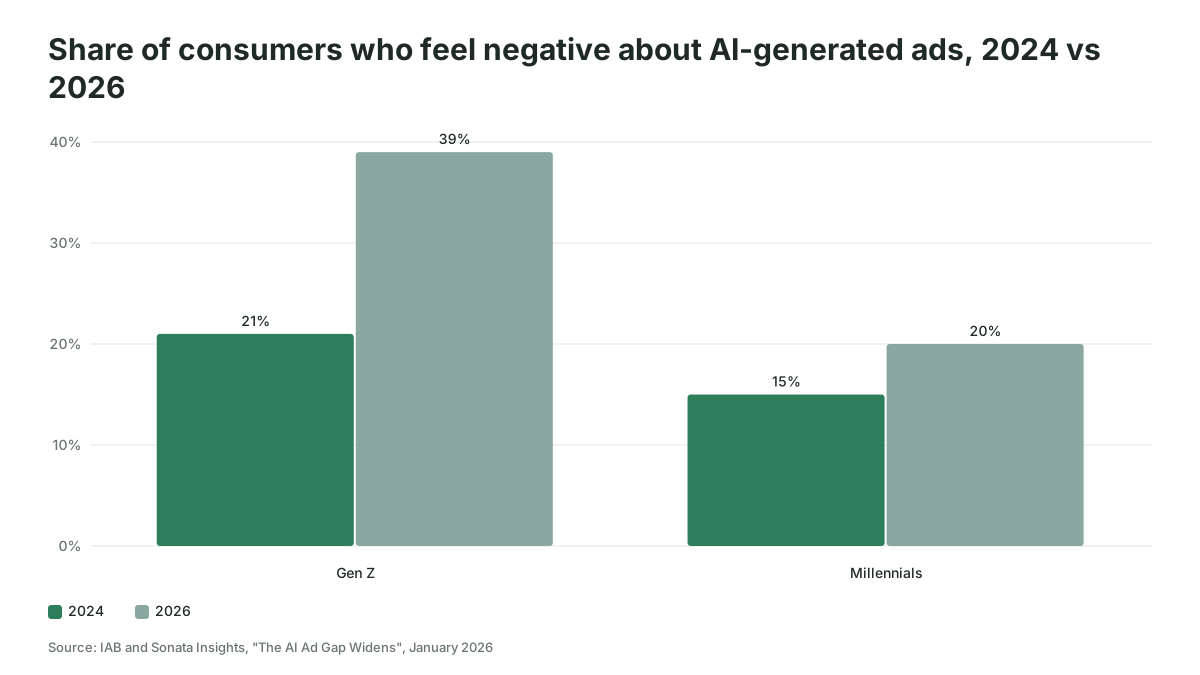
Add the audience view and the pattern gets clearer. The IAB's January 2026 study of 505 US Gen Z and Millennial consumers and 104 ad executives found that 82% of executives think these consumers feel positive about AI-generated ads, against 45% of consumers who do. The share of Gen Z who feel negative about AI-generated ads rose from 21% in 2024 to 39%, and among Millennials from 15% to 20%. Younger professionals sit on B2B buying committees too, so the gap isn't only a consumer-brand problem.
We'd give a B2B team a simple rule. Use generative AI freely for backgrounds, resizes, product scenes and copy drafts. Use real people, with signed releases, for any face that stands for a customer, an employee or an expert. A generated "customer" giving a testimonial is a disclosure problem in New York and a credibility problem everywhere, and the FTC's 2024 rule on fake reviews names "AI-generated fake reviews" among the things it is meant to deter.
Rights and disclosure need a written default
Two more governance questions belong in your policy before the first generated asset runs.
The first question is who owns the asset. The US Copyright Office concluded in January 2025 that generative AI outputs can be protected "only where a human author has determined sufficient expressive elements", and that writing prompts alone does not make you the author. In practice, a fully generated image may be something a competitor can copy without consequence. If an asset is meant to become part of your brand, such as a mascot or a signature visual, have a designer shape it so a human made the expressive choices.
The second is when to disclose. The IAB's AI Transparency and Disclosure Framework, released in January 2026, calls for disclosure when AI "materially affects the authenticity, identity, or representation in ways that may mislead consumers", rather than labeling every use. We think that's the right default. A generated background behind a real product screenshot doesn't mislead anyone, while a generated person in a lab coat does. The IAB's consumer study adds a useful counterweight to the NYU finding: 73% of the consumers surveyed said knowing an ad was made with AI would increase or have no effect on their likelihood to buy.
In the UK, the IPA publishes a best practice guide for responsible use of generative AI in advertising, last updated in February 2026, which is a reasonable template if your legal team wants a starting document.
More variants can mean less learning on a B2B budget
Generative AI lowers the cost of making an ad, but it does nothing to the cost of learning which ad works, and that second cost is set by your media budget. This is where most pilots go wrong.
Here's a hypothetical example of the arithmetic. Imagine a team spending $20,000 a month on LinkedIn at a $10 cost per click. That buys about 2,000 clicks. Split across four variants, each gets roughly 500 clicks, which is enough to see a large difference in conversion rate. Split across twenty generated variants, each gets about 100, and you'll be reading noise. The team that generated twenty ads produced more creative and learned less.
So the budget implication runs in two directions. Production spend can fall, because a first draft of copy or a resized image no longer needs a designer's afternoon. Review time rises, because every asset still needs a person to check claims, likeness and brand. And the number of variants you can actually test is fixed by spend, not by how many the model can produce. We'd set a variant cap per campaign based on budget before anyone opens a generator, and our piece on using AI to plan and read creative tests shows how to size it.
For the team, the change is in roles more than headcount. Designers spend less time on resizes and more on the assets that carry the brand. Paid media leads spend more time reviewing and less time writing headline number fourteen. And someone has to own the policy table, and it's the kind of job nobody volunteers for. The humans-in-the-loop guide for ad spend covers how to set those sign-off points without slowing the team down.
Signs your generative AI rollout is going wrong
Most generative AI pilots in advertising fail in predictable ways, and you can spot them early.
- Assets run that nobody approved. A platform's automatic creative features are switched on in a campaign and the brand team finds out from a screenshot in Slack.
- Variant counts climb while learning stalls. Every test has more arms, and no test reaches a result anyone would act on.
- Copy drifts toward sameness. Your LinkedIn ads start sounding like your competitors' LinkedIn ads, which the Ju and Aral finding on output diversity predicts.
- Claims slip through. A generated headline promises a percentage your product team has never measured.
- Reporting stops at clicks. The pilot is declared a success on click-through rate, and nobody checks whether the leads reached a sales conversation.
None of these is a reason to stop. Each one is a reason to fill in the owner column of the table and to judge the pilot on cost per opportunity rather than cost per click.
Where to start
Copy the seven-stage table into a shared document this week, put a name in the "who signs" column for every row, and check which auto-generation settings are switched on in your Google, Meta and LinkedIn accounts. If you'd like help setting up the review steps and AI tooling around your own workflow, that's the kind of work Scalewell does with paid teams.
Frequently asked questions
What is the difference between generative AI and AI in advertising?
AI in advertising covers any machine learning in the ad stack, including bidding, targeting and budget allocation that platforms have run for years. Generative AI is the narrower set of models that produce new content: copy, images, video, audio and translations. A smart bidding strategy is AI; a tool that writes your headlines or paints a background is generative AI.
Why can't I generate images in my Google Ads account?
Google says image generation is "rolling out gradually to eligible advertisers." To qualify, the account must be active, must have run ads for at least 30 days and must have a history of policy compliance. If your account meets those terms and you still see nothing, the gradual rollout may not have reached it yet.
Can I copyright an ad made with generative AI?
You can protect what a person contributed, such as creative arrangements or changes to the generated output, but typing the prompt doesn't count as authorship. So keep the working files that show a designer's edits for any asset you might one day need to defend, such as a campaign character, a signature visual or a product illustration.
Is generative AI advertising cheaper?
Production usually gets cheaper, because drafts and resizes take minutes. Total cost often doesn't fall as much as expected, because review time rises and media spend stays the same. The saving only reaches the business if the team tests a sensible number of variants and judges them on pipeline rather than on volume of assets produced.
Which generative AI tools do paid teams use for ads?
Most teams use the generators inside the ad platforms, such as Google's Asset Studio, Meta's Advantage+ creative and LinkedIn's AI creative drafting, alongside a general assistant like ChatGPT, Claude or Gemini for research, briefs and copy. Image and video tools fill the gaps. The tool matters less than the review step around it.