B2B marketing trends for 2027: what AI changes for paid and demand gen
Seven B2B marketing trends for 2027, each taken from named 2026 research and turned into the decision it forces for paid media and demand gen teams.

Seven B2B marketing trends for 2027 come through in published research, and the biggest are these: buyers research with AI but still pick a favorite before they call sales, claims need proof that AI tools can verify, search is judged on AI answers as well as clicks, pipeline is replacing the MQL, and flat budgets have to fund AI.
You're probably reading this with a planning deck open. Someone has already pasted in a slide titled "AI changes everything", the CFO has asked which line it changes, and nobody has an answer that fits on the slide. That's the gap this post tries to close.
Every trend below comes from research published in 2026 by a named firm, with the date beside it, and each one ends with what it changes for a paid media and demand gen team. We left out anything that is only a prediction with no study behind it. This is a planning read on the future of B2B marketing for the CMO, VP of Marketing or head of demand gen setting next year's priorities, and we'll refresh it every year when the new studies land.
Seven B2B marketing trends for 2027 the research agrees on
Seven findings show up across the 2026 studies from Forrester, the Content Marketing Institute, B2BMX Insights (the publication formerly called Demand Gen Report), 6sense, the LinkedIn B2B Institute, Gartner and IAB. The table puts each one next to its source and the decision it touches, so you can drop the rows you already act on and keep the rest.
| Trend | Source and date | What it changes for paid and demand gen |
|---|---|---|
| Buyers use AI less for discovery than for evaluation | 6sense 2026 B2B Buyer Experience Report | Brand presence before the deal still decides the shortlist |
| AI agents take part in most purchases | Forrester Predictions 2027, October 21, 2026 | Claims in ads and on pages need proof a machine can check |
| Buyers want human proof to back the AI answer | Forrester, LinkedIn B2B Institute, 2026 | Peer and customer proof earns more of the creative budget |
| Search is measured on AI answers as well as clicks | IAB Outlook update, September 10, 2026 | Paid search reporting needs a visibility measure added |
| Pipeline influenced is the top marketing metric | B2BMX Insights benchmark, October 29, 2026 | Platforms get judged on CRM outcomes, not form fills |
| Budgets are flat while AI takes a bigger share | Gartner CMO Spend Survey, May 2026 | AI money comes out of programs, people or tools |
| Audiences are more skeptical of AI-made content | CMI 2027 trends report, November 4, 2026 | Creative made with AI needs a disclosure and review rule |
Planning takes fewer hours, and lands on pipeline evidence, when AI does the gathering and sorting behind each of these calls, and that is the planning work Scalewell helps marketing leaders hand to AI. The sections below take the trends one at a time.
Buyers use AI to research but still choose a favorite before they call
Buyers use large language models during evaluation far more than for finding vendors, according to 6sense's 2026 B2B Buyer Experience Report, which covers 3,596 completed purchases and 1,011 buying journeys that ended without a decision. Use of an LLM somewhere in the evaluation fell from 94% the year before to 81%, only 26% used one to discover vendors, and just 17% to 21% cited LLMs as an influential source of information during their decision.
The same study puts first vendor contact, on average, 59.2% of the way through a 10.3-month cycle, with buying groups of about 10 people. And 6sense's report page says the favorite a buyer holds before that first contact ultimately wins 82% of the time.
So what does that change for paid? It means the shortlist is mostly set by the time anyone fills in a form, and AI hasn't changed who gets onto it as much as the headlines suggest. The ads that matter most run in the months before a buying group is ready to talk, to an audience of roughly ten people per account who will never all click the same thing.
That puts LinkedIn and brand budgets back in the conversation for 2027. Dreamdata's LinkedIn Ads Benchmarks Report 2026, published March 10, 2026, found LinkedIn takes 41% of B2B paid social budgets and that the full B2B journey takes 272 days. If your plan judges awareness spend after one quarter, it is grading a 272-day journey a third of the way through.
Buyers will need proof that AI tools can verify
Forrester's 2027 B2B go-to-market predictions, released October 21, 2026, are headlined "AI Agents Will Influence 75% Of B2B Purchase Decisions." The release also predicts that two-thirds of providers will lose deals because buyers cannot verify their claims, and that buyers will double their human interactions to check what the AI recommended.
Those two predictions point the same way. When an AI assistant summarizes your category, it repeats what it can find and confirm, and a claim like "the fastest platform" with nothing behind it gets dropped or doubted. Then the buyer goes to a person, a peer, an analyst or a reference customer, to check the answer.
The LinkedIn B2B Institute made the human side of this its main argument in June. In a June 19, 2026 post on moving from visibility to "buyability", Mimi Turner of the Institute argues that buyers want a choice they can defend, and puts it in one line: "flying faster does not make flying safer."
For a paid team, the practical change sits in the creative brief. Ads that carry a named customer, a specific number with a source, or a person from a similar company give both the AI and the buying committee something to check. LinkedIn is the obvious place to run that kind of proof, through formats such as thought leader ads, which put a real person's post in front of the account list. We would move budget from generic feature ads toward proof-led ones before adding new channels.
Search is now measured on AI answers as well as clicks
Optimizing content for AI-generated answers is the top area of increased focus among ad buyers, at 76%, according to IAB's 2026 outlook update of September 10, 2026, based on more than 200 brand and agency decision makers. Adapting to AI-driven search is their top media investment challenge, named by 44%.
The measurement finding matters more for planning. In the same update, 86% of buyers said they are changing, or expect to change, how they measure media performance within 12 months because of conversational AI tools and agents, and the most common change, at 48%, is measuring brand visibility and citations inside AI tools.
The Content Marketing Institute saw the traffic side of the same shift. In its 2027 trends research, 31% of B2B marketers reported a traffic increase over the last 12 months and 31% a decrease, and 79% of those losing traffic blamed AI-powered search.
For the future of paid search, this means two numbers where you used to have one. Clicks and cost per opportunity still decide what you bid on, but a share of the demand now forms inside answers you don't pay for and can't see in Google Ads. Ads are also moving into those answer surfaces: Microsoft serves ads in Copilot from existing Microsoft Advertising campaigns with no separate reporting, and OpenAI now sells ads in ChatGPT as well. Our guide to LLM visibility covers how to split that budget between earning citations and buying ads. For 2027, plan a quarterly check next to the paid search report: ask ChatGPT, Gemini, Copilot and Perplexity the same 10 to 20 questions your buyers ask about the category, and log which vendors each answer names and cites.
Pipeline influenced has replaced the MQL as the number marketing answers for
Pipeline influenced is now the top performance metric among B2B marketers, at 44%, ahead of opportunities generated and MQLs, according to the 2026 B2BMX Insights Benchmark Report published October 29, 2026. Revenue-based quotas rose from 25.33% of teams in 2025 to 33.33% in 2026.
This is the demand generation trend with the most consequences for paid, and our guide to revenue marketing covers running paid and demand gen against pipeline day to day. A team measured on pipeline can't defend a platform on cost per lead, because a cheap lead that sales never works costs more per opportunity than an expensive one that turns into a deal. And every 400-lead report that never mentions what sales did with them gets harder to present.
The research also shows how much the answer depends on the measurement window. Dreamdata calculates the 121% LinkedIn return it reports, against 67% for Google Search and 51% for Meta, with its own data-driven attribution on closed-won deals over 12 months, using its customers' data. A platform judged on a 30-day window and form fills would look very different. Whatever model you pick, connect the ad platforms to CRM stages before the year starts, so 2027 budget calls rest on opportunities. In LinkedIn Campaign Manager that starts under Measure, Conversion tracking, Create conversion, using the Conversions API or a CSV upload of CRM stages. Our post on board reporting for marketing ROI covers how to present it.
Budgets are flat, so AI spending has to come from somewhere
Marketing budgets held at 7.8% of company revenue in 2026, against 7.7% in 2025, in Gartner's annual CMO Spend Survey of 401 marketing leaders, as reported by Marketing Dive on May 11, 2026. CMOs directed an average of 15.3% of their budgets to AI, while just 30% said their organization has the infrastructure to lead in it.
A flat budget with a growing AI line has one consequence: the money comes from something else. Forrester's October release predicts most CMOs will cut programs or accept reduced capacity after overestimating AI gains, eliminating as many as 25% of roles and then choosing between rehiring and running smaller. That's an uncomfortable sentence to read during planning, and it is also a warning about promising savings before the AI jobs actually run.
On one of the big AI marketing trends, how much budget AI tools still attract, the surveys disagree, which is worth knowing before you copy anyone's numbers. B2BMX Insights found 60.4% of marketers prioritizing budget for AI-powered tools in 2026. CMI's 2027 report found AI-powered marketing tools named as a top 2027 investment area by 30%, down 15 points from the year before.
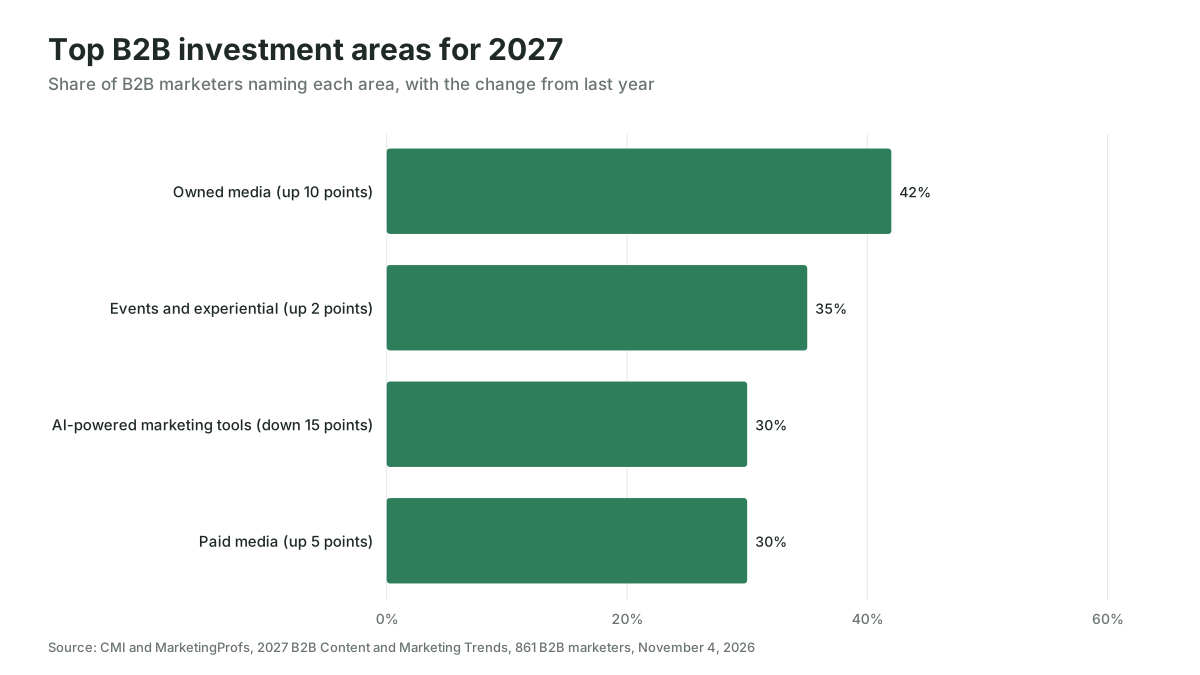
In the same CMI data, owned media leads at 42% (up 10 points), events and experiential sit at 35% (up 2), and paid media is up 5 points, to 30%. Events are rising across studies too: 62.2% of B2BMX respondents plan to invest more in in-person events and trade shows. Forrester's 2027 budget planning post of July 9, 2026 lists four priorities, including AI-enabled marketing workflows and the integration of brand and demand programs, and recommends a dedicated experimentation budget. That integration is already happening: 41.7% of B2BMX respondents say their brand and demand teams run shared campaigns and goals. For the split itself, our B2B marketing budget guide walks through it.
Skepticism about AI-made content is the risk to plan for
Seventy-five percent of B2B marketers worry that AI is making audiences more skeptical of online content, and 52% say their organization has no policy on disclosing AI use, according to the Content Marketing Institute's 2027 B2B Content and Marketing Trends report, published November 4, 2026 from a survey of 861 B2B marketers. Just 8% disclose AI use on every piece.
The same report found 88% of B2B marketers' organizations use AI content tools, and the share using or experimenting with AI agents more than doubled to 59% in a year. Production is speeding up while the rules lag behind it. IAB's buyers put concern about low-quality AI content at 38%, and Forrester's predictions blog expects five Fortune 500 companies to apologize for AI content that damages customer trust.
For paid teams the risk is concrete, because ads are the content a buying committee sees most often without asking for it. A disclosure rule and a human review step for AI-made creative belong in the 2027 plan before volume goes up, which is cheaper than writing the apology. Our post on AI slop in B2B ads covers where generated creative hurts trust and where it saves hours without showing.
The 2026 research leaves pipeline impact unmeasured
Surveys of marketers tell you what marketers believe and plan, and they are weaker on what works. Most of the studies above are self-reported, and their samples differ a lot: Gartner's respondents mostly work at large enterprises, while 52.8% of B2BMX respondents report revenue under $50 million. A trend that holds for one group can fail for the other.
Some numbers also move fast enough to mislead. LinkedIn's June post cites 94% LLM use from 6sense's 2025 study, while the 2026 study puts it at 81%. Forrester's 75% is an analyst prediction, and in public it appears only as a headline and a page banner, with no method attached. Treat any figure here as a reason to check your own data, and expect next year's edition of this post to change some of them.
None of the studies measure what these shifts do to pipeline at your company. That still takes your CRM, your sales cycle and a test with a control group. A trend that cannot be checked against your own numbers within a quarter or two is a reading-list item, and it shouldn't take a budget line.
How Scalewell turns a trends review into hours back and a ranked plan
A trends review pays off when it gives your team hours back and a plan it can staff, which is what Scalewell's work aims at. A free 30-minute conversation comes first. Next comes an audit of how the team spends its week, listing the recurring jobs and the tools and data each one uses, with a score for where AI earns its place first.
Those scores feed the part that matters most here, a ranked roadmap that puts your chosen 2027 changes in order. Then we build the first jobs into the tools you already use, over a sprint of typically 8 to 12 weeks, and train your people to keep them running and change them without Scalewell.
Where to start
This week, put the seven trends in the table next to your 2027 plan and mark each one as already funded, needs a decision, or not relevant to your buyers, then take the "needs a decision" rows to the next planning meeting with one owner each. If you'd like a second view on which of those rows AI could carry first, Scalewell is happy to look over the list with you on a short call.
Frequently asked questions
Are B2B marketing budgets going up in 2027?
Most marketers expect them to. Forrester's 2027 budget planning guides, released in July 2026 from a survey of more than 2,600 business and technology decision makers, report that 91% of marketers expect budget increases in 2027. That figure covers marketers overall rather than B2B alone, so check it against your own finance team's guidance.
What does buyability mean in B2B marketing?
Buyability is the LinkedIn B2B Institute's word for how easy a vendor is to buy, which its June 2026 post describes as "the navigation system that connects trust to revenue." The same post calls defensibility "the most important emotional driver in B2B buying" and lists being defensible as one of four rules for getting bought.
What is agentic buying?
Agentic buying is the term Forrester uses for buyers handing parts of a purchase to AI agents that research and compare on their behalf. For a seller, the agent becomes a first reader of your website, documentation and reviews, so facts it can find and check matter as much as the copy a person sees.
How often should a marketing team update its trend assumptions?
Once a year is the minimum, timed to the research calendar. Forrester's predictions arrive in October, the CMI trends report in November, the 6sense buyer study late in the year, and Gartner's CMO Spend Survey in May. A quick check before each quarterly reforecast catches the figures that move fastest, such as AI usage rates.
What is the future of demand generation with AI?
The studies describe demand generation measured on pipeline and revenue, with AI doing more of the production work. B2BMX Insights found 70% of marketers now use AI to draft and scale content. Expect more of the team's week to move from making assets to proving which ones created opportunities.