LLM visibility for B2B: how to split the AI search budget between earning citations and buying ads
LLM visibility is two budget lines: citations earned through content and PR, measured by share of model, and ads in AI answers, judged on cost per opportunity.

LLM visibility is how often your brand is named, cited or shown in answers from ChatGPT, Claude, Gemini, Copilot and Google's AI features. For a B2B marketing leader it's two budget lines: citations earned through content and PR, measured by share of model, and ads in AI answers, bought from search and judged on cost per opportunity.
The question usually arrives as a screenshot. Someone on the leadership team asked ChatGPT for the best tools in your category, a competitor came up first, you didn't come up at all, and the message underneath says "what are we doing about this?" You can't answer with an SEO audit, and you can't answer with a ChatGPT ad either, because each one only fixes half of what the screenshot shows.
This guide is for whoever owns that budget, usually the CMO or VP of Marketing. It separates the two things people mean by AI visibility, shows how to measure each, gives a decision rule and a hypothetical split for a B2B team, and covers what goes wrong. The ad mechanics live elsewhere: our guide to AI search advertising maps every ad surface as of November 2026. Getting both lines measured, so the next screenshot gets an answer with a number in it, is planning work Scalewell takes on alongside B2B paid and demand gen teams.
AI visibility means two different things with two different budgets
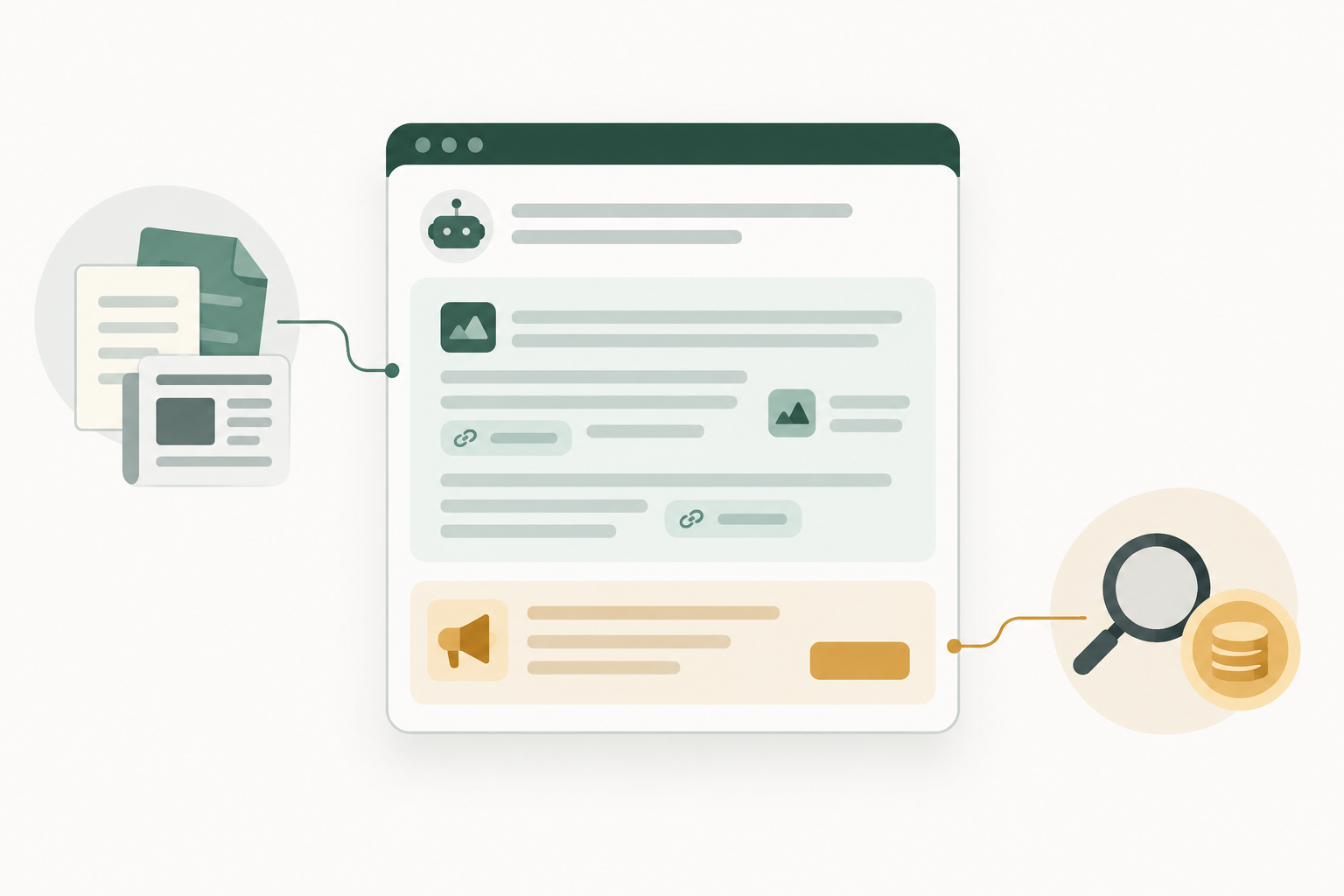
Earned visibility is your brand appearing inside the answer itself, named or linked as a source. Paid visibility is a sponsored unit placed in, beside or below the answer. They sit on the same screen, but they come from different teams, different money and different timelines.
| Earning citations | Buying ads in AI answers | |
|---|---|---|
| Where it shows | Inside the answer, as a mention or a linked source | A labeled sponsored unit near the answer |
| Who controls it | Nobody fully; the model chooses its sources | You, through bids, budgets and targeting |
| Budget line | Content, PR, analyst relations, reviews | Search and paid social |
| Speed | Months; depends on what the model retrieves | Days; campaigns can go live this week |
| How you measure it | Share of model across a fixed prompt set | Cost per opportunity in the CRM |
| Main risk | Paying for activity you can't tie to pipeline | Paying for placements reported blended into other numbers |
The split matters because the two lines answer to different tests. Earned visibility behaves like brand and category presence, so it gets judged over quarters. Paid visibility behaves like search, so it gets judged on the same cost per opportunity as the rest of your paid budget. Mixing them in one line usually means the paid half gets judged on brand metrics, or the earned half gets cancelled for not producing leads in a month.
AI answers send little traffic, but they shape the shortlist
AI referrals are still a small share of visits. SE Ranking's study of 101,574 websites found that AI platforms sent 0.32% of all website traffic from January to April 2026, against 42.75% from organic search, a gap of roughly 134 to 1 (SE Ranking). If you judge LLM visibility on sessions, it will lose every budget meeting.
The effect shows up in what buyers do on the results page instead. Pew Research Center's analysis of 68,879 Google searches by 900 US adults in March 2025 found that people clicked a traditional result on 8% of visits when an AI summary appeared, against 15% when one didn't, and clicked a link inside the summary on 1% (Pew Research Center). The answer is often where the reading stops.
So the right frame is influence on the shortlist, and that's why the earned line belongs with brand and category work. A buyer who sees three vendors named in an answer and never clicks still walks into your sales process with a list. Whether you're on it shows up later, in direct traffic, branded search and the "how did you hear about us" field, not in the referral report.
Earning citations takes the same work as being worth citing
Getting cited by ChatGPT and other assistants depends mostly on being findable, being specific and being mentioned by others. Google says its AI features don't need any special optimization beyond normal SEO and that pages must be indexed and eligible to show a snippet (Google Search Central), which is a useful antidote to anyone selling a secret file format.
Four things are worth funding, roughly in this order:
- Let the crawlers in. OpenAI's documentation says sites that opt out of OAI-SearchBot won't be shown in ChatGPT search answers, though they can still appear as navigational links (OpenAI). Check that your robots.txt isn't blocking the search crawlers your team wants to appear in; blocking the training crawler is a separate choice.
- Write pages that answer buyer questions plainly. Category pages, comparison pages and pricing explanations that answer the question in the first paragraph, with named sources and real numbers, give a model something to lift.
- Add evidence. The KDD 2024 study that coined generative engine optimization found that adding citations, quotations from relevant sources and statistics raised a source's visibility in generated answers by 30 to 40% on the paper's main visibility measure (Aggarwal et al.). It was a lab result with a benchmark, so treat it as direction, not a promise.
- Earn mentions on pages you don't own. Review sites, analyst reports, comparison articles and community threads are where models find the names they recommend. That's PR and analyst relations work, and it's slow.
None of this is new marketing; it's the content and PR work a B2B brand should already be doing, measured against a new outcome. That's also why we'd fund it from the content and PR budget and not from paid media. The paid team's job here is to measure it, not to own it.
Share of model measures earned visibility you can report
Share of model is the share of answers to a fixed set of buyer questions that name your brand, compared with the share that name each competitor. It's the earned line's version of share of voice, and it's the number you can put in a quarterly review.
A workable version takes an afternoon to set up:
- Write 30 to 50 buyer questions. Use the questions buyers ask before a shortlist: "best [category] for [industry]", "[competitor] alternatives", "how to choose a [category] vendor", plus the problems your product solves, written the way a buyer would type them.
- Run each question several times in each assistant. Answers vary between runs, so one run per question produces noise. Three to five runs each in ChatGPT, Claude, Gemini, Copilot and Google's AI Mode gives a steadier read.
- Record four fields per answer. Was the brand mentioned, was it linked as a source, where did it appear in the list, and was the description accurate.
- Repeat monthly and chart the trend. The level matters less than the direction against your three closest competitors.
Here's how a summary might look, using hypothetical numbers from 40 questions run five times in ChatGPT, for a B2B HR software company with three competitors:
| Brand (hypothetical) | Answers mentioning it | Answers citing its site | Share of model |
|---|---|---|---|
| Your company | 54 of 200 | 21 | 27% |
| Competitor A | 88 of 200 | 40 | 44% |
| Competitor B | 41 of 200 | 12 | 21% |
| Competitor C | 17 of 200 | 6 | 9% |
Read it the way you'd read share of voice. Competitor A's lead tells you where its content and coverage are stronger, and the accuracy field tells you whether the answers describe your product correctly, which is often the cheaper problem to fix. Tracking tools can automate the runs, but the prompt set and the competitor list are yours to own, because they encode what you think buyers ask.
Ads in AI answers mostly come from campaigns you already run
Paid AI visibility is less of a new budget than it looks, because three of the four main surfaces sell placements through existing campaigns. Google says Search, Shopping and Performance Max campaigns can serve in and around AI Overviews and AI Mode, and Microsoft says eligible campaigns are opted into Copilot ads automatically with no separate reporting. ChatGPT is the one surface with its own ads manager. Perplexity, the Gemini app and Claude sell no ads as of November 2026, so the earned line is the only way into those answers. LinkedIn isn't an AI answer surface, and it stays the channel for reaching buyers by job title and company, which none of the four AI surfaces offers as a targeting option.
That changes the budget question. For Google and Microsoft, the decision is which match types and campaign settings let your existing spend reach AI placements, and our guides to AI Overview ads, AI Mode ads and Microsoft Copilot ads cover those settings. For ChatGPT, it's whether to fund a separate test, which our ChatGPT Ads Manager guide sizes for B2B.
All of it gets judged on cost per opportunity, because the buyer who clicks an ad in an AI answer goes through the same form, the same SDR and the same CRM stage as any other search lead. If the placement reports blended into your search numbers, as Google's and Microsoft's do, run it as an experiment on part of the budget and compare opportunities, not clicks.
A decision rule for splitting the AI search budget
Split the budget by what each line can prove, using three questions about your own market. The answers decide how much goes to earning, how much to buying, and how much to measuring before you commit to either.
- Do AI answers in your category name vendors? Run ten buyer questions this week. If the answers list vendors, earned visibility affects your shortlist and deserves a content and PR line. If they give generic advice and name nobody, keep the earned spend small and check again next quarter.
- Is search already a large share of your paid budget? If it is, your existing campaigns already reach AI placements on Google and Microsoft, and the paid decision is settings, not new money. If search is small, a ChatGPT test may be your cheapest way into AI answers.
- Can you tie the spend to opportunities? If your CRM records the source of each opportunity reliably, fund the paid line on cost per opportunity. If it doesn't, fix that before you add any new paid surface, because you won't be able to judge it.
Imagine a B2B SaaS team spending $40,000 a month on paid search and $15,000 on content and PR, with AI answers in its category naming five vendors, and reliable opportunity tracking. A reasonable split, as a hypothetical, would look like this:
| Line | Monthly amount | Comes from | Judged on |
|---|---|---|---|
| AI Max or broad match experiment on part of Google search, set up under Campaigns, Experiments in Google Ads | No new money; 20% of the search budget moved into the test arm | Search budget | Cost per opportunity against the control arm |
| ChatGPT ads test | $3,000, ring-fenced for one quarter | Search budget | Cost per opportunity, stopped at quarter end if it runs above the search average |
| Citation work: comparison pages, data-backed content, review and analyst coverage | $4,000 of the existing content and PR budget, refocused | Content and PR | Share of model trend over two quarters |
| Share of model tracking | $500 or an analyst's afternoon a month | Marketing ops | Whether the report gets used in reviews |
The money mostly moves within existing lines; very little is new. The useful change is that each line now has its own test and its own owner, so the screenshot from the leadership team gets an answer with numbers attached.
How Scalewell sets the order of AI search work for a paid team
Scalewell helps paid and demand gen teams give each AI visibility line its own owner, test and monthly number, so the screenshot question stops arriving as a fire drill. A free 30-minute call comes first. An audit of the team's week then lists the recurring work behind both lines, such as the share of model run and the AI placement readout, and scores each job. The ranked roadmap from that audit picks the first job for AI. That job is then built in a sprint that usually lasts 8 to 12 weeks, inside the tools your team already has, and your people are trained to run it without Scalewell afterwards.
LLM visibility programs fail when they measure the wrong thing
The most common failure is judging earned visibility on referral traffic. At a fraction of a percent of visits, AI referrals will always look too small to fund, so the citation work gets cut before it has time to change share of model. Report the earned line on share of model and branded search trends, and leave sessions out of it.
Buying a tool before writing the prompt set. Visibility trackers are useful, but a tool with someone else's prompts tells you about someone else's buyers. Write your own 30 to 50 questions first, then choose a tool that runs them.
Treating a ChatGPT ad as the fix for a missing citation. A sponsored unit near an answer that names three competitors doesn't put you in the answer. It can be worth testing on its own merits, but it solves a different problem.
Chasing single answers. Answers vary between runs and between days. A screenshot of one answer is an anecdote; a monthly trend across hundreds of runs is a measure. Agree with the leadership team that decisions get made on the trend.
Rewriting pages for machines. Pages stuffed with keywords or written as lists of fragments read badly to people and, in the GEO study, keyword stuffing performed worse than doing nothing. Write for the buyer and add evidence; that's the work both audiences reward.
Where to start
Run ten buyer questions through ChatGPT, Claude and Google's AI Mode this week, three times each, and note who gets named. That one afternoon tells you whether earned visibility matters in your category and which competitor owns it. If you'd like help turning the result into a budget split and a monthly measure, Scalewell does that work with B2B paid teams.
Frequently asked questions
Can you pay to be cited in ChatGPT or Google's AI answers?
No. Google's ads help page says "Paid advertising does not influence the organic responses generated by Google AI", and OpenAI's help center says "Ads do not influence ChatGPT's answers." An ad buys a labeled sponsored slot near the answer. Being named inside it still depends on your site, reviews, analyst coverage and what others write about you.
Does blocking GPTBot keep a site out of ChatGPT answers?
Not on its own. OpenAI's crawler documentation says disallowing GPTBot means a site's content "should not be used in training generative AI foundation models", while search visibility is controlled by OAI-SearchBot. A site can block training and still appear in ChatGPT search answers, as long as OAI-SearchBot is allowed in robots.txt.
Is LLM visibility the same as GEO or AEO?
Mostly the same idea under different names. Generative engine optimization (GEO) comes from a 2023 research paper accepted to KDD 2024, and answer engine optimization (AEO) is the marketing industry's term for the same work. Both describe the earned half: getting named or cited inside the answer. LLM visibility is the wider term, because it also covers the sponsored units placed near the answer.
Do Perplexity, Gemini and Claude sell ads?
Not as of November 2026. Perplexity dropped the sponsored answers it tested, Google has said there are no ads in the Gemini app, and Anthropic wrote on February 4, 2026 that "Claude will remain ad-free." The only ads in AI answers you can buy today are in Google AI Overviews, Google AI Mode, Microsoft Copilot and ChatGPT.