AI slop ads in B2B: where generated creative hurts trust and where it pays
AI slop ads cost a B2B brand trust with a buying committee, while AI used for research, briefs and versions saves hours the buyer never sees.
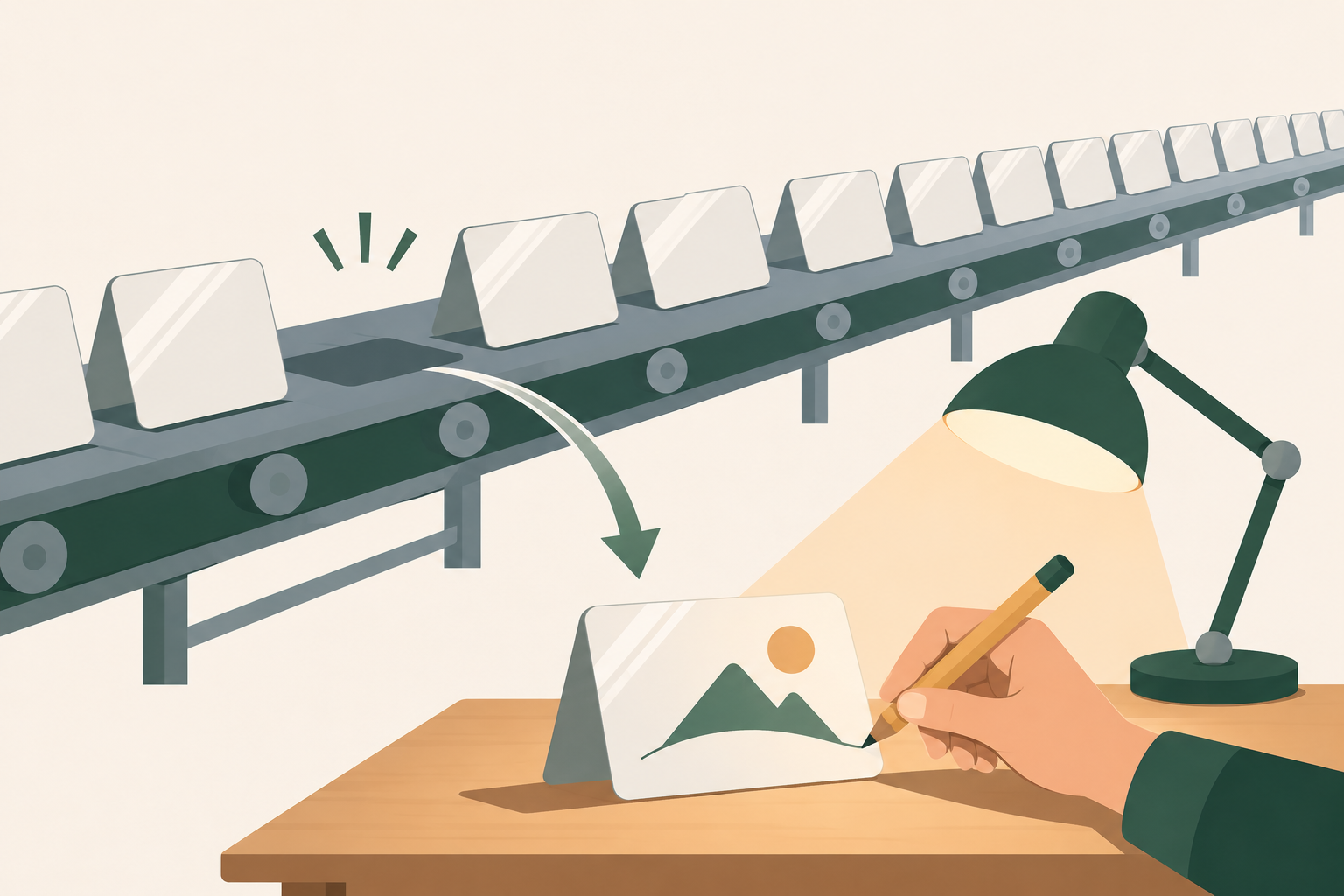
AI slop ads are ads that look mass-produced by a model: generic claims, interchangeable visuals and nothing a buyer could check. In B2B they cost trust with a buying committee that is already looking for reasons to cut a vendor. AI pays when it speeds up research, briefs and versions the buyer never sees.
Picture a hypothetical first call. Your rep opens with the agenda, and the prospect's head of IT says, half joking, "Before we start, was that LinkedIn ad of yours made by a robot?" Everyone laughs, and the next forty minutes go to proving your product is more careful than your advertising. Nobody in your team will ever see that cost in a dashboard.
This article is for the marketing leader who has to set the rule on generated creative. It explains why slop costs more in B2B than in consumer marketing, sorts the creative jobs by whether a buyer can see the AI, and gives you a two-question test your approvers can apply to every ad. Hours back on creative production, with no ad a buying committee would read as slop, is where Scalewell puts its effort with paid and demand gen teams.
AI slop ads are cheap to make and expensive to be seen running
Merriam-Webster named "slop" its 2025 word of the year on December 15, 2025, and defined it as "digital content of low quality that is produced usually in quantity by means of artificial intelligence." Notice the two parts of that definition: low quality and in quantity. An ad becomes slop when volume replaced judgment, whatever tool made it.
That matters because the damage comes from what the viewer suspects, more than from what actually happened. Raptive, an ad network, surveyed 3,000 US adults in a study published in 2025 and found that when people suspected content was AI-generated, they rated it 48% less trustworthy, and ads shown beside it saw a 14% drop in purchase consideration. Raptive sells advertising next to human-made content, so read it as an interested party's study. The direction still tells you something useful: a well-made ad that merely looks generated pays a penalty too, because the reaction follows the suspicion.
Consumer attitudes are moving the same way. Gartner found that 50% of US consumers would prefer to give their business to brands that don't use generative AI in consumer-facing messages, advertising and content, from a survey of 1,539 people in October 2025, as reported by CMSWire on March 16, 2026. In a separate poll of 307 US consumers in March 2026, 49% said generative AI has made content quality worse, according to CX Today on June 10, 2026. Kate Muhl, a VP analyst at Gartner, put it plainly: "AI-generated content is increasing the volume of media that consumers encounter, but not necessarily the value."
Your buyers are those consumers on a work day. They bring the same filter to LinkedIn that they bring to their personal feeds, and they now have a word for what they're filtering out.
Buying committees punish slop harder than consumers do
A B2B ad is judged by a group, and every extra person in that group is another chance for someone to decide your company cuts corners. Forrester's 2026 State of Business Buying, based on nearly 18,000 business buyers, found that buying groups for purchases with generative AI features average 14 members, against seven for purchases without them. If you sell anything with AI in it, the room reading your ads has doubled.
Those people also check what they read. Gartner found that 69% of B2B buyers rely on sales reps to validate what they found, and more than half said they had received misleading information from AI tools, as MarTech reported on May 20, 2026. A buyer who has been burned by an AI answer is the person most likely to spot an AI ad.
The consequence shows up in shortlists. In the 2026 Edelman and LinkedIn B2B thought leadership report, 59% of final decision-makers said a vendor's poor or absent thought leadership contributed to that vendor being removed from consideration, and 51% named adding "context, nuance and human judgment" as one of the most important jobs of thought leadership now that buyers also read AI-generated answers, as PPC Land reported on November 14, 2026. Those figures are about thought leadership rather than ads, but a sponsored post is often where that content first reaches the committee.
Consumer brands at least hear about it. McDonald's Netherlands posted a 45-second AI-generated Christmas ad on December 6, 2025 and removed it within days after a public backlash. A B2B brand rarely gets a backlash. It gets a quieter outcome: a shortlist of three that becomes two, and a lost-deal reason in the CRM that says "went with competitor."
Small audiences make it worse. LinkedIn's floor for a matched audience is 300 members, and an account-based campaign often reaches only a few thousand people in total. Take a hypothetical campaign to 400 target accounts for a product with AI features: at Forrester's 14 members per buying group, that's 5,600 people, and over a quarter each of them may see the same ad a dozen times. In consumer marketing a weak ad gets lost in the volume, while in B2B the same few thousand people see it again and again.
Generated creative hurts trust when it stands in for proof
Generated creative damages B2B trust when it replaces something the buyer expects to be real or specific to you. Our guide to AI generated ads for B2B covers the obvious offenders, such as invented people, fake product screens and made-up quotes, along with the research on click-through rates and platform labels. Slop goes wider than fakes, though, and the subtler kinds are the ones that get past approval.
The first kind is sameness. In a preregistered experiment with 758 Boston Consulting Group consultants, Dell'Acqua and colleagues found that people using GPT-4 produced higher-quality product ideas but with "a marked reduction in the variability of these ideas." If you and your three closest rivals all prompt similar models with similar inputs, your ads converge. A buying committee comparing four vendors then sees four versions of the same promise and has no reason to remember yours.
The second is the claim nobody owns. A model fills gaps with plausible category language, so "streamline your workflow" and "actionable insights" appear because the brief was thin, and no one at your company would defend those words to a customer. The third is the visual that has nothing to do with the product: abstract glowing networks, generic offices, a handshake rendered in soft blue light. Each says your team had nothing specific to show.
The fourth is the mismatch. An ad that promises a specific outcome and clicks through to a landing page that never mentions it reads as careless, and careless is exactly the impression slop leaves. None of these four needs a six-fingered hand to fail. They fail because they could belong to any company in your category.
AI pays where the buyer never sees it
AI earns its place in B2B creative work on the jobs that happen before an ad exists or around it, where speed matters and nothing visible to the buyer is invented. The same BCG experiment found that on tasks inside what the authors call the AI frontier, consultants with GPT-4 completed 12.2% more tasks, finished 25.1% more quickly and produced results rated more than 40% higher in quality. On a task deliberately chosen to sit outside that frontier, they were 19 percentage points less likely to reach the correct answer.
That split is the whole argument in miniature. AI does well on drafting, summarizing and sorting, and badly where judgment about specifics decides the outcome. In ad creative, that maps neatly onto what the buyer sees and what they don't.
| Creative job | Does the buyer see the AI? | Trust risk | Where it belongs |
|---|---|---|---|
| Summarizing call recordings and win-loss notes for buyer language | No | Low | AI drafts, a marketer picks the lines |
| Turning performance data into a creative brief | No | Low | AI drafts, the creative lead edits |
| Reading competitor ads to find claims your rivals all make | No | Low | AI sorts, a person decides the gap |
| Generating 20 headline angles to cut down to three | Only if the weak ones survive | Medium | AI drafts, a person who talks to customers chooses |
| Resizing an approved design for other placements | Rarely | Low | AI does it, a designer spot-checks faces and text |
| Pre-checking ads against specs, brand rules and claims | No | Low | AI flags, a named person signs |
| Generated backgrounds behind a real screenshot or real photo | Sometimes | Medium | Keep the true part real, check the look |
| Generated people, product screens, logos or quotes | Yes | High | Leave out of B2B ads |
| Full ads generated from a one-line prompt | Yes | High | Concept roughs only, never published |
The top half of the table is where generated work saves hours without ever touching the buyer's view of you. Turning ad data into briefs and running an AI pre-check before brand and legal review are both jobs a buyer never knows happened, and both make the human-made ad that follows more specific.
There's a nice irony in it. The best defense against slop is often AI itself, used to dig up the customer's own words so the copy sounds like nobody else's.
Ask two questions before any generated element ships
Every generated element in an ad should pass two questions before it spends money. First, would a buyer on the committee notice that this was generated? Second, if they noticed, would it change what they believe about your company?
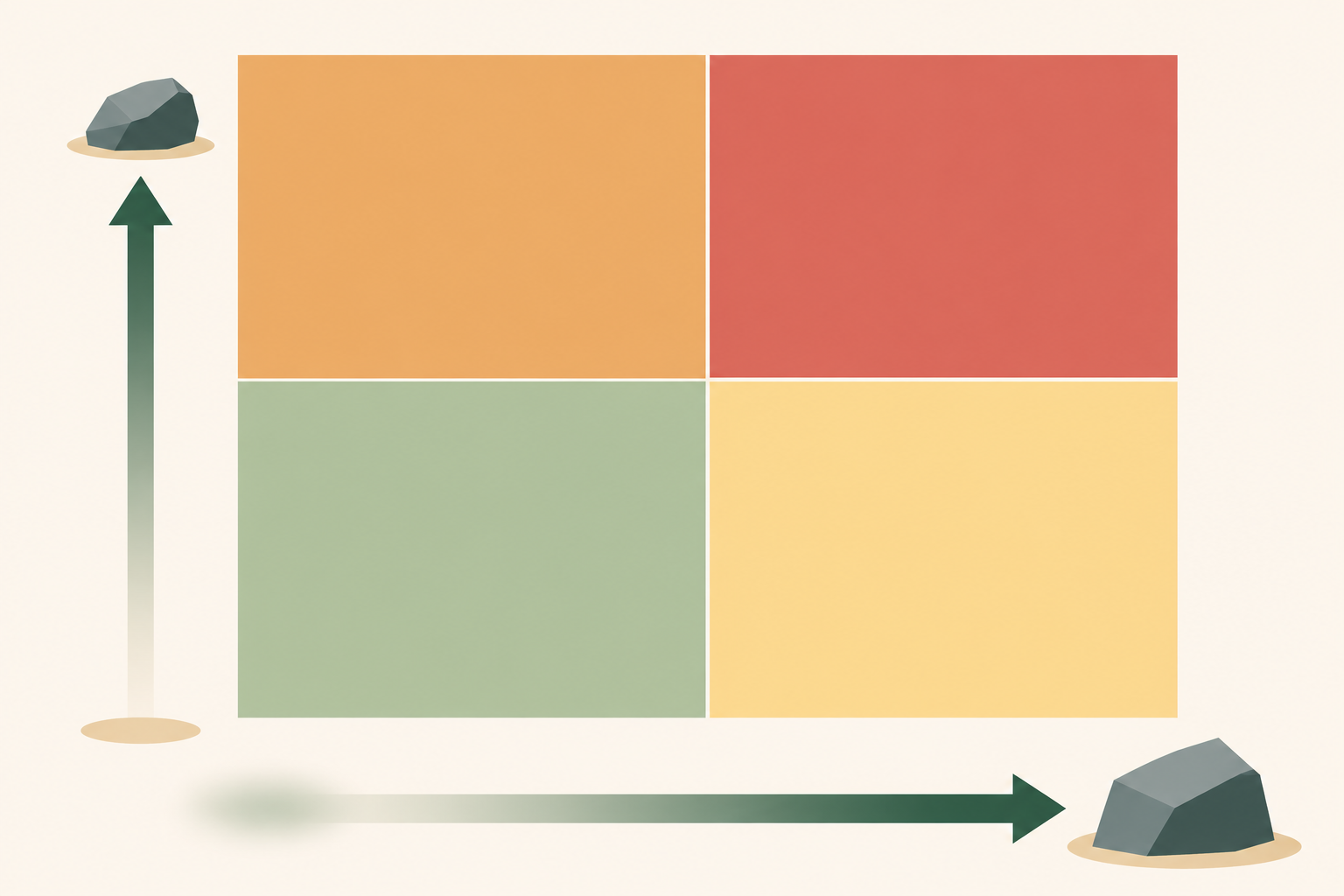
When both answers are no, use AI as freely as you like. When the first is yes and the second is no, as with a generated background behind a real product screenshot, the element can run once a person has checked that it doesn't carry the glossy, over-saturated look buyers read as AI. If the second answer is yes, the element is doing the job of proof, and proof has to be real.
Here's how it plays out with two hypothetical teams. Company A sets a target of 30 new LinkedIn and Meta variants a month and lets the generator produce full ads. Company B uses AI to pull buyer phrases from 20 recorded sales calls, drafts angles from them, and has a designer build eight ads around real screenshots. By the end of the month the first team has hit its variant target, while the second ships ads that sound like its customers, and its approvers spend their time on eight decisions instead of thirty.
The rule also settles the arguments that eat up approval meetings. "Is this AI image good enough?" turns into "is this image standing in for something that should be real?", which a coordinator can answer.
Volume targets produce slop faster than any tool
Slop usually enters a B2B program through a target, and the tool is just how it gets there. A team measured on variants shipped per month will meet the number, and generators make that number cheap to hit. Count variants, and you're paying people to produce slop.
The second failure is approvers who were never shown what slop looks like. A brand guide covers logos and fonts, and it says nothing about interchangeable claims or the soft, overlit style people now read as generated. People approve what looks polished, and generated work is nearly always polished. The fix is training with real examples: your own rejected ads, competitor ads that blur together, and a short list of phrases your sales team would never say out loud.
The third failure is judging creative on the metrics slop flatters. Generated variants can lift click-through rate while doing nothing for opportunities, so read every test against pipeline, which our piece on AI creative testing covers. And if your policy on generated content lives in one person's head, write it down; our AI brand safety guardrail policy gives you a version to copy.
This approach doesn't suit everyone. A team with no settled positioning gets little from AI drafting, because the model will amplify the confusion. And a team in a category where every rival already runs generated creative may find that plain, specific, human-made ads are the cheapest way to stand out.
How Scalewell helps a team keep AI's creative hours and lose the slop
A paid team that saves hours on briefs, research and versions while every published ad stays specific and true is the outcome Scalewell works toward. A free 30-minute call opens the work, followed by an audit of the team's week that scores every recurring creative job for whether AI should take it on. Those scores become a ranked roadmap, and over a build phase of roughly 8 to 12 weeks, sometimes more, Scalewell builds the first jobs inside the software your people work in today. The last step matters most here: the people who brief, make and approve ads are trained to spot slop and to change the AI jobs themselves, without Scalewell.
Measure slop by what it does to pipeline and sales calls
The test of your creative rule is whether pipeline per dollar holds or improves as AI takes on more of the production work. Tag every ad by how it was made, such as human-made, AI-assisted or AI-generated background, in the ad name and in the utm_content parameter of its URL, so the tag reaches your CRM with each lead, then compare cost per opportunity by tag after a full sales cycle.
Add one qualitative check that no platform report will give you. Ask your sales team once a month whether any prospect mentioned your ads, and in what words, or search your call recordings for mentions of your ads. One "was that made by AI?" on a first call tells you more about trust than a click-through rate ever will, and it's free to collect.
Where to start
Pull the last 20 ads your team published and sort each element against the two questions: would a buyer notice the AI, and would it change what they believe? Anything that lands in the top right comes down this week. If you'd like a hand turning that sort into training your approvers can run themselves, Scalewell can help build it and then hand it over.
Frequently asked questions
Is AI slop the same as AI-generated content?
They overlap without being the same thing. AI-generated content is anything a model helped make, and plenty of it is useful and invisible. AI slop is the low-quality, mass-produced kind, where volume replaced judgment. A carefully edited headline that started as a model draft isn't slop. A full ad generated from one prompt and published unchecked usually is, however polished it looks.
What is the difference between AI slop and AI washing?
AI slop describes how an ad was made: low-quality creative produced in volume with AI. AI washing describes what an ad claims: overstating how much AI your product uses. Both damage trust, but AI washing also draws regulators. The FTC announced five actions under Operation AI Comply on September 25, 2024, against operations that used AI hype or sold AI tools that could be used to deceive.
Should B2B companies disclose AI use in their ads?
Disclose where a law or platform requires it, and where a buyer would feel misled if they found out later, such as any synthetic person. In New York, for example, General Business Law section 396-b has required a conspicuous disclosure since June 9, 2026 whenever an advertiser knows an ad contains a synthetic performer. Platform labels and legal requirements differ by channel and market, so keep a written policy that names who checks them. Disclosure of minor edits, like resizing or color correction, is rarely expected.
Does AI slop hurt SEO and organic content as well as ads?
Slop can hurt organic content too. Google said in February 2023 that it focuses "on the quality of content, rather than how content is produced," and that using AI to generate content mainly to manipulate rankings breaks its spam policies. B2B buyers apply the same skepticism to blog posts and LinkedIn articles as to ads, so the same two questions work for organic content.
How do you write an AI policy that stops slop without banning AI?
Write it around jobs, not tools. List which creative jobs AI may do alone, which need a named person to approve, and which elements must always be real, such as people, product screens, quotes and numbers. Then train approvers on examples. A ban pushes AI use out of sight, which makes slop harder to catch.