Marketing budget allocation for B2B when the platforms automate the buying
When the platforms choose bids and placements, a B2B budget becomes four layers (signal floors, learning reserve, test holdout and flexible spend) reforecast each quarter on pipeline.

Marketing budget allocation for a B2B team that runs Smart Bidding, Performance Max or Advantage+ comes down to four layers rather than one split by channel. Fund a signal floor for every automated campaign, set aside a learning reserve, ring-fence a test holdout, and let only what's left move at each quarterly reforecast against pipeline.
Picture the planning meeting in October. Finance wants next year's number by the end of the month, last year's plan was a spreadsheet with one row per channel, and half the rows now belong to systems that choose their own bids, audiences and placements. The CFO's question is simple enough: if the platforms decide where the money goes inside each campaign, what exactly are you deciding?
This guide to marketing budget planning is for the marketing leader, whether CMO, VP or head of demand gen, who has to defend the paid budget for a year. It covers the benchmarks worth quoting, the costs automation adds, a filled-in hypothetical split, the quarterly rhythm and the one page your CFO needs.
B2B marketing budget benchmarks put paid media at about a third of spend
Gartner's 2026 CMO Spend Survey of 401 CMOs put the average marketing budget at 7.8% of company revenue, as Marketing Dive reported on May 11, 2026. Later results from the same survey, as Chief Marketer reported on June 24, 2026, put paid media at a five-year high of 31.4% of that budget, up from 25.1% in 2021.
Those figures tell your CFO whether you're in the normal range. A company with $80 million in revenue and an average budget would spend about $6.2 million on marketing and just under $2 million of it on paid media.
They can't set your number, though, because an average says nothing about your contract value, sales cycle or Total Addressable List. Work the budget up from the pipeline target and the cost per opportunity you can afford, as our media plan template shows step by step, and use Gartner as a sense check in the deck.
Scalewell helps demand gen leaders put AI to work on this planning cycle, so the quarterly reforecast is drafted from pipeline data before it reaches the CFO and the team's week goes on the calls only people can make.
Automation changes what a paid budget has to pay for
Automated bidding and targeting add three costs that a manual account never had to name: the minimum spend each campaign needs to feed the algorithm enough conversions, the weeks of spend while it learns, and the money held back to test whether it works. Leave them out and the plan looks efficient on paper, then underdelivers by March.
The platforms publish the numbers behind the first two. Google's Target ROAS page lists "at least 15 conversions in the past 30 days" as a requirement for Search campaigns, and says a changed target needs time to reach its goal: "give it 1-2 conversion cycles". Microsoft's Performance Max guidance recommends 30 conversions in the last 30 days before adding Target ROAS, says the learning period "can take either two to four weeks or two to three conversion cycles", and suggests giving Performance Max "up to two to three times the budget" of your historical standalone campaigns.
So what does that mean in dollars? It means each automated campaign has a floor, and the floor is the conversion minimum multiplied by your cost per conversion at the stage you bid on. If a sales-qualified stage costs $400 and Google wants 15 a month, that campaign needs about $6,000 a month before it can bid on that stage at all. Our guide to AI bidding has each platform's floor and what to do when a campaign falls below it.
Some platform rules make the floor much higher. For Demand Gen campaigns on Target CPA, Google's About Demand Gen campaigns page recommends "a budget that's at least 10 times your target CPA", and its API developer guide says 15 times. At a hypothetical $150 target CPA, even the lower multiple is $1,500 a day, or roughly $45,000 a month, for one campaign.
Automation also blurs what a line buys. Microsoft's help page on ads in Copilot says advertisers "cannot opt out" of Copilot serving and that it "does not currently support specific metrics" for those ads, so part of your Microsoft search budget buys placements you can't report separately.
Fund four layers before you split anything by channel
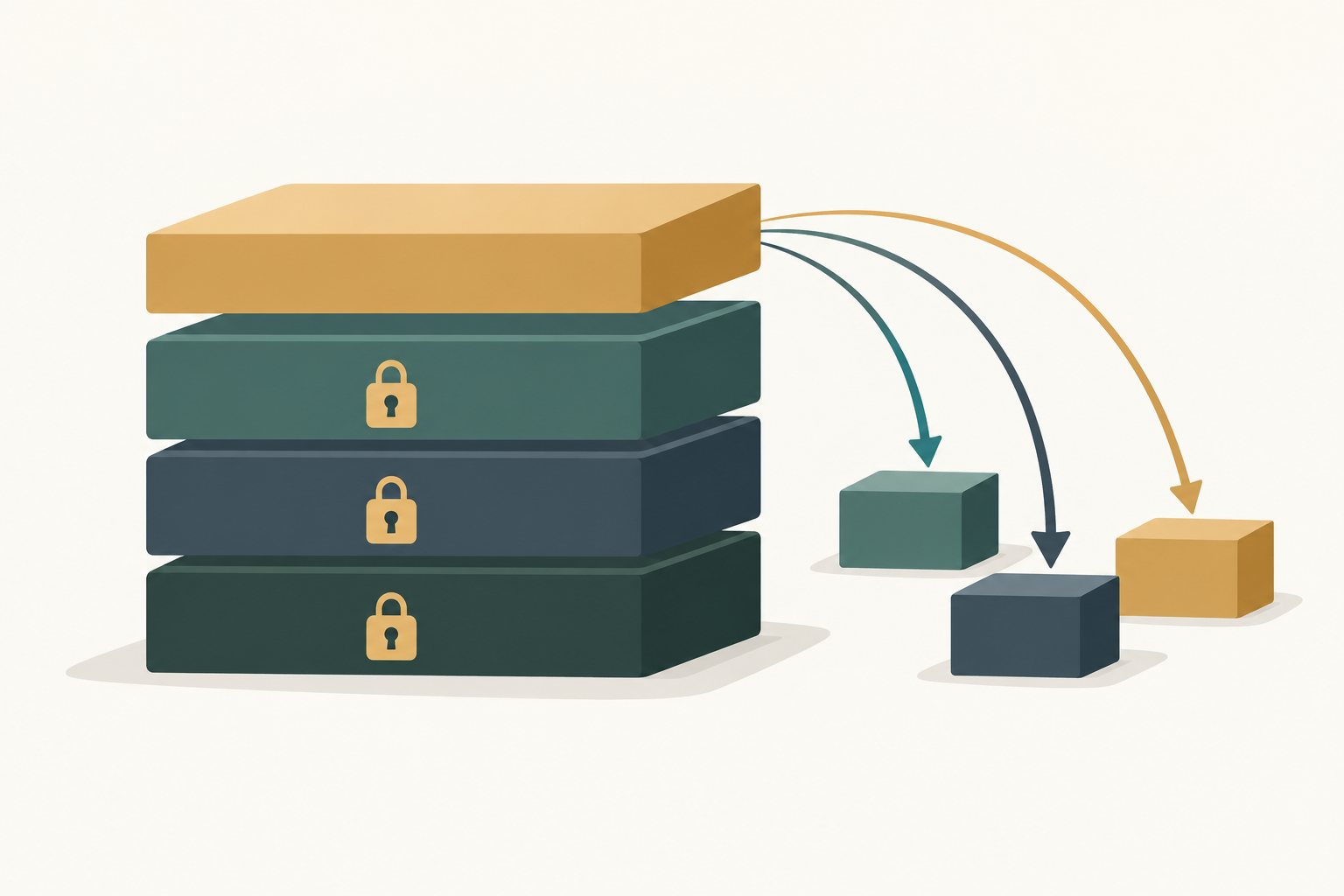
A budget built for automated buying has four layers, decided in this order: signal floors, learning reserve, test holdout and flexible spend. The first three are commitments for the quarter, and only the fourth moves when the reforecast says it should.
| Layer | What it pays for | How to size it | Who can move it |
|---|---|---|---|
| Signal floor | The minimum spend that gives each automated campaign enough conversions at the stage it bids on | Platform conversion minimum times your cost per conversion at that stage, per campaign | Nobody during the quarter; cut a campaign rather than starve it |
| Learning reserve | Spend during learning weeks for new campaigns, new bid strategies and goal changes | The weeks each platform documents for learning, times the campaign's planned weekly spend | Released into flexible spend if no new campaign launches |
| Test holdout | Incrementality and lift tests that tell you whether a channel creates pipeline | The platform's test minimum, or the holdout sized from your account list | Only the CMO, and only against a written test brief |
| Flexible spend | Everything else, moved toward the lines producing opportunities below the ceiling | What remains after the first three | The head of paid media, within limits agreed with finance |
The order stops the most common mistake in a B2B account: ten automated campaigns each funded at half its floor, all stuck in learning, and a quarterly review that blames the platform.
Holdout minimums are not small: LinkedIn's Conversion Lift help page requires an $80,000 cumulative budget over 30 to 90 days, and Google's user-based Conversion Lift asks for at least 1,000 observed conversions and a $5,000 campaign budget. Our guide to incrementality testing covers the cheaper account holdout most B2B teams should start with.
Split brand, demand creation and demand capture by job, not by habit
The split between brand, demand creation and demand capture should follow what each line is there to do, with each line judged on its own measure. LinkedIn's B2B Institute, drawing on IPA Databank B2B cases from 1998 to 2018, says on its principles of growth page that "brands should balance the budget between long-term brand building and short-term sales activation with a 50/50 split." The cases are award entries rather than a random sample, so treat it as a direction.
Spend is drifting the other way. The same Gartner survey found 62.6% of media spend going to awareness and conversion, a 10% increase from 2024, while loyalty and retention fell below 15%, as Marketing Dive reported on June 9, 2026. Ewan McIntyre, chief of research in Gartner's marketing practice, put the risk in one line: "AI can help marketers optimize faster, but optimization is not the same as strategy." Automated bidding pulls money toward whatever converts fastest, and in B2B that is usually demand capture.
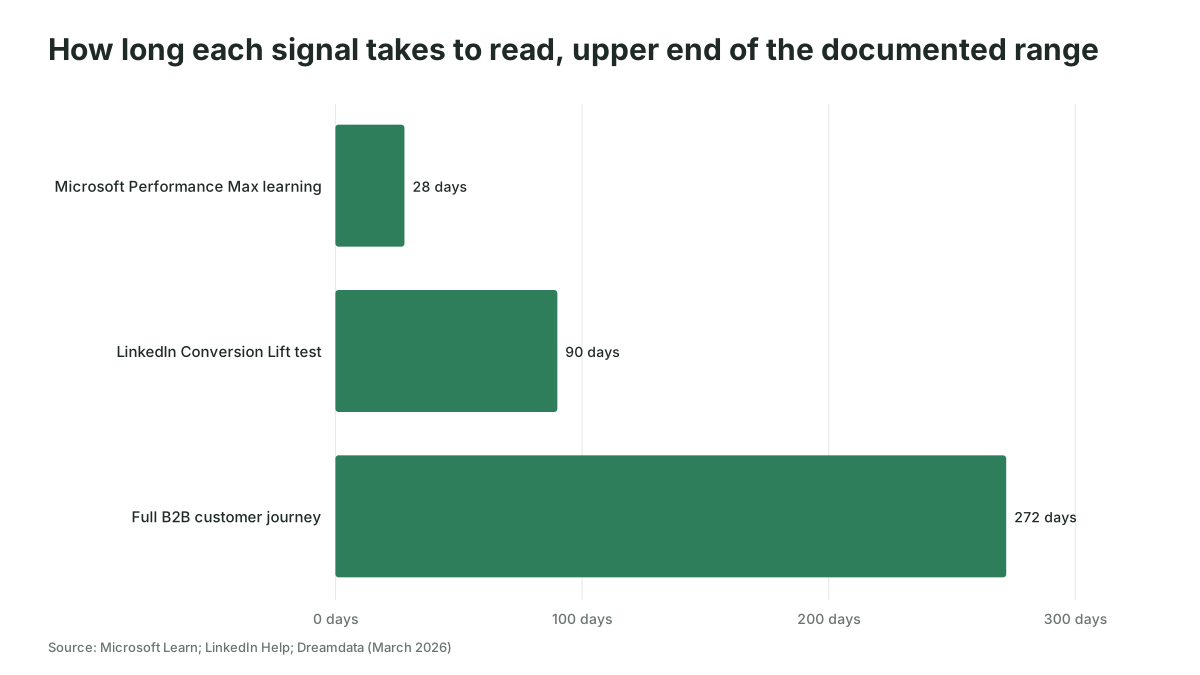
The reason to protect the creation line is the length of the journey. Dreamdata's 2026 benchmarks release, drawn from 3.5 million customer journeys, finds the full B2B journey now takes 272 days, up from 211. A LinkedIn campaign that reaches a buying committee in January may show up as an opportunity in the fall, so demand creation gets judged on account engagement and opportunities from the Total Addressable List over two or more quarters, and demand capture on cost per opportunity each month.
A filled-in hypothetical budget split for one year
Here is the whole framework applied to an invented company: $80 million in revenue, an average contract value of $60,000, a 272-day journey and a $2 million annual paid media budget, which is close to the Gartner average. Every figure below is hypothetical, so replace each one with your own.
| Line | Annual budget | Share | Layer | Judged on |
|---|---|---|---|---|
| Brand: LinkedIn video and thought leader ads, YouTube, on the Total Addressable List | $360,000 | 18% | Flexible, with a quarterly minimum | Reach and frequency into target accounts, brand lift where tested |
| Demand creation: LinkedIn sponsored content and Meta to target accounts and committees | $640,000 | 32% | Floors for each automated campaign, rest flexible | Engaged accounts and opportunities from the list, over two quarters |
| Demand capture: Google and Microsoft search, retargeting | $700,000 | 35% | Floors for each automated campaign, rest flexible | Cost per opportunity against the ceiling, monthly |
| Learning reserve | $100,000 | 5% | Reserve, released if unused | Not judged; tracked so it isn't counted as waste |
| Test holdout: one LinkedIn Conversion Lift test plus an account holdout | $200,000 | 10% | Locked; CMO releases | Incremental opportunities per dollar |
| Total | $2,000,000 | 100% |
Brand and demand creation together take 50%, in line with the LinkedIn B2B Institute's 50/50 guidance. The $200,000 holdout covers LinkedIn's $80,000 lift test minimum with room for a second test. The $100,000 learning reserve covers four weeks of launch spend at $3,000 a week for each of eight new or restructured campaigns over the year, sized on the upper end of Microsoft's two to four week learning window.
A team with a short list of named accounts would shrink brand in favor of demand creation aimed at those accounts, and a team with strong search demand and a 90-day cycle could carry more capture.
Reforecast every quarter on pipeline, and leave pacing to the monthly check
The quarterly reforecast is where flexible spend moves, and it should move on opportunities and cost per opportunity, not on platform-reported conversions. Lock the floors, the holdout and the brand minimum for the quarter, then shift the flexible layer toward the lines that produced opportunities below the ceiling and away from those above it.
Judging windows set the pace: one to two conversion cycles for a Google Target ROAS change, two weeks between Microsoft target changes, at least 30 days for a LinkedIn lift test. With a B2B cycle measured in months, monthly reallocation mostly reacts to noise, while a quarter shows opportunities from capture and early signs from creation.
Keeping spend on plan within the month is a separate job, covered in our guide to PPC budget pacing.
AI budget planning earns its place here. A model with your CRM export and platform spend can recount each campaign against its floor, flag lines whose cost per opportunity drifted above the ceiling, and draft three reforecast scenarios before the meeting. It shouldn't choose between them, because each option commits money someone has to defend. Which of these planning jobs AI should take on first, and in what order, is the subject of our guide to a ranked AI implementation roadmap.
The CFO needs one page: committed, flexible and what each dollar returned
Give the CFO one page with four parts: what is committed, what can move, what it returned and what would change the plan.
- The split by layer. Floors, reserve, holdout and flexible spend, with the share of the total that is locked for the quarter.
- The ceiling. The cost per opportunity you can afford, worked from contract value, win rate and the CAC payback finance accepts, and each line's actual against it.
- Pipeline coverage. Opportunities and pipeline value created by paid media this quarter, against the target, with demand creation lines shown on their longer window.
- Tests and decisions. Which tests ran, what they found and what budget moved as a result, plus the rule for releasing the reserve.
That page answers the opening question: the platforms decide bids and placements inside each campaign, and you decide which campaigns exist, how much signal each gets, what is held back to test them and what earns more next quarter. For the board-level version, with CAC payback and pipeline velocity, see our guide to reporting marketing ROI to the board.
Budgets built for automation fail in four familiar ways
Too many campaigns under their floor. Last year's structure gets copied into automated campaigns, and none clears its conversion minimum. Consolidate before the year starts.
Bidding on the wrong stage to clear the floor. Optimizing for form fills makes the floor cheap and the pipeline thin. If a qualified stage can't reach the minimum, fund fewer campaigns on that stage rather than more on a stage sales ignores. Google's Demand Gen value-based bidding page also says a conversion with a value of 0 or less doesn't count toward eligibility, so give lead stages values above zero before moving budget there.
The holdout becomes a top-up. Once test money tops up a behind-plan line, you lose the one number that says whether the channel works.
Demand creation judged on the capture clock. A LinkedIn line measured on cost per opportunity in its first quarter will look expensive against search every time. Agree its window with the CFO before the year starts, not after the first review.
How Scalewell turns budget planning work into a ranked AI roadmap
Floor counts, reforecast drafts and CFO packs are the planning work Scalewell helps a demand gen team put in order and hand to AI. Work begins with a free 30-minute call. A review of the team's week then lists each recurring planning job and scores where AI should start, and those scores become a ranked roadmap, with hours saved and pipeline as each job's test.
A sprint then builds the top jobs in software the team uses today, adding new systems only if needed, typically over 8 to 12 weeks, though sometimes longer. The builders are B2B paid media practitioners, and the team keeps the roadmap and the training to adjust everything without Scalewell.
A budget built this way should survive the second quarter
The budget is working when the second-quarter reforecast moves flexible spend without touching the floors, the holdout has produced at least one result that changed a line, and cost per opportunity on capture lines sits at or below the ceiling you agreed with finance. If the reforecast turns into a negotiation over which locked layer to raid, the campaign count was too high, and the fix is fewer campaigns next quarter.
Where to start
Before the next planning meeting, list every automated campaign with its conversions in the last 30 days at the stage it bids on and the platform's minimum beside it, and you'll know how many campaigns your budget can actually fund. When the team wants AI drafting those counts and the reforecast scenarios each quarter, Scalewell can help work out which planning jobs to hand over first.
Frequently asked questions
What percentage of revenue should a B2B company spend on marketing?
Gartner's 2026 CMO Spend Survey puts the average at 7.8% of company revenue, as Marketing Dive reported, with paid media at 31.4% of that budget, as Chief Marketer reported. Quote it to show where you sit, then build your own number up from the pipeline target, the contract value and the cost per opportunity you can afford.
How much of a marketing budget should go to AI tools?
In Gartner's 2026 CMO Spend Survey, 15.3% of marketing budgets on average went to AI, as Marketing Dive reported on May 11, 2026. That figure mixes software, data work and people, so it is not a target. Budget AI the way you budget any other spend: name the job it takes on, the hours it saves and the pipeline decision it improves, and fund it from the line it replaces.
Should a B2B marketing budget be set annually or quarterly?
Set the total annually, because finance plans the year and your commitments, such as lift tests and brand minimums, need a full year to show results. Then reforecast the flexible part every quarter on opportunities and cost per opportunity.
How do you allocate a marketing budget across channels?
Give each channel a job first, then fund it to that job's minimum. Search and retargeting capture existing demand and are judged on cost per opportunity. LinkedIn and paid social create demand on your account list and are judged over two or more quarters.
What happens to the budget if a campaign never leaves the learning phase?
A campaign stuck in learning is usually underfunded for its conversion goal or edited too often. Check its conversions in the last 30 days against the platform's minimum, such as Google's 15 for Target ROAS on Search. If it can't reach the minimum, merge it with a similar campaign rather than adding small amounts of budget, and keep the bid goal on a stage sales still accepts.