AI search advertising: where ads appear in AI answers and how B2B teams should buy them
Ads in AI answers run on four surfaces as of November 2026, and three of them already draw on your search budget, so the real decisions are match types, assets and one ring-fenced ChatGPT test.

AI search advertising means paying to appear inside or beside answers written by an AI assistant. As of November 2026 the four main places to buy it are Google AI Overviews, Google AI Mode, Microsoft Copilot and ChatGPT. Google and Microsoft sell it through campaigns you already run. ChatGPT is the only one with its own ads manager.
The question usually reaches you sideways. Your CEO asks a chatbot about your category over the weekend, sees a rival named in the answer, and on Monday wants to know "why we're not in there". That one question bundles two jobs. One is advertising, which you can buy. The other is being cited in the answer itself, which you can't.
This guide is for the marketing leader who has to answer it with a plan and a budget line. It maps each surface as it stands in November 2026: how you buy it, whether a B2B buyer will see it, how far along it is, and what to test first. Then it takes the four questions your CFO will ask, on budget, measurement, brand safety and the difference from organic AI visibility. Each surface has its own deep dive, linked where it comes up.
AI search ads run on four main surfaces as of November 2026
Google AI Overviews, Google AI Mode, Microsoft Copilot and ChatGPT are the four main AI answer surfaces that sell ads as of November 2026. The table below compares them on what a B2B team needs to know before spending, and every row comes from the platforms' own pages or reporting on them, as of November 10, 2026.
| Surface | How you buy it | Can you target or exclude it? | Reporting | Maturity, November 2026 | Test first |
|---|---|---|---|---|---|
| Google AI Overviews | Existing Search, Shopping and Performance Max campaigns | No, and no separate opt-out | Included in campaign and search terms reports, not split out | Live in the US and select English-speaking markets | Whether broad match or AI Max brings qualified opportunities |
| Google AI Mode | The same campaigns, same auction | No | Same as AI Overviews | Scaling to 10 more countries since October 28, 2026; multiturn ads launching in the US | The same test, read on longer queries |
| Microsoft Copilot | Eligible Microsoft Advertising campaigns, opted in automatically | No opt-out; negative keywords apply | No Copilot-specific metrics | Live | Logo assets and Performance Max on Microsoft |
| ChatGPT | ChatGPT Ads Manager, a separate self-serve tool | Yes, it's its own campaign | Its own Insights reporting | Self-serve in a growing list of markets; more than 40 countries in total | A ring-fenced 60 to 90 day test |
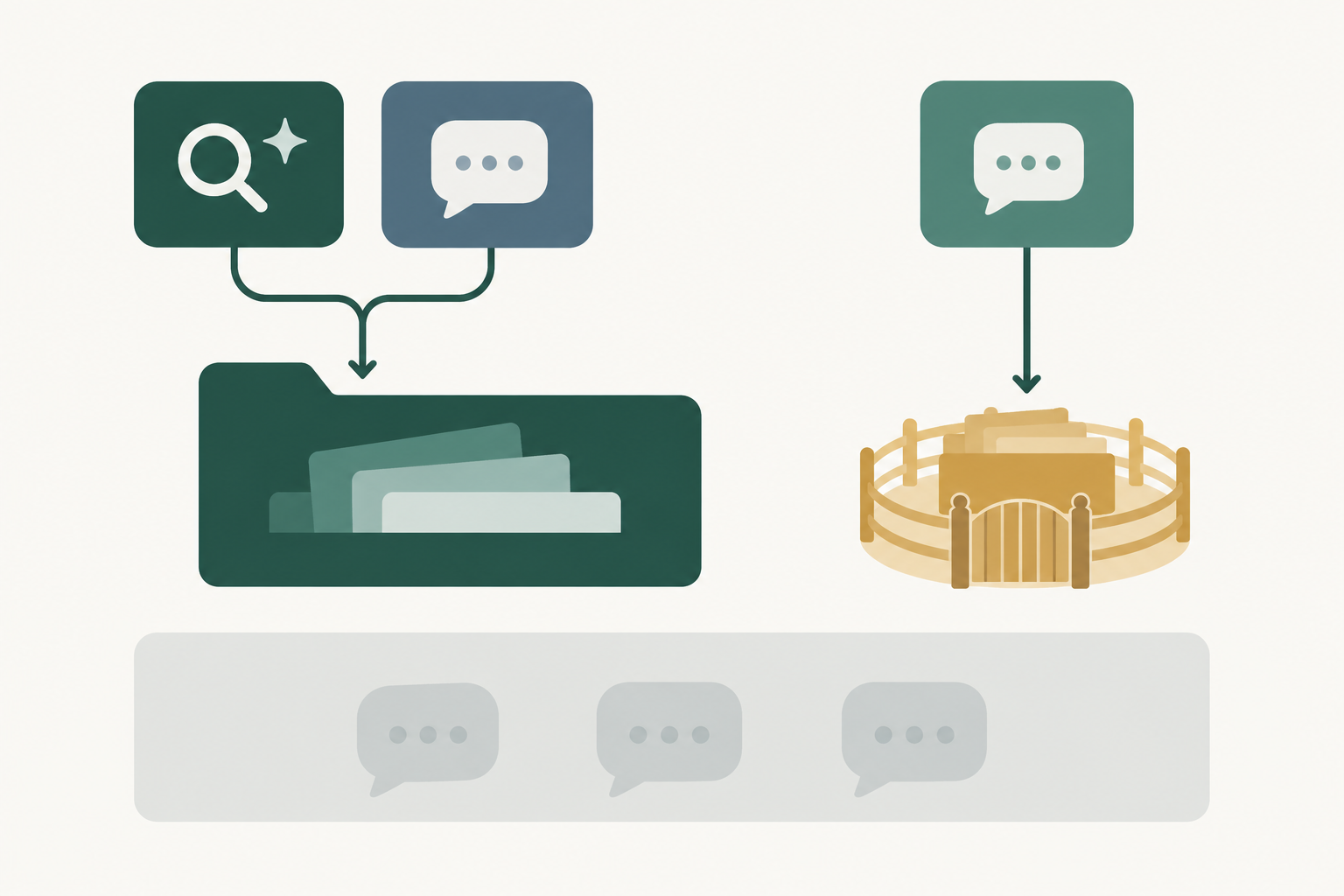
Read the table as one split. Three of the four surfaces can already be spending your money if you run Google and Microsoft search, so most of the work is managing exposure you already have. Only ChatGPT is a buying decision from scratch. The team gains most when AI placements sit in the weekly review next to CRM opportunities, and Scalewell builds that routine with paid teams across every engine they buy.
Google AI Overviews and AI Mode come through your existing campaigns
Google sells ads in AI Overviews and AI Mode through existing Search, Shopping and Performance Max campaigns, with no new campaign type and no separate budget. Google's help page on ads in AI-powered experiences in Google Search says those campaigns "are automatically eligible", that text and Shopping ads can appear, and that you "can't target ads exclusively to AI Overviews or AI Mode, or opt out of showing ads in them separately from Search."
Match type is the lever you actually control. The same page says AI-powered targeting, meaning AI Max for Search, broad match, Shopping and Performance Max, can match to both the query and the AI response. Exact and phrase match keywords only qualify when the query "expresses direct commercial intent", and they aren't eligible for contextual matching on exploratory questions.
That rule creates a real B2B dilemma. Long, exploratory questions are where a buyer describes a problem before they know your category name, which is exactly the moment you'd like to be seen. But broad match and AI Max are also how a tidy B2B account fills up with students and job seekers, which is why our AI Max guide recommends running it as an experiment against cost per opportunity.
AI Mode is moving faster than AI Overviews. On October 28, 2026 Google said it was scaling ads in AI Mode in ten more countries, including Australia, Canada, India and Singapore, and was launching multiturn ads in the US so ads can appear in follow-up questions. The UK, Brazil and Mexico are planned for the fourth quarter of 2026. Google also reports that AI Mode queries are on average three times longer than traditional searches, according to its own US data from May 2026.
Three formats from Google Marketing Live in May 2026 are worth watching for B2B. Google said it was testing Conversational Discovery ads and Highlighted Answers in AI Mode, and that Business Agent for Leads, which "puts a smart brand agent right inside your ad" in place of a static form, would come to Search "in the coming months". A lead form that talks back could qualify a buyer before they ever reach sales, or it could collect a lot of pleasant chats with people who'll never buy. Nobody has published B2B results for it yet.
For the detail, read our guides to ads in Google AI Overviews and ads in Google AI Mode.
Microsoft Copilot ads come with every eligible Microsoft Advertising campaign
Microsoft Copilot ads are built automatically from the assets in your existing Microsoft Advertising campaigns, and you can't switch them off. Microsoft's help page About ads in Copilot, last updated in June 2026, says "All eligible campaign and ad types are automatically opted in" and "Advertisers cannot opt out of serving ads". Negative keywords apply in Copilot the same way they do on the search network.
Eligibility has one easily missed condition. Search ads "must include a logo to be eligible to show in Copilot", according to the same page, and the eligible types are multimedia ads, product ads, search ads with logo extensions, and two travel formats. If your Microsoft account has never had a logo uploaded, your search ads aren't in Copilot at all, which is either a problem or a relief depending on how you feel about the next point.
Reporting is the weak spot. Microsoft says it "does not currently support specific metrics for ads served in Copilot", so Copilot clicks arrive mixed in with the rest of your Microsoft traffic. You'll know the money was spent but not where.
The B2B case for Microsoft has long rested on LinkedIn data. Microsoft's LinkedIn profile targeting page lists targeting by "company, industry or job function". Whether that targeting shapes which Copilot conversations show your ad isn't documented, so treat any claim that you can reach job titles inside Copilot as unproven. Our Copilot ads guide covers what this means for a Microsoft Ads budget.
ChatGPT is the only AI search surface with its own ads manager
ChatGPT ads are bought through ChatGPT Ads Manager, a separate self-serve tool that sits outside your search campaigns. CNBC reported on August 31, 2026 that OpenAI's ad business had reached a $1 billion annualized revenue run rate and that ads were available in more than 40 countries.
Targeting is where B2B teams should slow down. OpenAI's Ads documentation describes targeting by location, platform and uploaded custom audiences, plus context hints, which it says "are not exact-match keywords". Custom audiences used for inclusion need at least 25,000 matched users, so a list of 400 named accounts won't work as an audience.
Who sees the ads matters even more. The same CNBC report says ads appear for the free tier and Go subscribers. Your buyer on a company ChatGPT Enterprise seat isn't named among them. Our ChatGPT Ads Manager guide walks through setup and a test design judged on CRM opportunities.
Perplexity, Gemini and Claude have no ads to buy as of November 2026
Perplexity, the Gemini app and Claude carry no ads you can buy as of November 2026, so leave them out of the media plan and stop paying agencies to "prepare" for them.
- Perplexity tested sponsored answers placed under its chatbot's answers and then dropped them. MacRumors, reporting the Financial Times on February 18, 2026, said the ads were phased out in 2025 and that executives "don't plan to revisit it", with one saying "A user needs to believe this is the best possible answer".
- Gemini app has no ads announced. Google's chief business officer Philipp Schindler said on the April 2026 earnings call that Google is "open-minded" about ads there, as Android Headlines reported, and we found no launch since.
- Claude is ad-free by policy. Anthropic wrote on February 4, 2026: "Claude will remain ad-free."
If a vendor pitches you Perplexity or Gemini placements, ask them to show you the platform page that sells them.
Work-issued AI assistants mostly sit outside the auction
The AI tools B2B buyers use at work mostly don't carry ads, which narrows the B2B audience for AI search advertising more than the headline numbers suggest. In a January 2026 post, Forrester's John Buten wrote that 94% of business buyers now use AI in their buying process and that 61% use private AI tools provided by their organization.
Put that next to the ad rules. ChatGPT's ads, per CNBC, appear on the free and Go tiers, and Microsoft described the Copilot experience for people signed in with a work account as a "simplified, ad-free user interface" when it introduced it in August 2024. Google Search is the exception, since anyone can see an AI Overview on a work laptop.
So the AI tools buyers lean on most at work are the ones you can't advertise in. That's workable: AI search ads catch buyers on their own phone or on Google, and the company-issued assistant is reached the slow way, through what gets written about you.
Fund AI search ads from your search budget, with one exception
AI search ads on Google and Microsoft should come out of your existing search budget, because they already do. The budget decision there is about match types, AI Max and logo assets, which control how much of your search spend flows into AI answers. ChatGPT is the exception, and it deserves a separate, ring-fenced test line that someone has agreed in advance to cut if it doesn't produce opportunities.
Here's how that looks for a hypothetical company spending $60,000 a month on Google Search and $6,000 on Microsoft Ads:
- Google. Keep the core exact and phrase campaigns, and run AI Max or broad match as a controlled experiment on part of the budget. The experiment tells you whether contextual matching, which is what reaches AI Overviews and AI Mode, finds opportunities or just traffic.
- Microsoft. Add logo assets if you want Copilot exposure, or leave them off for now if you can't tolerate spend you can't see. Either way, it's a choice worth writing down.
- ChatGPT. Set aside a fixed amount, say $10,000 over 60 to 90 days, with a cost per opportunity ceiling agreed before launch.
The team that should wait on all of this is one without clean conversion data. If your Google account bids to form fills, opening it up to AI answers mostly buys more form fills. Fix the signal first, which our guide to AI bidding covers.
Measure AI search ads by cost per opportunity, because the platforms won't split them out
AI search ads can't be measured as a separate line on Google or Microsoft in November 2026, so you measure the decisions that change your exposure instead. Google's help page says AI Overviews and AI Mode results are included "in aggregate" in campaign and search terms reports, and Microsoft offers no Copilot metrics at all.
That leaves three workable measures:
| Surface | What you can measure | How |
|---|---|---|
| Google AI Overviews and AI Mode | The effect of AI-powered targeting on opportunities | A Google Ads experiment (broad match or AI Max on against off), judged on CRM opportunities |
| Microsoft Copilot | The effect of Copilot-eligible assets | A before and after on cost per opportunity once logo assets go live, with the caveat that other things move too |
| ChatGPT | The channel itself | Click IDs stored on the form and carried into the CRM, then cost per opportunity |
None of these is tidy, and it's frustrating to buy media you can't see in a report. But it's the same problem B2B teams already have with Performance Max, and the answer is the same: decide in advance what result would make you spend more, and judge it on pipeline in the CRM. Our AI attribution guide covers how to credit channels whose clicks you can't fully trace.
You can't write what Google's AI says next to your ad
Brand safety in AI search advertising is mostly about text you didn't write appearing beside text you did. Google's help page says ads in AI Overviews and AI Mode may appear with AI explainers, "concise, independent text generated by Google's Gemini models", and that advertisers "can't manually write, edit, approve, or opt out of them."
For a regulated B2B brand, that's the line to show your legal team. The explainer draws on "publicly available sources including your website", so out-of-date claims on your own pages could be summarized next to your ad.
The other platforms give you a little more. Microsoft says ads aren't shown in conversations its AI models flag as potentially harmful, and that if an ad can serve on Bing it can serve in Copilot, with ad copy that "will not be truncated", which matters for financial services disclaimers. On both Google and Microsoft your negative keyword lists still apply, so keep them current with a regular negative keyword review.
Paid placement in AI answers and organic AI visibility are separate jobs
Buying AI search ads doesn't change what the AI says about you in the answer itself. Google's help page states that "Paid advertising does not influence the organic responses generated by Google AI", and CNBC reported OpenAI saying its ads "do not influence ChatGPT's answers."
That's why the CEO's Monday question needs two answers. The ad budget buys a labeled "Sponsored" slot on four surfaces. Being named in the answer, often called AEO or GEO, depends on what your site, reviews, analysts and the wider web say about you, and it's the only way into Claude, Perplexity and the company-issued assistants. We'd give each its own owner and its own measure, so neither gets blamed for the other's results.
For where AI search sits in the wider picture of AI across paid media, read our hub on AI advertising.
How Scalewell takes the weekly search review off your team's plate
Scalewell helps search teams hand the weekly grind around Google and Microsoft budgets to AI, from search term reviews to experiment readouts. The Monday report on AI placements then arrives already written, with opportunities beside spend. The audit maps those recurring jobs and ranks the one AI should take on first.
That ranked roadmap drives a build sprint on your own accounts. Each job is judged on the hours it frees and the pipeline it touches, which is how this guide says to measure AI search ads anyway. The project itself is typically 8 to 12 weeks, sometimes a little longer.
Start with the search budget you already spend
Your first move is an AI Max or broad match experiment on part of your Google budget, judged on CRM opportunities. Then decide on logo assets in Microsoft, and only after that consider a ring-fenced ChatGPT test. Scalewell helps paid teams set up tests like these and connect them to pipeline reporting.
Frequently asked questions
Do ads in AI Overviews cost more than normal search ads?
No, they don't. Google's help page says ads in AI Overviews and AI Mode use the same auction and the same cost-per-click or conversion-based bidding as standard Search ads, and you aren't charged extra to take part. Microsoft treats Copilot ads as part of your existing campaigns too. What can change is how much you spend, because broad match and AI Max open your budget to more queries.
Are AI search ads available outside the US?
Yes, but unevenly by platform. Google says ads within AI Overviews and AI Mode are available in English in the US and select English-speaking markets, and on October 28, 2026 it began scaling AI Mode ads in ten more countries, with the UK planned for the fourth quarter of 2026. ChatGPT ads run in more than 40 countries. Check each platform's location list before you plan a non-US test.
Do I need new creative for AI search ads?
Not for Google or Microsoft. Google combines your existing headlines, descriptions, images and landing pages, and Microsoft builds Copilot ads from existing assets, though search ads need a logo to qualify. ChatGPT needs its own ads, with a title of up to 50 characters, a body of up to 100 and an image. On every surface, landing pages that answer a specific question matter more than they did.
Will AI search ads replace regular search ads?
Not on the evidence so far. On Google and Microsoft they run in the same auction as regular search ads, and Google's page says standard ads can still appear above or below an AI Overview. The shift to watch is in queries: longer, more conversational questions reward broad targeting, which puts more pressure on your conversion data.
Can a B2B company target job titles in AI search ads?
Not directly, as of November 2026. Google's AI placements follow your campaign targeting with no AI-specific options, ChatGPT targets by location, platform and custom audiences with no job title field, and Microsoft doesn't document whether LinkedIn profile targeting shapes Copilot delivery. For job title and company targeting, LinkedIn's own ads remain the channel built for it.