AI Mode ads: how Google's ads in AI Mode differ from AI Overviews
Google AI Mode ads reach long, multi-turn questions only through broad match, AI Max and Performance Max, and Google reports them blended into Search, so B2B teams need a test and a proxy.
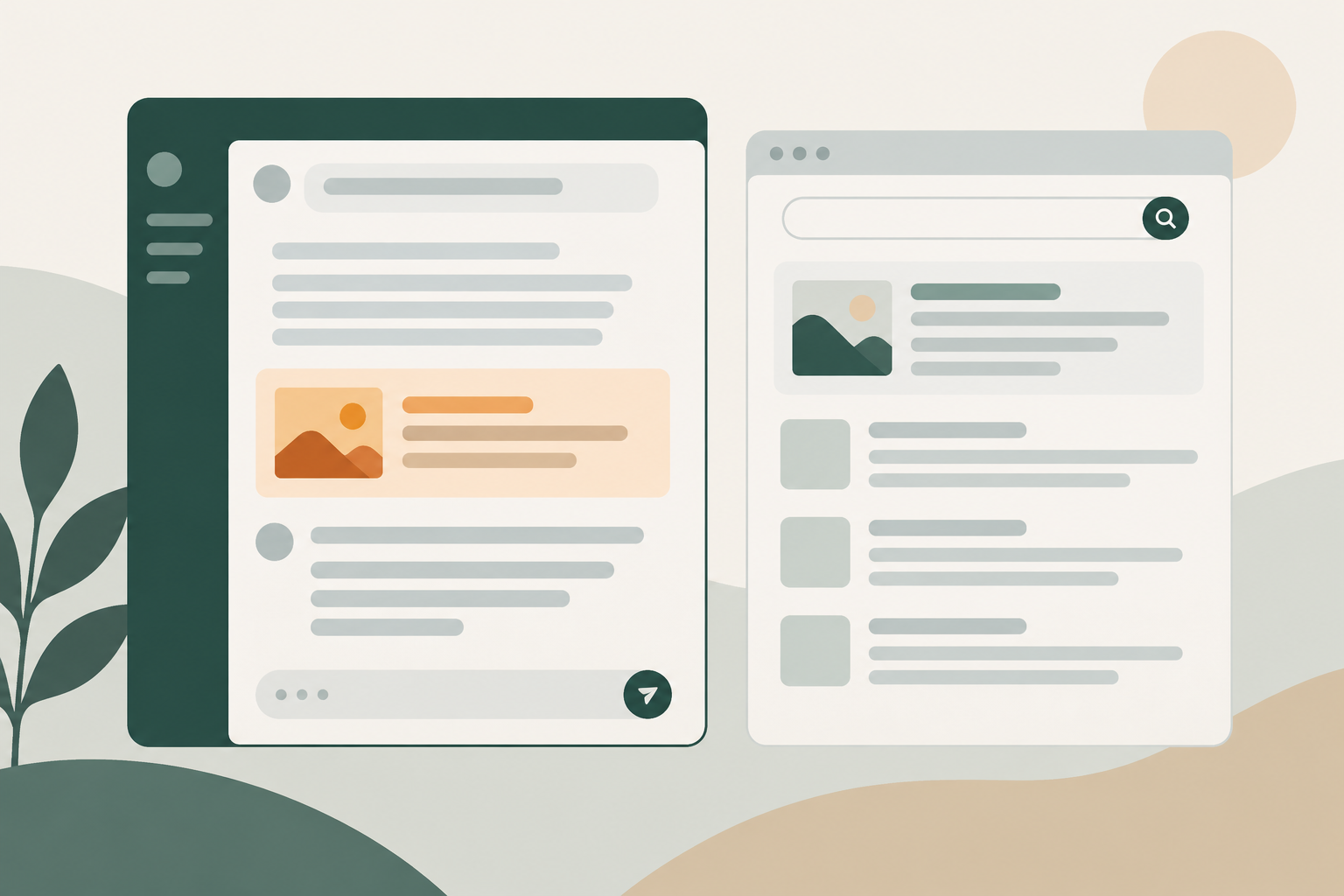
AI Mode ads are Google Search text and Shopping ads that appear inside or beside answers in AI Mode, Google's conversational search tab. As of November 2026 you can't buy them separately: existing Search, Shopping and Performance Max campaigns are eligible automatically. What you control is which match types can reach the longer, follow-up questions people ask there.
You've probably been asked about this already. Somebody saw a "Sponsored" block halfway through an AI Mode answer, sent a screenshot to the team channel, and asked whether you're in there and what it costs. The honest first answer is that you might be. Google won't tell you directly, because it reports these ads mixed in with ordinary Search.
This guide is for the paid media lead who has to answer that properly. It covers where AI Mode ads appear, how the matching differs from AI Overviews, what Google's reporting will and won't show you, and what a B2B Search account should change or test this quarter. If you need the basics of ads in AI Overviews first, start with our guide to ads in Google AI Overviews.
AI Mode is a conversation, and ads can follow it across turns
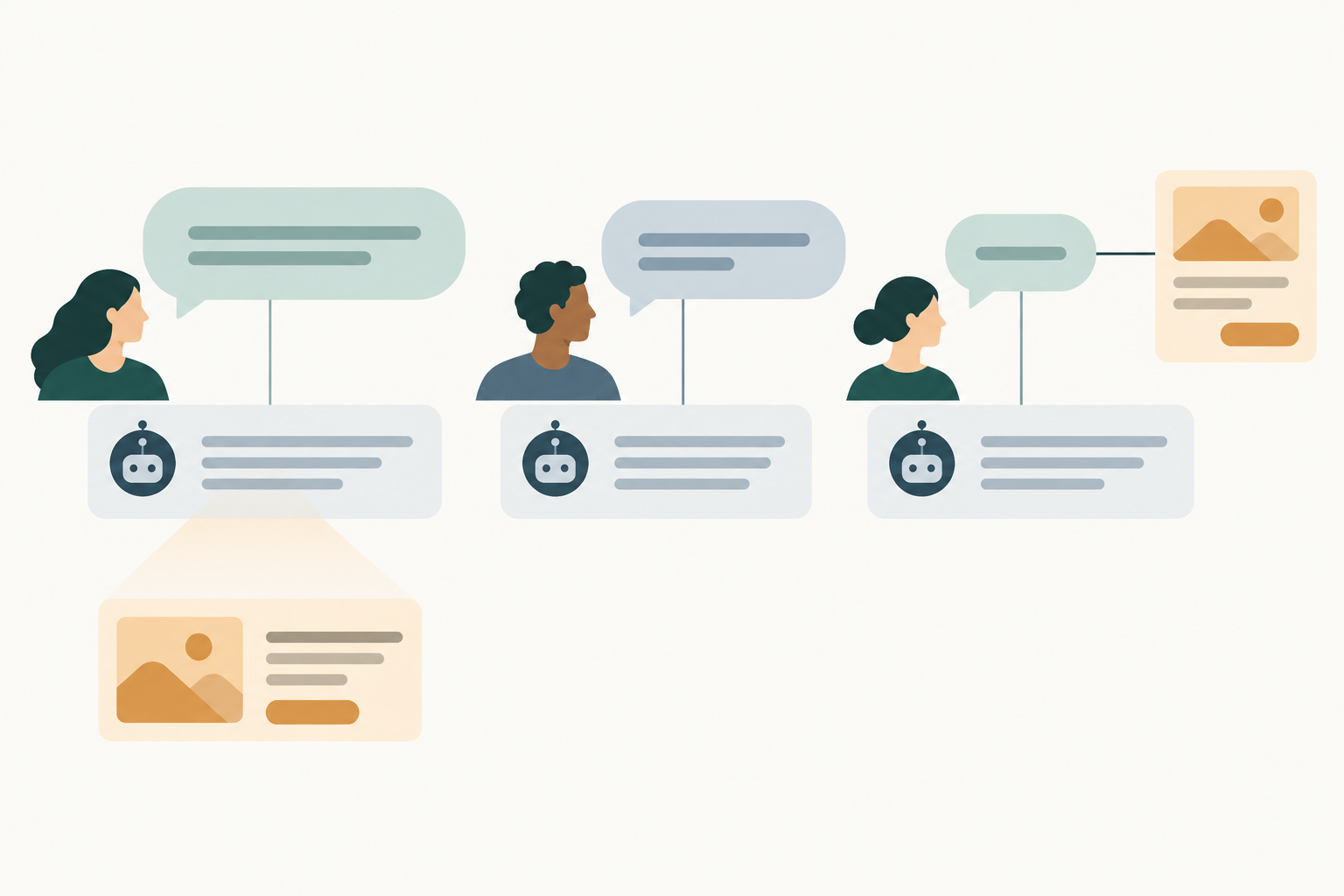
AI Mode is a separate search experience where a person asks a question, gets an AI answer and keeps asking follow-ups in the same thread. Google's AI Mode help page says it "divides your question into subtopics and searches for each one simultaneously," so one question becomes several searches behind the scenes.
That changes what your ads are matched against. In its October 28, 2026 announcement, Google said queries in AI Mode are "on average, three times longer than traditional searches," citing its own US data from May 2026. Sundar Pichai repeated the figure in the Q3 2026 earnings remarks and added that one in five AI Mode searches globally use voice, images or documents. Earlier, in the Q2 2026 remarks, he said AI Mode had passed 1 billion monthly active users.
The same October post launched multiturn ads in the US, "to allow ads in follow-up queries in AI Mode." Google's help page on ads in AI-powered experiences now describes ads appearing "within or alongside these AI-generated responses (including across follow-up questions in AI Mode)."
So the unit you're bidding into is no longer one query. It's a conversation that might start with "how do mid-size finance teams close the books faster" and reach "which close management tools integrate with NetSuite" three turns later. Seeing which of those conversations turn into pipeline is what lets a team judge AI Mode on its merits, and Scalewell builds that view into paid teams' weekly reporting.
AI Mode and AI Overviews share a rulebook but differ in where ads land
Ads in AI Mode and AI Overviews are governed by the same Google Ads help page, so eligibility, billing, controls and reporting are identical. The differences are in the surface itself: how the question arrives, how many turns it lasts, and which countries carry ads inside the answer. The table compares them as Google documents them in November 2026.
| AI Overviews | AI Mode | |
|---|---|---|
| What the person sees | A summary at the top of the normal results page | A separate conversational tab with follow-up questions |
| Typical query | The queries people type into normal Search | On average three times longer than traditional searches (Google, May 2026 US data) |
| Where ads appear | Above or below the overview, or within it | Within or alongside the AI answer, including on follow-up turns |
| Follow-up questions | No | Yes; multiturn ads launched in the US on October 28, 2026 |
| Eligible campaigns | Search, Shopping, Performance Max | Search, Shopping, Performance Max |
| Ad formats | Text and Shopping ads; tests of local inventory and vehicle ads | Same, plus format tests announced in May 2026 |
| Countries for ads inside the answer | US, Australia, Canada, India, Indonesia (AI Overviews only), Kenya, Malaysia, New Zealand, Nigeria, Pakistan (text ads only), Philippines, Singapore; English only | Same list, minus Indonesia |
| Countries for ads above or below | All 200+ countries and languages where AI Overviews run | Not applicable |
| Separate targeting or opt-out | No | No |
| Separate reporting | No, aggregated into Search | No, aggregated into Search |
Google's FAQ adds that an ad can appear above an AI Overview and within it on the same search, but never within it and immediately below it. And Google is closing the gap between the two surfaces anyway: in his July 22, 2026 earnings remarks, Pichai said Google had brought AI Overviews and AI Mode together into a single Search experience, so a searcher can move from an overview into a follow-up conversation. Treat them as two stages of one journey rather than two channels.
The UK, Brazil and Mexico were named in the October post as planned for Q4 2026. If you run UK campaigns, check the help page's country list before telling anyone your ads are in AI Mode there.
Your match types decide which AI Mode questions you can reach
Google matches ads in AI Mode in two ways, and your keyword match types decide which one you get. The help page calls them direct query matching, when the search "already expresses clear commercial intent," and contextual matching, where Google reads "both the user's query and the AI response" for a longer, exploratory question.
Google's own example is a person asking "why is my pool green and how do I clean it?" The question names no product, but the answer talks about vacuuming and algae treatment, so ads for pool vacuums become relevant. A B2B version would be someone asking how to cut month-end close from ten days to five, getting an answer that mentions close automation software, and seeing your ad because of what the answer said.
Here is who gets each kind of match, per the same page:
- AI Max for Search, broad match, Shopping and Performance Max are eligible for both contextual matching and direct query matching.
- Exact and phrase match keywords are eligible only when the query "expresses direct commercial intent," and they "aren't eligible for contextual matching on broader exploratory questions."
The exact and phrase rule is recent. On September 4, 2026 Ginny Marvin, Google's Ads Liaison, called it "a small experiment that recently kicked off," as PPC Land reported, and Google's help page now states it as standard behavior.
What does this mean for a B2B account built on exact and phrase match? You can show up when someone in AI Mode asks for "close management software pricing," but you can't show up in the earlier research turns, which is where a buying committee spends most of its time. Whether that matters depends on whether those early turns ever become pipeline for you, which is the thing to test.
Ads appear on about 29% of commercial AI Mode queries, more often on expensive keywords
The largest independent measurement we found comes from SE Ranking, which checked 50,032 commercial US keywords across 20 niches on June 30, 2026 and found a text ad in AI Mode on 29.45% of them. The keywords were all selected to trigger a text ad, so read it as the rate for keywords you're likely bidding on, not for all searches. SE Ranking itself calls the figure "a floor, not a ceiling," because the same query can show an ad in one session and nothing in the next.
Three findings in that study matter for a B2B team. Ad presence rose with cost per click: 24.33% on keywords under $2, 32.45% from $2 to $10 and 53.56% at $10 and above. When ads appeared, 71.1% of answers carried two of them, so you'll usually sit next to a competitor. And only 11.53% of advertiser domains also appeared among the sources AI Mode cited for the same query.
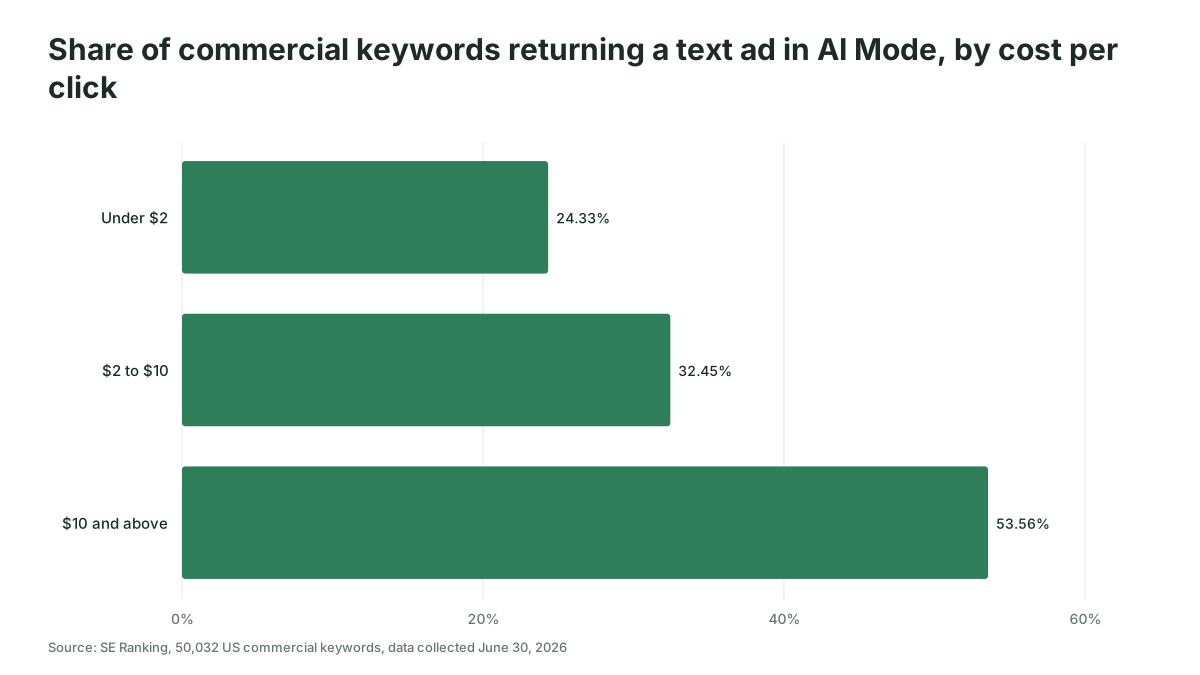
If your category terms cost more than $10 a click, the study suggests AI Mode ads are already a regular part of the result for your keywords. SE Ranking also notes that lead-generation verticals "surface ads heavily," while healthcare showed ads on just 2.64% of keywords. We found no public data on what AI Mode clicks are worth in B2B, measured in opportunities or pipeline. Google's October post says click-through rates are "similar between sponsored and organic product list items within AI Mode," but that measures shopping lists, not lead generation.
Google's reports blend AI Mode into Search, so measure it by proxy
Google reports AI Mode ads only in aggregate. The help page says AI Mode queries are "included in metrics such as impressions, clicks, conversions, and cost in all existing campaign reporting" and "included in aggregate in your search terms report." As of November 2026 Google documents no AI Mode segment, column or filter in Google Ads.
The search terms themselves carry a second problem. Google's page on ad group prioritization says that for searches on "Lens, AI Mode, AI Overviews, or auto-complete," the search term shown "represents the best approximation of the user's intent." So the row you see may be Google's summary of a conversational question, not the words the person typed. Our negative keywords guide covers what that does to a weekly review.
You can't read AI Mode off a report, but you can watch for the traffic that mostly arrives through it. Three proxies are worth tracking every week:
- Search term length. Filter the search terms report for terms of eight words or more and track their impressions, cost and conversions over time. The cutoff is our suggestion, not Google's, so pick one and keep it fixed.
- New question-shaped terms. Flag terms that read like questions or comparisons ("which", "how do", "vs", "for teams that") and appeared for the first time this month.
- What happens in the CRM. Tag leads from those terms and follow them to opportunities. A long-query lead that never reaches a sales conversation is the AI Mode equivalent of the student who downloads your whitepaper.
None of these isolates AI Mode cleanly, since long queries also come from voice search, but the trends read against your CRM beat waiting for Google to add a column.
A B2B Search team should change five things this quarter
The changes that matter follow from Google's eligibility rules, and here they are in the order we would make them.
- Decide which campaigns may enter research conversations. Keep brand and high-intent product campaigns on exact and phrase match, where AI Mode can still reach direct commercial queries. If you want ads in the research turns, use one category or problem-led campaign on broad match or AI Max, with a budget you're prepared to learn on. Our AI Max guide sets out how to test it on opportunities rather than form fills.
- Fix the conversion you bid on before you widen matching. Google's help page tells advertisers to pair AI-powered targeting with Smart Bidding "backed by accurate first-party conversion measurement." In B2B that means importing qualified leads or opportunities, because a form-fill goal can teach broad match to find more students and job seekers in long conversations. Our AI bidding guide covers when to trust platform bidding with that signal.
- Write negatives and brand exclusions for conversational traffic. Negative keywords, brand exclusions and asset pinning all still apply, per the help page. Add negatives for the research themes you never want to pay for, such as careers, definitions for students, free templates and "how to build your own."
- Bring your website up to date. Google says ads may show with "AI explainers," text written by Gemini from the query, the answer and public sources "including your website," and advertisers "can't manually write, edit, approve, or opt out of them." If your site still describes last year's product, that's what the explainer may repeat beside your ad. Make sure pricing pages, integration lists and security pages are current.
- Write assets that answer a question. A long AI Mode question is usually a problem statement. Headlines that name the problem and the type of company you serve ("Month-end close for mid-size finance teams") give the system something to match against an answer, which "Industry-leading platform" doesn't.
You can't buy AI Mode as a placement, so you can't hold back a budget line for it either. If the pressure is to "get into AI search," remember that it's paid for with Search budget and Search match types. AI Mode reaches someone who has already started asking, while LinkedIn reaches the named people on your account list before they ask anything, so don't take money from LinkedIn to fund it. Our guide to B2B paid media covers how the channels split that work.
New AI Mode formats are still tests
Google announced two AI Mode formats at Google Marketing Live on May 20, 2026, and described both as tests. With Conversational Discovery ads, "your ad answers a person's specific question" using creative Gemini builds for that search. Highlighted Answers let "highly relevant, high-quality ads" appear on a recommendation list inside an AI Mode answer. Both carry an independent AI explainer, and Google's advice was to "build a strong foundation with AI Max for Search, AI Max for Shopping campaigns and Performance Max."
The same event introduced Business Agent for Leads, a Gemini chat agent inside a Search ad that answers questions "based on your website." Google's lead generation roundup from May 2026 says it lets a prospect "ask specific questions about your business at any hour." For a B2B team, the questions to settle before trying it are what the agent says about pricing and security, and whether its leads reach your CRM with the conversation attached. Direct Offers, a pilot running since January 2026, surfaces shopping deals in AI Mode answers and is adding travel deals, so it doesn't apply to most lead-generation accounts.
When AI Mode ads aren't worth the effort
AI Mode ads aren't worth a project if your Search account is small and depends on exact and phrase match. You already reach direct commercial queries in AI Mode, and widening matching on thin conversion data tends to buy volume you can't judge. Fix measurement first, then revisit.
They also matter less if your buyers come from a short list of named accounts that rarely search for your category, because an AI Mode test will produce noise you can't trace to the accounts you care about. And if you mainly run campaigns outside the countries on Google's list, there's nothing to change yet beyond keeping your site accurate.
The teams that should test now have high-CPC category terms, a working offline conversion import and enough monthly conversions to run an experiment. For the wider picture across ChatGPT and Microsoft Copilot, see our guide to AI search advertising.
Where to start
Start with one category campaign on broad match or AI Max, bidding on qualified leads, and a weekly look at long search terms against your CRM. If you'd like help setting that up, Scalewell builds this kind of measurement and testing routine around the way your paid team already works.
Frequently asked questions
Can I opt out of ads in Google AI Mode?
You can't opt out of AI Mode on its own. Google's help page says you "can't target ads exclusively to AI Overviews or AI Mode, or opt out of showing ads in them separately from Search." The controls you have are the ordinary ones: negative keywords, brand exclusions and your choice of match types. Keeping a campaign on exact and phrase match limits it to queries with direct commercial intent.
Do AI Mode ads cost more than normal Search ads?
Google says ads in AI Overviews and AI Mode use "the same auction mechanism" and CPC or conversion-based bidding as standard Search ads, with no extra charge to take part. Google adds that standard invalid traffic protections apply and that you're only charged for valid clicks on your ads, so there is no AI Mode premium to budget for.
Are AI Mode ads available in the UK?
Not as of November 10, 2026. Google's help page lists the US, Australia, Canada, India, Kenya, Malaysia, New Zealand, Nigeria, Pakistan, the Philippines and Singapore for ads within AI Mode, in English. Google's October 28 announcement said it planned to add the UK, Brazil and Mexico in the fourth quarter of 2026.
Does advertising in AI Mode get my brand cited in the AI answer?
Buying the ad won't get you cited. Google states that buying ads "doesn't influence organic AI answers," and that whether your site is cited organically "doesn't affect your ad auction eligibility." Being cited depends on your content and organic search work, which is a separate job from the ad.