ChatGPT Ads Manager for B2B: what paid teams need to know in November 2026
ChatGPT Ads Manager is self-serve and growing fast, but its audience minimums and a Conversions API that only accepts events from the last seven days mean B2B teams should test it against cost per opportunity in the CRM.

ChatGPT Ads Manager is OpenAI's self-serve tool for buying the sponsored units that appear in ChatGPT, found at ads.openai.com. As of November 2026 it runs campaigns on impression, click and conversion-optimized bidding, with context hints instead of keywords and an Advertiser API behind it. For B2B teams, the targeting and measurement are the part to read closely.
You've probably had the message already. Someone senior saw a sponsored card under a ChatGPT answer, or read that OpenAI's ad business passed a billion dollars, and asked whether you're "on ChatGPT yet". It's a fair question, and it usually arrives with no budget attached and an expectation of an answer by Friday.
This guide is for the head of paid media or PPC lead who has to give that answer. It separates what OpenAI's own documentation says from what gets repeated about ChatGPT ads, walks through the setup step by step, and ends with a test design that judges the channel on pipeline in your CRM. If you want the wider view of AI across paid media first, start with our hub on AI in advertising.
ChatGPT ads reached more than 40 countries in 2026
ChatGPT ads went from a US test to more than 40 countries in about seven months. OpenAI began testing ads in the US in February 2026, and on August 31, 2026 it announced that the ad business had reached a $1 billion annualized revenue run rate, that ads were available in more than 40 countries, and that it was rolling out self-service access across India, Europe, the Middle East and North Africa, as CNBC reported that day. CTech reported on September 1, 2026 that Ads Manager, the self-serve tool, was introduced in May, that markets outside the self-serve rollout are sold through OpenAI's advertising team and its agency and technology partners, and that OpenAI described the platform as "now used by tens of thousands of advertisers".
That run rate tells you advertisers are spending real money, mostly consumer brands if the examples in OpenAI's own documentation are any guide: trail shoes, spring sales, product feeds and hotel listings. It doesn't tell you anything about B2B returns, and we found no published B2B benchmark for ChatGPT ads as of November 2026. That gap is the reason to run a small, measured test. A test like this only concludes when conversions are tied to CRM opportunities, and Scalewell helps paid teams build the weekly readout that makes the channel decision clear.
Who sees the ads matters for targeting. CNBC reported on August 31, 2026 that ads appear for OpenAI's free tier and its Go subscribers, that OpenAI says they are "clearly labeled and do not influence ChatGPT's answers", and that "advertisers do not have access to users' private conversations." The reporting names no paid business plan, so your buyer using a company ChatGPT Enterprise seat at work is probably not in your audience. Your buyer asking the free app a question on their phone at 9pm might be.
B2B teams should fund ads in ChatGPT only as a capped test for now
A B2B team should fund ads in ChatGPT as a fixed test budget it can afford to lose, because as of November 2026 nothing published shows what ChatGPT advertising returns in pipeline. What is known supports a test and argues against a standing line item. OpenAI's Ads documentation shows an Advertiser API, conversion-optimized campaigns in open beta that still bill per click, inclusion audiences that need 25,000 matched users, and a Conversions API that only accepts events from the last 7 days. Insights reporting defaults to a 30-day click and 1-day view window. On reach, CNBC reported on August 31, 2026 that the ads appear for free and Go users in more than 40 countries.
The test budget is a number of opportunities, worked backwards. Decide how many opportunities you need to read a result and the most you would pay for each, then multiply: 15 opportunities at a $1,000 ceiling gives the $15,000 in the hypothetical worked example further down. Take that money from an experiments budget rather than from a channel that already produces pipeline, so a failed test costs a lesson and no pipeline.
Three changes would turn the test into a planned budget line: company or role targeting, or an audience minimum small enough for an account list; a way to send CRM stages older than seven days; and published B2B results with a named advertiser and sample. Until one of those arrives, treat OpenAI ads as a test and budget them like one.
Six common claims about ChatGPT ads, checked against the docs
ChatGPT advertising attracts a lot of confident commentary, and some of it was written before the product changed. The table below checks the common claims against OpenAI's Ads documentation, read on November 9, 2026.
| What you'll hear | What OpenAI's docs say (November 2026) |
|---|---|
| "It's keyword buying, like Google Search" | Ad groups use context hints, which "are not exact-match keywords". An ad group can hold up to 2,000 of them. |
| "There's no API, so tools can't manage it" | The Advertiser API covers campaigns, ad groups, ads, audiences, conversion setup and reporting, with bearer token authentication and a bulk API. Some vendor pages written early in 2026 still say otherwise. |
| "You pay per lead" | Conversion campaigns (oCPC, in open beta) optimize toward one tracked event but bill per valid click. |
| "You can target by role or company" | Targeting is location, platform (iOS app, Android app, web) and custom audiences you upload. There is no job title, seniority or company targeting in the docs. |
| "It's a single text ad" | The chat_card ad has a title of 3 to 50 characters, a body of up to 100 characters, an image of at least 640 by 640 pixels and a landing page. Enabled accounts can use 4 to 6 square images since October 26, 2026. |
| "Everyone pays about the same CPC" | It's an auction. The docs use a $2 click bid and a $60 CPM only as illustrative examples, and daily budget minimums depend on the account currency. |
The last row is worth a second look. You'll find third-party pages quoting a default CPM or a recommended CPC range, but none trace back to an OpenAI price list, so we'd plan the test budget from your own bid ceiling instead of from somebody's average.
Context hints decide when your ad is eligible to show
Context hints are free-text descriptions, set on each ad group, of when your product would be useful, and OpenAI says they "help guide when they appear". The docs give an example of the difference: "Shoes" is less useful than "Lightweight trail running shoes for rocky terrain". For B2B, translate that into the problem your buyer would describe to ChatGPT, written in their words.
Here is what that looks like for a hypothetical company selling expense management software to finance teams:
| Weak hint | Stronger hint |
|---|---|
| Expense software | Replacing spreadsheets for employee expense reimbursement at a 200-person company |
| Finance automation | Speeding up month-end close when expense receipts arrive late |
| CFO tools | Comparing corporate card programs with built-in spend controls |
OpenAI describes hints as covering what "the creative and landing page may not fully cover", so write the creative and landing page as carefully as the hints. And because hints "do not replace explicit geographic, platform, or audience targeting", set those on the campaign separately.
The B2B gaps are audience size and a seven-day limit on sending conversions
ChatGPT Ads Manager has two limits that matter far more to a B2B team than to a shoe brand. Both come straight from the documentation, and together they shape how you should test.
First, custom audiences used for inclusion or bid multipliers "require at least 25,000 matched users". An account-based list of 400 target companies, or even a full Total Addressable List, will rarely match that many people. LinkedIn, by comparison, says a list "must match a minimum of 300 member accounts to be used in an active ad set", according to its company list targeting help page. The useful part for B2B: exclusion audiences have no minimum, so you can keep current customers and open opportunities out of the campaign from day one.
Second, the Conversions API only accepts events whose timestamp is "within the last 7 days". Your server can confirm a demo booking the same day, but it can't send an opportunity that sales creates five weeks after the click. So the platform can optimize toward a lead or a booked meeting and nothing deeper, which is exactly the trap we describe in our guide to B2B paid media: the algorithm gets very good at whatever cheap action you let it count.
| What a B2B test needs | ChatGPT Ads Manager, November 2026 |
|---|---|
| Reach a named account list | Inclusion audiences need 25,000 matched users (LinkedIn company lists need 300 matched members) |
| Keep customers out | Exclusion audiences, with no minimum size |
| Optimize to a B2B event | lead_created and appointment_scheduled are standard events |
| Feed back pipeline | Server events must be less than 7 days old |
| Judge on opportunities | Only in your CRM, through captured click IDs and UTMs |
Setting up a first B2B campaign takes nine steps
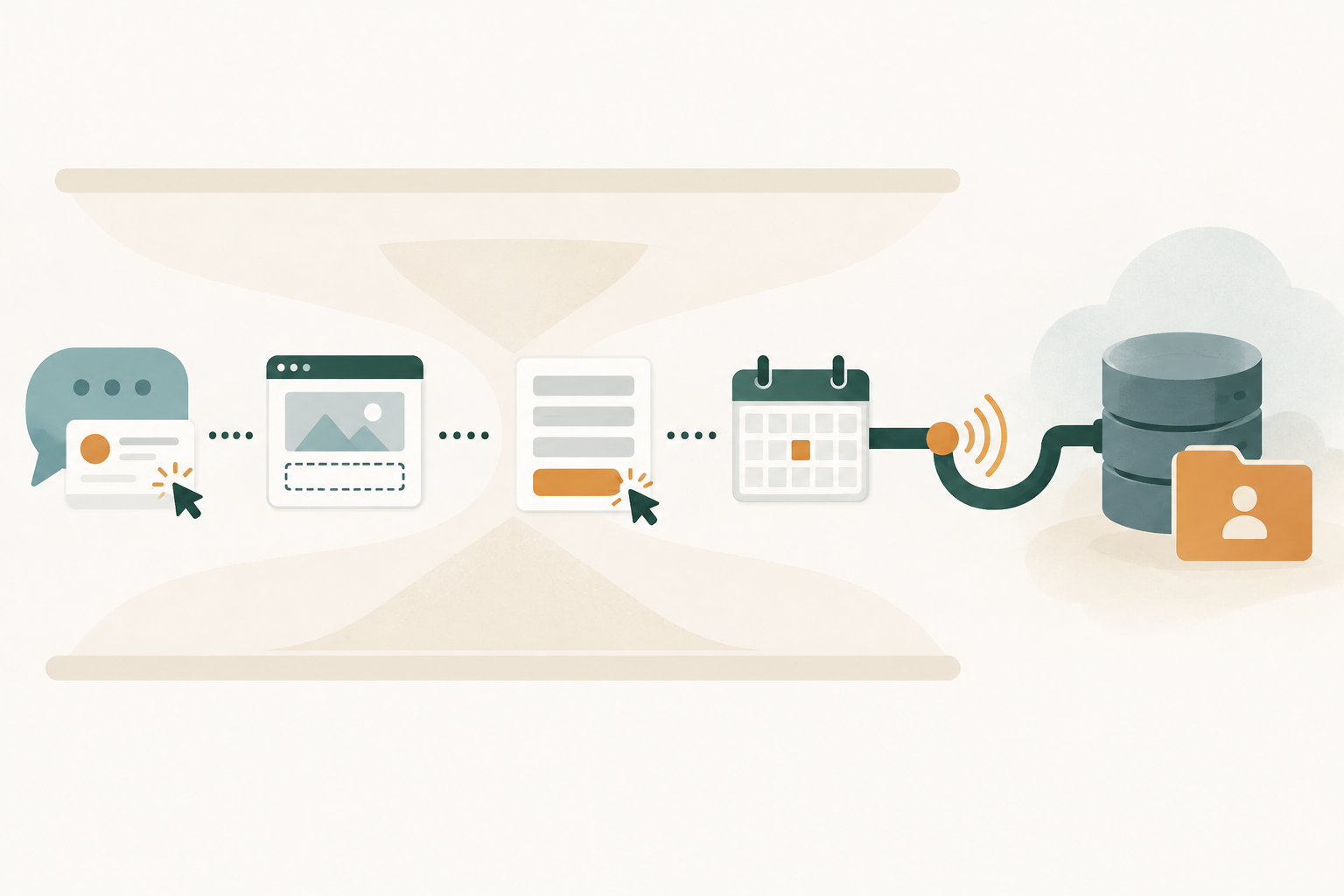
Setting up ChatGPT Ads Manager for a B2B test takes nine steps, and the measurement steps come before the ads. Every term below is from OpenAI's documentation as of November 2026, so expect some names to change.
- Check eligibility first. Read OpenAI's ad policies for your category before anything else, because ads that violate them are rejected at review. Regulated categories such as financial services and health deserve a careful read.
- Create the ad account at ads.openai.com. You'll set a legal name, an internal account name and the public brand name shown in ads, plus an advertiser icon of at least 256 by 256 pixels. Currency and timezone are set when the account is created, and a brand name change pauses delivery until it passes review again.
- Create a data source and install the Measurement Pixel. The Pixel ID identifies your site, and no API key goes in the browser. Configure the Pixel's consent controls first if your site needs consent for measurement.
- Send the two B2B events. Fire
lead_createdwhen a form is submitted andappointment_scheduledwhen a demo is booked. If your booking tool confirms meetings on the server, send that event through the Conversions API too, with the same event name and event ID so OpenAI can recognize the duplicate. - Add a tracking template. OpenAI's example is
utm_source=openai&utm_campaign={campaign_id}&utm_content={ad_id}&click_id={oppref}. Store the click ID and UTMs in hidden fields so they land on the CRM contact, because that's the only place you'll see opportunities. - Build the campaign with an exclusion list. Choose the clicks objective, a daily budget, your countries and platforms. Upload customers and open opportunities as an exclusion audience.
- Split ad groups by buyer problem. One ad group per problem, each with five to fifteen specific context hints written in the buyer's words. Use a fixed bid at first so you control cost while the data is thin.
- Write the ads. You get 50 characters of title and 100 of body, which is closer to a search ad than a LinkedIn post. Lead with the problem from the hints, and send people to a page that answers it. Creating an ad submits it for review, and editing it triggers a new review.
- Activate in order and check serving issues. Activate the ad, the ad group and then the campaign. If nothing delivers, request
serving_issuesbefore raising bids, because a paused campaign or an outstanding account review can stop an approved ad from serving.
Once a campaign has steady appointment_scheduled volume, you can try a conversions campaign that optimizes toward that event while still paying per click. OpenAI doesn't publish a minimum conversion volume for that switch, so we'd use the same thresholds you apply on other platforms, which our signal budget rule sets out.
Judge the test on cost per opportunity from your CRM
A ChatGPT ads test for B2B should be judged on opportunities in your CRM, because the platform can't see them. OpenAI's Insights reporting returns impressions, clicks, spend, CTR, CPC, conversions and CPA, and since September 30, 2026 conversions default to a 30-day click window plus a 1-day view window. That's fine for steering bids. For the budget decision, set the view window to zero when you compare with CRM numbers, since view-through credit will flatter a channel whose buyers can't be identified.
Here's a worked example, and every number in it is hypothetical. Imagine a team puts $15,000 into ChatGPT ads over 60 days and pays an average of $3 per click, so it buys 5,000 clicks. If 1.5% of those clicks become leads, that's 75 leads, and if sales turns one in five into an opportunity, that's 15 opportunities at $1,000 each. Whether $1,000 is good depends entirely on your average deal size and win rate. If your LinkedIn programme produces opportunities at $700, the test lost. If it produces them at $1,800, you've found a cheaper source and the next quarter's plan should say so.
Set the decision rule before launch, write it in the test brief, and stop arguing about CTR in the review. We'd use three outcomes:
| Result after 60 to 90 days | Decision |
|---|---|
| Cost per opportunity at or below your blended paid average | Scale in steps of about 25% and add ad groups |
| Within 50% above the average, with healthy opportunity quality | Extend the test with tighter hints and new landing pages |
| More than 50% above, or opportunities that sales disqualifies | Stop and retest in six months, when targeting and measurement may have changed |
The window is long on purpose. B2B sales cycles mean the opportunities created by a test in month one keep appearing in month three, and calling the test after two weeks of lead data is how a channel gets judged on form fills.
Teams with small account lists or broken tracking should wait
Some B2B teams should leave ChatGPT ads alone for now, and saying so plainly saves a lot of wasted test budget. If your whole market is a few hundred named accounts, the 25,000 matched-user minimum means you can't reach them as a list, and context hints alone won't find a buying committee that small. Stay with LinkedIn and account-based programs.
Wait as well if you can't yet get a click ID from a landing page into your CRM. Without that link you'll be judging the channel on platform-reported leads, and that is the same mistake that makes cheap LinkedIn lead forms look brilliant until sales calls them. Fix the tracking on your existing channels first, which pays back everywhere.
The teams that suit an early test are those with a product people research by describing a problem, a deal size that tolerates a learning budget, and a clean path from ad click to CRM opportunity. Software sold to developers, finance or operations teams is a plausible candidate, since we'd expect those buyers to describe a specific problem when they ask ChatGPT for help. If that's you, the test is cheap to design.
AI agents can manage ChatGPT ads through the Advertiser API
The Advertiser API means ChatGPT ads can be managed by the same kind of AI tooling you may already use on Google and Meta. OpenAI's docs describe an API partner setup for agencies and tools managing client accounts, an audit log of changes, and rate limits of 600 requests per minute per endpoint and 1,200 overall. Third-party agent tools have started to list ChatGPT Ads alongside other platforms; Adspirer, for example, includes it in its supported platforms.
The rules you use elsewhere still apply here: let an agent pull Insights reports and draft hint lists, and keep a person approving anything that changes bids, budgets or account branding, as we argue in our piece on keeping humans in the loop on ad spend. For how this fits a wider PPC workflow, see AI PPC management.
Where to start
If ChatGPT ads look like a fit, get the click ID into your CRM first and run one 60 to 90 day test against a cost per opportunity you've agreed in advance. Scalewell helps paid teams set up tests like this one and connect them to pipeline reporting.
Frequently asked questions
Do ChatGPT Plus and Enterprise users see ads?
CNBC's August 31, 2026 report of OpenAI's announcement names only the free tier and Go subscribers, and the Ads documentation for advertisers doesn't list eligible plans. Plan on the assumption that Plus, Business and Enterprise users don't see your ads, and check OpenAI's help center before you promise anyone otherwise. For B2B that means much of the research done on company seats is out of reach.
How much do ChatGPT ads cost?
ChatGPT ads are sold through an auction, and OpenAI publishes no average CPC or CPM. You set a fixed bid or let Maximize Results adjust bids, pay per click or, where your account has access, per impression, and face a daily budget minimum that depends on your account currency. Plan the test from the most you can pay per opportunity, then work back to a click bid.
Do ads change what ChatGPT says about my brand?
OpenAI says ads are clearly labeled and do not influence ChatGPT's answers, according to CNBC's report of its August 2026 announcement. On that statement, buying ads shouldn't change how ChatGPT describes you in its answers. Being cited in those answers is a separate job that depends on your content and how other sources describe you.
Is ChatGPT Ads Manager available outside the US?
Yes, in a growing list. CNBC reported on August 31, 2026 that ChatGPT ads were available in more than 40 countries and that self-service access was rolling out across India, Europe, the Middle East and North Africa, and CTech reported that other markets are served through OpenAI's advertising team and partners. OpenAI's docs add that a valid ISO country code "does not mean it is available for advertising in your account", so check the supported advertising locations list for yours.