Generative AI risks a CFO or legal team will ask a marketing leader about, and the answer to each
The six AI questions a CFO or general counsel will put to a B2B marketing leader, the published terms and laws behind each answer, and an example risk register you can adapt and send.
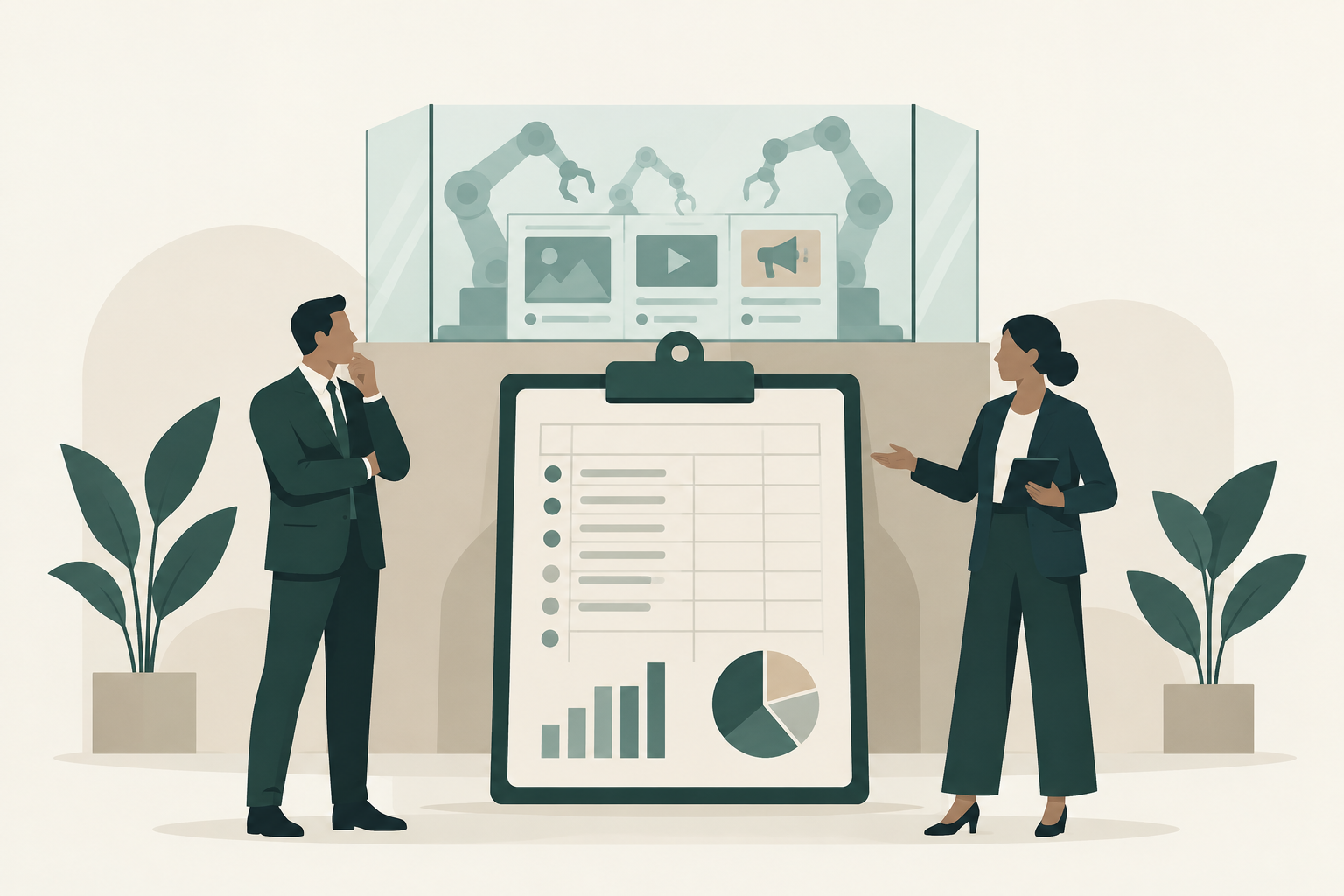
The generative AI risks a B2B marketing leader is asked about come down to six questions: what customer data reaches which model, who can move ad spend, what the AI says in your name, who owns what it makes, what the vendor contract covers, and what happens when the vendor changes. Each has a control and an owner.
The question usually arrives as an email from the CFO or the audit committee. Here is an imagined version of it: "Before we approve more AI spend in marketing, can you tell me what could go wrong and who's watching it?" A reply that starts with "the team is being careful" won't survive the meeting.
This guide is for the CMO, VP Marketing or head of demand gen who has to give that answer. It takes each question in the order finance and legal tend to ask it, gives the answer with the published terms and laws behind it, and ends with an example risk register, filled in, that you can edit and send. It is not legal advice, and your counsel should read the register before it goes to the board. The guardrail policy for the ad accounts sits in our guide to AI brand safety in B2B paid media.
The answer to "are the risks under control" starts with a list of jobs
Generative AI risks are under control when you can name every job AI does in the team, the data each job touches, the access it has, and the person who owns it. Without that list, any answer about risk is a guess.
The list matters most for the tools nobody approved. IBM's Cost of a Data Breach Report 2026, which analyzed 602 breaches with the Ponemon Institute, found that incidents involving shadow AI (AI tools used without the organization's approval) by employees "more than doubled to 43 percent" from 20 percent in 2025, as summarized by Baker Donelson on July 30, 2026. The same summary reports that 68% of organizations with an AI-related incident lacked AI governance policies. For a marketing leader, that makes the first risk an inventory problem: the exposure is the personal chatbot account someone uses for the weekly report, more than the approved tool with a contract behind it.
Scalewell helps paid and demand gen teams map the recurring jobs in their week and decide which ones AI should take on first, so the conversation with finance starts from a known list instead of a worry.
The inventory is a short survey: ask each person and each agency which AI tools they use, on which plan, for which job, and with what data. The sections below say which answers are a problem.
Customer data stays safe on paid business plans with written terms
Customer data is protected when it only goes into AI tools on paid business or API plans whose terms say the vendor doesn't train on it. The plan tier decides this, more than the brand of the model, and the published terms differ in ways a CFO can check.
Three of the large model vendors put it in writing, quoted here as of November 2026:
| Vendor and plan | Training on your content | Retention you should know about |
|---|---|---|
| Anthropic API and other offerings under its commercial terms | "Anthropic may not train models on Customer Content from Services," per its commercial terms | No day count in the terms; confidential information is destroyed "promptly upon request," with backup copies excepted |
| OpenAI API | "As of March 1, 2023, data sent to the OpenAI API is not used to train or improve OpenAI models," per its data controls documentation | Abuse monitoring logs "retained for up to 30 days"; zero data retention is "subject to prior approval by OpenAI" |
| Google Gemini API, paid | "Google doesn't use your prompts" or "responses to improve our products," per its Gemini API terms effective March 23, 2026 | "Google logs prompts and responses for a limited period of time" to detect policy violations |
| Google Gemini API, unpaid | Content used to "provide, improve, and develop" products, and "human reviewers may read, annotate, and process" it | Google's own warning: "Do not submit sensitive, confidential, or personal information to the Unpaid Services" |
The last row is the one to show the CFO: the same company's model runs under opposite data rules on the paid and unpaid tiers. A team member testing a prompt on a free tier with last quarter's closed-won list has put customer data into a product whose terms allow reviewers to read it.
So the answer to "where does our data go" has three parts: a short list of approved tools on business plans, a rule that customer names, emails and deal notes go nowhere else, and a data processing agreement on file for each approved vendor. The rule's wording is in the guide to AI brand safety.
Ad spend exposure is capped by permissions, not by the model
The amount an AI tool can misspend is set by the access it has to the ad accounts, and as of November 2026 two of the three official ad platform connections below cannot change budgets at all.
Start with what the platforms already allow without any AI involved. Google's help page on daily budgets says a campaign may spend "twice your average daily budget" on a single day, with the month capped at "30.4 times your average daily budget." That ceiling rises with the budget, so an agent that can raise budgets can raise it too. Keeping budget increases a human action is covered in the guide to where humans stay in the loop on ad spend.
Then check what each connection can do:
| Connection (as of November 2026) | What it can change |
|---|---|
| Google Ads MCP server | "Read and partial mutate (asset creation, video uploads, and label management with propose-and-confirm validation, or configurable read-only mode)"; it "cannot create, modify, pause, or enable campaigns, ad groups, ads, budgets, or bids," per Google's developer page |
| Microsoft Advertising MCP server | Free, hosted by Microsoft and read-only; Microsoft lists nine tools that "never modify account data" |
| LinkedIn's own MCP server | Reads and writes ad accounts; in beta and in use, not yet publicly documented |
| ChatGPT Pro with a custom MCP server | Pro users "can connect custom MCP servers with read/fetch permissions"; full MCP support is for ChatGPT Business and Enterprise/Edu on web |
The figure a CFO wants is the worst case. With read-only access, the worst an AI tool can do to spend is nothing. Give a tool write access to, say, a hypothetical LinkedIn account spending $1,500 a day, and the worst case becomes those budgets times the days before someone notices, which is why the control that matters is a daily spend alert and a named person who reads it. The full map of which connection reads what is in our guide to MCP for marketing.
AI-written claims carry the same legal risk as your own
An ad claim written by AI is legally your claim, and the regulators have said so. The US Federal Trade Commission's then chair, Lina M. Khan, said when it launched Operation AI Comply on September 25, 2024 that "there is no AI exemption from the laws on the books."
For a B2B team the exposure is narrow but real. A generated headline that rounds a case-study figure from 31% to "over a third", or a testimonial from a customer who doesn't exist, is the same problem it would be if an intern wrote it, only produced faster and in more variants. The control is a claims register (every number and comparison your ads may use, with its source) and a check of every new ad against it, which is the job our creative approval workflow gives to an AI pre-check before a person signs.
Disclosure rules now add a second layer for imagery. New York General Business Law section 396-b, in effect since June 9, 2026, says an advertiser with "actual knowledge" that an ad contains a synthetic performer "shall conspicuously disclose" it, with civil penalties of $1,000 for a first violation and $5,000 after, per the New York State Senate's text. The European Commission's AI Act page gives August 2026 as the month the EU AI Act's transparency rules come into effect. The legal answer most teams can give is short: AI-written text needs the same claims review as any copy, and a generated person in an ad needs a label in the markets that require one, plus counsel's sign-off.
AI legal risks include ad assets you may not own
Ad copy and images produced mostly by AI may not be protected by US copyright, which means a competitor could reuse them and you would have little to stop it. The US Copyright Office's report Copyright and Artificial Intelligence, Part 2: Copyrightability, released January 29, 2025, concludes that protection can extend to cases where "a human makes creative arrangements or modifications of the output, but not the mere provision of prompts," as the Office's announcement puts it.
The courts have held the same line. The Supreme Court denied certiorari in Thaler v. Perlmutter on March 2, 2026, leaving in place the ruling that a work needs a human author, as Holland & Knight's note on the denial records. That matters little for a search headline that lives for weeks and a lot for a campaign concept, mascot or hero image you'll use for a year, which should carry real human work. Your trademark protects the brand on top of whatever the copyright question decides.
The other half of copyright risk runs the other way: someone claims your AI output infringes their work. Some vendors cover that in their contracts, and the detail of the cover is where legal will spend its time. As of November 2026, Anthropic's commercial terms say it "will defend Customer" against claims that "Customer's paid use of the Services" or "Outputs generated through such authorized use" violate "any third-party intellectual property right." The same terms exclude claims to the extent they arise from "modifications made by Customer to the Services or Outputs," from "the combination of the Services or Outputs with technology or content not provided by Anthropic," and from "an alleged violation of trademark based on use of an Output in trade or commerce." Ad production edits and combines outputs all day, and running an ad is use in commerce, so a marketing team should read that clause with counsel before treating it as cover.
Google Cloud's service specific terms, as of November 2026, add two layers: claims about Google's "use of training data," and claims that "an unmodified Generated Output from a Generative AI Indemnified Service" infringes. The output layer does not apply where the customer used output it "knew or should have known was likely infringing," or where the claim "is based on a trademark-related right as a result of Customer's use of such Generated Output in trade or commerce." The list of covered services names the Gemini Enterprise Agent Platform API (formerly Vertex AI API) used with generally available Gemini models, and Gemini in Workspace; the Gemini API terms in the data table above are not on it.
AI vendor risk comes down to five contract answers
AI vendor management for a marketing team means getting five answers in writing before any tool touches customer data or ad accounts: data use, retention, indemnity, model changes and exit. A vendor that can't answer them on a call is giving you an answer anyway.
| Question for the vendor | What a good answer looks like | Who checks it |
|---|---|---|
| Do you train on our inputs or outputs? | A clause saying no, on the plan you're buying | Privacy owner |
| How long do you keep our data, and where? | A stated retention period and a data processing agreement | Privacy owner |
| Do you indemnify us for IP claims on outputs? | A clause, with the exclusions read by counsel | Legal |
| How much notice before a model or feature you depend on is retired? | A stated notice period in days | Head of marketing ops |
| Can we export our prompts, workflows and logs if we leave? | Plain files, in a format another tool can use | Head of paid media |
AI vendor lock-in sits in the workflows a team builds around one model
AI vendor lock-in for a marketing team is mostly the cost of rebuilding prompts, skills and connections when a model is retired or a vendor's price changes, and the published notice periods are short. As of November 2026, Anthropic's model deprecations page promises "at least 60 days' notice before model retirement for publicly released models," and it notified developers on September 30, 2026 that Claude Sonnet 4.5 retires on November 30, 2026. OpenAI's deprecations page gives generally available models "At least 6 months" and says preview models "may be retired with much shorter notice, such as 2 weeks."
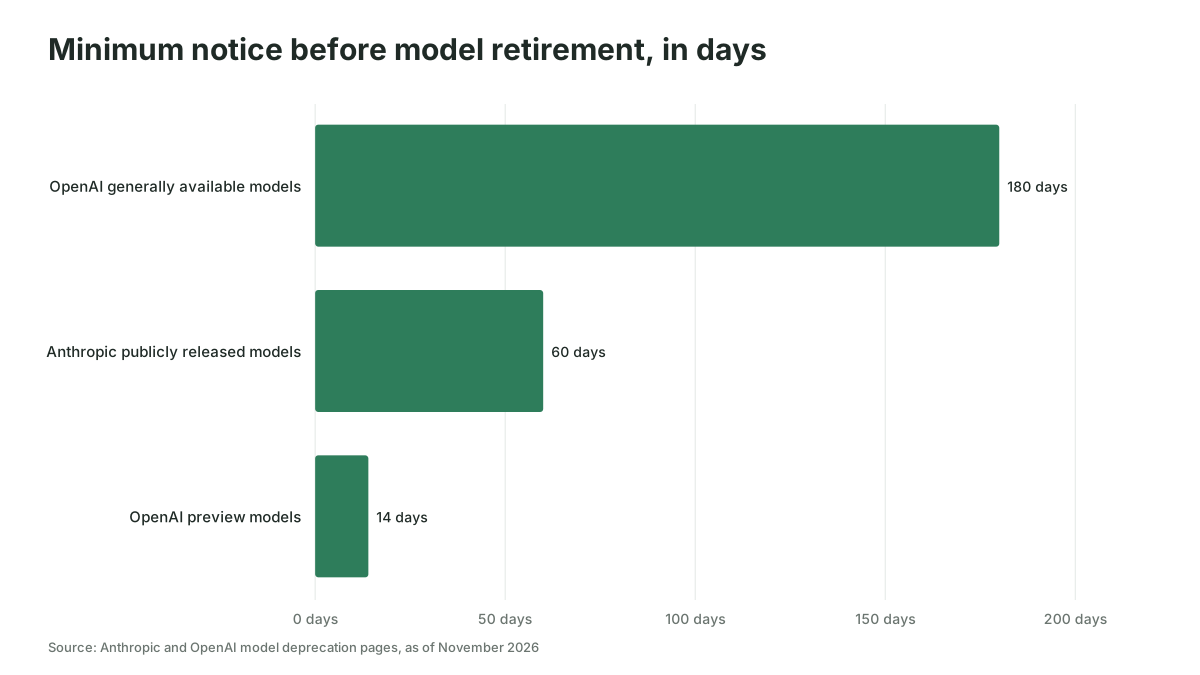
Sixty days is enough to switch a model in a well-kept workflow and not enough to rebuild a messy one, such as a weekly report that depends on a prompt someone tuned by hand inside one chat product with no copy anywhere else.
The controls for lock-in cost little. Keep prompts, skills and instructions as plain text in a place your company owns. Test each important workflow on a second model once a quarter, so you know the switching cost before you're forced to pay it. And prefer connections built on open standards: the Model Context Protocol, which AI clients such as Claude and ChatGPT use to reach ad platforms and CRMs, was donated by Anthropic to the Agentic AI Foundation under the Linux Foundation on December 9, 2025, with Anthropic, Block and OpenAI as co-founders. That makes a connection easier to carry from one AI client to another.
An example generative AI risk register, filled in
The register below lists the risks a CFO or general counsel will ask a B2B marketing leader about, with a control and an owner for each. It is an example for a mid-size B2B team using AI in paid media, not a record of any real company, so rate likelihood and impact for your own tools and access.
| Risk | Likelihood (hypothetical) | Impact | Control | Owner | Evidence the control works |
|---|---|---|---|---|---|
| Customer data pasted into a personal or free AI account | High | High | Approved-tools list on business plans; written data rule; DPA per vendor | Privacy owner | Quarterly tool inventory shows no unapproved tools with customer data |
| AI tool or agent overspends an ad account | Low with read-only access; medium with write access | High | Read-only by default; budget changes stay human; daily spend alert | Head of paid media | Access review shows which tools hold write rights; alert tested |
| AI-written ad makes a claim you can't support | Medium | High in regulated categories | Claims register; pre-check on every new ad; named signer | Brand or compliance owner | Every live claim maps to a register entry |
| Synthetic person in an ad without a required label | Low | Medium (New York: $1,000, then $5,000 per violation) | Real people with releases by default; counsel signs off on any synthetic person | Compliance owner | Asset log records how each face was made |
| AI-generated asset can't be protected or is copied | Medium | Low for short-lived ads; medium for long-running concepts | Human creative work on assets you'll keep; trademark on brand elements | Brand owner | Long-running assets have a record of human edits |
| Third party claims an AI output infringes their work | Low | Medium | Vendors with IP indemnity; exclusions reviewed by counsel; reverse image check on hero assets | Legal | Indemnity clause on file for each approved vendor |
| Model retired or vendor changes price or terms | High over 12 months | Medium | Prompts and skills stored as company-owned text; quarterly test on a second model; open-standard connections | Head of marketing ops | Last switch test date and result recorded |
| Nobody owns the AI jobs once the champion leaves | Medium | Medium | Each AI job has a named owner and a one-page runbook | CMO | Register reviewed quarterly with names current |
With a finance audience, the "Evidence the control works" column does the most work: if a row has no evidence you can produce on request, the control is a hope, and the CFO will notice.
Once each AI job has a known risk and control, the cost of those controls belongs in the case for the spend, covered in our guide to the business case for AI in B2B paid media.
Risk registers fail when nobody reruns the inventory
A generative AI risk register fails in a predictable way: it is accurate on the day it's written and wrong three months later, because the team adopted new tools and nobody updated it.
Three habits keep it honest. Rerun the tool inventory every quarter, including agencies, since a new plugin or a free tier is how shadow AI starts. Review write access to the ad accounts on the same schedule, since access granted for one test tends to stay. And keep the register short enough to read in the meeting, with detail living in the brand safety policy, the claims register and the vendor files.
The opposite failure is a register so cautious that every AI job needs legal sign-off, which pushes the team back to personal accounts and recreates the top risk on the list. Approve a sanctioned route quickly and people will use it.
Where to start
This week, send every person and agency on the team a three-line survey asking which AI tools they use, on which plan, and with what data, then put the answers into your own copy of the example register above with an owner on each row. Scalewell works with B2B marketing teams to turn that inventory into a ranked plan of which jobs AI takes on next, so the risk review and the roadmap come from the same list.
Frequently asked questions
Is it legal to use AI-generated images in B2B ads?
Generally yes in the US, as long as the ad's claims are true and you follow disclosure rules where they apply. Check the image tool's terms on commercial use and indemnity, and have counsel confirm for regulated markets.
Who should own AI risk in marketing?
The CMO or VP Marketing owns the register and answers to the CFO for it, and each risk has a working owner: the privacy owner for data, the head of paid media for ad account access, a brand or compliance owner for claims and disclosure, and legal for indemnity and copyright. Agencies follow the same rules in their contract.
Does a vendor's no-training promise cover the AI tools built on top of it?
It does not carry over by itself, because a marketing tool built on one of the big models has its own terms with you, and the model vendor's terms are an agreement with the tool maker. Ask the tool maker which model and plan sit underneath, whether its own contract repeats the no-training and retention commitments, and whether you would be told if the model changed.
Does the NIST AI Risk Management Framework apply to marketing teams?
NIST describes its AI Risk Management Framework, released January 26, 2023, as "intended for voluntary use," and added a generative AI profile on July 26, 2024. If your security or legal team already works from it, describing your marketing controls in its terms makes their review easier.