Machine customers: what happens to B2B paid media when AI agents shortlist vendors
Gartner's machine customer forecasts meet two buyer surveys that disagree, and this article shows where paid media still acts when an AI agent drafts the vendor shortlist, what that does to brand and search budget, and how to measure shortlist share in the CRM.

Machine customers are AI systems that research, choose or buy on someone's behalf. In B2B today, that mostly means an AI agent doing the buyer's research and drafting the vendor shortlist. The agent never sees your ads, so paid media has to earn a place in the buyer's memory before the prompt and survive the check afterwards.
The question usually reaches you from the top. Picture a hypothetical exchange before a board meeting: the CEO forwards a headline about AI agents running most B2B buying and asks why the company is still paying LinkedIn to show ads to people. The CMO reaches for a slide about impressions, and both of them know it doesn't answer the question.
Answering it means putting a budget behind the answer. It covers what the machine customer forecasts actually say, what buyer surveys show about AI and shortlists, where paid media still acts when an agent does the research, how brand budget and landing pages change, and how to measure all of it in your own pipeline.
Machine customers in B2B are mostly researchers for now
Gartner, which popularized the term, defines a machine customer as "a nonhuman economic actor that obtains goods or services in exchange for payment," as Gartner analyst Don Scheibenreif wrote in CIO Dive on March 27, 2023. The forecast behind the boardroom headlines came later. Gartner predicted in October 2025 that "90% of B2B purchases in 2028 will be mediated by AI agents," representing over $15 trillion in spending, as SiliconANGLE reported on October 21, 2025.
The verb in that forecast deserves a careful read, because mediated covers a lot of ground, from a printer reordering toner to an agent comparing software vendors for a human who then decides. Only the first kind is real machine buying. The second is what a B2B marketer selling a considered product will meet first, because nobody hands a six-figure contract to software that can't sit in a procurement meeting.
Considered B2B purchases are still group decisions. Forrester's 2026 State of Business Buying release (January 21, 2026) says the typical decision involves 13 internal stakeholders and nine external influencers, and that procurement professionals are decision makers in 53% of buying cycles. An agent can do the reading for that group. It can't replace the group.
The agents themselves are built to stop short of the purchase. When OpenAI launched ChatGPT agent in July 2025, its announcement used "analyze three competitors and create a slide deck" as an example task and said the agent is trained to ask permission before actions with real-world consequences, such as a purchase. That's the job to plan for: a machine doing the buyer's homework and handing a person a short list.
Buyer surveys disagree on how much AI shapes the shortlist
The two largest recent buyer surveys point in different directions, and the gap between them is the most useful thing in this debate. G2's March 2026 survey of 1,076 B2B software buyers, published April 15, 2026, found that 51% now start their research with an AI chatbot more often than with Google, up from 29% in G2's 2025 report. It also found that 69% chose a different vendor than they had planned because it appeared in a chatbot's recommendation, and 41% use Deep Research tools for structured software evaluations.
6sense's 2026 B2B Buyer Experience Report, built on 3,596 completed purchase journeys, reads much calmer. It found that 81% of buyers used a large language model somewhere in the journey, down from 94% the year before, but only 26% use one to find new vendors, and just 17% to 21% cite AI tools as an influential source. The pre-contact favorite wins 82% of the time, and the average Day-1 shortlist holds 3.3 vendors.
| G2, March 2026 survey | 6sense, 2026 report | |
|---|---|---|
| Who was asked | 1,076 B2B software buyers | 3,596 completed purchase journeys |
| Headline on AI | 51% start research with a chatbot more often than Google | 81% used an LLM somewhere in the journey |
| AI and vendor choice | 69% picked a vendor they hadn't planned on after a chatbot recommendation | 26% use LLMs to find new vendors; 17% to 21% call AI an influential source |
| What decides the winner | Chatbots are the top shortlist influencer | The pre-contact favorite wins 82% of the time |
Both vendors have an interest in their answer. G2 sells review visibility and found that review site citations are the top trust signal in an AI answer, while 6sense sells account intelligence built on the idea that buyers decide before they call. Our reading of the two together is that AI mostly reorders and checks a shortlist that the buyer's memory already started, and that the minority of deals where a chatbot introduces a new vendor is real and worth tracking in your own pipeline.
Making budget calls on pipeline evidence, while agents take over more of the buyer's research, is the hard part, and Scalewell works alongside paid media leaders to set up AI jobs that gather that evidence each week.
An AI agent never sees your ads, so paid media works on the people who brief it
An agent compiling a vendor comparison reads web pages, review sites, documentation and other people's write-ups, and none of that includes the LinkedIn video or YouTube ad you paid for. Ad impressions go to people. Some AI answers now carry ads, which we cover in AI search advertising, but those are shown to the person reading the answer, and an agent running a research task in the background is a different reader. What agents read on your own pages is the subject of the agentic web.
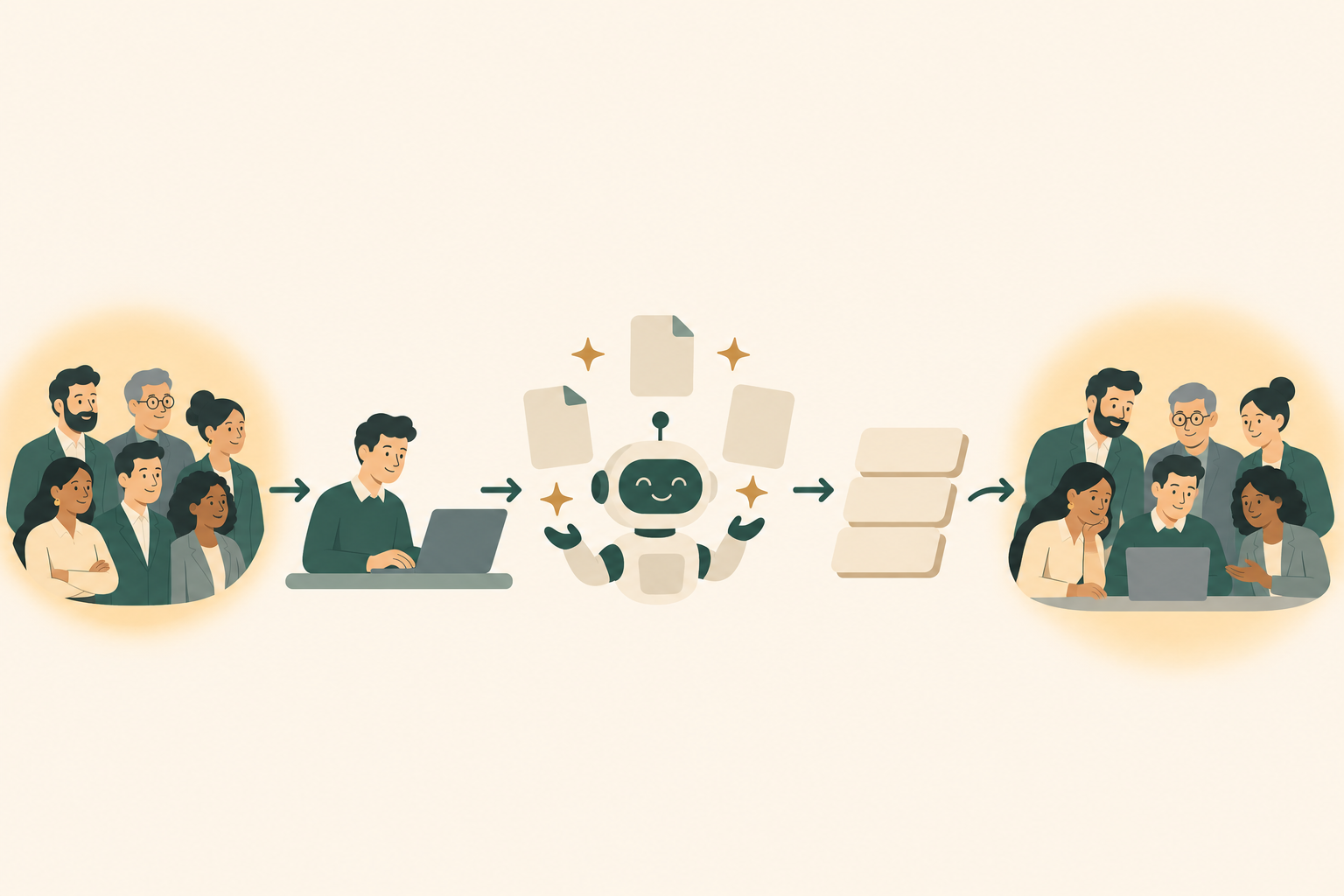
So paid media still acts, at two moments around the agent. The first is before the prompt. A person writes the brief, and that person names the vendors they already know, sets the criteria and decides which sources count. "Compare Vendor X, Vendor Y and anyone else worth a look" is a very different instruction from a blank search, and the vendors in the first half of that sentence start with an advantage.
The second moment is after the shortlist. The agent hands over three or four names and a summary, and members of the buying committee check it against what they've seen, heard from peers and read themselves. A vendor they recognize gets the benefit of the doubt. A name they've never met gets scrutiny, which is how a cheap mention in a chatbot answer can still lose to the brand that's been in their LinkedIn feed for a year.
The timing makes this concrete. John Dawes of the Ehrenberg-Bass Institute, in research with LinkedIn's B2B Institute, estimated that only about 5% of B2B buyers are in market at any time. Dreamdata's 2026 LinkedIn Ads Benchmarks, built on its customers' data across more than 3.5 million customer journeys, puts the average time from a first LinkedIn ad impression to revenue at 281 days. The person who briefs an agent next spring is being shaped by what they see this year.
Brand budget becomes the budget for getting named in the prompt
The budget consequence is that spend on being remembered by the buying committee becomes spend on getting onto the shortlist an agent starts from. That's a stronger case for brand budget than most CMOs have had, and it comes with an obligation: if brand spend is now shortlist spend, it should be judged on shortlist evidence rather than reach.
LinkedIn is where this lands hardest for most B2B teams, because it is the paid channel that reaches named job functions inside named accounts while they're out of market. Video, document ads and thought leader ads aimed at the whole buying committee are the lines that do this job. They rarely produce a form fill this quarter, which is exactly why they're the first lines cut when someone reads a forecast about agents.
Search moves the other way. Generic research queries are the ones an agent or an AI answer now handles, so the clicks they used to bring may thin out. Branded search and competitor comparison terms become the moment a human verifies what the agent said, and those terms deserve protection rather than cuts. How to split the AI search budget between earning citations and buying placements is covered in LLM visibility, and the wider split between brand, demand creation and capture in B2B marketing budget allocation.
In a hypothetical case, Company A and Company B each spend $800,000 a year on paid media and both see generic search clicks fall by a fifth. Company A cuts its LinkedIn awareness line from $240,000 to $120,000 to fund more generic search, chasing the clicks that are leaving. Company B keeps the LinkedIn line, moves $60,000 from generic search into branded and comparison terms, and starts asking every new opportunity where the vendor list came from. A year later, B can show whether it was on more Day-1 shortlists, while A can show a cost per click.
Measure shortlist share with questions sales already asks
Shortlist share is the percentage of new opportunities in which the buyer says you were on their list before they contacted anyone. Neither ad platforms nor web analytics can see it, because the research happened inside a chatbot or an agent session, so the measure has to come from the buyer.
Add two required fields to the opportunity record and have the account executive fill them on the first call. In HubSpot, create them under Settings, Properties, on the Deals object. In Salesforce, add them in Object Manager, Opportunity, Fields & Relationships. The first field asks whether we were on the buyer's list before first contact (yes, added during evaluation, or unknown). The second records which sources built the list, as a multi-select that includes AI chatbots or agents, review sites, peers, analysts, search and "already knew you."
Then report three numbers each quarter: shortlist share, the share of opportunities whose list came partly from an AI tool, and the win rate for Day-1 opportunities against those added later. In a hypothetical quarter with 60 new opportunities, 36 on the Day-1 list give a shortlist share of 60%. If 11 of those 36 close (31%) against 3 of the other 24 (13%), being on the list is worth more than double the win rate, and the LinkedIn line that builds that list now has a pipeline number behind it.
For a cleaner read on the memory side, a brand lift study on LinkedIn or YouTube measures recall among people who saw the ads against people who didn't. The brand lift study guide covers the audience sizes each platform needs and how to read the result against pipeline.
Landing pages now get checked twice
Landing pages for B2B paid traffic now have a second job: confirming what an agent already told the buyer. The person arriving from a branded search or a comparison term has usually read a summary of your pricing, integrations and security posture somewhere else, and the page either confirms it quickly or creates doubt.
Put a pricing range or the pricing model, the integrations list, security and compliance documents, and named proof within one scroll of the top. Gated content is harder to defend as well. 6sense found that 17.7% of buyers used AI tools to avoid filling out a form, which means a whitepaper behind a form is increasingly something a buyer's agent summarizes from the outside instead of something they download. The page-level detail, by offer and funnel stage, is in B2B landing pages.
Six lines in the paid plan to review before next year
These are the lines in a typical B2B paid plan that agent-led research changes, with how we'd judge each one in the CRM.
| Plan line | What changes when agents do the research | How to judge it |
|---|---|---|
| LinkedIn awareness, video and thought leader ads | Becomes the main way to get named in the buyer's brief | Shortlist share and Day-1 win rate among targeted accounts |
| LinkedIn retargeting of buying committees | Reaches the people who check the agent's shortlist | Opportunity progression on accounts with committee engagement |
| Google and Microsoft generic search | Fewer early research clicks as AI answers the question | Cost per opportunity, not cost per click |
| Branded and competitor comparison search | Where verifiers land after reading an AI summary | Impression share and conversion to opportunity |
| Ads inside AI answers | A placement for humans reading answers, not for agents | A capped test judged on opportunities, not clicks |
| Gated content syndication | Weaker as buyers use AI to avoid forms | Opportunities per lead, with a cut date if two quarters pass without one opportunity |
How Scalewell helps you defend the budget with shortlist evidence
A plan that names the lines agents change, and the CRM evidence that will prove them, is the gain Scalewell helps a marketing leader reach first. The free 30-minute call is the place to start: bring the paid plan you're about to defend and talk it through with B2B paid media practitioners, then decide whether it needs more than a conversation. If it does, an audit of the team's week scores each recurring job so you can see which ones AI should handle first. A ranked roadmap fixes the sequence, and a sprint, usually 8 to 12 weeks, builds the top jobs into tools you already use. Afterwards your people run and adjust those jobs with no help from Scalewell.
Machine customer forecasts are oversold in three places
The forecasts are useful as direction and dangerous as a budget input. Three mistakes come up most often.
Treating 90% as your category. Gartner's figure covers all B2B buying, including routine reordering by systems that never read an ad. A complex software or services sale with a committee of 13 is the slowest part of that market to change, and planning as if your buyers vanished in 2028 will cost you the brand presence that gets you onto their lists in 2027.
Cutting capture before the evidence arrives. Generic search may thin, but branded and comparison search is where verified buyers show up. Cut those and you lose the visit that follows a good agent summary.
Rebuilding everything for bots. People still sign. Forrester found that more than 60% of business buyers use a trial, rising to 78% for purchases of $10 million or more. A site rebuilt purely for machine readers and stripped of the proof humans want will lose the second check even if it passes the first.
Where to start
Pull your last 20 closed-won deals and read the first-call notes for each one, looking for two things: whether the buyer knew you before they contacted you, and whether an AI tool helped build their list. That afternoon's count is your first shortlist share. If you want a second opinion on what that count means for next year's plan, Scalewell can go through it with you.
Frequently asked questions
Who came up with the term machine customers?
Gartner popularized the term, and its analysts Don Scheibenreif and Mark Raskino set it out in their 2023 book When Machines Become Customers, as The Register reported on September 12, 2023. Scheibenreif also calls them "custobots." The idea covers connected devices that reorder supplies as well as AI agents acting for people.
How many machine customers are there?
Gartner counted more than 13 billion internet-connected products with the potential to behave as customers and expected 15 billion by 2028, as CNBC reported on February 21, 2024. Most are devices such as printers and vehicles, not AI agents shortlisting software vendors, so the count says little about a B2B sales cycle.
Is agentic commerce the same as machine customers?
Agentic commerce usually means AI agents completing purchases, a narrower idea. OpenAI's Instant Checkout, launched September 29, 2025 on the Agentic Commerce Protocol it built with Stripe, started with US shoppers buying from Etsy sellers, and in March 2026 OpenAI said it was moving checkout into merchant apps. That is consumer buying, far from a committee signing a B2B contract.
What percentage of revenue could come from machine customers?
CEOs surveyed by Gartner estimate that 15% to 20% of their revenue will come from machine customers by 2030, according to the same CNBC report. That is an executive expectation, not a measured share, and it spans every industry, so treat it as a sign of where boards are looking rather than a planning number.
Will AI agents replace B2B sales reps?
Current evidence says sales still has a central role. 6sense's 2026 report found that buyers first engage sellers roughly 59% of the way through an average 10.3-month cycle, which still leaves sellers months of evaluation, validation and negotiation to run. Agents shorten the research, while people still run the trials, the security review and the contract.