The agentic web: what B2B paid media and landing pages need when AI agents visit
AI agent sessions submit forms about as often as human ones, so B2B landing pages need readable facts and plain forms, and bidding needs pipeline stages an agent can't fake.

The agentic web is the part of the internet where AI agents open pages, read them, click and fill in forms on a person's behalf. For a B2B paid media team it changes three things at once: whether a landing page works for software, whether tracking counts that visit as a buyer, and what bidding learns from it.
Picture the quarterly pipeline review. Demo requests from paid search are up, the platform says cost per conversion fell, and the head of sales says a good share of the new contacts never picked up the phone. Some of that is the usual argument about lead quality. Some of it, from this year on, may be software that filled in your form because a buyer asked it to compare three vendors before lunch.
If you run marketing and have to decide what, if anything, to change, start here. It covers which agents can act on your pages as of November 2026, how much of that traffic anyone can measure, and what landing pages, tracking and bidding need in response. It stays on the visit itself. Being cited inside AI answers is a different job, covered in our guide to LLM visibility for B2B, and what agents do to the way buyers build a shortlist is covered in our guide to machine customers.
The agentic web is agents doing tasks, which is different from crawlers and AI answers
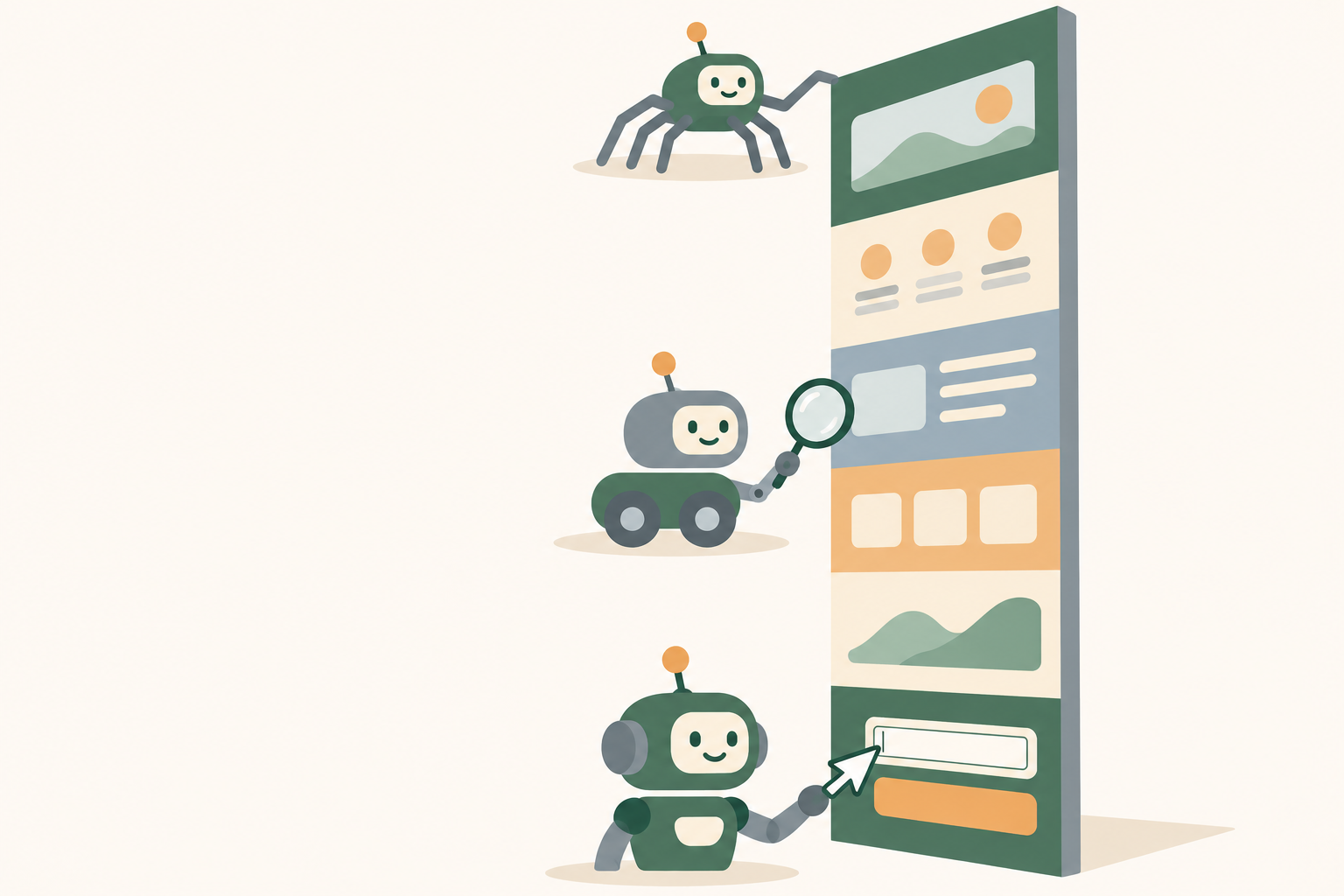
An AI agent on the agentic web is software that completes a task in a browser for a person: it loads your page, reads it, clicks through and submits what the task needs. That makes it the third kind of machine visitor a marketing site gets, and the first one that reaches the bottom of the page where your form sits.
The first kind is the training crawler, such as GPTBot, which OpenAI's bot documentation describes as collecting content that may be used to train its models. The second is the answer fetcher, such as ChatGPT-User, which visits a page when someone asks ChatGPT a question and reads it for the answer.
The third kind acts on the page: it fills in the demo form, picks a time slot or downloads the report, because a person told it to. For paid media that's the visit that matters, since it touches the events your conversion tags and bidding strategies are built on.
Keeping bidding and pipeline reports tied to real buyers while those visits climb is work Scalewell sets up with paid and demand gen teams, so the check runs every month instead of as a one-off cleanup.
Four agentic browsers B2B buyers can use as of November 2026
Four agentic browsers or browser agents are open to the public as of November 2026, and only one documents a clear way for your site to recognize it. Most people searching for AI browsers want one to install; a marketer needs to know who can use each, what it can do on a page, and whether your site can tell.
| Agent | Who can use it (November 2026) | What it can do on your page | Can your site identify it | Source |
|---|---|---|---|---|
| Gemini in Chrome auto browse | US users aged 18 or over, English, with Google AI Plus, Pro or Ultra on a personal account; desktop only, rolling out gradually | Multi-step tasks; aims to ask the user to confirm before submitting web forms, and may hand over for account creation and accepting terms | Runs in the user's own Chrome. Google documents a separate Google-Agent fetcher for agents hosted on its servers, with a published user agent and IP list | Google help, Google-Agent |
| ChatGPT Work cloud browser (Atlas retired) | Paid ChatGPT plans except Free and Go, started on web or mobile, rolling out by region. Atlas, launched October 21, 2025, has been retired; 9to5Mac reported the new desktop app with ChatGPT Work on July 9, 2026 | Reads pages, clicks and fills in forms in a cloud browser; pauses for sign-in and asks before consequential actions such as payments | Yes: signs requests with Web Bot Auth, with a Signature-Agent header of "https://chatgpt.com" | OpenAI, OpenAI help, OpenAI help, 9to5Mac |
| Perplexity Comet | Free to everyone since October 2, 2025; Mac, Windows, iOS and Android | Handles delegated tasks such as research and purchases | No documented signal found | Perplexity blog, Perplexity |
| Claude in Chrome | Paid Claude plans (Pro, Max, Ultra, Team, Enterprise); Chrome on desktop only | Reads, clicks, types, moves between pages and fills in forms | No documented signal found | Anthropic help |
Two things in that table matter for a B2B team. The first is churn: OpenAI launched a standalone agentic browser in October 2025 and has already retired it, so build for agents in general, never for one named product.
The second is that few agents identify themselves. OpenAI's help page says ChatGPT Work's Cloud browser "uses Web Bot Auth to sign outbound HTTP requests" and that Cloudflare lists it as a signed agent. Google says it is "experimenting with the Web Bot Auth protocol" for its hosted agents. The agents that run inside a person's own browser, though, act through that person's signed-in session, and none of the help pages above tells a site owner how to separate an agent step from a human one.
Agent sessions grew 88% in three weeks in Microsoft Clarity's data
The best public measure of agentic web traffic as of November 2026 is Microsoft Clarity's analysis of agent sessions, published October 29, 2026. It counted over 5.2 million agentic sessions across 230,511 Clarity projects between August 13 and September 9, 2026, and found that agentic session volume "increased by 88% in just three weeks."
Divide those totals and the average project saw about 23 agent sessions in four weeks. That's small, so you're not redesigning for a flood, but a curve that nearly doubles in three weeks is a reason to start counting now.
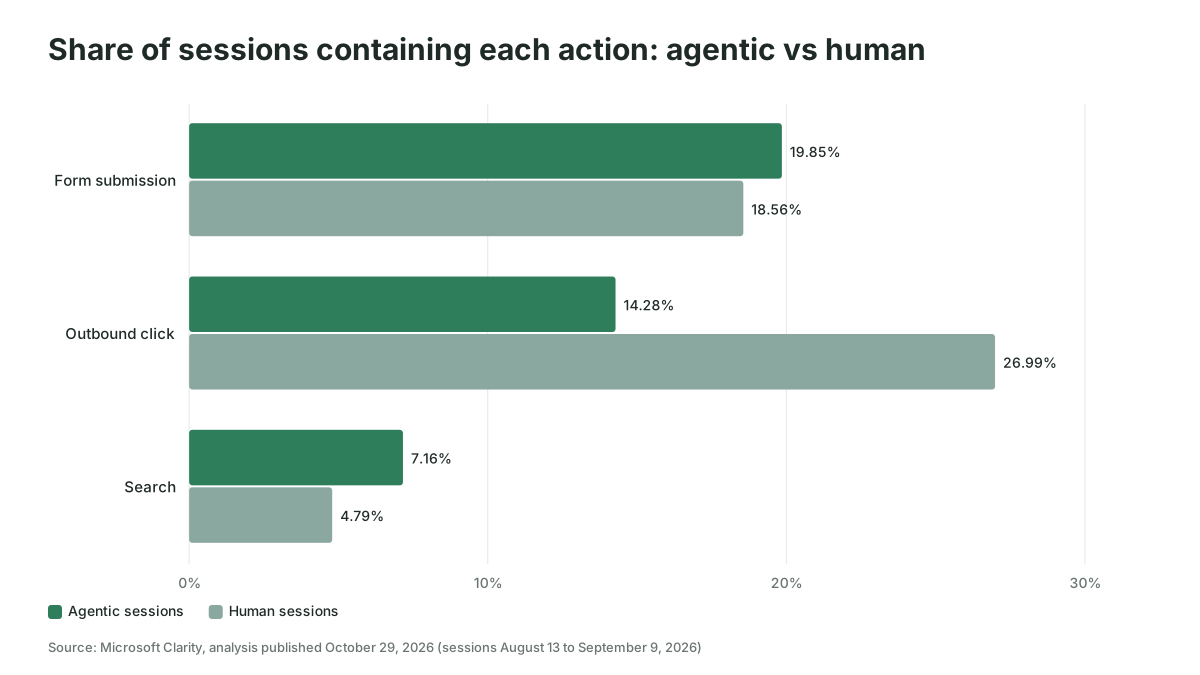
The more useful finding for a demand gen team is what agents do once they arrive. Clarity found a form submission in 19.85% of agentic sessions against 18.56% of human ones. Agents made an outbound click in 14.28% of sessions against 26.99% for people, and ran a site search in 7.16% against 4.79%.
So an agent session reaches your form about as often as a human one and wanders off far less, which is what you'd expect from software sent to do one task. On a B2B page built around a demo request, it lands on the event your bidding learns from.
Clarity is careful about the limits. Its authors note that "an agentic-classified session may also include a human handoff," so a recorded form submission wasn't necessarily completed by the agent alone. Checkout also appears in 25.21% of agentic sessions, which suggests a large ecommerce share in the sample, so read the figures as a direction of travel for B2B sites rather than a forecast.
Cloudflare's July 1, 2026 report says "more than 50% of traffic on the Internet is now non-human," but much of that is crawling, with 52% of crawler requests made for AI training as of June 2026.
Landing pages for the agentic web need forms an agent can finish and facts it can read
A landing page that works on the agentic web states its important facts as plain text and uses form fields a machine can identify. That advice is old, but it weighs more once a buyer's agent may be the first reader of your page.
Facts belong in the text first. An agent asked to compare three vendors looks for the pricing model, the integrations, the security certifications and the deployment options. If those sit inside images, behind a tab that loads on click, or in a "contact us" box, the agent has little to put in the table it builds for the buyer. Write them as text on the page.
On the form, labelled fields, native buttons and plain HTML select menus tell an agent what each element does. OpenAI's Atlas launch post said "website owners can also add ARIA tags to improve how ChatGPT agent works for their websites in Atlas." Accessibility specialist Adrian Roselli replied that "ARIA should only be a fallback," and we'd side with him: native HTML elements do the job and serve screen reader users at the same time.
Finally, decide where the human comes in. Google's auto browse page says Gemini aims to ask the user to confirm before it submits web forms or schedules events, and may ask the user to take over to create an account or accept terms of service. A free trial that needs an account will usually end with a human; a five-field demo form and a calendar can be finished by an agent end to end. Either can be right, as long as you choose on purpose.
Our guides to B2B landing pages for paid traffic and B2B conversion rate optimization cover the page itself.
Tracking counts most agent sessions as people, and bidding learns from them
Most analytics and ad platform tracking records an agent session in a real browser as a human visit, because the agent loads the page and runs its tags the way a person's browser does. That's where the agentic web costs a paid team money.
Google Analytics 4 excludes known bots using "the International Spiders and Bots List, maintained by the Interactive Advertising Bureau," combined with Google's own research. The same page says you "cannot disable known bot traffic exclusion or see how much known bot traffic was excluded," and it doesn't mention AI agents.
The ad platforms share the blind spot. A Google Ads conversion tag, a Microsoft Advertising UET tag and the LinkedIn Insight Tag all record a form fill when the thank-you page loads, whoever loaded it, and Smart Bidding and its equivalents then look for more clicks like that one.
Billing for agent clicks is unsettled too. Google's invalid traffic page doesn't mention AI agents, and ad fraud prevention firm Spider AF wrote in an article updated November 20, 2026 that it found "no official position from Google, Meta, or industry groups" on whether agent clicks count as invalid.
LinkedIn is the exception on the platform side. Its User Agreement, effective November 3, 2025, forbids members to "use bots or other unauthorized automated methods to access the Services." So an agent filling in a LinkedIn Lead Gen Form breaks those terms. Terms don't block software, though, so the part you control for LinkedIn campaigns is your own landing pages.
Here's what that does to a hypothetical team spending $30,000 a month on paid search.
| Hypothetical month | All demo requests | Human sessions | Agent sessions |
|---|---|---|---|
| Demo requests | 120 | 102 | 18 |
| Opportunities created | 24 | 23 | 1 |
| Opportunity rate | 20% | 22.5% | 5.6% |
On form fills, the platform reports $250 per conversion ($30,000 divided by 120) and treats all 120 as equal signals. On opportunities, the cost is $1,250 each ($30,000 divided by 24), and the 18 agent requests, 15% of the total, produce one opportunity between them. Bidding on form fills asks the platform for more of a visit that converts to pipeline at a quarter of the human rate.
The fix is one B2B teams need anyway: optimize on pipeline stages an agent can't fake. Send qualified opportunities from the CRM back to Google Ads, Microsoft Advertising and LinkedIn, as our offline conversion tracking guide describes. Once those stages arrive in enough volume, demote the form fill in Google Ads: open Goals, then Conversions, then Summary, click Edit goal on the goal that holds it, and choose "Secondary (observe only)" under Conversion action optimization. Google's help page says secondary actions stay in the All conversions column but are "not for bidding."
Measure agent visits before you change any budget
You can measure agent visits on your own pages today with tools most teams already have, and that should come before any change to spend.
Microsoft Clarity's Agent Activity dashboard is "generally available for projects with agentic traffic," according to the Clarity team, and Clarity itself is free. It detects agentic browser providers across the OpenAI, Google and Anthropic ecosystems, and Perplexity isn't named among them. Install it on your paid landing pages if it isn't there already.
If your site sits behind Cloudflare, its signed agents documentation says all customers can now use AI Crawler and Agent access policies to block or allow verified agents, with Search, Agent and Training presets on all plans.
Then run one comparison a month: form fills from agent sessions, form fills from human sessions, and the opportunity rate of each once sales has worked them. A rule of thumb, not a benchmark, to replace with your own line after three months of data: if agent-session requests become opportunities at half the human rate or better, leave them alone; if they fall below half, as in the hypothetical above, take form fills out of bidding and route agent-session requests to email nurture instead of an SDR call.
Budget is the last thing to move, because a few dozen agent sessions a month calls for measurement, and reallocation can wait.
Blocking every agent is the most common overreaction
The most expensive mistake on the agentic web is blocking all agents at the firewall, because it takes your pages out of the comparisons buyers asked their agents to make. If your pricing and product pages refuse a buyer's agent, the shortlist it was sent to build gets built without you.
Since Cloudflare now leaves that choice to customers, check what your bot rules do to signed agents on your pricing, product and demo pages.
The second mistake runs the other way: rebuilding pages for machines. Stuffing ARIA labels with keywords, which Roselli predicts, harms the buyers who still visit in person, and they're the ones who sign.
The third is treating every agent form fill as junk. A person asked the agent to send that request, and some of those sessions end with a human at the keyboard. Score them on what happens next, like a lead from any source.
And with a few dozen agent sessions a month, one large account's research week can swing the share, so look at three months before you act on a trend.
How Scalewell keeps your bidding learning from real buyers
When bidding learns from opportunities instead of form fills, agent visits stop distorting it, and that only holds if someone checks it every month. Scalewell's work starts with a free 30-minute call and then an audit of the team's week: every recurring job, the platforms and data it touches, and a score for which one AI should take on first, which can include the agent and pipeline checks described here.
That audit becomes a ranked roadmap. The first jobs are then built during an 8 to 12 week sprint, sometimes longer, inside your existing ad platforms, CRM and reporting tools, with new systems only where those fall short. Your team then runs and adjusts every job without Scalewell.
Review agent visits monthly beside pipeline, not as a site project
Treat the agentic web as a monthly line in the pipeline review, next to channel performance, rather than a website project. The line has three numbers: agent share of form fills, opportunity rate for agent and human requests, and any change to your bot rules.
If agent requests convert to pipeline, the pages are working for agents and the buyers behind them. If they don't, the bidding change above protects spend. Our guide to data readiness for AI covers the CRM fields that make the opportunity-rate comparison possible.
Where to start
This week, add Microsoft Clarity to your main paid landing page if it isn't there, and then, a month from now, check the form fills Clarity shows inside agent sessions against what happened to those requests in your CRM. If you want help turning that into a check that runs every month, Scalewell works with paid and demand gen leaders to build it into the tools they already use.
Frequently asked questions
Is the agentic web the same as Web3 or the semantic web?
Web3 and the semantic web are different ideas. Web3 refers to blockchain-based ownership, and the semantic web is a long-running effort to make page meaning machine-readable through structured data. The agentic web describes AI agents using the ordinary web through a browser, clicking and typing for a person. Agents benefit from well-structured pages, but they work on ordinary pages without any new protocol.
Will robots.txt stop AI agents from using my site?
Robots.txt mostly won't stop them. OpenAI says robots.txt rules "may not apply" to ChatGPT-User because a person started the request, and Google says its user-triggered fetchers "generally ignore robots.txt rules." Robots.txt still controls training crawlers such as GPTBot. To control agents, use firewall or bot management rules, ideally ones that recognize signed agents.
Do I need an llms.txt file for AI agents?
There's no evidence you do. Google's AI features guidance says "you don't need to create new machine readable files, AI text files, or markup to appear in these features." None of the agent help pages checked for this guide asks site owners for one either. Clear text and labelled forms do more.
Are AI browsers safe for my team to use at work?
Use them with care on anything that spends money or sends messages. Google's own help page lists mistakes auto browse can make, including clicking the wrong button, completing unwanted purchases and "confirming a task is done when it's not." Keep agents away from ad account changes and payment steps unless a person confirms each action.
Will agentic browsers replace Google search for B2B buyers?
Current evidence says it won't. Cloudflare's July 2026 report says Google still accounts for "approximately 88% of referral traffic" across its network. Agents add a new kind of visit on top of search, so plan for both: search and LinkedIn campaigns still bring the people, and agents increasingly bring a person's errand.