The dark funnel: making budget calls on pipeline when AI hides more of the journey
Most of the B2B journey now happens before sales and out of tracking's sight, so split paid spend into capture, shape and prove lines and judge each on the pipeline evidence it can actually produce.

The dark funnel is the part of a B2B buying journey your tracking never records: AI chats, peer advice, private communities, podcasts and the shortlist a buying group agrees before anyone fills in a form. AI research is making it bigger, so budget calls have to rest on account-level pipeline and controlled tests rather than attributed clicks.
Here's an imagined budget review. The CFO points at the attribution report, where LinkedIn gets credit for 9% of last year's pipeline, and asks why it takes a quarter of the paid budget. The VP of Marketing replies that the real influence happens where the software can't see, which is true, and also sounds exactly like what someone would say to protect a budget.
Winning that argument takes evidence instead of conviction. It covers how much of the journey now happens out of sight, how to split paid spend by the kind of proof each line can produce, the decision rules to agree with finance before the quarter starts, and where these budgets usually go wrong. Choosing an attribution model is a separate question, and our guide to AI attribution for B2B covers it.
The dark funnel now covers most of the journey before sales
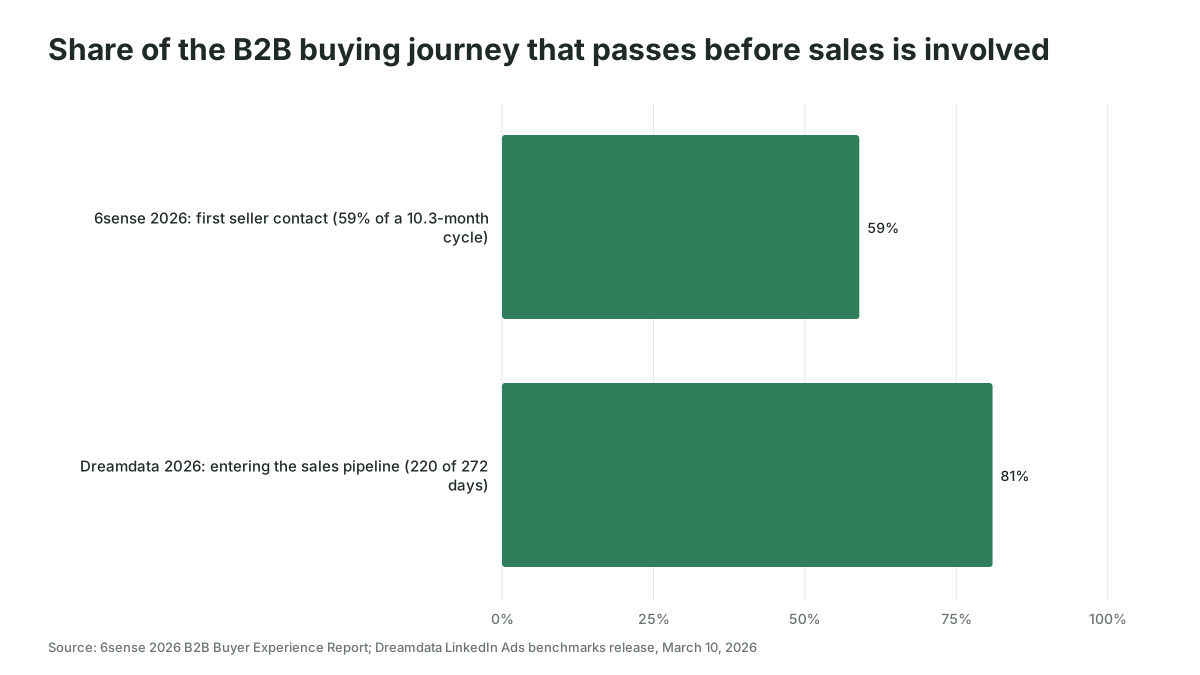
The dark funnel covers most of a B2B purchase because buyers settle on a favorite long before they talk to a seller. 6sense's 2026 B2B Buyer Experience Report, which studied 3,596 completed purchases worth at least $25,000 a year, found that buyers first engage sellers 59% of the way through an average 10.3-month cycle, and that the pre-contact favorite ultimately wins 82% of the time.
Dreamdata sees the same pattern in tracking data. Its LinkedIn Ads benchmarks release of March 10, 2026 says the average B2B journey has stretched from 211 to 272 days, and that buyers spend the first 220 days, roughly seven months, forming their purchasing decisions before ever entering the sales pipeline.
Put those two findings side by side and the budget problem is plain. The decision is mostly made in a stretch your CRM barely sees, and the touches attribution does record pile up at the end, when the buyer already knows who they'll pick. Paid media that works early collects little credit, and the branded search ad that catches the finished decision collects a lot.
AI assistants hide the middle of the journey more than the start
AI assistants mostly hide the comparison stage, where buyers check and rank vendors they already know. Forrester's John Buten wrote on January 22, 2026 that 94% of business buyers now use AI in their buying process, up from 89% a year earlier, and that 61% use private AI tools provided by their own organization. A conversation inside a company's own Copilot or ChatGPT workspace leaves no cookie, no referral and no form fill for you to count.
The 6sense study adds a useful correction to the hype. LLM use during evaluations fell from 94% in 6sense's 2025 study to 81% in 2026, only 26% of buyers used LLMs to find new vendors, and use peaked in the middle of the journey, at 59% against 43% at the beginning. So AI is less often where buyers first hear your name and more often where they test what they've already heard.
That shift matters for budget, because if buyers ask an assistant to compare the three vendors on their list, the work that put you on the list happened earlier, through ads, peers, content and sales conversations from previous cycles. And it happened across a lot of people: Forrester's State of Business Buying 2026, as reported by Digital Commerce 360 on January 22, 2026, puts the average at 13 internal stakeholders and nine external participants influencing a B2B purchase. One person's AI session is one of dozens of touches you'll never see.
Budget decisions made on pipeline, with the evidence gathered every month rather than rebuilt in a rush before each review, are the outcome Scalewell helps demand gen teams reach by handing the gathering to AI.
Split paid spend by the proof each line can produce
The fastest way out of the dark funnel argument is to stop judging every dollar by the same evidence. Some spend catches buyers who've already decided, and attribution sees it well. Some spend tries to make you the pre-contact favorite months earlier, and attribution sees almost none of it. And a small slice exists only to test whether that second kind works.
| Budget line | What it pays for | Typical spend | Judged on | When you read it |
|---|---|---|---|---|
| Capture | Buyers already looking for you or your category | Branded and high-intent search on Google Ads and Microsoft Advertising, retargeting, demo-request campaigns | Cost per opportunity from the CRM, against a ceiling agreed with finance | Monthly |
| Shape | A place on the shortlist before the buyer contacts anyone | LinkedIn sponsored content and thought leader ads to the target account list, YouTube and Meta video for reach across the buying group, sponsored newsletters and podcasts | Opportunity rate and win rate in target accounts the spend reached, compared with accounts it didn't, plus self-reported mentions | Quarterly, with the funding decision after two quarters |
| Prove | Evidence that shape spend causes pipeline | An account holdout or a lift test on the largest shape channel | The difference in opportunities between exposed and held-out accounts | When the test concludes |
Dark funnel marketing lives in the shape line, and it's the line most teams either overfund on faith or cut on the evidence of a report that was never built to see it. Writing down how each line is judged, before anyone looks at results, takes the faith and the panic out of both moves.
This split sits on top of the budget layers in our guide to B2B marketing budget allocation. That guide decides how much each layer gets and when to reforecast; this one decides what evidence each line has to show to keep its money.
Judge shape spend on target accounts, not on attributed clicks
Shape spend should be judged by what happens to the accounts it reached, because that's the unit a buying committee works in and the unit your CRM can count. The question is simple: did target accounts that saw your ads create more opportunities, and win more often, than target accounts that didn't?
LinkedIn makes the first half of that comparison easier than most platforms. In Campaign Manager, click Plan in the left menu and then Companies to open Companies Hub, which shows impressions, engagements and leads by account. As of November 2026, LinkedIn's help page says revenue metrics there need your CRM connected through Business Manager using CRM Sync. Without that connection, export the account view and match it to opportunities in your CRM yourself, which is a tidy job for an AI assistant with access to both.
Here's how the comparison reads in practice. Imagine a hypothetical company with 1,200 accounts on its target list. Over two quarters, its LinkedIn campaigns reached 500 of them at least once a month, and the other 700 saw little or nothing. The reached accounts produced 40 new opportunities, a rate of 8%, while the unreached accounts produced 21, a rate of 3%.
That gap is encouraging, and it proves less than it looks. Targeting, retargeting and your sales team's attention all drift toward accounts that are already warm, so the reached group was probably more likely to buy anyway. Treat the account comparison as the signal that justifies a test, and the test as the thing that justifies the money.
Two more readings belong next to the opportunity rate. Win rate in reached accounts tells you whether shape spend is doing its actual job, which is making you the favorite before contact, and 6sense's 82% figure is the reason that number deserves attention. Self-reported answers from the demo form catch the channels software misses, including AI assistants; our attribution guide shows how to sort those answers with a model.
Agree the decision rules with finance before the quarter starts
A decision rule is a sentence, written before the results arrive, that says what evidence will move each budget line up, down or nowhere. It's the single most useful thing you can bring to a CFO, because it turns "trust me" into "here's what we agreed would count."
Timing is the part teams get wrong. If buyers spend about 220 days forming a decision before they enter the sales pipeline, a quarter of shape spend can't show up as opportunities yet. So read leading signals in the first quarter, such as account reach, engagement in Companies Hub and self-reported mentions, and make the funding call on opportunities from the second quarter on. Even then you're only seeing the faster journeys, which is worth saying out loud in the meeting.
The thresholds below are examples to replace with numbers you and finance agree on:
| Line | Signal | Example threshold | Action |
|---|---|---|---|
| Capture | Cost per opportunity | Above the agreed ceiling for two months in a row | Cut the campaign or move its budget to a better capture campaign |
| Shape | Opportunity rate, reached versus unreached accounts | Reached accounts at 1.5 times the unreached rate or better after two quarters | Renew, and fund a holdout if one hasn't run |
| Shape | Same comparison | No meaningful gap after two quarters | Shrink to the floor, change audience or creative, and retest |
| Prove | Holdout result | Exposed accounts produce more opportunities than held-out accounts | Grow the shape line next quarter |
| Prove | Holdout result | Inconclusive | Hold the shape line flat and extend the test; don't grow it |
The prove line deserves care. An account holdout removes a random set of target accounts from your LinkedIn targeting for two quarters and compares their opportunities with everyone else's. To set one up in Campaign Manager, click Plan, then Audiences, then Create audience and Matched Audience, upload the held-out accounts as a company list, and exclude that list in each shape ad set; as of November 2026, LinkedIn's help page says a list needs at least 300 rows to upload, so a holdout smaller than that can't be built this way. Remember that LinkedIn's 300-member matched audience floor applies to each ad set after narrowing, so excluding accounts can push a small campaign under it. LinkedIn also offers Conversion Lift Testing, which splits the target audience into test and control groups, with the honest caveat that "conclusive results aren't guaranteed." Our guide to incrementality testing covers sizing a holdout when audiences are small.
When the results go to the board, mark each shape line as proven or pending rather than mixing the two. The format for that is in our guide to reporting B2B marketing ROI to the board.
Hidden-journey budgets fail in four predictable ways
Budgets built around an invisible journey go wrong in the same few ways, and most of them start with good intentions.
The dark funnel becomes a blank check. Once "it works where we can't see" is accepted as an answer, every underperforming program can claim it. Give every shape line a renewal date and a rule, and let it lose money in public if it doesn't meet the rule.
Shape spend gets cut because attribution says so. Capture metrics look better the quarter after the cut, because the remaining spend sits where attribution looks. Any damage to pipeline would arrive two or three quarters later, long after the decision felt right. If you must cut, cut a random subset of accounts and you've built a holdout by accident.
Proxies get treated as pipeline. Intent surges, engagement scores, website visitor identification and share of model are useful for deciding which accounts to reach. None of them is a reason to renew a budget, because none of them is an opportunity. Our guide to LLM visibility covers how to report AI answer presence as its own earned line.
Small target lists run tests that can't conclude. When opportunity counts per group are in single digits, a holdout can't separate signal from luck. Teams with short target lists do better with the account comparison, win rates, sales notes and a longer read.
How Scalewell frees the hours to judge hidden pipeline every month
Scalewell helps a demand gen team win back the hours that monthly evidence gathering eats, so dark funnel spend gets judged on pipeline rather than on instinct. Everything begins with a free half-hour call. Then the audit of the team's week, the step that matters most here, lists every recurring job, from account exports and CRM matching to sorting form answers and drafting the budget pack, records the tools and data each one touches, and scores which jobs AI should take first. A ranked roadmap sets their order, and the build sprint, usually 8 to 12 weeks, sets them up inside the team's current tools. The team then learns to run and adjust everything without Scalewell.
Where to start
This week, export your target account list, mark which accounts your LinkedIn campaigns reached in the last two quarters, and count new opportunities in each group from your CRM. A large gap is your case for a holdout, and no gap at all is a cheaper lesson than another year of argument. If you'd like help making that comparison a job that runs itself every month, Scalewell is happy to talk it through.
Frequently asked questions
Is the dark funnel the same as dark social?
They overlap, but they aren't the same thing. Dark social usually means content shared privately through messaging apps, email and direct messages, where analytics records the visit with no referral source. It's one part of the dark funnel. The dark funnel is wider and also includes AI chats, podcasts, events, analyst calls and the internal debate inside a buying group.
Can intent data or website visitor identification reveal the dark funnel?
Each one reveals a slice of it at most. Third-party intent data shows research activity across publisher networks, and visitor identification names some of the companies that reach your site. Neither sees a private AI conversation, a peer recommendation or a podcast. Use both to choose which accounts to reach, and judge the spend on opportunities.
Should "AI assistant" be an option in a how did you hear about us field?
Add it, because the form is the only way to hear about AI research at all, since those sessions leave no tracking trail. Add it as its own option rather than burying it under "online search," and leave a free-text box so buyers can name the tool. Read the trend over quarters, because single months are noisy.
Is the dark funnel longer for some B2B purchases than others?
It runs longer when the buyer is adding something new. 6sense's 2026 study found that journeys for a new capability averaged 11.3 months, against 8.2 months for replacing an existing product. If you sell into a new category, buyers spend longer forming a view before contact, so give shape spend more time before you judge it.
Does a bigger dark funnel mean brand spend should go up?
A bigger dark funnel doesn't automatically justify more brand spend. A bigger hidden journey raises the value of being known early, but it doesn't prove that any particular program achieves that. Fund brand and shape spend at a level finance agrees to, attach a decision rule, and grow it only when the account comparison and a holdout both point the same way.