AI in B2B marketing: where it gives a paid and demand gen team hours back
AI in B2B marketing pays back through hours on recurring weekly jobs and through budget decisions made on pipeline once CRM outcomes reach the ad platforms, and this guide maps both across six areas of a paid and demand gen team's work.
AI in B2B marketing pays back in two places. It gives a paid and demand gen team hours back on the recurring work it repeats every week, such as reports, search term reviews, ad variants and list upkeep. And it moves budget decisions onto pipeline once CRM outcomes reach the ad platforms and the reports.
Most AI updates at a planning meeting sound the same. Here is an imagined but familiar exchange. The CFO asks what the AI line bought this year, and the answer is that the team now ships three times as many assets. Nobody in the room can say whether any of them reached a buying committee that later signed.
This article is the map we'd hand a CMO before that meeting. It sorts the work of a B2B paid and demand gen team into six areas, shows where AI takes recurring hours off the team in each one and which pipeline decision it supports, and points to our deeper guide on each piece. It deliberately skips tool lists, because our survey of AI tools for B2B marketing already covers them by job and price.
B2B teams use AI mostly for speed, and few report better results
B2B marketing teams have adopted AI widely, and the published surveys show it has made them faster far more often than it has made them better. In the Content Marketing Institute and MarketingProfs B2B Content and Marketing Trends report, fielded from June 23 to August 11, 2026 among 861 B2B marketers, 88% said their organization uses AI-powered content creation tools. Asked to pick up to three contributions generative AI made to their content creation, 78% picked speed, 59% efficiency and 44% volume, while 12% picked performance improvement.
So roughly one B2B marketer in eight counts better performance among the top things AI has done for their content. Most of the rest describe a faster team producing more, which is useful, and also exactly what the CFO's question was probing.
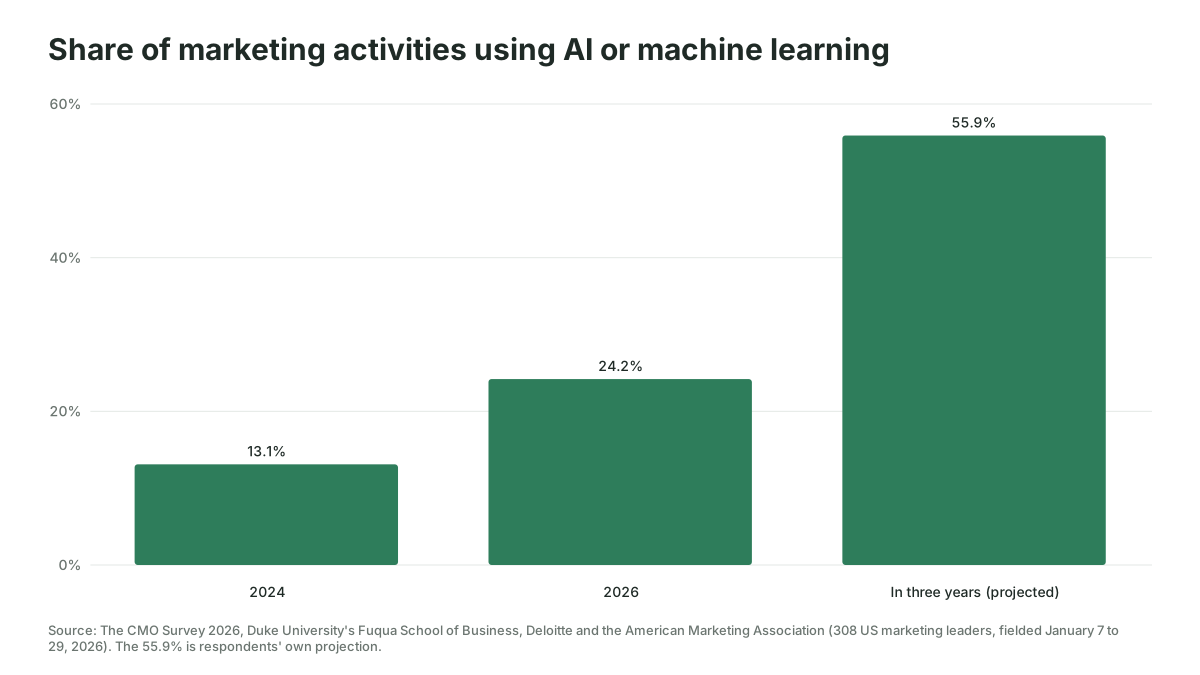
The CMO Survey, sponsored by Duke University's Fuqua School of Business, Deloitte and the American Marketing Association, puts a number on how much of the work AI touches. Its 308 respondents, marketing leaders at for-profit US companies, 97% of them VP level or above, surveyed from January 7 to 29, 2026, said their companies use AI or machine learning in optimizing and automating marketing 24.2% of the time, up from 13.1% in 2024, and they expect 55.9% within three years. The same report found that no marketing technology activity scores above 5 on its 7-point performance scale, and that performance levels have not improved in two years.
Budgets are moving the same way. Gartner's 2026 CMO Spend Survey of 401 CMOs and senior marketing leaders in North America and Europe, reported by MarTech on May 12, 2026, found an average of 15.3% of marketing budgets going to AI initiatives, while only 30% said their organizations had mature or fully developed AI readiness capabilities. Our guide to AI adoption in marketing sets these surveys side by side and explains why their numbers differ so much.
Put the three together and the pattern is clear. Spend and usage are climbing, and results lag. The CMO Survey's respondents name budget, integration, bandwidth and talent as the biggest barriers, and in our view the common thread is AI sprinkled across tasks instead of given specific jobs with an owner and a measure. Getting hours back from AI, and budget calls made on pipeline, depends on choosing which weekly jobs it takes on first, and that choice is what Scalewell works on with paid and demand gen teams, from picking the jobs to getting them running.
AI in B2B marketing pays off through hours back and decisions on pipeline
The two returns from AI in B2B marketing come from different kinds of work, and each has its own test. Hours come back when AI takes over a job the team repeats on a schedule. Better decisions come when the outcome data a decision needs, such as sales qualified leads, opportunities and closed revenue, reaches the place where that decision gets made.
A job passes the hours test when four things are true. It recurs at least weekly, its steps can be written down, a mistake in it is easy to spot and undo, and the data it needs can reach the model through an export, an API or a connector. The weekly performance report passes all four. A pricing change for next year's plan passes none of them, and no amount of prompting fixes that.
A decision passes the pipeline test when the system making it can see what happened after the form fill. If Google's bidding only sees form submissions, it buys form submissions. If the monthly report only shows platform-reported conversions, the budget conversation runs on those. AI helps here too, mostly by doing the joining and checking work that keeps CRM data flowing to the platforms and the reports.
Why bother with tests at all, when the team could just give everyone a seat in a B2B marketing AI tool? Because thinly spread AI produces thinly spread gains. In the Real-Time Population Survey of US adults aged 18 to 64, summarized by the St. Louis Fed's FRED blog on August 27, 2026, the share of work hours that employed respondents reported saving thanks to AI assistance grew from 1.6% to 2.2% between the third quarter of 2024 and the second quarter of 2026. That is real, and it is also too small to see on a team's calendar unless the savings are concentrated on chosen jobs. Our guide to AI marketing workflows turns these four tests into a scored inventory of the team's week.
Six areas where AI gives a paid and demand gen team hours back
The work of a B2B paid and demand gen team falls into six areas, and AI can take recurring work off the team in every one of them while people keep the judgment calls. The table shows what moves to AI, what stays, and which pipeline decision each area feeds.
| Area | Recurring work AI can take on | What stays with your team | Pipeline decision it supports |
|---|---|---|---|
| Reporting and analysis | Pulling platform and CRM numbers, writing the weekly narrative, flagging anomalies | Metric definitions, what goes to the board | Which campaigns earn next month's budget on cost per opportunity |
| Search and campaign upkeep | Sorting search terms by intent, drafting negatives, pacing checks, audit checklists | Bids, budgets, launches and pauses | Which queries and placements to stop paying for |
| Creative and copy | Variants, resizes, briefs drawn from tagged performance, pre-checks against specs | Claims, brand voice, final approval | Which messages produce opportunities rather than clicks |
| Audiences and ABM | Refreshing account lists from the CRM, keeping exclusions current, checking list sizes | Which accounts to target and why | Spend concentrated on accounts that can buy |
| Lead qualification and routing | Labeling fit and intent, routing to the right rep, chasing slow follow-ups | Qualification definitions, the agreement with sales | Which leads count as the signal sent back to the platforms |
| Competitor and market research | Collecting and tagging rival ads and landing pages | Positioning and the response | Where your offer needs to look different |
Reporting and campaign upkeep tend to pass the hours test most cleanly, because they run on a fixed schedule, follow written rules and touch nothing irreversible. We'd start there for most teams. The weekly report is a good first job precisely because everyone already knows what a correct one looks like.
Creative is where speed gains are easiest to claim and hardest to cash. AI can draft ten LinkedIn ad variants in minutes, but on a small B2B audience most of those variants will never collect enough impressions to tell you which one worked. The useful job is narrower: briefs drawn from what the team has already tagged as working, plus mechanical checks before anything goes to review.
Audiences and lead handling are where hours and pipeline meet. A model that refreshes target account lists from the CRM every week saves list work and also keeps spend on accounts that can still buy. Lists still have platform floors to respect, such as LinkedIn's 300-member minimum for a matched audience, so the AI job includes checking each list's size before it ships.
Decisions move onto pipeline only when CRM outcomes reach the ad platforms
The ad platforms' own AI optimizes toward whatever you tell it counts as a conversion, so the pipeline half of AI in B2B marketing is mostly a data plumbing job. B2B buying makes this harder than it sounds. Dreamdata's LinkedIn Ads Benchmarks Report 2026, released on March 10, 2026 from 3.5 million customer journeys, put the full B2B buyer journey at 272 days, with 88 touchpoints and 10 stakeholders.
A journey that long means the outcome you care about arrives months after the click. Any platform left to optimize on form fills will happily find more people who fill in forms, and the report will look great until sales reviews the list. Each major platform documents a way to send later-stage CRM outcomes back, with its own conditions, as of November 2026.
| Platform | What you send | Documented conditions |
|---|---|---|
| Google Ads | Offline conversion imports, matched by click ID, or enhanced conversions for leads with hashed first-party data | No minimum volume stated; Google says the added data improves "accuracy and bidding performance", and API uploads move to the Data Manager API starting June 15, 2026 (Google Ads Help) |
| Conversions API events with the QUALIFIED_LEAD conversion type, used by the qualified leads optimization goal under the lead generation objective | Data shared within 30 days; LinkedIn recommends five or more qualified leads within two weeks for the learning phase (LinkedIn docs, August 2026) | |
| Meta | CRM funnel stages through the conversion leads integration | At least 200 leads a month, daily uploads, Instant Forms only, target stage within 28 days at a 1% to 40% conversion rate (Meta developer docs) |
| Microsoft Advertising | Lifecycle stage changes synced from HubSpot | Native HubSpot sync with a consent property and an existing Microsoft pixel (HubSpot help, updated October 4, 2026) |
Read the conditions column before you pick a platform to start with. Take a hypothetical team that generates 120 Meta Instant Form leads a month. It is 80 short of Meta's 200 floor, so its first pipeline feed belongs on LinkedIn or Google, where the documented conditions are lighter. LinkedIn's recommended five qualified leads in two weeks is a much lower bar for a B2B account with a real sales team behind it.
AI earns its hours on this side as well. Matching CRM records to click IDs, catching uploads that failed overnight, and checking that each opportunity carries a campaign key are all recurring jobs with written rules. Our setup guide to offline conversion tracking covers the field mapping and upload windows for each platform.
AI in B2B marketing fails on small volumes, unchecked claims and hours with nowhere to go
In our view, five failure modes account for most of the AI for B2B marketing programs that stall, and a model that was not clever enough is rarely one of them.
- Too few outcomes to learn from. Any AI that learns from results needs results, and a B2B account with a handful of opportunities a month gives it very little. Start with jobs that need no volume, such as reporting and checks, while the pipeline feed builds up.
- Claims nobody checked. In the same Content Marketing Institute research, 54% of B2B marketers named ensuring accuracy among their top three challenges in using AI for content creation, and 75% worried that AI is making audiences more skeptical of online content. A buying committee of ten people gives one wrong claim ten chances to be noticed, so a person signs off every claim before it ships.
- Hours saved with nowhere to go. If the team saves time and spends it on more of the same campaign hygiene, nothing changes in the P&L. Decide in advance where the hours go, and count them the way our guide to AI marketing ROI sets out.
- Tools bought before jobs. A renewal for a platform nobody opened since spring is a familiar line in any martech review. Name the weekly job first and buy only for that job.
- Jobs with no owner. A pilot that belongs to everyone stops the week its champion goes on holiday. Each AI job needs one named owner who checks its output and changes it when the rules change.
A B2B AI marketing strategy fits on one page with four decisions
A workable B2B AI marketing strategy is four decisions written on one page, and the marketing leader owns all of them. Which two jobs AI takes on first. Who owns each job and checks its output. Where the saved hours go, named as work, such as more concluded tests or faster follow-up on high-fit accounts. And which pipeline signal each ad platform receives, by when.
Here is how the same budget plays out at two hypothetical companies. Company A buys AI seats for the whole team and reports usage each month, so its strategy slide counts prompts. Company B gives AI two jobs, the weekly report and a nightly qualified lead upload to LinkedIn, names an owner for each, and reports hours on the first job and cost per opportunity on the second. At the next budget review Company B has an answer for the CFO, and Company A has a usage chart.
Everything else in a B2B AI marketing strategy, from the tools to the training plan, follows from those four lines. If you cannot fill them in yet, the gap is information about your own week, which an assessment of the team's recurring work produces. When the four lines need to grow into a plan for the whole department, our guide to AI transformation strategy expands them into five decisions with a filled-in one-page template.
How Scalewell gives a paid and demand gen team its hours back on the right jobs
Scalewell aims at the two gains this article describes: hours your team gets back each week and budget calls made on pipeline. The first step costs nothing, a free 30-minute call in which you walk us through how the paid and demand gen week runs, and we tell you whether AI has an obvious first job in it. If it does, an audit of the week scores every recurring job, a ranked roadmap puts them in order, and a build sprint of 8 to 12 weeks in most cases, sometimes longer, puts the first jobs inside your current tools. People who have run B2B paid media build it, then train your team to run and change every job without Scalewell.
Where to start
This week, list every job your paid and demand gen team repeats at least weekly, and next to each one write whether the outcome it serves ever reaches your CRM. The jobs with a yes in both columns are your first two. If you'd like a second opinion on that list, a short call with Scalewell is an easy way to get one.
Frequently asked questions
Will AI replace B2B marketers?
AI takes over recurring tasks in B2B marketing, such as reports, list upkeep and first drafts, but the decisions that carry risk stay with people: budgets, claims, target accounts and the agreement with sales. The roles change more than they disappear, because someone has to own each AI job, check its output and update it when the rules change.
Is AI in B2B marketing different from AI in B2C marketing?
Yes, mainly because of volume and time. B2C teams often have thousands of purchases a month for platform AI to learn from, while a B2B team may have a few dozen opportunities that arrive months after the first click. B2B teams therefore lean on AI for reporting, audience upkeep and sending CRM outcomes back, rather than on fully automated optimization.
What data does a B2B team need before using AI?
A B2B team needs three things before AI can help with pipeline decisions: spend data by campaign from each ad platform, CRM records with dated stage changes such as SQL and opportunity, and a campaign key that links the two. Hours-only jobs such as search term sorting can start without the CRM join, so do those while the data work happens.
How long does AI in B2B marketing take to show results?
Hours saved show up within weeks, as long as you logged how long each job took before AI took it on and log it again afterwards. Pipeline effects take at least one full sales cycle, because the opportunities the platforms learn from arrive long after the click. Report the two on separate timelines so the slower one is not judged too early.
Is it safe to let AI make changes in our ad accounts?
Start with read access and let AI propose changes that a person approves before anything goes live. Budgets, bids, launches and pauses should stay behind human approval, since a mistake there spends money immediately. Widen access one job at a time, only after the proposals from that job have proven reliable over several weeks of review.