Zero-click marketing: what AI Overviews and LinkedIn mean for B2B paid budgets
Zero-click search moves paid search toward capture, asks LinkedIn ads to make the argument in the feed, and shifts measurement from clicks to accounts and opportunities.

Zero click marketing means planning for buyers who get their answer in an AI Overview, a chatbot reply or the LinkedIn feed without visiting your site. For a B2B paid budget, it changes three things: what paid search is for, how much of the message a LinkedIn ad must carry, and how you prove any of it worked.
You'll usually notice it in the monthly report first. Organic sessions are down, the click-through rate on your comparison and "how to" search campaigns has slipped, and yet the opportunity count hasn't moved much. Then the question arrives from finance: if fewer people click, should we cut the content budget and put the money into paid? Nobody in the room has a good answer, because every number on the slide was built on the assumption that buyers click.
That call sits with the marketing leader. It doesn't cover buying the ad placement inside AI answers, which our guide to AI Overview ads handles, or getting your brand cited by the models, which sits in our post on LLM visibility. It covers what zero-click does to paid media's job, how to measure paid when the click stops being the main signal, and the order in which to make the changes.
Zero-click search now ends most Google searches
Most Google searches in the US now end without a click to any website. SparkToro's 2026 study, based on Similarweb's US desktop and mobile panel for January to April 2026, found that "68.01% of Google searches ended without a click." The same author measured 60.45% for 2024 on a different panel, so treat the trend as direction rather than a precise rise.
That figure covers all searches, including weather and sports scores. The more useful numbers for a B2B leader are about the queries your buyers run when an AI Overview appears. Seer Interactive's April 2026 update, which tracked 53 brands and about 5.47 million queries, found organic click-through rate on queries showing an AI Overview fell from 3.19% in January 2025 to 2.36% in February 2026. Paid click-through rate on those same queries went the other way, from 14.64% to 16.21%.
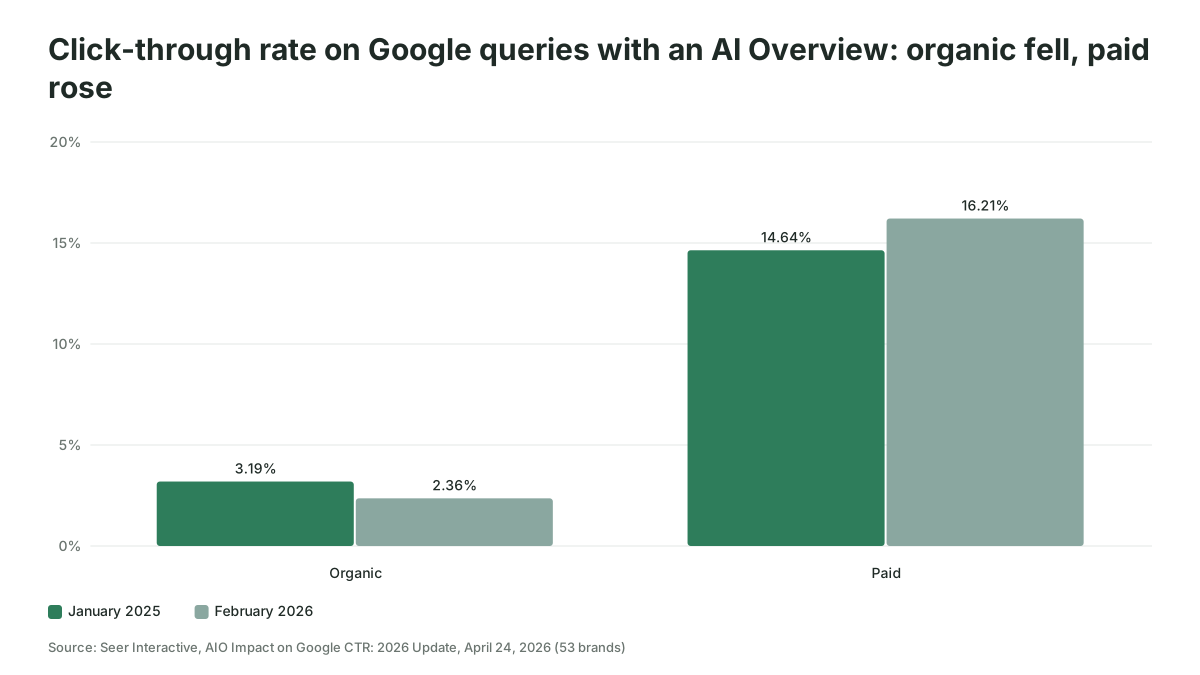
So the shrinking click is mostly an organic problem on Google, and paid has held up on these queries, staying in a band of roughly 13 to 16% through 2025 and into early 2026 by Seer's count. Paid click-through rate on queries without an AI Overview is still higher, 21.85% in February 2026, so as more of your research queries trigger an Overview, a campaign's blended paid click-through rate can slip anyway, which is the pattern in that monthly report. That's good news for your search budget and a warning for everything paid used to get for free from organic research traffic, such as retargeting pools and first-touch data.
B2B buyers are moving their research into AI tools as well. Forrester's John Buten wrote in January 2026 that the share of buyers using AI in their buying process grew to 94%, and that Forrester's 2025 Buyers' Journey Survey found generative AI and conversational search had become buyers' top source of information.
Budget calls that still rest on pipeline after the clicks thin out are the outcome Scalewell works toward with B2B demand gen leaders, starting from the reports their teams already pull.
Zero-click marketing changes three jobs paid media does
Zero-click marketing changes paid media's work in three places: paid search moves closer to the decision, LinkedIn ads have to make the argument without a click, and paid becomes the main way to measure influence you can no longer see in site traffic. Each one has a budget consequence, so take them in turn.
Paid search does more capture and less research
Paid search in a zero-click world earns its keep on the searches buyers run once they already have a shortlist: your brand, competitor names, pricing and "alternative to" terms. The research-stage queries still exist, but the AI answer now does much of the explaining, and Bain's Natasha Sommerfeld and Zak Prauer wrote in March 2025 that "85% of B2B buyers purchase from their 'day one' list," the vendors they had in mind before searching.
One public example shows what that looks like in an account. Digiday reported in July 2025 that the B2B commerce software company Commercetools saw its click-through rate fall 20% from November 2024, which it put down to Google's AI Overviews, while conversions held steady. Its CMO, Jen Jones, called the lower traffic the "new normal". The article doesn't say whether the drop was in organic or paid clicks, and it reads the steady conversions as a sign that the lost visitors were at the earliest stage of buying, while the buyers ready to talk still clicked.
That points to a decision rule for informational campaigns, which we'd apply before anyone cuts a budget line. Judge each research-stage campaign on cost per opportunity over at least a quarter, and ignore click-through rate on its own. If clicks fell and opportunities held, the campaign still produces pipeline at the same cost per opportunity and the lost clicks weren't buying anything, so leave it alone. If opportunities fell with the clicks, the answer engine has taken that job, and the money belongs somewhere the buyer still pays attention.
Microsoft's ads in Copilot are served from your existing Microsoft Advertising campaigns with no separate reporting, so the same cost per opportunity rule applies there, and our post on Microsoft Copilot ads covers what you can and can't see there.
LinkedIn ads have to make the argument inside the feed
A LinkedIn ad in a zero-click world has to deliver the whole point to someone who will never click it. That's zero click content in practice: the insight, the number and the reason to care sit in the ad itself, and the landing page becomes a bonus for the few who want more.
LinkedIn's own formats already work this way. Its document ads page says advertisers can "Allow members to read and download documents directly in their newsfeed" and can "decide whether to share your content freely or in exchange for their lead information" through a Lead Gen Form. Lead Gen Forms themselves keep the conversion on LinkedIn, and LinkedIn's blog says its "data shows that the average LinkedIn Lead Gen Form conversion rate is 13%", against a 4.02% Unbounce landing page average. That figure counts form fills, not pipeline, which matters a great deal later. Our guide to LinkedIn Lead Gen Forms covers routing those fills to sales.
Thought leader ads push the same way, since they sponsor an employee's native post. As of November 2026 they run only on the brand awareness, engagement and video views objectives, so they're built to be read in the feed rather than to send traffic, and our post on LinkedIn thought leader ads covers how to judge them on account pipeline.
You'll hear that LinkedIn punishes posts with links, and the evidence is less settled than the folklore. A Metricool study of over 577,000 company posts, reported by Search Engine Journal in April 2025, found posts with links got 13.57% more interactions and 4.90% more views. A 2026 LinkPost analysis of 358,000 posts, summarized by Ordinal, found linked posts reached a median of 448 impressions against 705 without links. LinkedIn's Laura Lorenzetti told Buffer that "Our algorithm is really focusing on the value and content that's being shared in the post." For paid, the argument barely matters, because you buy the impression either way. What matters is that the impression teaches the buyer something.
Paid becomes the measurement layer for what nobody clicks
Paid platforms, LinkedIn above all, now hold much of the evidence about buyers who never reach your site, because LinkedIn logs which companies saw and engaged with your ads and posts. Site analytics can't do that for a zero-click buyer. That makes paid the part of the program best placed to show whether your target accounts are hearing from you, which is a new job and a useful one when finance asks what the content budget bought.
There's a practical knock-on for retargeting. If fewer people visit, website retargeting pools shrink, and small B2B audiences hit LinkedIn's 300-member matched audience floor sooner. LinkedIn's Matched Audiences help page lists on-platform sources you can retarget instead, including members who "Engaged with your document ad", "Opened or submitted your Lead Gen Form" and "Viewed your video ad". You'll find them in Campaign Manager under Plan, then Audiences, with Matched selected.
Measuring paid when fewer clicks happen means counting accounts and opportunities
Paid media in a zero-click market is measured by whether target accounts saw and engaged with it, and whether those accounts went on to create opportunities. Clicks and sessions become a secondary check. Here's the scorecard we'd use, with where each number lives as of November 2026.
| Measure | What it tells you | Where to find it | Watch out for |
|---|---|---|---|
| Target accounts reached and engaged | Whether your account list is hearing from you at all | LinkedIn Campaign Manager: Plan, then Companies (Companies Hub), with organic and paid engagement by company | Engagement level is LinkedIn's scoring, not buying intent |
| View-through conversions | Conversions after an ad view with no click | LinkedIn: Measure, then Conversion tracking; the default window is 90-day click and 90-day view | Views over-credit ads shown to people who'd convert anyway |
| Pipeline and revenue touched by LinkedIn | Opportunities at accounts LinkedIn reached | Revenue Attribution Report in LinkedIn Business Manager, connected to HubSpot, Dynamics 365 or Salesforce | LinkedIn describes it as any-touch, so it overlaps every other channel's credit |
| Branded search impressions | Whether demand is growing even if visits don't | Google Ads search terms report and Google Search Console | Search Console mixes AI Overview data into the Web search type |
| Self-reported source | What buyers say brought them in, including AI tools and LinkedIn posts | A required free-text field on demo and contact forms, coded each month | Buyers remember the last thing, not the first |
| Cost per opportunity by channel | What each channel costs per real sales conversation | CRM opportunities joined to platform spend | Needs a full sales cycle before it settles |
| Incremental pipeline | Pipeline that wouldn't exist without the ads | An account holdout test | Needs enough accounts to conclude |
Three of those numbers come from LinkedIn's help pages. Companies Hub "provides company engagement and revenue data in a central location" and needs a Company Page linked to the ad account, plus a CRM connection for revenue. The conversion window page says "we recommend a 90-day click, 90-day view window, which is the default in Campaign Manager." And the Revenue Attribution Report reports revenue won, ROAS and pipeline from your CRM.
On the Google side, Google's AI features page says AI Overview and AI Mode traffic is reported "within the 'Web' search type" in Search Console, so there's no separate line to watch. That's why branded impressions and self-reported source carry more weight than they used to.
The honest catch is that the first three measures all flatter LinkedIn. View-through and any-touch attribution give credit to ads that may have changed nothing. Use them to see whether your accounts are being reached, and use a holdout to see whether reaching them created pipeline. Our guide to incrementality testing covers how to size one when the account list is small.
Timing matters as much as the measure. Dreamdata's March 10, 2026 release on its LinkedIn Ads Benchmarks Report puts the full B2B journey at 272 days. A scorecard read monthly will show reach and engagement moving long before opportunities do, so agree with finance up front which number you'll judge each quarter.
A hypothetical budget shift shows the decision rule at work
A hypothetical example makes the rule concrete. Imagine two B2B software companies, A and B, each spending its full, capped budget of $36,000 a quarter on Google Search campaigns built around comparison and "how to" queries. Last year each got 12 opportunities a quarter from those campaigns, a cost per opportunity of $3,000.
This year both see click-through rate on those campaigns fall by a quarter.
| Hypothetical | Spend per quarter | Opportunities last year | Opportunities this year | Cost per opportunity this year | Decision |
|---|---|---|---|---|---|
| Company A | $36,000 | 12 | 12 | $3,000 | Keep the budget; the lost clicks were early-stage |
| Company B | $36,000 | 12 | 6 | $6,000 | Move a third of the spend, $12,000, into LinkedIn document ads aimed at the same account list |
Company A's clicks fell, but its opportunities didn't, so cutting the campaign would remove pipeline to fix a vanity metric. For Company B, opportunities halved with the clicks, which says the answer engine now does that research job. So B keeps $24,000 a quarter on search, spends $12,000 on feed content that makes the argument without a click, and judges the move on two things: engaged target accounts in Companies Hub within the quarter, and opportunity rate against a holdout group of accounts over the next two quarters.
Neither company decided anything on organic traffic, and neither treated a LinkedIn engagement count as proof. That's the discipline zero-click asks for.
Zero-click planning goes wrong in four familiar ways
Most zero-click mistakes come from swapping one convenient number for another. These four come up most often.
- Cutting content because sessions fell. Content that answers buyer questions is what the AI answers draw on, and it feeds the feed formats above. Judge it on branded demand and opportunities, not visits.
- Moving everything behind Lead Gen Forms. A 13% form fill rate looks wonderful until sales calls the contacts. If you gate more, judge the forms on opportunities per thousand dollars, not fills.
- Calling view-through conversions proof. They show reach. Only a holdout shows cause, and a 90-day view window will credit LinkedIn with deals that were already moving.
- Reorganizing around link folklore. The studies disagree, and paid impressions are bought either way. Spend the energy on what the ad says.
There's also a quieter failure: nobody owns the scorecard. Each number lives in a different tool, so it gets pulled once for a board deck and then forgotten. Pulling it every week is exactly the sort of recurring job AI can take off the team's plate.
How Scalewell puts zero-click changes in a ranked order
The payoff is knowing which change to make first, with each judged on pipeline and AI handling the weekly pulls from LinkedIn, Google and the CRM. Following a free half-hour conversation, Scalewell maps your team's week, listing each recurring reporting and planning job, the data it touches and a score for where AI should start. The heart of the work is the ranked roadmap that follows, which puts the zero-click jobs in an order your team can absorb. The first jobs then get built in the ad accounts, CRM and dashboards your team already uses over a sprint that typically lasts 8 to 12 weeks, and your people learn to run and change them without Scalewell.
Where to start with zero-click marketing
This week, export your three largest research-stage search campaigns and put two quarters of clicks next to the opportunities they created, against the same quarters a year earlier. That one table tells you whether zero-click is costing you pipeline or only traffic. When you want to talk through which of those measurement jobs AI could take over, Scalewell offers a free call for exactly that conversation.
Frequently asked questions
Is zero-click marketing the same as answer engine optimization?
They overlap, but the scope differs. Answer engine optimization is one part of zero-click marketing: getting your brand cited inside AI answers. Zero-click marketing is the wider plan for buyers who never visit your site, so it also covers paid search, LinkedIn formats that work without a click, and how you measure influence through accounts and opportunities instead of sessions.
Is SEO still worth funding when most searches end without a click?
Yes, for most B2B companies, though it should be judged differently. Seer Interactive's April 2026 study found that brands cited in an AI Overview earned about 120% more organic clicks per impression than uncited brands on informational queries. Being the source still pays. Judge SEO on cited visibility, branded demand and opportunities rather than raw sessions.
How does Google Search Console count AI Overviews?
Google's Search Console help says that clicking a link to an external page in an AI Overview counts as a click, and an AI Overview occupies a single position in results, so every link inside it shares that position. The usual impression rules apply, and the data sits inside the Web search type with no separate AI Overview filter.
Should B2B companies stop gating content?
Not entirely, but gate less of it. Ungated content is what buyers and AI tools can read and repeat, and that's where a zero-click buyer forms a shortlist. Keep a form on assets whose value to sales outweighs the lost readers, such as benchmark data or tools, and check gated assets on opportunities created, not downloads.