B2B brand marketing when AI answers pick the shortlist
When AI assistants help write the vendor shortlist, B2B brand spend can be priced like any pipeline investment, by what each point of day-one shortlist presence is worth in bookings.

B2B brand marketing is the work of making your company a name buyers already know before they need you. Now that buyers ask AI assistants to suggest vendors, that memory decides whether you reach the shortlist at all, so brand spend belongs in the pipeline plan and should be judged on shortlist presence and win rate.
You've probably sat through the version of this meeting where brand loses. Finance asks what the awareness line produced last quarter, someone shows impressions and a video completion rate, and the line gets trimmed to fund another quarter of demand capture. It's an understandable call when brand can only report activity and demand capture reports opportunities.
Someone has to defend or cut that line, and it is usually the CMO. It shows why the shortlist now forms before sales hears from a buyer, why AI answers favor brands that already get talked about, and how to put a pipeline number on brand spend that finance can check. A brand budget decided on pipeline evidence, with AI keeping the shortlist tallies current each month, is what Scalewell sets up alongside B2B marketing and demand gen leaders.
The shortlist is set before a buyer ever talks to sales
Most B2B deals are decided by a list the buyer writes on their own. 6sense's 2026 B2B Buyer Experience Report, published in November 2026 and built on 3,596 completed purchase journeys, found that "the eventual winner was already on the Day 1 shortlist in 92% of journeys," and that "the pre-contact favorite ultimately wins 82% of the time" (6sense). The same report finds buyers first engage sellers "roughly 59% of the way through an average 10.3-month cycle."
Read those figures from the seller's side. If you aren't on the list the buyer writes before the first call, you're competing for the small share of deals that go to a late entrant, and your sales team often doesn't know the deal existed. 6sense sells intent data, so treat its numbers as vendor research, but the direction matches what most sales leaders say about deals they never saw.
The journey that leads to that list is long. Dreamdata's March 10, 2026 release on its LinkedIn benchmarks puts the full B2B customer journey at 272 days, with 88 touchpoints and 10 stakeholders on a typical deal (PR Newswire). Ten people, nine months, and one list that mostly decides the result: brand is whatever those ten people remember when the list gets written.

AI assistants now help write the B2B shortlist
AI chatbots have become the first stop for a large share of software buyers. G2's 2026 AI Search Insight Report, a survey of 1,076 B2B decision makers fielded in March 2026, found that "half (51%) now start their software research with an AI chatbot more often than Google," up from 29% in G2's 2025 survey (G2 2026, G2 2025). G2 also ranks AI chatbots as the top source influencing which vendors make buyer shortlists, named by 54% of respondents.
The figure that should worry you most is the next one. In the same survey, "69% report that AI chatbots have surfaced information that led them to choose a different vendor than expected." So the assistant adds and removes names on the list a buyer already had.
Forrester sees the same shift from the buying side. Its analyst John Buten wrote on January 22, 2026 that the share of business buyers using AI in their buying process grew to 94%, up from 89% a year earlier, and that 61% use private AI tools their organization provides (Forrester). That last point matters for measurement, because a private tool inside a buyer's company leaves no trace in anyone's referral report, which our article on the dark funnel takes up as a budget question.
Put the two studies side by side and the problem is clear. The shortlist decides most deals, and an assistant now helps write it. Whatever makes an assistant name your company is part of B2B brand building, whether or not your budget calls it that.
AI answers name the brands the web already talks about
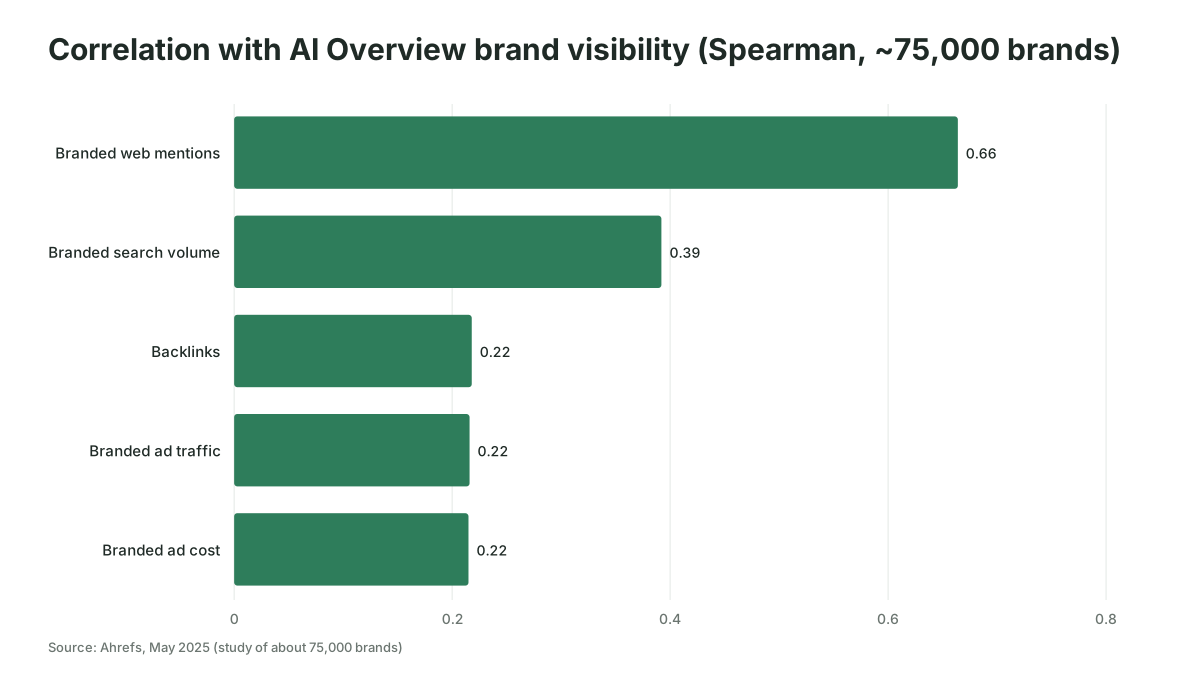
AI answers tend to name brands that other websites mention often. Ahrefs studied about 75,000 brands in May 2025 and found that branded web mentions had the strongest correlation with appearing in Google's AI Overviews, at 0.664, ahead of branded search volume at 0.392 and backlinks at 0.218 (Ahrefs). The gap at the top was steep: brands in the highest quartile for web mentions had a median of 169 AI Overview mentions, against 14 for the quartile below.
Two caveats keep that honest. It's a correlation, and Ahrefs says so plainly, and it covers Google's AI Overviews rather than ChatGPT or Claude. But it fits how these systems work: a model that retrieves and summarizes the web will name the companies the web discusses, and those are the companies with brand.
The finding that matters for a paid team is near the bottom of the list. Branded ad traffic correlated at 0.216 and branded ad cost at 0.215, among the weakest factors in the study. Bidding on your own name doesn't make an assistant think of you.
The work of earning those mentions and tracking how often assistants cite you is a content and PR job, and our guide to LLM visibility covers share of model and the citation work in detail. This article stays on the budget question underneath it: how much paid brand spend the shortlist justifies, and how you'd know.
B2B brand marketing becomes a pipeline decision once you price a shortlist point
Brand spend can be priced the same way as any pipeline investment once you treat shortlist presence as the outcome. The sum has four inputs you either have or can collect: how many buying processes start in your ICP each quarter, the share where you make the day-one list, your win rate when you're on it, and your average contract value.
Here's a hypothetical. A company sells to an ICP of 2,000 accounts at an average contract value of $60,000. LinkedIn's B2B Institute says research shows "95% of your potential buyers aren't ready to buy today" (LinkedIn B2B Institute), so assume the other 5%, about 100 accounts, are in a buying process in a given quarter. The company's sales team logs that it was on the day-one list for 30 of them and wins 20% of the deals it's in.
| Hypothetical scenario | Buying processes | On day-one list | Win rate when listed | Wins | Bookings at $60,000 |
|---|---|---|---|---|---|
| Today | 100 | 30% (30) | 20% | 6 | $360,000 |
| After a brand push | 100 | 45% (45) | 20% | 9 | $540,000 |
| Difference | 15 points | 3 | $180,000 a quarter |
With 100 processes, every point of shortlist presence is one more listed process, worth a 20% win rate times $60,000, or $12,000 in bookings a quarter. So an extra $100,000 a quarter of brand spend breaks even on bookings at a gain of about 8.3 points, before margin. That gives finance a number to test, and it gives you a target the brand plan has to hit.
The catch is time. With a journey that runs most of a year, the shortlist you're on this quarter reflects brand work from two or three quarters ago, so judge the line on a rolling basis and agree the lag with finance before the money goes out. We'd write that lag into the plan itself, because a brand line reviewed after one quarter will always look like it failed.
Deals you win without being on the day-one list are left out of the sum on purpose. 6sense's 92% figure says there aren't many of them, and counting them would flatter the baseline.
Five numbers tell you whether brand spend is reaching the shortlist
You can't run that sum without data your CRM probably doesn't hold yet. The scorecard below is what we'd collect, starting this quarter, so the next brand review has evidence instead of impressions.
| Measure | Where it comes from | Cadence | What a working brand line shows |
|---|---|---|---|
| Day-one shortlist presence | A required opportunity field in the CRM: "Were we on the buyer's list before first contact?" plus "Other vendors evaluated", filled in by the rep after discovery | Monthly, reported quarterly | The share of new opportunities answered "yes" rises over two to three quarters |
| Win rate, listed vs added late | Closed opportunities split by that same field | Quarterly | A clear gap in favor of listed deals, which is what makes each shortlist point worth money |
| Branded search demand | Google Search Console, Performance report for Search results, using the Branded filter | Monthly | Branded impressions and clicks grow faster than non-branded |
| ICP accounts reached on LinkedIn | Campaign Manager, Advertise page, Professional Demographics button, filtered to company name and exported as CSV | Monthly | A rising share of your target account list appears in the company breakdown |
| Self-reported source | A free-text "How did you hear about us?" field on demo and contact forms | Monthly | AI assistants, peers and LinkedIn content named more often |
The first two rows do most of the work, and they cost nothing but a field and a habit. They're also the rows most teams skip, because sales has to fill them in. A short AI job helps here: a model can read discovery call notes or transcripts each week, suggest the answer for each new opportunity and flag the ones where the rep left it blank, so ops checks a list instead of chasing people.
Google added the branded queries filter to Search Console in November 2025 and made it available to all eligible sites in March 2026; it classifies queries with an AI-assisted system and only works on top-level properties with enough search volume (Google Search Central). The LinkedIn breakdown covers members who interacted with your ads, so read it as a floor on reach (LinkedIn Help).
When you need proof that a specific campaign changed what people remember, run a survey test. Our guide to the brand lift study covers the platform minimums and how to line the result up against pipeline.
Fund brand from the whole ICP, with LinkedIn as the anchor
Brand budget in B2B paid media should reach the whole ICP, including the 95% not buying today, rather than only the accounts showing intent. The 2019 research by Les Binet and Peter Field for LinkedIn's B2B Institute found that "B2B businesses grow best when allocating 46% of budget to brand-building activity and 54% to activation marketing" (LinkedIn). Treat 46% as a reference point from their data, not a rule for your company.
LinkedIn is where most B2B teams can reach a buying committee by job function and company, so it's usually the anchor. Sponsored employee posts often carry more trust than company ads, and our guide to LinkedIn thought leader ads covers how to pick and judge them. YouTube and Meta can extend reach, but neither reports by the professional attributes your ICP is defined in, so judge them on the scorecard above and not on their own dashboards.
Keep brand and capture campaigns in separate lines with separate tests. Brand campaigns get judged on ICP reach and shortlist presence over quarters; capture campaigns get judged on cost per opportunity each month. When both share one line, the brand half always loses, because cost per lead is the easier number to read. Our article on B2B marketing budget allocation covers how to split the layers.
Brand spend is the wrong call for some B2B teams
Brand building only pays when the shortlist is the bottleneck, and for some teams it isn't. Before you fund a bigger line, check whether any of these describe you.
- Your market is a named list sales already covers. If you sell to 150 accounts and your reps know every buying group by name, the day-one list is mostly a sales relationship question, and account-based plays will do more than broad brand.
- You lose when you're on the list. If your win rate on listed deals is low, more shortlist presence buys more losses. Fix the product, pricing or sales motion first.
- You can't wait three quarters. A company that has to show pipeline this quarter to survive should spend on capture now and start the shortlist field so the brand case is ready later.
- Nobody will fill in the shortlist field. Without that data, brand stays a matter of opinion, and the line will be cut at the first bad quarter whatever it was doing.
- The creative wouldn't be remembered anyway. A brand budget spent on ads nobody could tell apart from a competitor's is the most expensive way to stay invisible.
There's also a measurement trap. Branded search and self-reported source both rise when sales and events are busy, so a good quarter for brand metrics can just be a good quarter. The shortlist field is the hardest to fake, which is why it sits at the top of the scorecard.
How Scalewell gets the brand tallies running before the next budget review
Walking into the budget review with shortlist share and listed win rate already counted is the gain Scalewell aims at for B2B marketing leaders. It begins with a free 30-minute conversation, and then the team's week is audited, covering recurring jobs such as tagging discovery notes or pulling branded search and LinkedIn company reach, and ranking where AI helps soonest.
The ranked roadmap matters most here, because it decides which brand measurement job is built first, weighed on hours saved and pipeline. The sprint that follows, usually 8 to 12 weeks, builds those jobs inside your existing CRM and reporting tools. Afterward your own people run and adjust the scorecard, with no need for Scalewell.
A brand line has earned its place when the shortlist numbers move
You'll know brand spend is working when three things happen inside a year. The share of new opportunities where you were on the day-one list rises, the win rate on those deals holds steady or improves, and branded search grows faster than non-branded search. If the shortlist share moves and the bookings sum clears the break-even you set with finance, keep the line and consider raising it. If two or three quarters pass and the shortlist field hasn't moved, change the creative or the audience before you change the budget, because a flat line usually means the ads weren't seen or weren't remembered.
Where to start
Add one required field to your CRM opportunity record this week, a custom deal property in HubSpot or a custom picklist on the Opportunity object in Salesforce: "Were we on the buyer's list before first contact?" After a quarter, split your win rate by the answer, and you'll have the first real input for pricing a shortlist point. If you'd like AI filling that field from call notes and keeping the rest of the scorecard current, Scalewell can help you decide which of those jobs to build first.
Frequently asked questions
What is the difference between B2B and B2C brand marketing?
B2B brand marketing reaches buying committees rather than individual shoppers, on cycles measured in months rather than minutes. Several people must remember you at once, the buyer often has to justify the choice to colleagues, and the result shows up as shortlist presence and win rate on large contracts rather than as a quick purchase.
Is B2B brand marketing the same as account-based marketing?
Not quite, because they do different jobs. Account-based marketing concentrates spend on a named list of accounts that sales is already working. Brand marketing reaches the wider ICP before any buying process starts, so the company is known when one begins. Most B2B teams run both, with separate budgets and separate measures of success.
Can a small B2B company afford brand marketing?
Yes, if it narrows the audience to its ICP rather than buying broad reach. A small company can run brand campaigns on LinkedIn against a defined list of industries and job functions, sponsor its founder's or experts' posts, and track the shortlist field from day one. What it shouldn't do is copy a large brand's channel mix.
What does B2B brand marketing include besides paid media?
It covers anything that makes buyers and the web talk about you: analyst briefings, press coverage, customer reviews, events, partner content and the posts your experts publish. Review sites matter here, because G2's 2026 survey ranks them the second source influencing vendor shortlists, named by 43% of respondents, behind AI chatbots.
Who should own the B2B brand budget, marketing or sales?
Marketing should own the budget, but sales should own the shortlist field that justifies it. The CMO sets the brand plan and its target, while sales leadership makes the day-one list question a required step after discovery, so both teams agree on the evidence before the next budget review.