The AI-first company and its marketing team: what changes in the week for paid and demand gen
In an AI-first company the paid and demand gen team reviews work AI jobs drafted, so the week, its rituals and each seat change, and every job needs a keeper, a runbook and a backup to keep running.

In an AI-first company, the paid and demand gen team stops doing recurring work by hand and starts reviewing it: AI jobs draft the weekly report, flag pacing drift and sort search terms before anyone logs in, and people spend the week on the calls those jobs raise about spend, creative and pipeline.
The phrase usually reaches the marketing floor as a memo. The CEO writes that the company is now AI-first, the all-hands nods along, and on Monday your head of paid opens the same five exports in the same order as last week. Nobody said what the team's week should look like instead, so it looks exactly the same, with a chat window open in another tab.
The hard part is turning that memo into a working week, and that is the job of whoever leads the team. It covers what the label means for a paid team, a before-and-after week, the rituals and seats that change, and how the team keeps the new week running once the launch energy fades. Company-level choices sit in our AI transformation strategy guide, hiring in how to build a B2B marketing team in an AI year, and the replacement question in the AI marketing team.
An AI-first company gives AI the first pass on recurring work
An AI-first company is one where AI gets the first attempt at recurring work by default, and a person has to explain why a repeated task still needs doing by hand. The label went mainstream in 2025. On April 28 that year, Duolingo posted an all-hands email from CEO Luis von Ahn on its LinkedIn page, declaring the company AI-first. Among the "constructive constraints" it listed: "Headcount will only be given if a team cannot automate more of their work" and "Most functions will have specific initiatives to fundamentally change how they work."
That second line is the part that lands on you. A memo can set the direction for a whole company, but only the function can decide what its own Tuesday looks like. For a B2B paid team, with long sales cycles, small audiences and a buying committee behind every opportunity, that redesign is specific and a little awkward, because the work that eats the week is mostly assembly: exports, joins, spreadsheets and status notes.
An AI-native company is the version built that way from day one, with no old habits to unwind. Most B2B marketing teams are the other kind, with years of account history, a CRM full of half-kept fields and a reporting ritual everyone knows by heart. For them, AI-native marketing is the destination and AI-first marketing is the rule that gets them there: every recurring job gets asked whether AI can do the first pass, and the answer gets written down.
Microsoft's 2025 Work Trend Index, a survey of 31,000 knowledge workers across 31 markets, describes the path in three phases. First, "AI acts as an assistant"; then "agents join teams as 'digital colleagues,' taking on specific tasks at human direction"; and finally "humans set direction for agents that run entire business processes and workflows." In a paid team, phase one is the chat window in the other tab. Phase two is where the week actually changes, because jobs start running on a schedule whether anyone remembers to open the tool or not. Phase three is where we'd slow down for anything that moves money, and the four decisions to keep signing on ad spend explains why.
More of the week spent on calls about spend and pipeline, with the AI jobs running quietly underneath, is the gain Scalewell helps paid and demand gen teams reach, and rebuilding the team's rituals around those jobs is the hard part.
The week moves from making outputs to reviewing them
The biggest change in an AI-first marketing team is where the hours sit: the assembly work moves to scheduled AI jobs, and people spend the time reading what those jobs produced and deciding what to do about it. Here's a typical week for a B2B paid and demand gen team, before and after.
| Day | Before: the team makes it | After: AI drafts it, the team decides |
|---|---|---|
| Monday | Pull exports from Google Ads, LinkedIn Campaign Manager, Meta and the CRM, then build the weekly report by hand | Read the drafted report and its exception list before a 30-minute review that ends in a short list of changes |
| Tuesday | Scroll the search terms report and update the pacing spreadsheet | Approve or reject the negative keywords the job drafted from Google Ads' search terms report (Campaigns, then Insights and reports, then Search terms); the pacing job speaks up only when spend drifts past an agreed limit, such as 10% off the monthly plan |
| Wednesday | Creative brainstorm from a blank page | Creative review starts from drafts already tagged by message, with last quarter's pipeline by message beside them |
| Thursday | Clean lead lists and upload matched audiences to LinkedIn | Check the audience job's log, which flags any list that matched too few members to run |
| Friday | Write the status update for the CMO from scratch | Update the decision log; the job keeper reviews the week's failed runs and rejected outputs |
The LinkedIn row is a good example of what a job should catch for you. LinkedIn's Matched Audiences best practices page says "The minimum ad set audience size is 300 member accounts and location is a required targeting facet." A small account list for a named-account program can fall under that floor once location narrows it, and a job that checks the Last audience count on the Audiences page in Campaign Manager after every upload saves you from a campaign that sits there approved and never delivers.
Notice what grows on the right of that table. Judgment is harder work than assembly, and a week of nothing but decisions is more tiring than a week of exports, which nobody mentions in the AI-first memo. We haven't found a credible published figure for how many hours this shift moves in a B2B paid team, so treat any vendor number you see as that vendor's claim and measure your own team's time before and after.
Four rituals change shape in an AI-first marketing team
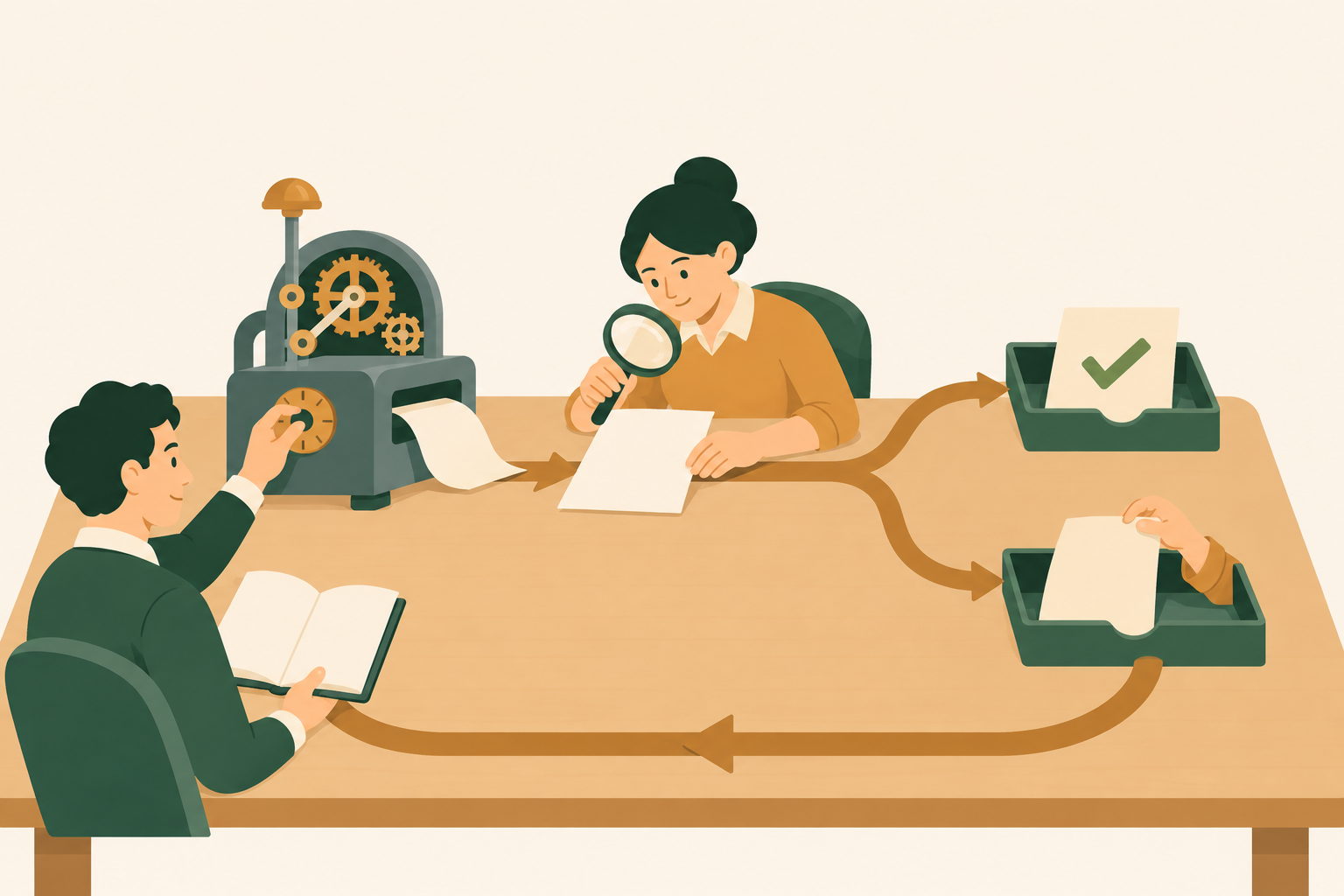
An AI-first marketing team keeps its meetings but changes what each one is for, because the material arrives already prepared. Four rituals change the most.
The Monday stand-up becomes an exception review. When the report is drafted overnight, nobody needs to walk the room through last week's numbers. The meeting starts from the exceptions the jobs flagged, such as spend drift, a campaign with clicks but no opportunities, or a LinkedIn audience that stopped delivering, and it ends when each exception has an owner and a decision.
The reporting meeting becomes a decision meeting. Everyone reads the report before the meeting, and the time goes on the two or three calls it raises. Write each call into a decision log with the date, the evidence and who made it. Three months later, that log is how you find out whether moving budget from Meta to LinkedIn was a good idea, rather than relying on whoever remembers it most confidently.
Creative review starts from a shortlist. AI can produce forty headlines in the time it takes to open a document, which means the scarce skill is choosing. The review becomes a selection against the messages that have produced pipeline before, plus one or two deliberate wildcards so the account doesn't converge on the same three phrases.
Test reviews follow rules agreed in advance. With a job reading results every week, the temptation to call a test early gets stronger, because the numbers are always right there. Agree the stopping rule and the result that would change your budget before the test starts, and let the weekly readout report against that rule.
These are the team's own rituals. The governance rhythm above them, with monthly job scorecards and quarterly re-ranking, belongs to the wider marketing operating model, and you'll want both.
Each seat keeps its title and changes its working day
Most seats on a paid and demand gen team keep their titles in an AI-first company, and what changes is the share of each day spent producing versus checking and deciding.
- The paid media specialist moves from building changes to reviewing changes a job drafted. Platform depth matters more here, because a fluent AI draft can be confidently wrong about how LinkedIn's targeting or Google's match types behave, and the specialist is the one who notices.
- The demand gen manager owns the decision log and the pipeline question, meaning which campaigns created opportunities that sales accepted, and makes sure every weekly call is judged on that.
- Marketing ops becomes the home of the job keepers, the seat our AI marketing team guide calls the AI workflow owner: the people who maintain the connections, read the run logs and fix a job when a platform changes something.
- The head of paid or demand gen sets the limits each job works within, such as how far spend can drift before a person is alerted, and signs the calls that move money.
The hand-offs between those seats get shorter, and there's research behind that. In a pre-registered field experiment with 776 professionals at Procter & Gamble, published as NBER working paper 33641 in April 2025, "individuals with AI matched the performance of teams without AI," and people using AI produced balanced solutions "regardless of their professional background." That study was on product innovation tasks, not ad accounts, so read it as a direction rather than a measurement for your team. In practice, a specialist with AI can draft a creative brief that used to need an analyst and a writer, which saves a round of meetings and also blurs who owns what. Naming one accountable owner per AI job is how you keep that blur from turning into nobody being accountable.
An AI-first team keeps running when every job has a keeper, a runbook and a backup
An AI-first team keeps working without outside help when each AI job is written down, owned by two people and built to fail loudly. The launch is the easy part. The hard part is month seven, when the person who set the job up is on leave, a platform renames a field and the Monday report quietly shows last week's numbers again.
Five habits keep the week running on its own:
- A one-page runbook per job. It says what the job does, which data it reads, when it runs, where the output lands, the limits it works within, what a failed run looks like and how to do the work by hand if the job is switched off.
- A keeper and a backup. Two people can change every job. If only one person knows how to edit a prompt, you have built a key-person risk and labelled it automation.
- A dated change log. Every change to a prompt, rule or limit gets a date, a reason and a name, so when results move you can tell whether the market changed or the job did.
- Jobs that fail loudly. A job that can't reach the CRM or an ad account should post that it failed, in the channel where the team works, instead of sending a report built on stale data.
- A monthly platform check. Google, Microsoft, Meta and LinkedIn all change their APIs, campaign types and audience rules through the year. The keeper spends one session a month reading the release notes for each platform the jobs touch and noting what needs updating.
The training that makes this possible happens on the team's own jobs and accounts, not in a generic course, and AI training for marketing teams lays out a curriculum by seat. Here's a simple test of whether you've got there: if the keeper of your reporting job took two weeks off, would the Monday review still happen, and could the backup fix a broken run? If the answer is no, the team is still running on one person's goodwill.
AI-first programs fail when they measure AI use instead of the work
AI-first programs in marketing go wrong when leaders count how much people use AI rather than whether the week changed and the decisions got better. Duolingo changed course on this in public. The 2025 memo said "AI use will be part of what we evaluate in performance reviews," and in April 2026, as Entrepreneur reported, von Ahn said AI use was no longer part of those reviews, explaining that "the most important thing in your performance is that you are doing whatever your job is as well as possible."
Three other failures come up often enough to plan for:
- The saved hours disappear into more output. If the hours AI frees go into more campaigns and more reports, the team is busier and the pipeline is the same. Decide in advance where the time goes, for example more tests that run to a conclusion or more time with sales on lead quality.
- Jobs without keepers rot. A job nobody owns keeps running until it's wrong, and then it keeps running anyway. Every job without a named keeper should be switched off until it has one.
- The memo arrives before the data. If the CRM can't tell you which leads became opportunities, AI jobs will make fast decisions on form fills. Fix the pipeline link first, or the new week just reaches the wrong answer sooner.
Who should wait? A team of two running one channel will get more from one well-kept job than from a reorganized week. And a team in the middle of a CRM migration should finish that first, because every job built now will need rebuilding afterwards.
How Scalewell helps a team keep its AI week running on its own
The gain is a paid and demand gen team that keeps its new week going after we've left, able to read a job's log, repair a failed run and add the next job. It opens with a free half-hour call. We then audit your team's week, listing every recurring job with the tools and data behind it and scoring which ones AI should take first, which sets a ranked roadmap. Then comes the build sprint: typically 8 to 12 weeks, occasionally more, with the first jobs going live in software your people use today. Training runs through all of it, so each job finishes with a keeper and a backup who run and change it without Scalewell.
Where to start
Pick the one recurring job your team complains about most, write its one-page runbook this week with a keeper and a backup named, and move its review into Monday's meeting as an exception item. If you'd like a B2B paid media practitioner to look over your week alongside you, a free 30-minute call with Scalewell is an easy place to begin.
Frequently asked questions
What is the difference between AI-first and AI-enabled?
An AI-enabled team has AI tools available and uses them when someone thinks to. An AI-first team has changed the default, so recurring work starts with an AI draft or a scheduled AI job and a person reviews it. The practical test is whether the work still happens on time when nobody remembers to open the tool.
Does an AI-first marketing team need a head of AI?
Most B2B marketing teams don't need a new executive title. They need someone accountable for the AI jobs as a set, often the head of marketing operations or the head of paid, with protected time for it. A separate head of AI makes more sense when several functions share the same jobs and data, which is a company decision.
How long does it take a marketing team to become AI-first?
There's no credible published benchmark, and it depends on data quality more than ambition. A better measure than the calendar is how many recurring jobs run every week with a keeper, a backup and a runbook. A team with one such job has started; a team where most of its weekly reporting and checks work that way is close.
What tools does an AI native marketing team use?
Mostly the tools it already has: the ad platforms, the CRM, a reporting tool and a shared workspace, plus an AI client connected to them. As of November 2026, Google, Microsoft, Meta and LinkedIn each offer some way for an AI client to read account data, with different limits on what it can change. The tool list matters less than who maintains each connection.
Is AI-first marketing a risk for brand and compliance?
It can be, if AI drafts reach the public without review. The usual safeguard is a written rule that people sign off anything carrying a claim, a price, a customer name or a regulated statement, plus limits on what any job can change in an ad account. With those rules in place, AI-first mostly speeds up drafts, and sign-off stays where it was.