Vibe marketing for B2B: what's real for a paid and demand gen team
For a B2B paid and demand gen team, vibe marketing comes down to small AI jobs your own people build, run every week and judge on pipeline.

Vibe marketing means building marketing work by describing what you want to an AI tool and letting it write the copy, the workflow or the small app. For a B2B paid and demand gen team, the real part is narrower: small AI jobs your own people build, run weekly and judge on pipeline.
Picture the message that starts this. Your CEO forwards a post claiming one marketer with AI agents now does the work of a whole team, with a single line on top: what's our plan for this? You run a LinkedIn budget against an audience of a few thousand accounts and a sales cycle measured in quarters, and you aren't sure the post was written with you in mind.
It mostly wasn't. This article traces where the term came from, separates the two meanings that share page one of Google, and explains why most of the advice assumes consumer volumes. Then it lists the jobs that hold up in a B2B account, the bar a vibe-built job has to clear, and where it goes wrong. It's written for the CMO or head of demand gen deciding whether to back it, and how far.
Vibe marketing borrowed its name from vibe coding in early 2025
Vibe marketing is a spin-off of vibe coding, a phrase Andrej Karpathy, an OpenAI co-founder, used in a post on X on February 2, 2025. He described a way of programming where you "fully give in to the vibes, embrace exponentials, and forget that the code even exists," as the Wikipedia entry on vibe coding quotes him. By November 6, 2025, Collins Dictionary had named vibe coding its word of the year, defined as "the use of artificial intelligence prompted by a natural language to assist with the writing of computer code."
The marketing version spread in late March 2025. Greg Isenberg, CEO of Late Checkout, opened a LinkedIn post with "Remember how VIBE CODING (replit, bolt, lovable) transformed 8-week development cycles into 2-day sprints?" and argued that one marketer with AI agents and automated workflows could now replace a team of specialists. Scott Brinker, who edits chiefmartec, wrote in August 2025: "I think Greg Isenberg gets credit as the first person to coin the phrase."
Search for the term today and you'll find two different ideas wearing the same name. Salesforce's guide for startups, published October 22, 2025, defines it as "creating an emotion around a brand" rather than pushing products, which is brand marketing with a new label. Klaviyo's CMO Jamie Domenici, writing on March 24, 2026, uses the AI meaning: "You start with intent, not process." Her examples are consumer ones, such as a win-back campaign for shoppers who haven't bought in 90 days.
We'd use the AI meaning, because it's the one that changes how a paid team spends its week. The emotional-brand meaning is a real discipline, but it already has a name.
For a B2B team, vibe marketing means small AI jobs the team builds and runs itself
Vibe marketing in a B2B paid team is a person describing one recurring task in plain language, having an AI tool build the script, skill or workflow that does it, and then running that job every week. The job has one input, one output and one named owner. A search term review that drafts negative keywords every Monday counts. A "marketing agent" that is supposed to run the whole account does not. Paid teams are already doing this: in the Global State of PPC 2026 survey of 1,306 PPC professionals, fielded in November and December 2025, 22% said they were vibe coding custom tools and scripts, according to PPC Chief's summary.
A team that gets hours back every week from jobs it built itself is the outcome Scalewell aims for with B2B paid and demand gen leaders, and the hard part is getting a prototype to run on schedule without the person who built it.
The vibe marketer, in this reading, is whoever on your team builds these jobs. They work in tools such as Claude, ChatGPT or Claude Code, and they need to understand the account well enough to tell when the output is wrong. Our guide to Claude Code for marketing covers what that looks like for people who don't code.
Drop Isenberg's headline claim, though. One marketer replacing a team may suit a founder selling a consumer app. In a B2B account someone still signs off budget moves, product claims and what sales is told about lead quality, and those calls carry the same weight whether a script or a person prepared the numbers.
Most vibe marketing advice assumes B2C volumes that B2B accounts don't have
Most published vibe marketing advice assumes you can run many fast, cheap tests and let the results pick winners. Brinker's own view is "To me, vibe marketing should be about experimentation," with lots of quick, cheap bets, the promising ones iterated, the proven ones scaled and the duds dropped. Domenici's piece imagines a team that ran 3 campaigns a month running 15. Both work when thousands of people convert every week.
B2B accounts rarely have that. LinkedIn's audience size guidance says "The minimum audience size required for an ad set is 300 member accounts" and suggests 50,000 to drive results. A tightly defined ICP can sit much closer to the 300 floor than to the 50,000 suggestion, so splitting it into fifteen campaigns leaves each one too thin to learn anything. And the outcome you care about shows up late: Dreamdata's LinkedIn Ads Benchmarks Report 2026, released March 10, 2026, puts the full B2B customer journey at 272 days with 10 stakeholders involved.
So what does the speed buy you, if more campaigns won't conclude? It buys back the work around the campaigns. Reporting, pacing, search term reviews, lead routing, pre-launch checks and briefs all recur every week regardless of audience size, and none of them needs a statistically significant test to be worth doing faster. That's where vibe marketing pays off for a B2B team.
Eight jobs a B2B paid team can vibe-build and run every week
The jobs below are small enough for one person to build and own, recur often enough to be worth building, and leave the real decision with a person. Our ranked list of which paid media tasks to automate first covers the order in more depth.
| Job | Where it runs | What it reads | What a person still decides |
|---|---|---|---|
| Search term review | Google Ads, Microsoft Advertising | Search terms report, converting queries | Which negatives go live |
| Budget pacing alert | Google Ads, Microsoft Advertising, LinkedIn | Spend to date against the monthly plan | Whether to move budget |
| Weekly summary in pipeline terms | Ad platforms plus CRM | Spend, opportunities, stage changes | What to tell leadership |
| Lead Gen Form check and routing | LinkedIn plus CRM | New form fills, ICP fit fields | Which leads sales calls first |
| Pre-launch tracking check | All platforms | Final URLs, UTM tags, conversion settings | Go or no go on launch |
| Creative fatigue check | LinkedIn, Meta | Frequency and CTR trend by ad | When to swap creative |
| Competitor ad scan | LinkedIn Ad Library, Meta Ad Library, Google Ads Transparency Center | Rivals' live ads | What to respond to |
| Brief from last month's results | Ad platforms plus CRM | Ad-level results joined to opportunities | Which creative gets made |
Google Ads is the easiest place to start, because scripts run inside the account. You'll find them under Tools, then Bulk actions, then Scripts, where a script can be set to run once, daily, weekly or monthly at a set hour, according to Google's help page. Each run is capped at 30 minutes, per the scripts limits page. An AI model can write the script from a plain description, and our guide to Google Ads scripts with AI shows how; the weekly negative keyword review is a good first one.
LinkedIn has no scripts inside Campaign Manager, so jobs reach it through the Marketing API or an AI connector. As of November 2026, LinkedIn's access page says every app approved for the Advertising API starts on its Development tier, which reads all ad accounts you administer and can edit up to five. That covers a company with five or fewer accounts to edit. Form fills come through the separate Lead Sync API, which is how the routing job in the table gets its data; our guide to LinkedIn Lead Gen Forms covers qualifying every fill.
Notice what the table leaves out. Nothing in it changes bids, launches campaigns or rewrites audiences on its own, and that's deliberate for a first round.
A vibe-built job counts once it runs on schedule, has an owner and a pipeline check
A vibe-built job is real when it runs on a schedule without its builder pressing a button, has a named owner who reads the output, writes somewhere the team already looks, and is checked against pipeline at least once a quarter. A prototype that impressed the team in a demo and then sat in someone's chat history doesn't meet any of those four tests.
Take two hypothetical teams that build the same search term job in the same afternoon. Company A's specialist runs it when she remembers, pastes the output into a message, and stops when she goes on vacation. Company B schedules the script for 7 a.m. every Monday, writes the suggested negatives to a shared sheet, names the paid lead as owner, and has the script log what it suggested and what was accepted. Six months later, only Company B can say whether the job still works.
There's a second reason to write the check down: people misjudge how much AI helps them. In METR's early-2025 study of 16 experienced developers working 246 real tasks, the developers expected AI to make them 24% faster and still believed afterward it had made them 20% faster. Measured against tasks done without AI, they took 19% longer.
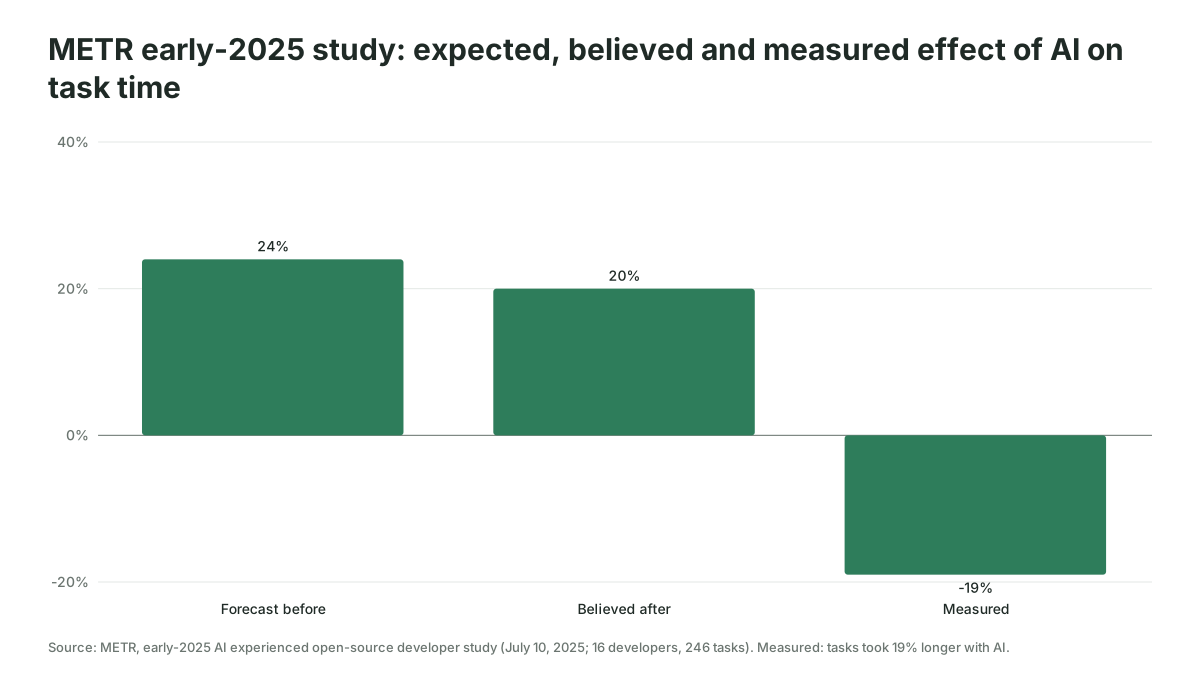
METR's February 2026 update on late-2025 tools points the other way, with a likely speedup, but METR calls that data "an unreliable signal" because of who agreed to take part. For a marketing team the lesson is plain: time the manual version of the job for a few weeks before you build, then time the review of the AI output after. The difference is your number, and it beats anyone's impression of how much faster things feel.
The pipeline check matters for a different reason. A job that drafts negatives can quietly exclude the long, odd queries that your best opportunities came from. Once a quarter, compare the queries, leads or ads the job touched against opportunities in the CRM, and keep the job only if it hasn't moved pipeline the wrong way.
Vibe marketing goes wrong when a prototype gets write access to spend
The biggest risk in vibe marketing for a B2B team is a job built in an afternoon that can change bids, budgets or audiences without a person signing off. Google Ads asks you to authorize a script to make changes before you preview or run it, and that authorization is the moment to stop and ask whether the job needs to write at all. Start every job read-only, use Preview, and give it write access only after its suggestions have been accepted unchanged for at least four weekly runs in a row.
The code itself can be weak in ways a marketer won't see. In Veracode's 2025 GenAI Code Security Report, 45% of code samples from more than 100 models failed security tests and introduced OWASP Top 10 vulnerabilities. A script that only reads a search terms report carries little risk. A small app holding an API token for your CRM and your LinkedIn account deserves a review from someone in IT before it runs on a schedule.
Three quieter failures are more common. Jobs get orphaned when the builder changes role, because nobody else knows the script exists or what it does. Jobs get judged on the wrong number, such as form fills, which is how a lead routing job ends up praised for volume that sales never works. And jobs that write ad copy can produce claims legal never approved, so anything that touches what the market reads goes through the same review as human copy.
Vibe marketing also isn't for every team yet. If opportunities in your CRM can't be traced back to campaigns, the pipeline check has nothing to read, and you'd get more from fixing that connection first. Our piece on taking an AI pilot to production covers what usually stalls teams at that point.
How Scalewell gets vibe-built jobs running every week without their builder
Scalewell's aim here is a paid team whose weekly checks run on their own, so the people who built them can spend Monday on decisions. You'd book a free 30-minute call first. An audit then maps every recurring job in the team's week and scores which ones AI should take first, and a ranked roadmap sets their order. The build sprint is where prototypes get rebuilt to the standard above, with schedules, owners, logs and a pipeline check, in the ad accounts, CRM and reports you already run. The sprint typically runs 8 to 12 weeks, sometimes longer. By the end, your team can change any of those jobs, or add the next one, without calling Scalewell.
Where to start with vibe marketing
Pick the one job someone on your team does by hand every Monday, time it for the next three weeks, and then have that person describe it to an AI tool and build a read-only version. If the reviewed output takes less time than the manual job and nothing in pipeline moves the wrong way, schedule it and name an owner. If you'd like a second pair of hands turning a handful of prototypes into jobs the team trusts, that's the kind of work Scalewell takes on with B2B paid teams.
Frequently asked questions
What is the difference between vibe marketing and vibe coding?
Vibe coding is describing software to an AI model and accepting the code it writes, often without reading every line. Vibe marketing applies the same habit to marketing work: describing a campaign, a report or a workflow and letting AI build it. In practice, a paid team's vibe marketing often involves some vibe coding, because many useful jobs are small scripts.
Do you need to know how to code to do vibe marketing?
No, but you need to know what correct output looks like. AI tools will write a Google Ads script or a spreadsheet formula from a plain description, and they'll also write one that runs without errors and does the wrong thing. The safeguard is domain knowledge plus a test on last month's data where you already know the answer.
Should a B2B company hire a vibe marketer?
Usually not as a separate role. The people best placed to build these jobs already run the accounts, because they know which numbers look wrong. A better move is giving one paid specialist or marketing ops person protected time to build and own a few jobs, then judging the result on hours saved and pipeline before adding headcount.
What tools do vibe marketers use?
Most use a general AI assistant such as Claude or ChatGPT to plan and write, plus an app builder or coding tool such as Claude Code, Cursor, Replit, Bolt or Lovable for anything that needs to run. Automation tools such as Zapier or n8n connect the pieces. Pick tools your IT team will approve to hold ad and CRM credentials.
Is vibe marketing just a passing buzzword?
The label may fade, as most marketing labels do, but the habit behind it is likely to stay. Describing work to an AI tool and getting a working draft back is now ordinary in many teams. What separates teams over time is whether those drafts become owned, measured jobs or stay as one-off experiments in someone's chat history.