Message testing before paid spend: where AI shortens it and where it can't
A pre-launch message test in five stages, where AI shortens the gathering, drafting and coding, real buyers decide belief and relevance, and a small panel is read for failures rather than winners.

Message testing means checking, before any ad budget goes out, whether the buyers you target understand, believe and care about each candidate message, so you fund only the ones that hold up. AI now shortens most of that work, from drafting candidates to coding responses, but it can't stand in for hearing from real buyers.
Picture the planning meeting before a launch. Product marketing has four positioning lines on a slide, sales likes the third, the CEO likes the first, and the paid team is about to put a quarter's LinkedIn budget behind whichever one wins the room. Someone suggests "letting the market decide," and nobody asks how many months and how many dollars the market will want for that answer.
If you sign off that spend, the test before launch is your cheapest insurance. It covers why the message decision belongs before launch in B2B, where AI cuts the time and cost of a pre-launch test, where it can't replace buyer input, how to read a small panel, and a hypothetical funding decision with the arithmetic shown. In-market creative tests have their own guide, on AI creative testing, so this one stops at the launch.
B2B message testing has to happen before launch because the market answers too slowly
Message testing belongs before paid spend in B2B because in-market results on pipeline arrive months after the budget is gone, and the buyers form their view early. 6sense's 2025 Buyer Experience Report, a survey of more than 4,000 buyers released November 12, 2025, found that 94% of buying groups ranked preferred vendors before first contact and bought from that early favorite 77% of the time. Whatever your ads said before that first contact had every chance to shape the ranking.
The time it takes to see pipeline is the second problem. Dreamdata's LinkedIn Ads Benchmarks Report 2026, released March 10, 2026, puts the full B2B journey at 272 days and the buying group at 10 stakeholders. If you launch four messages and wait for opportunities to tell you which one worked, you're reading the answer in the next fiscal year.
The platforms' own test tools don't rescue you either. LinkedIn's formal A/B test needs an audience of at least 1,000,000 per variant, according to its A/B testing API documentation, and runs for 2 weeks to 90 days, per Campaign Manager's help page. A tightly targeted ICP of 60,000 people at named accounts can't run one at all, and the creative testing guide linked above covers what to do instead once you launch. In-market tests are still worth doing once you've launched, but they're a poor way to choose your starting message.
Pre-launch message testing runs in five stages, and AI shortens four of them
A pre-launch message test moves from raw buyer language to a funded shortlist in five stages: gather what buyers already say, draft candidate messages, screen out the weak ones, test the finalists with real buyers, and fund the survivors. When AI takes the gathering, drafting and coding off the team, the test finishes inside the planning window, and Scalewell works with demand gen teams to turn that pre-launch check into a routine step before each launch, instead of a research project someone books once a year.
| Stage | The question it answers | What AI does | What still needs people or buyers |
|---|---|---|---|
| 1. Gather buyer language | What do buyers already say about the problem? | Pulls phrases, objections and comparisons from call transcripts, win/loss notes, reviews and competitor ads | Someone decides which sources represent the ICP |
| 2. Draft candidates | Which distinct messages are worth testing? | Writes candidates to a fixed hierarchy, each one a different claim | Product marketing picks claims the product can back |
| 3. Screen | Which candidates are confusing, generic or indistinct from rivals? | Flags jargon, scores clarity, checks overlap with competitor wording, runs a synthetic pre-screen | A person kills or keeps; nothing is ruled in here |
| 4. Test with buyers | Do people in the target roles understand, believe and care? | Codes open-ended answers and summarizes them by role | Real respondents from the ICP, nothing else |
| 5. Fund | Which two messages get paid budget, and what will the in-market test measure? | Drafts the in-market test plan and the sample size sums | The budget owner decides |
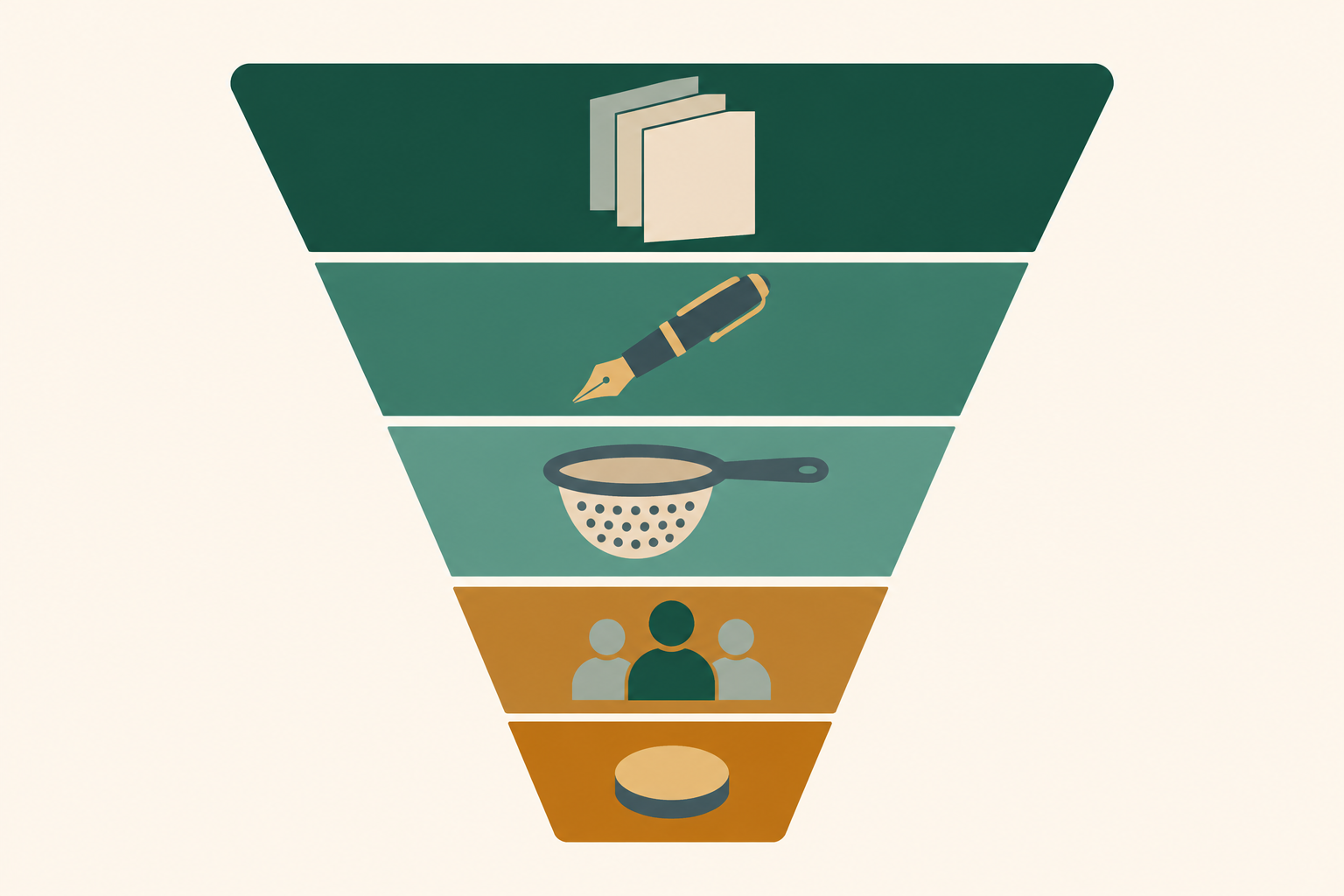
Stages 1 and 3 used to eat the most reading time, and they're exactly the stages AI now compresses. The buyer answers at stage 4 are the one input AI can't supply, and they decide the money.
AI shortens the gathering, drafting and coding work
AI's biggest time saving in message testing is turning a pile of buyer language into candidate messages and then into a readable summary of what buyers said. Each of these used to mean someone reading transcripts with a highlighter.
Gathering. Export the last quarter of sales call transcripts and win/loss notes, and ask a model to list the exact phrases buyers use for the problem, the objections they raise and the alternatives they name, with a count for each. Buyers' own words beat the ones in your positioning deck, and a model doesn't get bored on transcript forty. Add what competitors are saying in their ads, which our guide to AI competitor analysis shows how to collect and tag, so you can see which claims are already crowded.
Drafting. Give the model a message hierarchy (one core claim, three supporting points, one proof) and ask for candidates that each make a different core claim. Six to ten distinct candidates is plenty. Twenty versions of the same claim with different adjectives is a copy exercise, and AI creative brief generator covers how the winning message later becomes a brief.
You are helping plan a B2B message test before a paid launch.
Attached: buyer phrases and objections (with counts), our product facts, and competitor claims.
Write 8 candidate messages. Each must make a DIFFERENT core claim, use buyer phrases where possible,
and include one proof point taken only from the product facts. For each, list:
the core claim, the objection it answers, and the closest competitor claim.
Flag any candidate whose core claim appears in two or more competitor ads.
Coding. Once real buyers have answered, AI codes their open-ended replies into themes (confused by a term, doubts a claim, sees it as irrelevant to the role) and splits them by role. A person should still read every verbatim for the finalists, because that's where you find the objection nobody predicted.
Real buyers are still the only test of belief and relevance
AI can tell you a message is unclear or sounds like everyone else, but only people in your ICP can tell you whether they believe it and whether it matters to their job. That distinction is where most AI message testing claims overreach.
Synthetic respondents, meaning AI personas that answer as your buyers would, have some evidence behind them: Bain & Company reported on May 4, 2026 that its digital twins replicated about 90% of key outcomes of a prior consumer technology conjoint study. Bain also warns that in B2B "there may be too few key customers, such as CFOs in a single industry, to reliably sample," and advises using synthetic customers "as an augmentation layer to narrow options." We'd read that as permission to screen with them and nothing more. Our separate post on synthetic audiences covers how those panels are built and where they break.
Three things in particular need real buyers:
- Belief. A model tends to rate a confident claim as credible because it reads well. A head of IT security who has heard "zero-touch" from five vendors rates it as noise.
- Relevance by role. With around 10 people in a buying group, the message that lands with the practitioner can leave the CFO cold. You need answers from each role you plan to target in paid, not one averaged persona.
- Anything new. If your message describes a category or a pricing model that didn't exist in the training data, a synthetic panel has nothing to anchor on.
The rule we'd use is simple: AI can rule a message out, but only buyers can rule one in.
A 30-person panel finds big misses, not small differences
A pre-launch buyer panel of 15 to 30 people tells you whether a message is understood and credible, and it can't separate two messages that score a few points apart. Wynter, one of several vendors that run B2B message tests and named here only as an example, says on its message testing page that "15 is the minimum, 30 is what I recommend," drawn from a panel it put at 86,000+ verified B2B professionals as of November 2026.
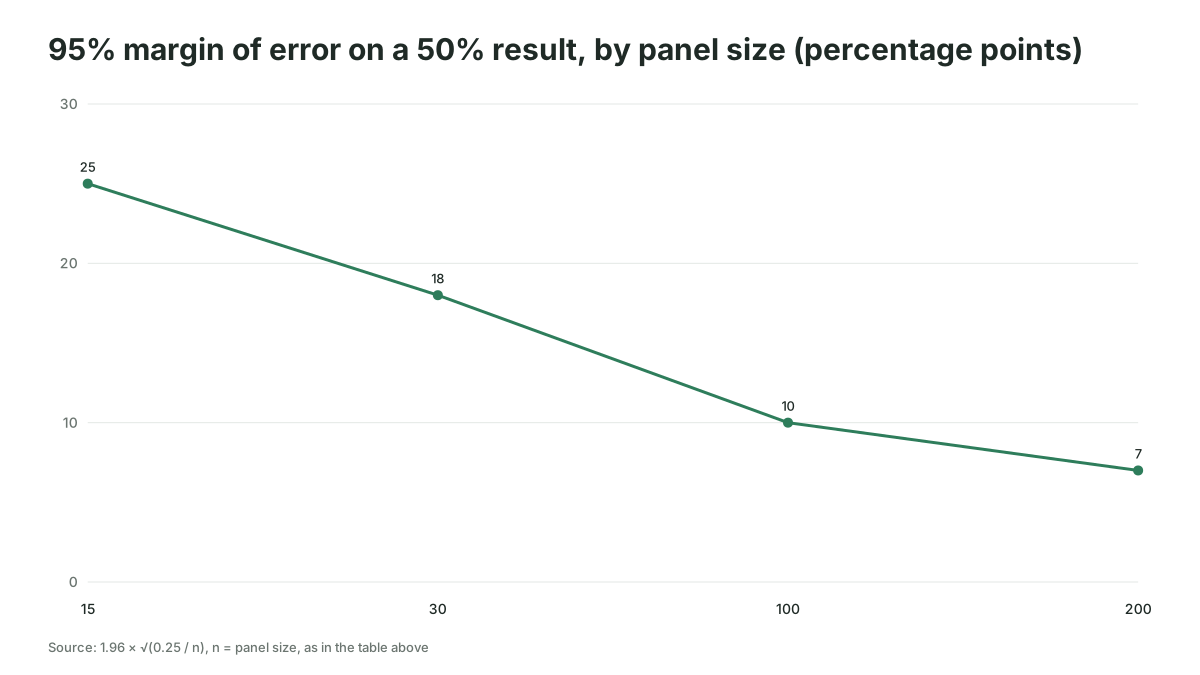
The arithmetic explains why that size is fine for some questions and useless for others. For a yes or no question, such as "could you explain what this product does?", the 95% margin of error on a 50% result is about plus or minus 25 points with 15 people and about 18 points with 30. If 80% of a 30-person panel can't restate your core claim, you've found a real problem. If Message A scores 62% and Message B scores 55%, you've found nothing.
| Panel size | 95% margin of error on a 50% result | What it can detect |
|---|---|---|
| 15 | plus or minus 25 points | Only a message most people misread or reject |
| 30 | plus or minus 18 points | A clear failure on clarity or credibility |
| 100 | plus or minus 10 points | A sizable gap between two messages |
| 200 | plus or minus 7 points | A moderate gap between two messages |
Wynter's own guide draws the distinction this way: "A/B testing is a measurement methodology. Message testing is a diagnostics exercise," from its guide to message testing. So set pass and fail rules before the panel runs. We'd fund a message when at least two-thirds of the respondents in the target role restate the core benefit in their own words and fewer than a third call the main claim hard to believe. A message that fails either rule goes back to drafting, whatever the CEO thinks of it.
A hypothetical funding decision: four messages, one launch, one ICP
The point of message testing is a budget decision, so here is one worked through. This example is hypothetical.
Imagine a company selling compliance software to mid-market manufacturers. Its LinkedIn ICP is 60,000 people at named accounts, too small for LinkedIn's formal A/B test at 1,000,000 per variant. Product marketing has four candidate messages.
- AI screen. The team gives the model a quarter of call transcripts and competitor ads, and it flags Message 1 as near-identical to two competitors' headlines and Message 4 as built on a term buyers never used in calls. A product marketer reads the flags, agrees on Message 1, and keeps Message 4 because the term is new on purpose.
- Buyer panel. Three messages go to a panel of 30 respondents each, drawn from the two target roles, compliance leads and operations directors. As of November 2026, one vendor, Wynter, starts pay-as-you-go tests at $899 and prices each test with a calculator; assuming one test per message at that starting price, three tests cost at least 3 × $899 = $2,697, and screening for two specific roles may push each test above the floor.
- Readout. Message 4 fails: fewer than half the operations directors can restate it. Messages 2 and 3 both pass, with 77% and 70% restating the benefit (23 and 21 of 30). That 7-point gap is well inside the margin of error for 30 people, so the panel hasn't picked a winner, and it shouldn't pretend to.
- Funding. Both survivors go live on LinkedIn in one ad set, with Rotate ads evenly chosen under ad rotation when you create or edit the ad set, with the in-market comparison set up as described in the AI creative testing guide. The team now spends its launch budget comparing two messages that buyers understood, instead of four of which one was confusing and one sounded like the competition.
The value lies in what didn't happen. No budget went to Message 1 or Message 4, and nobody had to wait two quarters of pipeline to learn that.
Message tests go wrong in four predictable ways
Pre-launch message tests fail when the candidates are too similar, the panel is wrong, the synthetic screen is treated as a verdict, or the message is tested apart from what follows the click.
- Testing adjectives. Candidates that share a core claim produce scores inside the margin of error, and the team reads noise as preference. Make each candidate a different claim.
- The wrong respondents. A panel of marketers rating a message aimed at plant managers tells you what marketers think. Match the panel to the roles you'll target in Campaign Manager, by function and seniority.
- Synthetic results as the answer. A synthetic panel that likes a message is a reason to test it with buyers, not a reason to fund it.
- The message without its page. A message that wins on a slide can fail beside a gated demo form. Test the headline the buyer will see after the click too, using our guide to B2B landing pages for what each offer's page needs.
There's also a quieter failure: the panel kills the CEO's favorite and the favorite launches anyway. If the pass and fail rules aren't agreed in writing before the panel runs, they tend to get reinterpreted after it.
How Scalewell makes a buyer-tested message part of every launch
When AI handles the transcript reading, the drafting and the coding, every launch can start on a message buyers have already checked, without stretching the planning calendar. Step one is a free half-hour call. Next comes a review of how your team spends its week: each recurring job, message testing included, gets scored for how much AI should take, and the scores become a ranked roadmap.
Most of the value sits in the build sprint, which typically takes 8 to 12 weeks (occasionally more), where B2B paid media practitioners set up those jobs in the CRM, call recorder and research tools you already use. After that, the whole test is something your own people run and change.
Where to start
Pull last quarter's call transcripts and win/loss notes before your next launch, and ask a model for the phrases, objections and alternatives buyers named, with counts. Hold your current positioning lines against that list, and you'll see which ones use the buyer's words and which use yours. If you'd like help making that a standing step before every launch, book Scalewell's free half-hour call.
Frequently asked questions
How much does B2B message testing cost?
Costs range from close to nothing for interviews with existing customers to several thousand dollars for a panel of verified buyers. As one example, as of November 2026 Wynter lists pay-as-you-go message tests from $899 and annual plans from $20,000 a year, and says tests cost 50% more without a subscription.
What is the difference between message testing and concept testing?
Concept testing asks whether people want a product or offer at all, usually before it exists. Message testing assumes the product is set and asks which way of describing it buyers understand, believe and care about. In B2B, concept testing tends to sit with product teams and message testing with product marketing and demand gen.
Can I run message testing with my own customers instead of a panel?
Yes, and existing customers are good at telling you whether a claim is true. They're weaker at telling you how a cold prospect reacts, because they already know the product. Use customers for credibility checks and a panel or prospect interviews for first impressions, and keep the two sets of results apart.
How long does a message test take?
A panel test with a vendor can return results within 12 to 48 hours; that is the range one vendor, Wynter, gives on its pricing page as of November 2026. The slower parts are gathering buyer language, drafting candidates and agreeing pass and fail rules, which is where AI saves the most time.
Should I message test on LinkedIn organic posts before paying?
Organic posts are a weak test because your followers are rarely a clean sample of your ICP, and likes don't tell you who understood or believed the claim. A post that does well tells you the message interests your network. Treat it as a screen at stage 3, never as the buyer test.