Agentic advertising: how much of your B2B ad buying to hand to platform agents
Platform agents already run much of a B2B ad budget by default, so this article gives a three-test rule, a filled-in scorecard and a quarterly step plan for deciding how much buying to hand over when the board measures pipeline.

Agentic advertising means letting an ad platform's own AI choose your queries, audiences, creative, bids and budget pacing. For a B2B team judged on pipeline, hand a platform agent a campaign only when it learns from a CRM stage you send back, that stage lands inside its attribution window, and you can compare it with a control.
You've probably heard the question in a board prep meeting. The CEO has read that Meta's assistant will soon plan and create campaigns from a chat, and asks, in an imagined but familiar exchange, "If the platforms run the buying, what is the paid team for?" The honest answer is awkward: a good share of your budget is probably agent-run already, and nobody chose which share. Spend decisions the board can trace to pipeline, with the team's hours going to the calls a platform agent can't make, are what Scalewell builds with B2B paid and demand gen teams before more of the buying moves to platform agents.
Setting that share is a leadership call, so what follows is written for whoever makes it. It shows what each platform's agent controls as of November 2026, gives a three-test rule for handing over a campaign, fills in a scorecard, and shows how to grow the agent-run share in steps a board can follow.
Agentic advertising here means the platforms' agents buying for you
Agentic advertising, in this article, is the AI inside Google Ads, Meta Ads Manager, LinkedIn Campaign Manager and Microsoft Advertising making buying decisions that a media buyer used to make. That's different from the agents your own team builds to report, audit and propose changes, which we cover in agentic marketing for paid teams. Our guide to AI performance marketing maps what platform AI runs; this one decides how much buying to hand it.
The platform version is the one already spending your money. You set a goal and a budget, and the agent works out the rest. The catch is that the agent works toward whatever it can see, and in B2B what it can see by default is a form fill.
Forrester put the wider problem plainly in a November 10, 2026 post by Nikhil Lai and Melissa Bongarzone: "Layering AI onto broken processes merely automates inefficiencies." If your conversion signal is a whitepaper download, a platform agent will find you a great many people who download whitepapers.
Much of your budget is already agent-run by default
The platforms have moved their agents into the default settings, so the first question for a marketing leader is how much you've already handed over, not how much to hand over next. Four defaults matter most, as of November 2026.
Meta's Advantage+ leads campaign page says Advantage+ "is the default setting in Meta Ads Manager for campaigns using the leads objective," and that with it on, "Advantage+ audience, placements and campaign budget are also enabled." Narrowing the targeting heavily or removing automated features switches it off.
LinkedIn's help page on audience expansion states that "Audience expansion is automatically enabled on ad sets where it's available." For a program built on a named account list, that's a quiet leak outside the list you approved. To turn it off, open the ad set in Campaign Manager and clear the "Enable Audience Expansion" checkbox in the Audience section.
Microsoft Advertising's AI Max announcement of August 27, 2026 says the suite is optional but enabled by default for new Search campaigns, and it can be turned off at creation or later. Microsoft Copilot ads are served from existing Microsoft Ads campaigns, with no opt-out and no separate reporting.
Google's auto-applied recommendations are the fourth. They're off until someone switches them on in the top bar of the Recommendations page, and then they can adjust CPA and ROAS targets, add broad match keywords and turn on Display expansion.
In an account that runs Meta lead campaigns and LinkedIn ad sets on their defaults, a large share of spend can be agent-run without a single decision in the planning doc. That share is the number to find before anything else.
Each platform's agent controls a different part of the buy
Each platform's agent, as of November 2026, takes over a different part of the buy, and only some of them can learn from a pipeline stage. The table sums up what the official pages say.
| Platform | Agent features | What it decides | On by default | Can it learn from a CRM stage |
|---|---|---|---|---|
| Google Ads | AI Max for Search, Smart Bidding, auto-applied recommendations, Ask Advisor (beta) | Queries beyond your keywords, ad text, landing page, bids; Ask Advisor applies changes with your approval | AI Max is switched on per campaign; auto-apply is off until enabled | Yes, through offline conversion import or enhanced conversions for leads |
| Meta | Advantage+ leads campaigns, Advantage+ audience, the business assistant | Audience, placements, budget across ad sets, creative variations | Yes, for the leads objective | Yes, conversion leads through the Conversions API |
| Audience expansion, predictive audiences, maximum delivery, Draft with AI | Who beyond your targeting sees the ad, bids, draft copy | Audience expansion, where available | Yes, qualified leads through the Conversions API | |
| Microsoft Advertising | AI Max for Search, Copilot ads, Copilot in the platform | Queries, ad text, landing page; Copilot placement | AI Max on new Search campaigns; Copilot ads always | Yes, through offline conversions |
Google's AI Max help page describes three features (search term matching, text customization and final URL expansion), each of which can be switched off on its own, plus brand and URL exclusions. Its Ask Advisor agent, still in beta, can pause a campaign or update a daily budget, but only "with your approval," and it isn't available in manager accounts. We cover the AI Max test itself in AI Max for Google Ads.
Meta has gone furthest on stated intent. Its Advertising Week post of October 6, 2026 says the assistant will soon let you plan and create a campaign, and adds that "Previews, approvals, and controls let you decide what to hand off and what to own."
LinkedIn retired Accelerate as a standalone campaign type in August 2026, as BrandRocket reported on August 24, 2026, and spread its automation across ordinary campaigns. The trade-off that matters most for B2B sits on LinkedIn's lead generation help page: once you optimize for qualified leads through the Conversions API, "the only bidding strategy available is maximum delivery." You get a better signal, and in exchange you hand over the bids.
Agentic advertising pays in B2B only when the agent learns from pipeline
A platform agent should run a campaign when it passes three tests: it optimizes to a CRM stage, that stage happens inside the window the platform can see, and you have a control to compare it with. Fail any one and the agent is optimizing to something the board doesn't measure.
Test 1: the signal is a CRM stage. Every platform now accepts one. Google's enhanced conversions for leads is, in Google's words, "an upgraded version of offline conversion import," and from June 15, 2026 those uploads go through the Data Manager API. Meta tells advertisers to "connect your CRM to the Meta Conversions API to optimise your campaign for leads more likely to convert." LinkedIn takes qualified leads through its own Conversions API. Until that feed runs, no campaign passes this test; our guide to offline conversion tracking covers building it.
Test 2: the stage lands inside the agent's window. Dreamdata's March 10, 2026 release puts the full B2B buyer journey at 272 days. Google's conversion window runs from 1 to 90 days after a click, depending on the conversion source, with 30 as the default. LinkedIn's conversion window page allows 1, 7, 30 or 90 days, and 180 or 365 days only for some categories, such as qualified lead, sent through the Conversions API or a CSV upload. On Meta, the Business Help Center lists click-through windows of 1 day or 7 days after a link click, and view-through of 1 day.
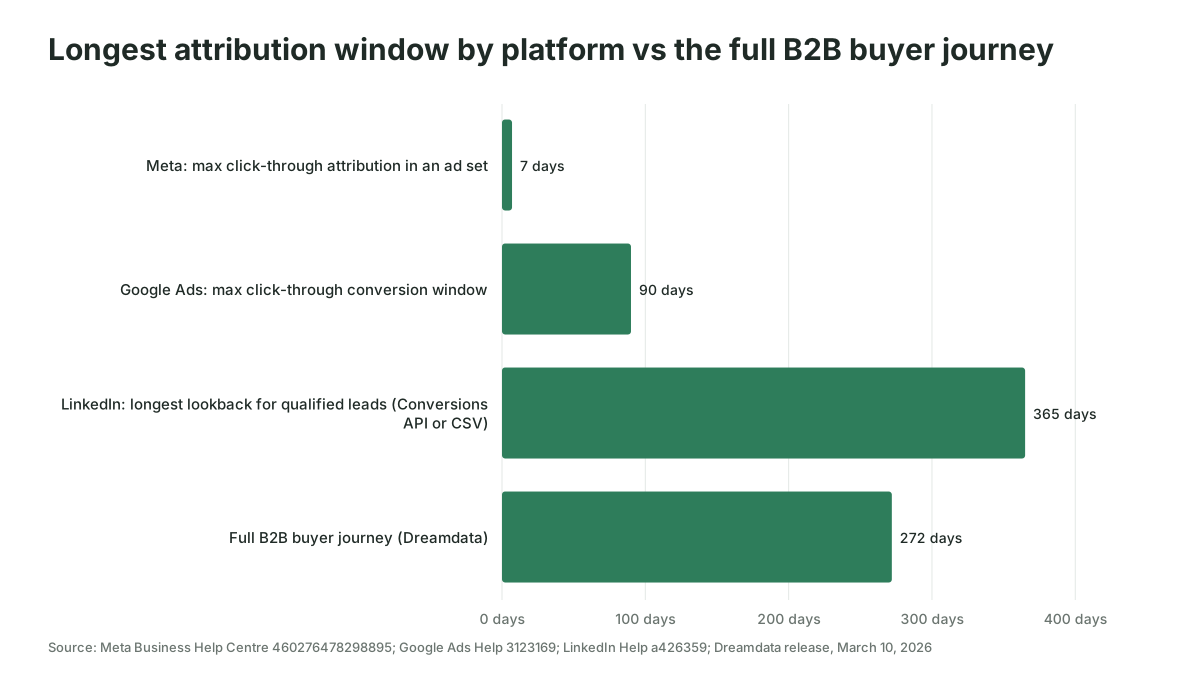
So pick the earliest stage that still predicts pipeline. Closed revenue is the truest signal and the least useful one to a Meta agent whose ad set counts a click for a week at most. A sales-accepted lead or a held first meeting usually happens within days or weeks of the click, which puts it inside every platform's window.
Test 3: there's a control. You need a comparable campaign, ad group or audience the agent doesn't run, judged on the same CRM stage over the same period. Google's guidance on measuring Smart Bidding says to use "a time frame that includes at least 2 full conversion cycles." Without a control, a falling cost per lead only proves the agent found cheaper leads.
Conversion volume matters too. A campaign that passes all three tests on a handful of qualified conversions a month is a test candidate, not a hand-over; our guide to AI bidding lists each platform's minimums.
A hand-over scorecard filled in for a typical B2B account
The scorecard below applies the three tests to the campaign types most B2B accounts run. It's our recommendation for a team that already sends CRM stages back to the platforms; if you don't yet, every row reads "keep" until you do.
| Campaign job | Signal is a CRM stage | Stage inside the window | Control possible | Our call |
|---|---|---|---|---|
| Google non-brand search | Yes, with offline conversion import | Yes, for a sales-accepted lead | Yes, a campaign experiment | Hand over queries and bids, keep brand exclusions and negatives |
| Google brand search | Yes, but the demand already exists | Yes | Hard, demand is already there | Keep bids and copy human, AI Max off |
| Meta prospecting into the ICP | Yes, conversion leads by Conversions API | Only if the stage lands within 7 days | Yes, a split test | Hand over audience and placements, keep custom audience exclusions current |
| Meta retargeting | Yes | Yes | Weak, audiences are small | Keep audiences human |
| LinkedIn named account list (ABM) | Yes, qualified leads by Conversions API | Yes | Yes, a matched holdout of accounts | Keep audience expansion off; optimize to qualified leads, which brings maximum delivery, only if the list stays above LinkedIn's 300-member floor after exclusions |
| LinkedIn prospecting by role and industry | Yes | Yes | Yes | Hand over bids; test predictive audiences against your own targeting |
| Microsoft Advertising search | Yes, with offline conversions | Yes | Yes | Leave AI Max off at creation, then test it as you would on Google |
Two rows need a word. Brand search stays human because we'd expect most of the agent's gains there to be people who would have clicked your organic listing anyway, and there's no clean way to prove otherwise. The ABM row stays tight because the account list is the strategy. Meta's Advantage+ audience documentation is honest about what survives automation there: "location constraints, minimum age, language, and custom audience exclusions." Everything else can be widened, which is why the exclusion lists are the part your team keeps.
Grow the agent-run share in steps the board can follow
The agent-run share of spend should grow one campaign group at a time, and only after the agent-run version beats or ties its control on cost per opportunity over two full conversion cycles. That ties every increase to a pipeline number, the only evidence a board will accept for handing more money to a vendor's algorithm.
Here is a hypothetical worked example. Company A spends $300,000 a quarter across Google, Meta, LinkedIn and Microsoft Advertising. The inventory of defaults shows $120,000 of that, or 40%, is already agent-run, most of it Meta under Advantage+ and LinkedIn ad sets with audience expansion on. The team turns expansion off on the ABM ad sets, which takes $30,000 back under its control and brings the agent-run share to 30%.
Next it splits Google non-brand search, $90,000 a quarter, into a 50/50 experiment with AI Max on one side. After the quarter, the AI Max arm has spent $45,000 for 12 opportunities, or $3,750 each. The control has spent $45,000 for 8, or $5,625 each. That's a third cheaper per opportunity, but 12 against 8 is a small count, and four opportunities either way could be chance. While the test runs, the agent-run share is $135,000 of $300,000, or 45%. Company A treats the result as a lead, not proof, and runs the same split one more quarter. If the AI Max arm wins again, the whole $90,000 moves to AI Max and the agent-run share becomes $180,000 of $300,000, or 60%.
The arithmetic matters less than the rhythm. Each quarter, one group graduates or doesn't, and the board sees two numbers: the agent-run share of spend, and cost per opportunity for agent-run against team-run campaigns. If the second number turns against the agents, the share goes back down.
We'd count a tie as a pass when the agent frees real time, because those hours go to creative, exclusion lists and the CRM feed, the work that decides what every agent learns.
Where handing the buying to platform agents goes wrong in B2B
Most failures come from handing over a campaign that fails one of the three tests, usually the signal test. Five of them are worth naming in advance.
The agent optimizes to the cheap lead. Meta's own Advantage+ leads page reports "14% lower cost per lead" and "10% lower cost per qualified lead." Those are Meta's averages, not a forecast, and both stop at the lead. Only your CRM shows how much of that saving reaches an opportunity.
Expansion reaches outside the buying committee. Audience expansion, search term matching and Advantage+ audience all widen the pool by design. In a market of a few thousand accounts, wider usually means further from the ICP.
The agent spends the whole budget. Maximum delivery on LinkedIn aims to produce as many results as the budget allows, so the budget becomes the brake. Set it as a ceiling you'd be comfortable seeing spent in full on the agent's chosen audience.
Generated copy says something you can't stand behind. AI Max's text customization and final URL expansion write and route ads from your site. Microsoft's AI Max lets you block terms from generated copy, and Google's lets you exclude URLs, so set both before launch.
The reporting blends the agents together. Copilot ads appear inside normal Microsoft Ads reports, and AI Max traffic sits in the same campaigns as keyword traffic. On Microsoft, AI Max queries show up with an "AI optimized" match type in search term reports. If you can't separate what the agent bought, you can't run the control, so label agent-run campaigns in their names before launch so the split survives into your CRM.
How Scalewell maps the buying work before the agents get more of it
A paid team that knows which buying calls it still owns, and spends its hours on those instead of on bid edits, is what Scalewell works toward. After a free 30-minute call, the step that matters most here is the audit of the team's week: every recurring buying job, from pacing checks to exclusion list updates, scored for whether a platform agent, the team's own AI or a person should run it. Those scores become a ranked roadmap. The top jobs then get built in the ad platforms and CRM you already use; that build usually takes 8 to 12 weeks, though some run longer. Finally the team learns to run that split, and change it, without Scalewell.
The agent-run share is right when cost per opportunity holds as it grows
You've set the share well when the agent-run portion of spend rises quarter by quarter and cost per opportunity on those campaigns stays at or below the team-run ones. Read both from the CRM, not from the platforms, because each platform grades its own agent on its own conversions.
A second check costs nothing: ask sales each month whether lead quality has held. If reps start asking where the leads came from, look first at the campaign that graduated most recently.
Where to start
This week, list every live campaign with its quarterly spend and mark four settings: Advantage+ on Meta, audience expansion on LinkedIn, AI Max on Google and Microsoft, and auto-apply in Google's Recommendations page. Divide the spend under those settings by the total, and you have your current agent-run share. Should you want another opinion on which settings to keep, bring the list to a free 30-minute call with Scalewell.
Frequently asked questions
Is agentic advertising the same as programmatic advertising?
They overlap, but they are different things. Programmatic advertising is the automated buying of ad inventory through exchanges, usually one impression at a time, by rules and bids someone set. Agentic advertising adds software that decides its own next steps toward a goal, across audiences, creative and budget. A programmatic buy can be run by an agent, but plenty of programmatic buying involves no agent at all.
Will platform agents replace media buyers?
They replace parts of the job, mostly manual bidding and routine targeting edits. They don't decide which CRM stage to optimize to, keep exclusion lists current, design controls or report spend in pipeline to a board. A B2B paid team gets smaller in some tasks and more important in those, so plan retraining before you plan headcount changes.
Who should own the settings of a platform agent?
The paid team should own the settings an agent can't change by itself: exclusion lists, brand and URL exclusions, budget ceilings and the choice of which campaigns to hand over. Marketing ops should own the CRM feed the agents learn from, because one broken stage mapping misleads every platform at once. Put both owners' names next to each campaign in the planning doc.
Do I need a separate budget to test platform agents?
Usually not, because the cleanest test splits a campaign you already fund, half run by the agent and half by your current settings, so total spend stays the same and only the method changes. A separate budget line tends to buy a test on a different audience, which makes the comparison with your control meaningless.
Do agentic ads work for small B2B accounts?
Often not yet, because platform agents learn from conversions, and a small account may log only a handful of qualified ones a month. In that case, keep bids and audiences in human hands, send CRM stages back anyway so the history builds, and use the platforms' AI for drafting copy and assets, where volume matters less.